
How can you tell you are depressed rather than simply sad, stressed, exhausted, or going through a difficult period?
Usually, there is not one symptom that provides the answer.
Depression tends to involve a pattern of changes in mood, interest, thinking, energy, sleep, appetite, behavior, or daily functioning that persists and begins affecting how you live your life.
Some women recognize depression because they feel deeply sad.
Others do not feel particularly sad at all.
They may feel numb, irritable, exhausted, disconnected, unmotivated, or unlike themselves. They may continue going to work, caring for children, maintaining relationships, and handling responsibilities while privately struggling.
That is why recognizing depression requires looking at the whole pattern, not simply asking, “Am I sad?”
If symptoms are persistent or interfering with your ability to function, a professional evaluation can help determine whether depression or another condition may be contributing.
How Can You Tell You Are Depressed Instead of Just Sad?
Sadness is a normal human emotion.
You may feel sad after a loss, disappointment, argument, difficult transition, or painful experience. Feeling sad does not automatically mean you have a depressive disorder.
Depression involves more than the presence of sadness.
Clinicians consider factors such as:
Which symptoms are present
How long they have been occurring
How frequently they occur
How intense they are
Whether they represent a change from your usual functioning
How much they interfere with everyday life
Whether another medical or psychiatric condition could better explain them
For a major depressive episode, symptoms are generally present during the same two-week period, with either depressed mood or markedly reduced interest or pleasure among the central symptoms.
But the two-week criterion should not be used as a home diagnostic test.
You do not suddenly “have depression” because Day 14 arrived.
And you do not need to wait two weeks to speak with someone if symptoms are severe, rapidly worsening, or concerning you.
9 Signs That May Indicate Depression
The National Institute of Mental Health identifies changes in mood, interest, energy, concentration, sleep, appetite, behavior, and thoughts of death or suicide among common signs and symptoms of depression.
Depression does not look identical in every woman, but there are several common patterns worth noticing.
1. You Feel Sad, Empty, or Hopeless Much of the Time
Persistent low mood is one of the symptoms most commonly associated with depression.
You may describe it as sadness, emptiness, heaviness, despair, or a sense that things are unlikely to improve.
For some women, the feeling is obvious.
For others, depression is quieter.
Instead of crying frequently, you may simply notice that life has lost some of its emotional range.
2. You’ve Lost Interest in Things You Normally Enjoy
One of the most important signs of depression is loss of interest or pleasure, sometimes called anhedonia.
Activities you normally enjoy may begin feeling pointless or require too much effort.
You may stop:
Seeing friends
Exercising
Cooking
Participating in hobbies
Going out
Having sex
Listening to music
Planning things you normally look forward to
The important clue is change.
If you have always disliked large social gatherings, avoiding one is not necessarily meaningful.
If you previously loved seeing friends and now repeatedly turn down invitations because nothing sounds enjoyable, that change deserves attention.
3. Your Energy Has Changed
Depression can involve significant fatigue or loss of energy.
Ordinary activities may begin requiring disproportionate effort.
Getting dressed.
Answering email.
Making dinner.
Driving somewhere.
Having a conversation.
Completing work that once felt routine.
This is different from simply being tired after a long day.
The question is whether low energy has become persistent and part of a larger change in your functioning.
4. Your Sleep Is Different
Depression can be associated with several changes in sleep.
You may:
Have difficulty falling asleep
Wake repeatedly
Wake much earlier than intended
Sleep substantially more than usual
Spend long periods in bed without feeling rested
Sleep problems have many possible causes, so insomnia or excessive sleep alone does not establish a depression diagnosis.
But when sleep changes occur alongside persistent low mood, loss of interest, fatigue, concentration problems, or other depressive symptoms, they become clinically relevant.
5. Your Appetite or Weight Has Changed
Depression can affect appetite in either direction.
Some women lose interest in food and unintentionally eat less.
Others notice increased appetite or changes in eating patterns.
Clinicians pay attention to meaningful appetite or weight changes that occur alongside other depressive symptoms.
Again, these changes can have many causes—including medical conditions and medications—which is one reason evaluation sometimes requires looking beyond mental health alone.
6. Concentrating or Making Decisions Has Become Harder
Depression can affect thinking.
You may notice that you:
Read the same paragraph repeatedly
Forget what someone just told you
Struggle to make relatively ordinary decisions
Lose your train of thought
Have difficulty completing work
Feel mentally slowed down
Become overwhelmed by choices that normally would not bother you
Women sometimes interpret these changes as laziness, lack of discipline, or failure.
They can be part of depression, but they can also occur with anxiety, sleep deprivation, medications, medical conditions, ADHD, substance use, and other circumstances.
Context matters.
7. You’re Withdrawing From Other People
Withdrawal can happen gradually.
You stop answering messages.
You cancel plans.
You eat alone.
You spend more time in your room.
You stop calling people.
Eventually, people may stop inviting you because you have declined so often.
Sometimes withdrawal occurs because social interaction feels exhausting.
Sometimes it reflects loss of interest.
Sometimes a woman does not want anyone to see how poorly she is doing.
Whatever the reason, a significant change in your level of social engagement can be another piece of the depression picture.
8. You’re Much Harder on Yourself
Depression can be associated with feelings of worthlessness or excessive or inappropriate guilt.
You may begin interpreting ordinary mistakes as evidence that something is fundamentally wrong with you.
Thoughts can become increasingly absolute:
“I ruin everything.”
“Everyone would be better without me.”
“I’m failing at everything.”
“I’m a burden.”
“Nothing I do is good enough.”
Not every self-critical thought means someone has depression.
What matters is the overall pattern, intensity, persistence, and relationship to other symptoms.
9. Other People Say You Don’t Seem Like Yourself
Sometimes other people notice a change first.
A partner may say you seem distant.
A coworker may notice that you are unusually quiet.
A friend may ask why you keep canceling.
A family member may notice irritability, exhaustion, withdrawal, or a loss of enthusiasm.
Other people’s observations do not establish a diagnosis.
But when several people who know you well notice a meaningful change, it may be worth considering what they are seeing.
Depression Doesn’t Always Look Like Sadness
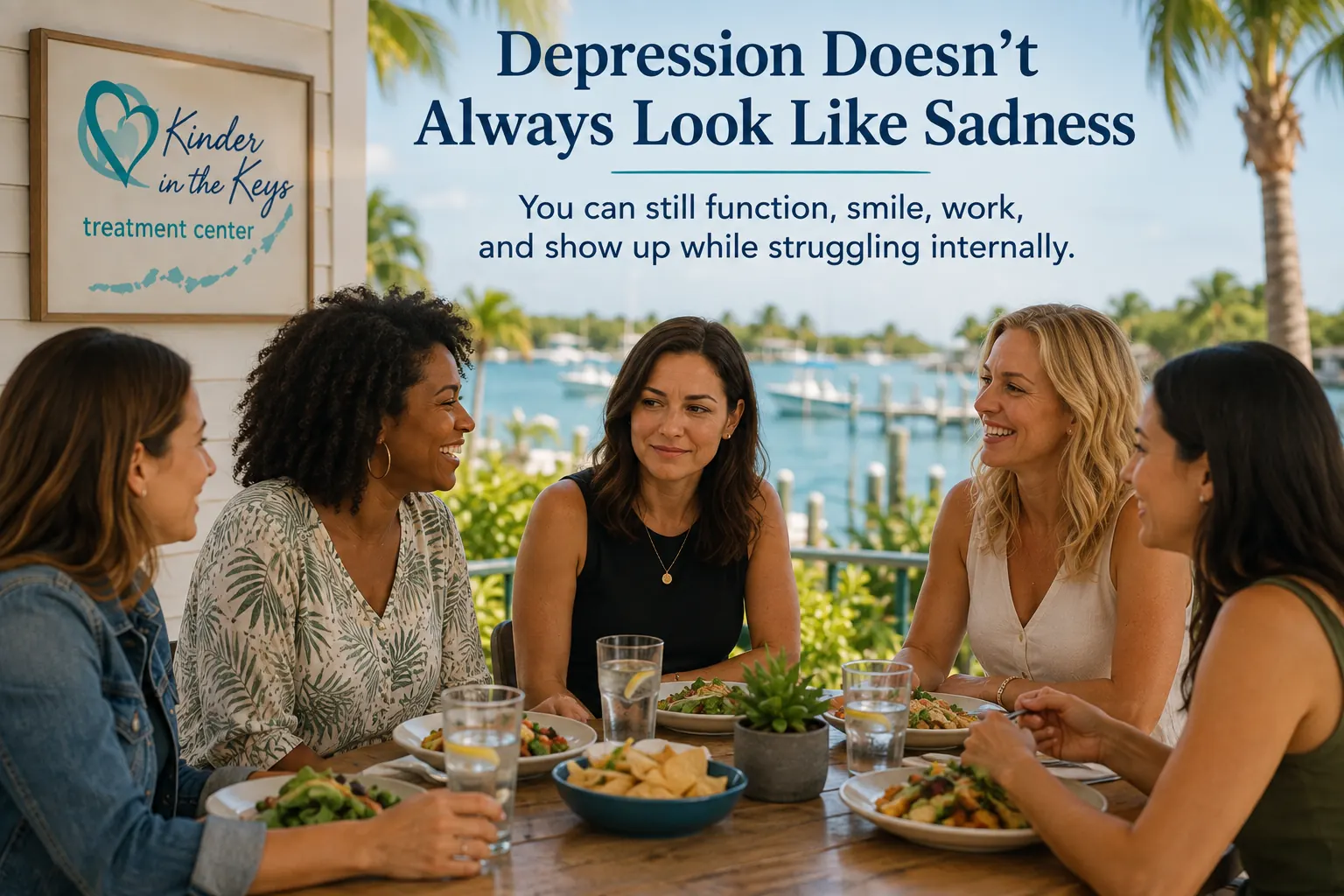
This is particularly important for women who remain highly functional.
You can be depressed and still:
Go to work
Run a business
Raise children
Care for family members
Exercise
Maintain friendships
Pay bills
Look put together
Smile
Laugh
Have good moments
Functioning does not automatically mean someone is well.
At the same time, the informal phrase “high-functioning depression” is not a formal psychiatric diagnosis.
It is commonly used to describe people who continue meeting significant external responsibilities while experiencing depressive symptoms internally.
A clinician still needs to determine whether those symptoms meet criteria for a depressive disorder or are better explained by something else.
Can Irritability Be a Sign of Depression?
It can be.
Although sadness and loss of interest receive more attention, some women notice increased irritability, frustration, or a lower tolerance for everyday stress when depressed.
You may find yourself:
Snapping at people
Becoming overwhelmed more easily
Feeling constantly annoyed
Having less patience
Reacting strongly to relatively minor frustrations
Irritability by itself does not mean someone has depression.
But a noticeable change in irritability occurring alongside other depressive symptoms can be clinically relevant.
What About Physical Symptoms?
Depression can occur alongside physical symptoms, including fatigue, sleep disturbance, appetite changes, and psychomotor changes.
Some people experiencing depression also report physical discomfort or pain.
However, new or unexplained physical symptoms should not automatically be attributed to depression.
Medical conditions, medications, hormonal changes, sleep disorders, nutritional deficiencies, pain conditions, and many other factors can affect mood, energy, concentration, sleep, and physical well-being.
A healthcare professional may recommend medical evaluation when symptoms could have a physical cause.
Could Something Else Look Like Depression?
Yes.
This is one reason self-diagnosis has limitations.
Symptoms that resemble depression may occur with:
Anxiety disorders
Bipolar disorder
Grief
Trauma-related conditions
Sleep disorders
Substance use
Medication side effects
Thyroid and other medical conditions
Hormonal changes
Other psychiatric conditions
Bipolar disorder deserves particular attention.
Someone experiencing a depressive episode may initially appear to have unipolar depression, but a history of manic or hypomanic symptoms can substantially change diagnosis and treatment.
A thorough evaluation therefore includes more than asking whether someone currently feels depressed.
Can a Depression Test Tell Me If I’m Depressed?
Screening questionnaires can be useful, but they have limitations.
Tools such as depression questionnaires can help identify symptoms and estimate symptom severity.
They can also give you language for discussing what you have been experiencing with a healthcare professional.
But a screening questionnaire is not the same thing as a clinical diagnosis.
A score cannot independently determine:
Why symptoms are occurring
Whether another condition better explains them
Whether medication is appropriate
What level of treatment you need
Whether a medical problem is contributing
Use screening as information—not as the final word.
How Is Depression Diagnosed?
Depression is diagnosed through clinical evaluation.
A healthcare or mental health professional may ask about:
Current symptoms
Duration
Severity
Daily functioning
Sleep
Appetite
Energy
Concentration
Medical history
Medications
Substance use
Previous depressive episodes
Previous treatment
Family psychiatric history
Manic or hypomanic symptoms
Safety concerns
Depending on the circumstances, medical evaluation or laboratory testing may also be appropriate to investigate conditions that could contribute to depressive symptoms.
Diagnosis is about understanding the whole clinical picture.
When Should You Get Help for Depression?
You do not need to wait until you are unable to function before seeking professional help.
NIMH also recommends considering both symptom severity and how symptoms are affecting daily functioning when deciding whether professional help may be needed.
Consider an evaluation when symptoms:
Persist
Are becoming more intense
Keep returning
Interfere with work or school
Affect relationships
Disrupt sleep or eating
Make ordinary self-care difficult
Cause significant withdrawal
Lead to increased alcohol or substance use
Make you feel unlike yourself
Are concerning you even if you cannot explain why
Treatment can begin before depression reaches a crisis point.
What If You’re Having Thoughts About Death or Suicide?
Thoughts about death or suicide require attention.
If you are experiencing suicidal thoughts, a mental health crisis, or significant emotional distress in the United States, you can call or text 988 to reach the 988 Suicide & Crisis Lifeline.
If you believe you are in immediate danger, cannot remain safe, or are experiencing a life-threatening emergency, call 911 or go to the nearest emergency department.
Do not rely on a blog, questionnaire, or online screening tool during an immediate safety crisis.
What Happens If You Are Diagnosed With Depression?
A depression diagnosis does not automatically determine one treatment.
Treatment planning considers factors such as:
Type and severity of symptoms
Duration
Functional impairment
Safety
Previous treatment
Medical history
Medications
Co-occurring conditions
Personal preferences
Available support
Treatment may involve psychotherapy, medication, lifestyle and wellness support, or a combination of approaches.
Some women are appropriately treated through traditional outpatient care.
Others benefit from more structured treatment such as PHP or residential mental health care.
Acute psychiatric hospitalization is a different level of care and may be necessary when hospital-level stabilization is required.
The appropriate setting depends on clinical need.
When Is Residential Depression Treatment Appropriate?
Residential treatment is not necessary simply because someone has depression.
It may be considered when symptoms significantly interfere with functioning and outpatient treatment is not providing enough structure or support.
At Kinder in the Keys, residential mental health treatment for adult women includes:
Individual therapy once per week
Family therapy once per week when desired and clinically appropriate
Daily therapeutic groups
Psychiatric evaluation and medication management when appropriate
Access to clinicians outside scheduled individual sessions when clinically needed
24/7 residential coverage
Structured therapeutic programming
Wellness and experiential activities that complement clinical care
Discharge and continuing-care planning
Kinder provides residential mental health treatment, not acute inpatient psychiatric hospitalization.
The goal is to determine whether residential care matches the woman’s current clinical needs—not simply whether she has a depression diagnosis.
How Can You Tell You Are Depressed? Frequently Asked Questions
How can you tell you are depressed or just sad?
Look at the entire pattern rather than one emotion.
Sadness can occur without depression. Depression generally involves persistent changes in mood and/or interest together with other symptoms that may affect sleep, energy, appetite, concentration, thinking, behavior, and functioning.
A professional evaluation can determine whether symptoms meet criteria for a depressive disorder.
What are often the first signs of depression?
There is no universal first symptom.
Some women initially notice fatigue, sleep changes, withdrawal, irritability, reduced motivation, concentration difficulties, or loss of interest.
Others recognize persistent sadness first.
The important clue is often a meaningful change from your usual functioning.
Can you be depressed without feeling sad?
Yes.
Some people experiencing depression describe numbness, emptiness, irritability, loss of interest, exhaustion, or disconnection rather than obvious sadness.
Depressed mood is not the only central symptom considered when evaluating major depression.
Can you have depression and still function normally?
Someone can continue fulfilling significant responsibilities while experiencing depression.
External functioning does not reveal everything about a person’s internal mental health.
However, “high-functioning depression” is not itself a formal diagnosis, so symptoms still need to be evaluated clinically.
Can depression go away without treatment?
The course of depression varies.
Some depressive episodes improve over time, while others persist, recur, or require treatment.
It is not accurate to say that every depressive episode inevitably worsens without professional intervention.
If symptoms persist, recur, significantly interfere with functioning, or concern you, professional evaluation is appropriate.
Recognizing Depression Is the Beginning, Not the Diagnosis
If you have been asking how can you tell you are depressed, pay attention to patterns.
Has your mood changed?
Have you lost interest in things you normally enjoy?
Has your sleep changed?
Are you exhausted?
Are you withdrawing?
Is concentration harder?
Are you much more critical of yourself?
Do you feel unlike yourself?
One symptom does not provide the answer.
But a persistent cluster of changes deserves attention.
You do not need to diagnose yourself before asking for help.
A qualified healthcare or mental health professional can help determine what is happening, rule out other potential causes, and recommend an appropriate level of care.
For women whose depression is significantly interfering with everyday functioning and who need more structure than traditional outpatient treatment provides, Kinder in the Keys offers residential depression treatment for adult women in Key Largo, Florida.
Medically Reviewed By
Dr. Laura Tanzini, DrPH, LMFT
Doctor of Public Health | Specialty in Lifestyle Medicine
Licensed Marriage and Family Therapist (Florida & California)
Founder & CEO, Kinder in the Keys
This article has been clinically reviewed for accuracy and consistency with current depression assessment and treatment principles.
Medical Disclaimer: This article is provided for educational and informational purposes only and is not intended to diagnose depression or replace individualized medical or mental health care. If you are concerned about your symptoms, speak with an appropriately qualified healthcare professional.