
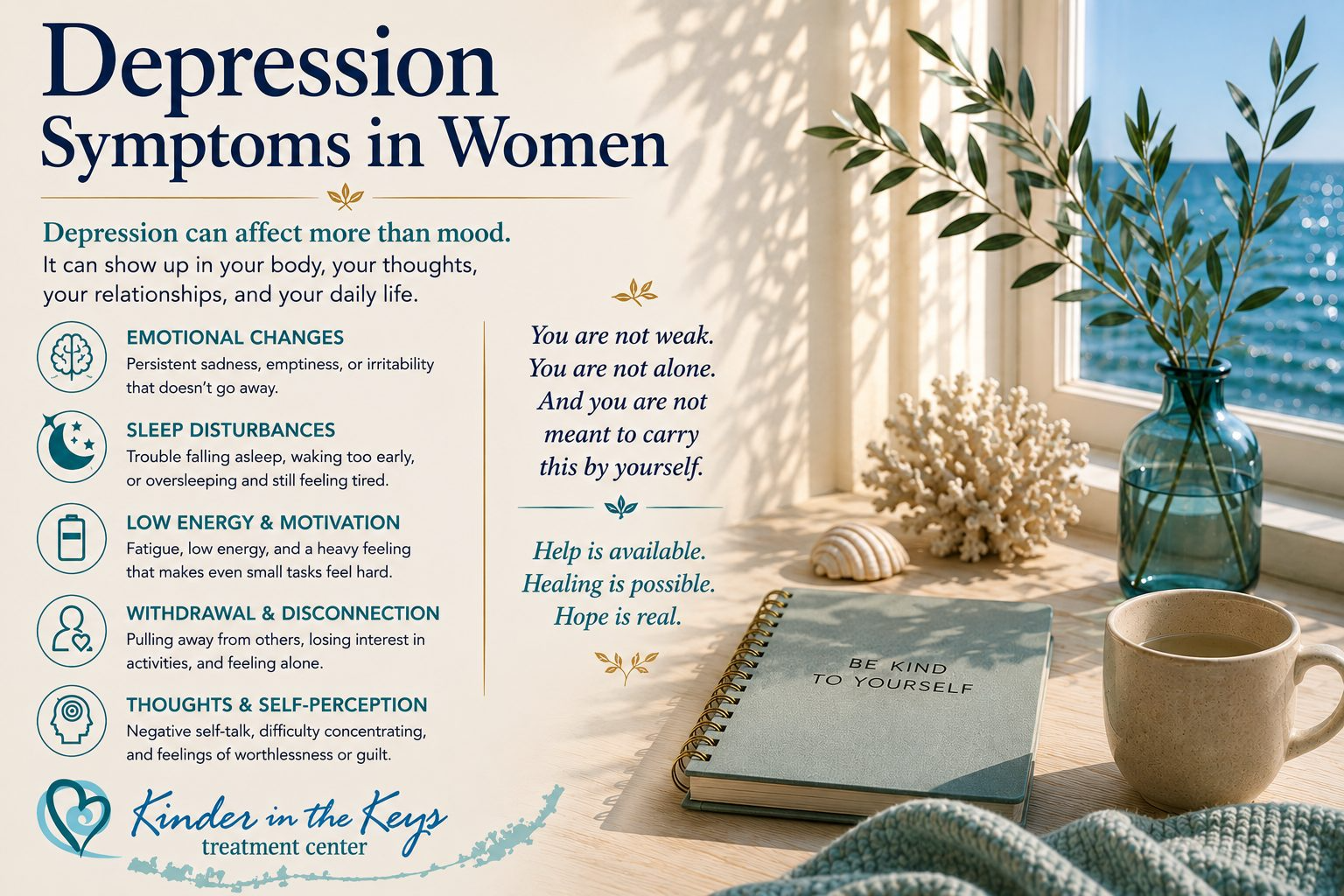
Depression symptoms can affect much more than mood. Depression can change how a woman sleeps, thinks, eats, works, relates to other people, experiences pleasure, and manages everyday responsibilities.
For some women, depression looks like persistent sadness. For others, it may feel more like emptiness, irritability, exhaustion, disconnection, or losing interest in a life they previously enjoyed.
That is one reason depression can be difficult to recognize.
A woman may continue going to work, caring for her family, answering emails, attending appointments, and appearing functional while privately struggling with significant symptoms.
Depression is not weakness, laziness, or an inability to cope. It is a treatable mental health condition.
At Kinder in the Keys, our depression treatment program for women helps women understand what is driving their symptoms and develop an individualized treatment plan when depression has begun interfering significantly with their lives.
What Are the Symptoms of Depression?
Depression involves a pattern of emotional, cognitive, behavioral, and physical symptoms.
A major depressive episode is not diagnosed because someone has had a bad day, experienced temporary sadness, or felt exhausted for a few days.
Clinicians consider which symptoms are present, how long they have lasted, their severity, whether they represent a change from the person’s usual functioning, and how significantly they interfere with everyday life.
Common depression symptoms can include:
Persistent sadness, emptiness, or low mood
Loss of interest or pleasure in activities
Significant changes in appetite or weight
Sleeping too much or too little
Fatigue or loss of energy
Difficulty concentrating, thinking, or making decisions
Feelings of worthlessness or excessive or inappropriate guilt
Observable slowing of movement or speech, or significant restlessness
Recurrent thoughts of death or suicide
The National Institute of Mental Health identifies depression symptoms across mood, thinking, sleep, appetite, energy, behavior, and everyday functioning, while emphasizing that not everyone experiences the same combination of symptoms.
If you’re trying to organize changes you’ve noticed in yourself, our depression symptoms checklist provides a simple way to review common signs before speaking with a professional.
Not every woman experiences every symptom.
The way depression feels can also change over time or from one depressive episode to another.
Depression Does Not Always Feel Like Sadness
One of the most important things to understand about depression is that feeling sad is not the only way it can present.
Some women describe depression as emotional numbness.
Others say they simply stop caring about things that used to matter.
A woman may notice that she no longer looks forward to seeing friends, participating in hobbies, traveling, exercising, working toward goals, having sex, or spending time with people she loves.
She may say:
“Nothing sounds good.”
“I don’t feel like myself.”
“I know I should care, but I don’t.”
“Everything feels like work.”
That loss of interest or pleasure is called anhedonia, and it is one of the core symptoms clinicians assess when evaluating major depression.
Emotional Symptoms of Depression
Depression can affect emotional experience in several ways.
A woman may experience:
Persistent sadness
Emptiness
Hopelessness
Irritability
Excessive guilt
Feelings of worthlessness
Emotional numbness
Increased sensitivity to criticism or perceived failure
Difficulty experiencing pleasure
Feeling overwhelmed by ordinary demands
Some women cry frequently.
Others rarely cry at all.
The absence of tears does not mean depression is absent, just as crying does not automatically mean someone has a depressive disorder.
The complete pattern matters.
Cognitive Symptoms of Depression
Depression can significantly affect thinking.
Women sometimes describe this as brain fog, although that term is not itself a diagnosis.
Symptoms may include:
Difficulty concentrating
Trouble making decisions
Forgetfulness
Slower thinking
Difficulty following conversations or reading
Trouble organizing tasks
Persistent negative thoughts
Excessive self-criticism
Difficulty imagining that circumstances can improve
These symptoms can affect work, school, relationships, parenting, finances, and other daily responsibilities.
A woman who previously managed a demanding schedule may suddenly find relatively simple decisions exhausting.
That change in functioning can be clinically important.
Physical Symptoms of Depression
Depression can also have physical symptoms.
These may include:
Fatigue
Changes in sleep
Changes in appetite
Weight changes
Reduced energy
Psychomotor slowing
Restlessness or agitation
Changes in sexual interest
Physical heaviness or feeling slowed down
However, physical symptoms should not automatically be attributed to depression.
Fatigue, sleep problems, appetite changes, concentration difficulties, weight changes, and other symptoms can also occur with medical conditions, medications, hormonal changes, sleep disorders, nutritional problems, and other health concerns.
A proper evaluation may therefore include medical assessment when appropriate.
Mental health treatment should never substitute for evaluating a possible physical cause of new or unexplained symptoms.
Sleep Changes and Depression
Sleep disturbance is common in depression, but it does not look the same for everyone.
Some women experience insomnia and have difficulty falling asleep, staying asleep, or returning to sleep after waking.
Others sleep much longer than usual and still wake feeling exhausted.
Some notice changes in sleep before they recognize changes in mood.
Sleep and depression can also influence one another. Poor sleep can worsen emotional functioning, while depression can significantly disrupt normal sleep patterns.
The relationship between insomnia and depression can become particularly important when persistent sleep disruption and mood symptoms occur together.
Persistent changes in sleep deserve attention, particularly when they occur alongside other depression symptoms.
Appetite and Weight Changes
Depression can affect appetite in either direction.
Some women lose interest in food and eat substantially less than usual.
Others notice increased appetite or changes in eating patterns.
Changes in weight can occur as a result.
Again, appetite or weight changes alone do not establish a depression diagnosis.
Significant or unexplained changes should be evaluated in the context of the woman’s overall physical and mental health.
Irritability Can Be Part of Depression
Depression is often pictured as quiet sadness, but irritability can also occur.
A woman may notice:
Less patience
Feeling easily overwhelmed
Increased frustration
Becoming unusually reactive to minor problems
Wanting to be left alone
Difficulty tolerating noise, demands, or interruptions
Irritability has many possible causes and does not automatically indicate depression.
But when it appears alongside persistent low mood, loss of interest, sleep changes, fatigue, guilt, concentration problems, or other depressive symptoms, it can be part of the clinical picture.
Depression Can Affect Motivation and Daily Functioning
Depression can make ordinary tasks feel disproportionately difficult.
A woman may struggle to:
Get out of bed
Shower or get dressed
Prepare meals
Return phone calls
Complete work
Pay bills
Keep appointments
Maintain her home
Exercise
Socialize
Participate in activities she normally enjoys
This is not necessarily because she does not understand what needs to be done.
She may know exactly what she should do and still feel unable to generate the energy, concentration, motivation, or emotional engagement necessary to do it.
That distinction is important.
Depression-related impairment should not be mistaken for laziness or lack of character.
Depression Can Affect Relationships
Depression often changes the way a woman interacts with other people.
She may withdraw because conversation feels exhausting.
She may stop answering messages, decline invitations, or spend increasing amounts of time alone.
Some women become less emotionally available to partners or family members.
Others become more irritable or feel guilty because they believe they are disappointing the people around them.
Depression can also distort perception.
A woman may become convinced that she is a burden, that other people would be better without her, or that nobody genuinely wants her around.
Those beliefs can feel completely true while she is depressed even when they do not accurately reflect her relationships.
What Does Depression Feel Like Day to Day?
Depression can be difficult to explain because symptoms become woven into ordinary life.
A woman may wake already exhausted.
Getting dressed takes more effort than it once did.
She goes to work but has difficulty concentrating. Tasks take longer. She begins falling behind and criticizes herself for not functioning the way she used to.
She comes home with little energy left for relationships, meals, exercise, or activities she once enjoyed.
Eventually she may stop doing those things altogether.
From the outside, she may still appear to be functioning.
Inside, maintaining that appearance may require nearly everything she has.
That is why severity cannot always be judged by whether someone is still working, parenting, attending school, or maintaining other responsibilities.
Can You Have Depression and Still Function?
Yes.
Some women continue meeting significant responsibilities while experiencing depression.
The phrase “high-functioning depression” is commonly used online, although it is not a formal diagnosis.
Functioning is also not simply present or absent.
A woman may perform well professionally while struggling significantly in relationships, sleep, self-care, emotional well-being, or other areas of life.
Another may maintain appearances temporarily by using enormous amounts of energy to compensate for worsening symptoms.
The important question is not:
“Can she still function?”
It is:
“How much is this costing her, and how much has her functioning changed?”
Depression Symptoms and Hormonal Changes
Women experience hormonal transitions throughout life, and mood symptoms can sometimes occur in connection with reproductive events or hormonal changes.
However, depression in women should not automatically be dismissed as “just hormones.”
Mood changes may occur during pregnancy, after childbirth, around the menstrual cycle, or during perimenopause, but persistent or severe depression symptoms deserve appropriate evaluation.
A clinician should consider the timing and pattern of symptoms along with medical, psychiatric, medication, reproductive, and other relevant history.
When Depression Looks Like Anxiety
Depression and anxiety frequently occur together.
Some women with depression experience significant worry, tension, restlessness, or feelings of dread.
Others become overwhelmed by decisions or begin avoiding situations because everything feels difficult to manage.
Anxiety symptoms do not necessarily mean that depression is absent.
Likewise, not every anxious woman is depressed.
When symptoms overlap, assessment can help determine whether depression, an anxiety disorder, both conditions, or another problem is present.
Depression Symptoms Are Not the Same as a Diagnosis
Recognizing yourself in a list of symptoms does not automatically mean that you have major depressive disorder.
Many depression symptoms can occur with other conditions.
For example, fatigue and concentration problems can occur with sleep disorders or medical illness. Changes in mood can occur with grief, anxiety, trauma-related conditions, medication effects, substance use, bipolar disorders, hormonal changes, and other circumstances.
That is why diagnosis involves more than counting symptoms.
A qualified professional considers:
Which symptoms are present
How long they have lasted
Severity
Functional impairment
Previous episodes
Medical history
Medication use
Substance use
Family psychiatric history
Current stressors
Other possible mental health conditions
Whether symptoms could be better explained by another cause
The purpose is to understand what is actually happening, not simply attach the first diagnosis that resembles a symptom list.
What Is a Major Depressive Episode?
A major depressive episode involves a specific cluster of symptoms occurring during the same period.
Under DSM-5-TR criteria, five or more qualifying symptoms must be present during the same two-week period and represent a change from previous functioning.
At least one must be either:
Depressed mood, or
Loss of interest or pleasure
Other criteria include changes involving sleep, appetite or weight, energy, concentration, psychomotor activity, feelings of worthlessness or excessive guilt, and recurrent thoughts of death or suicide.
Symptoms must also cause clinically significant distress or impairment and cannot simply be assumed to represent major depression without considering other diagnostic and medical explanations.
Depression and Self-Harm Are Not the Same Thing
Self-harm can occur in someone who has depression, but self-harm is not specific to depression and should not automatically be described as a depression symptom.
People may engage in self-harm in connection with several different mental health conditions or forms of emotional distress.
Regardless of diagnosis, self-harm deserves professional assessment.
It is particularly important to distinguish nonsuicidal self-injury from suicidal behavior while recognizing that both require careful evaluation of safety and risk.
Suicidal Thoughts Require Immediate Attention
Depression can involve recurrent thoughts of death, suicidal thoughts, or suicidal behavior.
These symptoms should always be taken seriously.
If you are experiencing suicidal thoughts or believe you may act on them, seek immediate help.
In the United States, call or text 988 to reach the Suicide & Crisis Lifeline.
If there is immediate danger, call 911 or go to the nearest emergency department.
A woman does not need to wait until she has a detailed suicide plan before asking for help.
When Should You Seek Professional Help for Depression Symptoms?
Consider professional evaluation when depression symptoms:
Persist for two weeks or longer
Are becoming more severe
Interfere with work or school
Affect relationships
Disrupt sleep or eating
Make self-care difficult
Cause significant emotional distress
Lead to increasing isolation
Return repeatedly
Include thoughts of death, suicide, or self-harm
NIMH recommends considering both how long symptoms have lasted and how much they interfere with everyday functioning when deciding whether professional help is needed.
You also do not need to wait exactly two weeks to speak with someone if symptoms are severe, safety is a concern, or functioning is deteriorating rapidly.
The two-week duration is part of diagnostic criteria for a major depressive episode—not a rule requiring someone to suffer untreated for fourteen days.
When Residential Depression Treatment May Be Appropriate
Not every woman with depression needs residential treatment.
Residential depression treatment for women may become appropriate when symptoms significantly disrupt functioning or a woman needs more structure and support than outpatient treatment can provide.
Many women receive effective treatment through outpatient psychotherapy, medication management when appropriate, or other community-based services.
Residential care may be considered when depression has become significantly disruptive, outpatient treatment has not provided enough support, symptoms repeatedly return or worsen, multiple mental health concerns complicate treatment, or a woman needs more structure than outpatient care can provide.
The appropriate level of care depends on the individual woman’s symptoms, safety, functioning, treatment history, and clinical needs.
Depression Treatment for Women at Kinder in the Keys
Kinder in the Keys provides residential mental health treatment for adult women in Key Largo, Florida.
Women come to treatment with different presentations of depression.
One woman may feel profoundly sad.
Another may feel almost nothing.
One may sleep twelve hours and remain exhausted.
Another may barely sleep.
One may have stopped functioning almost entirely.
Another may still be working while privately using every bit of her energy simply to maintain appearances.
Those differences matter.
Treatment begins with understanding the individual woman’s symptoms, what may be contributing to them, how they affect her life, and what needs to change.
Women participate in individual therapy and daily group programming within a small residential environment. Treatment approaches are selected according to each woman’s clinical needs rather than assuming that every woman with depression requires exactly the same intervention.
Depression Symptoms in Women: Frequently Asked Questions
What are the most common depression symptoms?
Common symptoms include persistent low mood, loss of interest or pleasure, changes in sleep or appetite, fatigue, difficulty concentrating, feelings of worthlessness or excessive guilt, psychomotor changes, and recurrent thoughts of death or suicide.
Can depression cause physical symptoms?
Depression can be associated with fatigue, sleep changes, appetite changes, changes in weight, psychomotor slowing or agitation, and reduced sexual interest. Physical symptoms can also have medical causes, so new or unexplained symptoms should be evaluated appropriately.
Can you have depression without feeling sad?
Yes. Some women primarily experience loss of interest, emotional numbness, irritability, exhaustion, or disconnection rather than obvious sadness. Diagnosis depends on the complete symptom pattern.
Is irritability a symptom of depression?
It can be. Irritability may occur with depression, but it has many possible causes. Clinicians consider whether it occurs alongside other depressive symptoms and represents a meaningful change from usual functioning.
Can someone be depressed and still go to work?
Yes. Continuing to work or fulfill responsibilities does not rule out depression. Some women maintain outward functioning while experiencing significant internal distress or impairment in other areas.
How long do depression symptoms have to last?
A major depressive episode requires qualifying symptoms during the same two-week period, but someone experiencing severe symptoms, rapid deterioration, suicidal thoughts, or significant impairment should not wait two weeks before seeking help.
Are self-harm and depression the same thing?
No. Self-harm can occur with depression but can also occur in other clinical contexts. It requires professional assessment regardless of the underlying diagnosis.
When are depression symptoms an emergency?
Suicidal thoughts, suicidal behavior, inability to maintain basic safety, or other acute psychiatric concerns require immediate evaluation. In the United States, call or text 988 for crisis support. Call 911 or seek emergency care when there is immediate danger.
Recognizing Depression Is the First Step
Depression does not look exactly the same in every woman.
It can appear as sadness, numbness, exhaustion, irritability, withdrawal, loss of pleasure, difficulty thinking, disrupted sleep, changes in appetite, or a gradual decline in everyday functioning.
What matters is the pattern, persistence, severity, and impact of the symptoms.
If you recognize significant changes in yourself, you do not need to determine the diagnosis alone.
A professional evaluation can help identify whether depression or another condition is present and what level of support may be appropriate.
Recognizing that something has changed is not the end of the story.
It is where appropriate treatment can begin.
Medically Reviewed By
Dr. Laura Tanzini, DrPH, LMFT
Doctor of Public Health | Specialty in Lifestyle Medicine
Licensed Marriage and Family Therapist (Florida & California)
Founder & CEO, Kinder in the Keys
This article has been clinically reviewed for accuracy and consistency with current evidence-based behavioral health principles. It is intended to provide educational information about depression symptoms in women and does not replace individualized assessment, diagnosis, or treatment by a qualified healthcare or mental health professional.
Medical Disclaimer
This article is for educational and informational purposes only and is not intended to diagnose, treat, cure, or prevent depression or any other mental health condition.
If depression symptoms are persistent, worsening, or interfering with daily functioning, seek evaluation from a qualified healthcare or mental health professional. If there is an immediate risk of self-harm or suicide, call or text 988in the United States or contact emergency services.