
Our Philosophy on Food & Nutrition at Kinder in the Keys
Nutrition and mental health have been connected throughout my education and my work in healthcare and mental health. Over the years, I became increasingly interested in the relationship between nutrition, physical health, and emotional well-being. I watched our food environment change as highly processed and convenience foods became increasingly common and agricultural practices changed.
My education in public health and lifestyle medicine further reinforced something I believe is sometimes overlooked in mental health treatment: the brain is part of the body.
We cannot completely separate emotional health from physical health. The brain and nervous system require adequate energy, amino acids, vitamins, minerals, essential fatty acids, and other nutrients to carry out their normal functions.
When I developed Kinder in the Keys, I wanted the connection between nutrition and mental health to be reflected in the treatment environment.
Today, Kinder does not follow an exclusively organic or non-GMO diet. Our approach is much more practical. We focus on providing fresh, balanced, thoughtfully prepared meals that supply the protein, carbohydrates, fats, vitamins, minerals, and other nutrients women need while participating in intensive mental health treatment.
Food does not replace psychotherapy, medication when clinically indicated, or other evidence-based mental health treatment. However, the connection between nutrition and mental health is an important component of whole-person care.
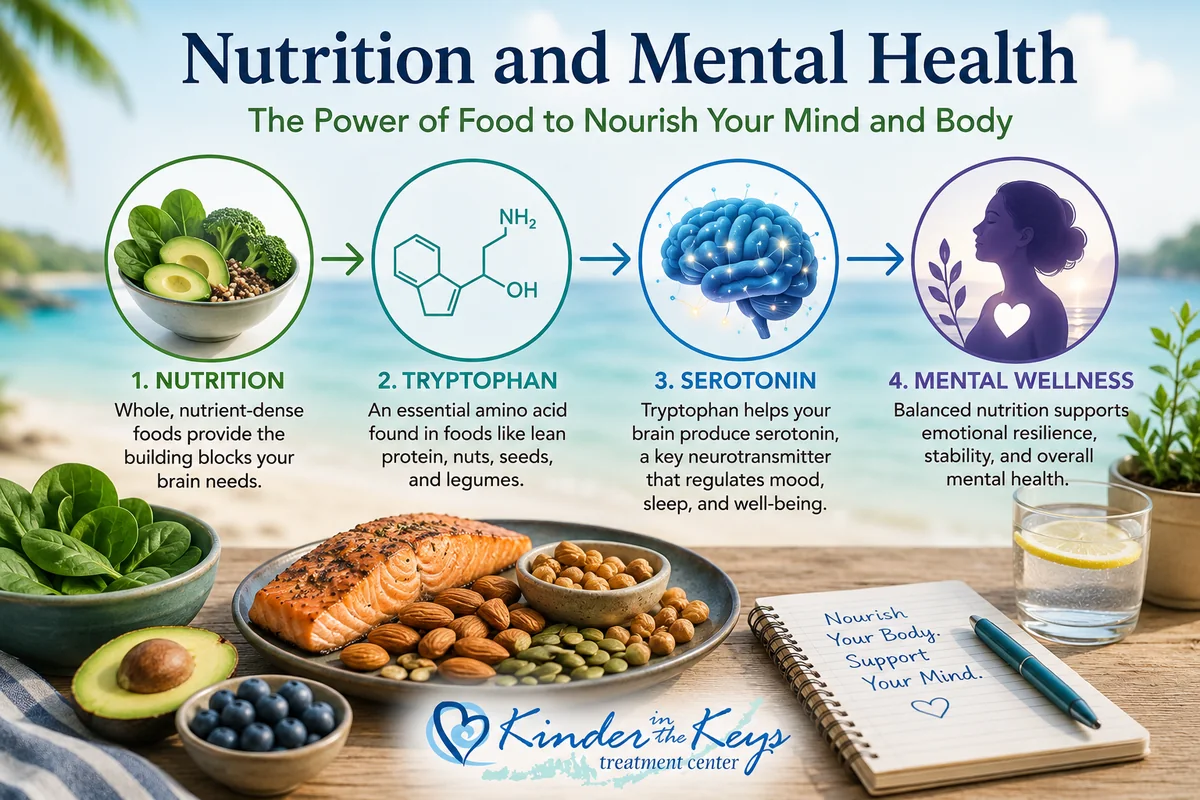
Nutrition and Mental Health: Tryptophan and Serotonin
One particularly interesting example of the connection between nutrition and mental health is the essential amino acid tryptophan.
Tryptophan is an essential amino acid. Unlike some amino acids that our bodies can manufacture, tryptophan must be obtained through our diet.
Tryptophan participates in several important metabolic pathways. Among them, it serves as a precursor in the production of serotonin, a neurotransmitter involved in mood, sleep, appetite, and numerous other functions. Serotonin can subsequently participate in the pathway that produces melatonin, a hormone important to the regulation of our sleep-wake cycle.
That does not mean eating a particular tryptophan-containing food will instantly increase serotonin in the brain or treat depression. Human metabolism is far more complicated than that.
What it does demonstrate is something important: our bodies require nutrients obtained through food to perform normal biological functions.
Dietary sources of tryptophan include foods such as:
Poultry
Fish
Eggs
Dairy products
Nuts and seeds
Beans and legumes
Oats and other grains
Rather than looking for a single “mood food,” our philosophy is to provide an overall dietary pattern that supplies adequate energy, protein, carbohydrates, healthy fats, vitamins, minerals, and essential amino acids.
What Is the Shikimate Pathway?
The relationship between tryptophan and plants brings us to an interesting biological process called the shikimate pathway.
Humans do not have a shikimate pathway. Plants and many microorganisms do.
- Plants use the shikimate pathway in the biosynthesis of the aromatic amino acids tryptophan, phenylalanine, and tyrosine. These amino acids are important in plant biology, and because humans cannot synthesize certain essential amino acids themselves, we ultimately obtain what we need through our diets.
Glyphosate, the active ingredient in many herbicides, works by inhibiting an enzyme involved in the shikimate pathway in susceptible plants.
This is one of the reasons glyphosate, genetically engineered herbicide-tolerant crops, agriculture, and nutrition are sometimes discussed together.
However, it is important to make a scientific distinction here.
Eating genetically modified food does not block a shikimate pathway in the human body because humans do not possess that pathway. Research continues into glyphosate exposure, agricultural practices, the gut microbiome, plant nutrient composition, and potential effects on human health.
For me, the larger lesson is not that one particular food or agricultural practice explains depression. It is that how food is produced, what nutrients our food provides, and the overall quality of our diets deserve consideration when discussing whole-person health.
Gluten Intolerance: Medical Necessity or Dietary Trend?
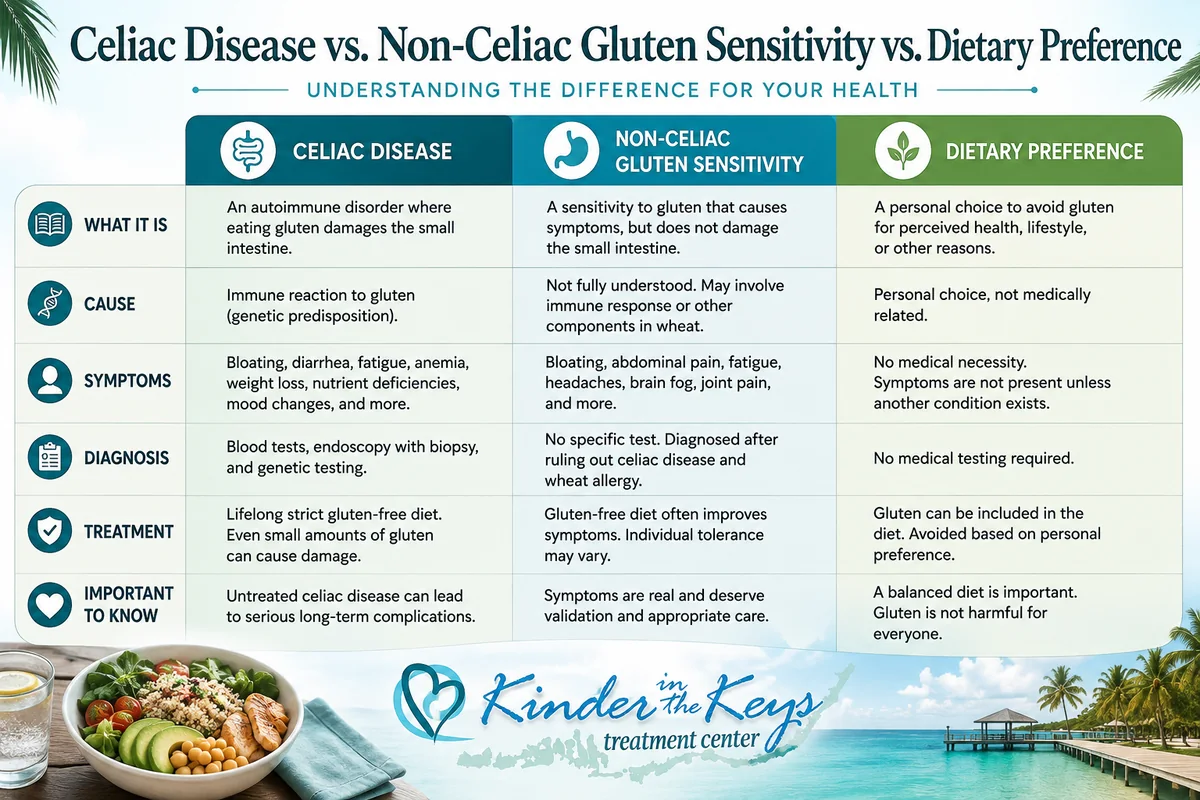
Gluten is another area where nutrition and popular dietary trends have become intertwined.
We frequently have women arrive at Kinder requesting a gluten-free diet despite never having been diagnosed with celiac disease.
There is an important distinction between celiac disease, non-celiac gluten sensitivity, and simply choosing to avoid gluten.
Celiac Disease Is a Medical Condition
Celiac disease is a chronic autoimmune disease in which consuming gluten triggers an immune response that damages the small intestine.
For someone diagnosed with celiac disease, avoiding gluten is not a dietary trend or preference. A strict gluten-free diet is medically necessary.
This is very different from assuming that gluten is unhealthy for everyone.
Gluten is a naturally occurring protein found in wheat, barley, and rye. For people who do not have celiac disease or another medically established reason to avoid it, foods containing gluten can be part of a healthy, balanced diet.
What About Non-Celiac Gluten Sensitivity?
Some individuals experience gastrointestinal or other symptoms after eating wheat or gluten-containing foods despite not having celiac disease or a wheat allergy. This is generally referred to as non-celiac gluten sensitivity or non-celiac wheat sensitivity.
It is an area that continues to be studied.
Interestingly, gluten may not always be the component responsible for the symptoms attributed to it. Other components of wheat-containing foods, including certain fermentable carbohydrates known as FODMAPs, may contribute to symptoms in some individuals.
This is one reason self-diagnosing a gluten problem can be misleading.
If someone believes she may have celiac disease, she should discuss appropriate testing with her healthcare provider before eliminating gluten from her diet. Beginning a gluten-free diet before testing can interfere with the accuracy of diagnostic testing.
Gluten-Free Does Not Automatically Mean Healthier
The popularity of gluten-free diets has created an enormous market for commercially prepared gluten-free products.
But a package labeled “gluten-free” does not automatically make the food nutritious.
A gluten-free cookie is still a cookie.
Gluten-free cakes, crackers, breads, desserts, and snack foods may still be highly processed and can contain significant amounts of added sugar, fat, sodium, or refined starches.
For someone with celiac disease, gluten-free foods are necessary. For everyone else, replacing ordinary processed foods with gluten-free processed foods does not inherently improve the nutritional quality of the diet.
There are also many naturally gluten-free foods, including:
Fruits and vegetables
Meat and poultry
Fish and seafood
Eggs
Dairy products
Beans and legumes
Nuts and seeds
Potatoes
Rice
Quinoa
Corn
Buckwheat
Flax and chia
A nutritious gluten-free diet therefore does not have to revolve around commercially manufactured gluten-free substitutes.
How Kinder Handles Gluten-Free Diet Requests
At Kinder in the Keys, we accommodate a medically necessary gluten-free diet for women with diagnosed celiac disease.
We do not routinely alter our standard meal program solely because someone prefers to avoid gluten.
There is an important reason for this distinction.
Kinder is a residential mental health treatment center—not a restaurant offering individually customized menus. Our standard food program is designed to provide balanced meals to the women in our care while allowing our treatment team to remain focused on the reason women come to Kinder: mental health treatment and recovery.
Women who prefer to follow a gluten-free diet without a medical diagnosis may use the options available through our Limited Plan or Do-It-Yourself Plan, when appropriate.
This approach allows us to respect individual dietary preferences without treating every dietary preference as a medical necessity.
Processed Foods, Sugar, and the Bigger Picture
The connection between nutrition and mental health is one reason we focus on overall dietary quality rather than labeling individual foods as inherently “good” or “bad.”
Highly processed foods can make it very easy to consume large amounts of added sugars, sodium, refined carbohydrates, and fats while providing fewer of some nutrients found in less processed foods.
That does not mean every processed food is unhealthy. Technically, freezing vegetables, cooking food, making yogurt, or canning beans all involve processing.
The more useful question is:
What does the overall diet look like?
At Kinder, we want women eating regular, balanced meals that provide adequate nutrition. We want food to support physical health rather than become another source of anxiety, restriction, perfectionism, or complicated food rules.
That distinction is especially important in a mental health treatment environment.
Why Nutrition and Mental Health Matter in Whole-Person Care
The relationship between nutrition and mental health is only one part of the larger picture of wellness.
Understanding nutrition and mental health means recognizing that mental health is influenced by an extraordinarily complex combination of biological, psychological, social, environmental, and lifestyle factors. No food can cure depression. Eliminating one ingredient cannot resolve trauma. And eating perfectly cannot replace therapy.
But neither should we pretend that the physical body is irrelevant to emotional health.
At Kinder in the Keys, women participate in intensive therapeutic work while also living within an environment designed to support healthier daily patterns.
That includes balanced nutrition, restorative sleep, physical activity, time outdoors, social connection, structure, and opportunities to develop healthier routines.
This whole-person approach recognizes the connection between nutrition and mental health while working alongside—not instead of—clinical mental health treatment.
That has always been at the heart of my philosophy.
We treat the woman as a whole person.
Nutrition is one piece of that much larger picture.
Dr. Laura Tanzini, DrPH, LMFT
Founder & CEO, Kinder in the Keys
Doctor of Public Health | Specialty in Lifestyle Medicine
Licensed Marriage and Family Therapist (Florida & California)