
The holidays are often portrayed as a joyful time filled with family, celebration, and connection. For many women, however, this season can also bring grief, loneliness, financial pressure, family conflict, exhaustion, anxiety, or worsening symptoms of an existing mental health condition.
The phrase holiday depression is commonly used to describe depressive symptoms or emotional distress that emerge or become more difficult during the holiday season. It is not a separate psychiatric diagnosis, and feeling sad or overwhelmed during the holidays does not automatically mean someone has major depressive disorder.
What Is Holiday Depression?
Holiday depression is an informal term used to describe sadness, depressive symptoms, or emotional distress that emerges or becomes more difficult during the holiday season.
It is not a separate mental health diagnosis.
For some women, the holidays intensify an existing depressive disorder. For others, grief, loneliness, financial pressure, family conflict, disrupted routines, unrealistic expectations, or difficult memories may contribute to feeling significantly worse during this time of year.
That is different from major depressive disorder with seasonal pattern, sometimes referred to as seasonal affective disorder (SAD).
Seasonal depression follows a recurring seasonal pattern and is not caused by the holidays themselves. Because the winter holidays occur during the time of year when seasonal depression commonly emerges, the two experiences can overlap.
Holiday stress is also extremely common. An American Psychological Association survey found that 89% of U.S. adults reported concerns that caused them stress during the holiday season, including financial pressure, missing loved ones, and anticipated family conflict.
Stress alone does not mean someone has depression.
What matters is the pattern: how severe the symptoms are, how long they persist, whether they interfere with daily functioning, and whether they continue after the immediate holiday stressors have passed.
Still, significant symptoms should not be dismissed simply because they occur during a stressful time of year.
Survey data from the National Alliance on Mental Illness (NAMI) have found that many people living with mental health conditions report that the holiday season can make their symptoms more difficult to manage.
Whether the holidays are intensifying an existing depression, bringing grief or loneliness to the surface, or creating emotional distress that feels unfamiliar, understanding the pattern can help you decide what kind of support you may need.
At Kinder in the Keys, our women’s depression treatment center provides residential mental health care for women whose depression has become severe enough to significantly interfere with daily functioning
Holiday Stress and Financial Pressure
Financial pressure can make the holiday season significantly more stressful.
Gifts, travel, meals, entertaining, decorations, and other holiday expenses can add up quickly. For someone already dealing with depression or anxiety, the pressure to create a certain kind of holiday can make an emotionally difficult season even harder.
Social expectations can contribute too. Seeing what other families are buying, giving, or doing may create the impression that a meaningful holiday requires spending more than you can comfortably afford.
It does not.
Setting a realistic holiday budget can reduce some of that pressure. Decide what you can afford before shopping, communicate expectations with family members, and give yourself permission to simplify traditions that create financial or emotional strain.
If money is limited, connection does not have to be expensive. Sharing a meal, watching a favorite movie, taking a walk, exchanging handwritten notes, or spending intentional time together can still create meaningful holiday experiences.
For women experiencing holiday depression, reducing unnecessary financial pressure will not treat a depressive disorder, but it can remove one avoidable source of stress during an already demanding time of year.
Feeling Isolated When Everyone Else Seems to Celebrate
The holidays can make loneliness and grief feel more visible.
Celebrations often emphasize family, relationships, traditions, and togetherness. For someone who has lost a loved one, lives far from family, is going through a divorce or separation, has difficult family relationships, or simply does not have the holiday experience she wishes she had, those messages can be painful.
Social media can intensify that comparison.
Photos of celebrations, gifts, decorated homes, vacations, and seemingly happy families show selected moments—not the full reality of other people’s lives. Comparing your most difficult moments with someone else’s carefully presented holiday can deepen feelings of inadequacy or isolation.
If social media consistently leaves you feeling worse, reducing your exposure during the holidays may be helpful.
Connection can also take different forms.
A phone call with someone you trust, a quiet meal with a friend, time with chosen family, a support group, volunteering, or simply being around other people can provide meaningful connection without requiring you to participate in large holiday gatherings.
Grief deserves room as well.
Remembering someone who has died, continuing a meaningful tradition, creating a new ritual, or choosing not to participate in a tradition that feels too painful can all be reasonable ways of navigating loss.
For someone experiencing holiday depression, the goal is not to manufacture holiday cheer.
It is to reduce unnecessary isolation while making room for whatever emotions are actually present.
The Pressure to Feel the Holiday Spirit
One of the more difficult parts of the holiday season can be the expectation that everyone should feel happy.
Holiday advertising, movies, social media, traditions, and even well-meaning family members can create pressure to be cheerful, grateful, social, and excited simply because the calendar says it is time to celebrate.
For someone experiencing grief, anxiety, depression, family conflict, or significant stress, that expectation can create another emotional burden.
Being told to “cheer up,” “enjoy the holidays,” or focus on everything you should be grateful for may feel dismissive when you are genuinely struggling.
You do not need to perform happiness for other people.
It is possible to appreciate parts of the holiday season while also feeling sadness, grief, anxiety, anger, loneliness, or exhaustion. Those emotions can exist at the same time.
If you are unsure whether what you are experiencing is temporary holiday distress or may reflect a broader pattern of depression, our depression checklist can help you organize the symptoms you have noticed before discussing them with a healthcare professional.
The checklist is an educational tool, not a diagnosis.
If symptoms are persistent, significantly interfering with your ability to function, or becoming more severe, a qualified healthcare professional can help determine whether you are experiencing holiday depression, major depressive disorder, grief, an anxiety disorder, seasonal depression, or another condition that requires attention.
Symptoms of Depression During the Holidays: What to Watch For
The symptoms associated with holiday depression can look similar to depression at other times of the year. The difficulty is that fatigue, disrupted routines, travel, financial stress, grief, and increased social demands can make significant symptoms easier to dismiss as “just the holidays.”
Symptoms that deserve attention may include:
Persistent sadness, emptiness, or hopelessness
Loss of interest or pleasure in activities you normally enjoy
Significant fatigue or loss of energy
Changes in sleep, including sleeping much more or less than usual
Changes in appetite or eating patterns
Difficulty concentrating or making decisions
Irritability or feeling emotionally overwhelmed
Withdrawal from friends, family, or activities
Feelings of worthlessness or excessive guilt
Difficulty completing normal responsibilities
Thoughts of death, suicide, or self-harm
One symptom by itself does not necessarily indicate a depressive disorder.
Clinicians look at the overall pattern, including how long symptoms have been present, how severe they are, and how much they interfere with daily functioning.
Some women continue meeting work, family, and holiday responsibilities while experiencing significant depression internally. Being able to function does not mean symptoms should be ignored.
If depressive symptoms persist for two weeks or longer, become increasingly severe, or significantly interfere with daily life, consider speaking with a qualified healthcare professional rather than assuming they will disappear when the holidays end.
Holiday Blues vs. Clinical Depression: When to Seek Help
Feeling sad, stressed, lonely, or overwhelmed during the holidays does not automatically mean you have a depressive disorder.
Temporary holiday blues may be connected to identifiable circumstances such as grief, financial pressure, family conflict, disrupted routines, loneliness, or exhaustion and may improve as those circumstances change.
Clinical depression involves a broader pattern of symptoms that is persistent, significant, and disruptive to daily functioning.
Consider talking with a healthcare or mental health professional when:
Symptoms persist for two weeks or longer
Sadness or hopelessness is present most days
You have lost interest or pleasure in activities you normally enjoy
Sleep or appetite has changed significantly
You are increasingly withdrawing from other people
Concentration or decision-making has become difficult
Symptoms interfere with work, relationships, self-care, or ordinary responsibilities
Alcohol or other substances are becoming a primary way of coping
You are experiencing thoughts of death, suicide, or self-harm
You do not need to wait until the holidays are over to ask for help.
Likewise, you do not need to prove that your symptoms are “bad enough” before discussing them with a professional.
An evaluation can help determine whether you are experiencing temporary holiday-related distress, grief, seasonal depression, major depressive disorder, anxiety, or another condition that may benefit from treatment.
If you are unable to keep yourself safe or believe you may act on suicidal thoughts, seek immediate emergency medical care.
How Holiday Depression Can Affect Family and Relationships
Holiday depression can affect relationships as well as the person experiencing the symptoms.
Withdrawal, irritability, fatigue, difficulty concentrating, reduced interest in activities, or emotional flatness may be confusing to family members—particularly during a season when people expect increased social interaction and celebration.
Holiday gatherings can also reactivate longstanding family dynamics.
Returning home, spending extended time with relatives, navigating divorced or blended families, grieving someone who is no longer present, or feeling pressure to fulfill an old family role can increase emotional stress.
Family members may want to help but not know what to say.
Listening without immediately trying to fix the problem, avoiding statements such as “cheer up” or “you should be grateful,” offering specific practical support, and encouraging professional help when symptoms are significant can be more useful than trying to convince someone to feel differently.
Our guide on how to help a family member with depression provides more detailed guidance for supporting someone while maintaining appropriate boundaries.
Family support matters, but family members are not responsible for diagnosing or treating depression.
If someone you care about is experiencing persistent or worsening symptoms, encourage her to speak with a qualified healthcare professional.
Seasonal Depression and the Holiday Season
Holiday depression and seasonal depression can overlap, but they are not the same thing.
Major depressive disorder with a seasonal pattern, often called seasonal affective disorder (SAD), involves depressive episodes that occur in a recurring seasonal pattern. For many people with a winter pattern, symptoms begin during the fall or winter and improve during the spring or summer.
Researchers continue to study why seasonal changes affect depression. Changes in daylight and circadian rhythms are thought to play a role, but seasonal depression should not be reduced to a simple explanation such as “less sunlight causes less serotonin.”
Symptoms associated with winter-pattern seasonal depression can include:
Persistent low mood
Loss of interest or pleasure
Low energy
Sleeping more than usual
Difficulty concentrating
Changes in appetite
Social withdrawal
Feelings of hopelessness
Because the winter holidays occur during the same months when seasonal depression may emerge, it is possible for holiday-related stress, grief, or loneliness to occur alongside a seasonal depressive episode.
Treatment depends on the individual’s symptoms and diagnosis. Options for seasonal depression may include psychotherapy, antidepressant medication, and light therapy when clinically appropriate.
The important distinction is that seasonal depression follows a recurring seasonal pattern, while holiday-related emotional distress is associated with the circumstances and pressures surrounding the holiday period.
A healthcare professional can help determine whether symptoms reflect temporary holiday stress, holiday depression, major depressive disorder with seasonal pattern, another depressive disorder, or a combination of factors
Self-Care Strategies to Support Mental Health During the Holidays
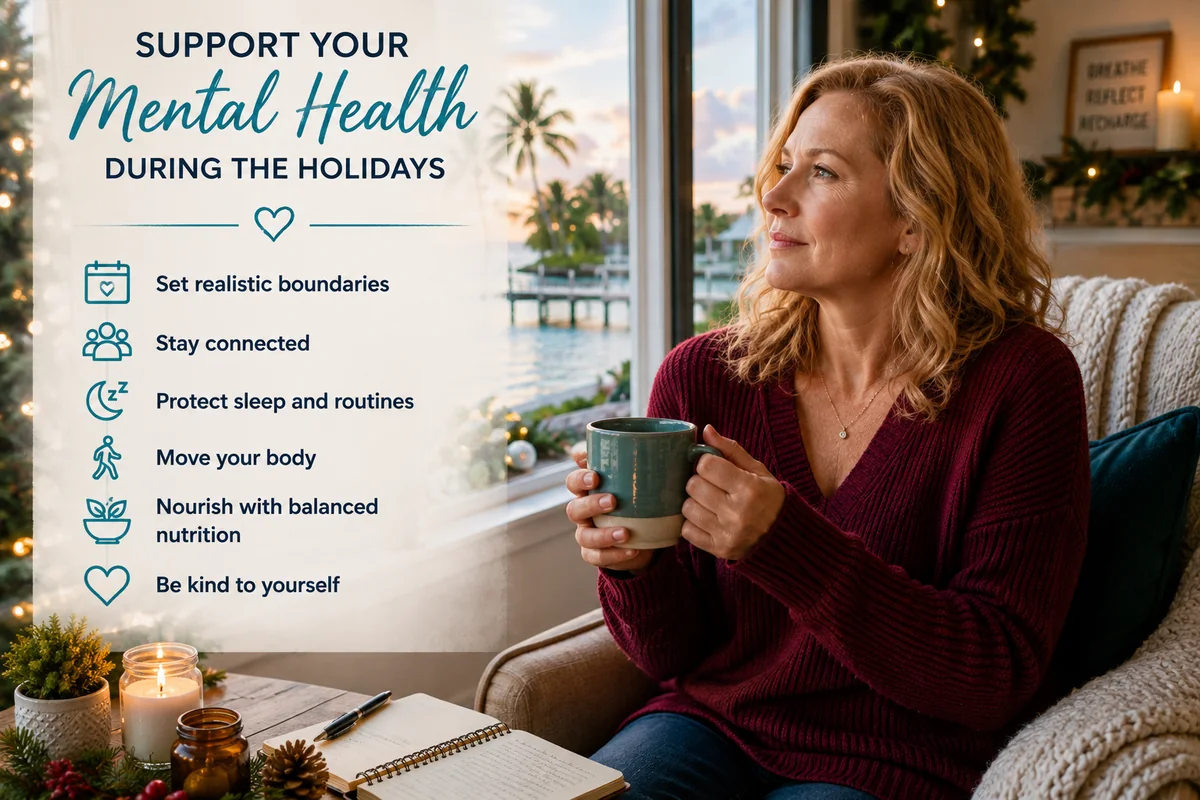
Self-care cannot cure holiday depression or replace treatment for a depressive disorder.
It can, however, reduce unnecessary stress and help protect routines that support mental and physical health during a demanding time of year.
Set Realistic Boundaries
You do not have to attend every gathering, accept every invitation, maintain every tradition, or meet everyone else’s expectations.
If certain events consistently leave you overwhelmed, consider shortening the amount of time you attend, declining some invitations, or changing traditions that no longer work for you.
Boundaries are not about avoiding every uncomfortable situation. They are about making intentional decisions about where you spend your limited time and emotional energy.
Stay Connected Without Forcing Yourself to Perform
Depression can make withdrawal feel appealing, but connection does not have to mean attending a crowded holiday party.
A quiet meal with a friend, a phone call, coffee with someone you trust, a support group, volunteering, or spending time with chosen family may feel more manageable.
The goal is not to force yourself to socialize.
It is to notice when isolation is becoming part of a pattern that is making your mental health more difficult.
Protect Sleep and Daily Routines
Holiday schedules can disrupt sleep, meals, exercise, medication routines, therapy appointments, and other habits that normally provide structure.
Try to preserve the routines that matter most to your well-being, even when the holiday schedule becomes busy.
Sleep deserves particular attention because depression and sleep problems can influence one another.
Our guide to depression and sleep explains that relationship in greater detail.
Use Physical Activity as Support, Not a Cure
Physical activity can support mental and physical health and may improve depressive symptoms for some people.
Walking, strength training, aerobic exercise, yoga, or another form of movement can also provide structure and time away from holiday demands.
Exercise should not, however, be presented as a “natural antidepressant” that makes clinical depression disappear.
For someone with significant depression, physical activity is best understood as one potential component of a broader treatment and wellness plan.
Pay Attention to Nutrition and Alcohol
Busy holiday schedules can make regular meals more difficult, while celebrations may involve more alcohol, sweets, or foods outside your normal routine.
There is no need to pursue a perfect holiday diet.
Regular, balanced nutrition can support physical health and energy, particularly when depression has already affected appetite or motivation.
Our guide to depression and diet explains how nutrition can support mental health without presenting food as a treatment for depression.
Alcohol deserves particular attention because using it to manage sadness, anxiety, loneliness, or social discomfort can create additional problems and may worsen sleep or mood for some people.
Make Room for the Feelings You Actually Have
Mindfulness, slow breathing, journaling, prayer, meditation, or quiet time may help some people manage acute stress or reconnect with the present moment.
The goal is not to use these practices to force yourself to feel happy.
A difficult holiday does not mean you are doing the holidays incorrectly.
Sometimes self-care means allowing yourself to acknowledge:
“This is a hard season for me.”
That recognition can be healthier than exhausting yourself trying to perform a version of holiday happiness you do not actually feel.
When to Seek Professional Help for Holiday Depression
You do not need to wait until the holiday season ends to ask for help.
Consider speaking with a qualified healthcare or mental health professional when holiday depression symptoms:
Persist for two weeks or longer
Become increasingly severe
Interfere with work, relationships, sleep, self-care, or daily responsibilities
Lead to significant withdrawal or isolation
Include increasing reliance on alcohol or other substances to cope
Occur alongside severe anxiety, trauma-related symptoms, or another mental health concern
Continue even after the immediate holiday stressors have passed
Include thoughts of death, suicide, or self-harm
An evaluation can help determine whether you are experiencing temporary holiday-related distress, grief, major depressive disorder, seasonal depression, an anxiety disorder, or another condition.
Treatment should be based on the actual diagnosis and individual needs rather than the assumption that all depression occurring during the holidays has the same cause.
Depending on the diagnosis and severity, treatment may include psychotherapy, medication, lifestyle support, light therapy for appropriate cases of seasonal depression, or a combination of approaches.
Frequently Asked Questions About Holiday Depression
Is holiday depression the same as seasonal affective disorder?
No.
Holiday depression is an informal term describing depressive symptoms or emotional distress that occur or become more difficult around the holiday season.
Major depressive disorder with seasonal pattern, often called seasonal affective disorder or SAD, is a recognized depressive condition involving episodes that follow a recurring seasonal pattern.
The two can overlap because the winter holidays occur during the same period when winter-pattern seasonal depression commonly emerges.
How do I know if I have the holiday blues or clinical depression?
Temporary sadness, stress, grief, or loneliness during the holidays does not automatically mean you have a depressive disorder.
Symptoms deserve greater attention when they persist for two weeks or longer, become severe, interfere significantly with daily functioning, or include hopelessness, loss of interest or pleasure, significant sleep or appetite changes, or thoughts of death or self-harm.
A qualified healthcare professional can evaluate the full pattern rather than relying on one symptom or a particular time of year.
Can grief cause depression during the holidays?
Grief and depression are not the same thing, although they can occur together.
The holidays may intensify grief because traditions, gatherings, music, anniversaries, or family rituals can bring memories of someone who has died.
Experiencing grief during the holidays does not automatically mean someone has clinical depression.
However, if symptoms become persistent, severe, or significantly impair functioning, professional evaluation may be helpful.
What can I do for someone who seems depressed during the holidays?
Listen without judgment.
Avoid telling the person to “cheer up,” reminding her that other people have it worse, or insisting that she should feel grateful because it is the holidays.
Offer specific support rather than simply saying, “Let me know if you need anything.”
You might offer to bring dinner, accompany her to an appointment, take a walk together, help with a practical task, or simply spend quiet time with her.
If symptoms appear significant or persistent, encourage professional support.
If someone is unable to remain safe or may act on suicidal thoughts, seek immediate emergency medical assistance.
When Holiday Depression Requires More Than Outpatient Support
Most people experiencing holiday stress, grief, loneliness, or temporary low mood do not need residential mental health treatment.
Even many people with a depressive disorder can be treated effectively through outpatient psychotherapy, medication management when appropriate, and other community-based care.
A higher level of care may be appropriate when depression has become severe enough to substantially interfere with daily functioning, when significant co-occurring mental health conditions complicate treatment, when safety concerns are present, or when outpatient treatment is no longer providing enough structure and support.
At Kinder in the Keys, our women’s depression treatment center provides residential mental health treatment for adult women whose depression and related mental health symptoms require a higher level of care.
The fact that symptoms become more noticeable during the holidays does not make them less important.
For some women, the holiday season simply becomes the point when an existing struggle can no longer be ignored.
Moving Through the Holidays Without Pretending
The holidays do not need to look perfect to be meaningful.
You may enjoy some traditions and avoid others.
You may feel grateful and sad at the same time.
You may want company one day and quiet the next.
And if you are experiencing holiday depression, you do not have to wait for January and hope that everything disappears when the decorations come down.
Pay attention to what your symptoms are telling you.
Reduce unnecessary pressures where you can. Protect the routines and relationships that support you. Allow yourself to acknowledge grief, loneliness, anger, exhaustion, or disappointment without treating those emotions as evidence that you have failed at the holidays.
And when symptoms are persistent, severe, or interfering significantly with your life, seek professional help.
The goal is not to manufacture holiday cheer.
It is to move through the season with enough honesty and support to take your mental health seriously.
Medically Reviewed By
Dr. Laura Tanzini, DrPH, LMFT
Doctor of Public Health | Specialty in Lifestyle Medicine
Licensed Marriage and Family Therapist (Florida & California)
Founder & CEO, Kinder in the Keys
Doctoral Research: Dr. Tanzini’s doctoral research at Loma Linda University examined childhood and adult traumatic events, cumulative trauma exposure, gender, forgiveness, life satisfaction, and long-term well-being.
This article has been clinically reviewed for accuracy and consistency with current behavioral health principles. Content is intended to provide general educational information and should not replace individualized evaluation, diagnosis, or treatment by a qualified healthcare professional.
Medical Disclaimer: The information provided in this article is for educational and informational purposes only and is not intended as medical advice, diagnosis, or treatment. Depression, grief, seasonal symptoms, and treatment needs vary by individual. If symptoms are persistent, severe, or interfering with daily functioning, consult a qualified healthcare or mental health professional. Seek immediate emergency medical care if you are unable to remain safe or believe you may act on suicidal thoughts.