
A holistic approach to depression means treating the whole woman rather than reducing depression to one symptom, one biological process, or one treatment.
Depression can affect mood, thinking, sleep, appetite, energy, relationships, physical health, motivation, and everyday functioning. At the same time, a woman’s physical health, trauma history, relationships, environment, sleep, nutrition, activity level, stress, and other life circumstances can influence how she feels and functions.
Whole-person care considers those connections.
But holistic treatment should not mean replacing evidence-based depression treatment with supplements, herbs, acupuncture, meditation, or other complementary practices.
It means asking a broader clinical question:
What is happening throughout this woman’s life and health that may be contributing to her depression, maintaining her symptoms, or affecting her recovery?
At Kinder in the Keys, our depression treatment program for women approaches treatment from this broader perspective while maintaining appropriate clinical care for depression.
What Does a Holistic Approach to Depression Actually Mean?
The word holistic is used so frequently in mental health marketing that its meaning can become unclear.
Sometimes it is used as another term for alternative medicine.
That is not how we use it.
A holistic approach considers multiple dimensions of a woman’s health and life while recognizing that major depression is a mental health condition requiring appropriate assessment and treatment.
Depending on the individual woman, treatment may need to consider:
Psychological symptoms
Thought and behavioral patterns
Trauma history
Physical health
Sleep
Nutrition
Movement and physical activity
Relationships
Social support
Stress
Daily routines
Environment
Substance use
Medications
Meaning, values, and purpose
These factors do not all cause depression, and every woman does not need intervention in every area.
The purpose is to understand which factors are clinically relevant for this particular woman.
Holistic Does Not Mean Medication-Free
One of the biggest misconceptions about holistic mental health treatment is that it means avoiding medication.
It does not.
Medication can be an appropriate component of depression treatment for some women and should be prescribed and managed by an appropriately qualified medical professional.
Other women may receive psychotherapy without medication, depending on their diagnosis, symptoms, severity, treatment history, preferences, medical considerations, and clinical recommendations.
A whole-person approach does not begin with the assumption that medication is either the answer to everything or something that should always be avoided.
Instead, medication is considered one potential component of an individualized treatment plan.
The same principle applies to psychotherapy, nutrition, exercise, sleep interventions, and other aspects of care.
There is no single intervention that is appropriate for every woman with depression. The National Institute of Mental Health notes that depression treatment typically involves psychotherapy, medication, or both, with treatment decisions based on the individual’s needs, preferences, symptoms, and medical situation.
Depression Is More Than “Brain Chemistry”
Depression is sometimes explained as though it results simply from a chemical imbalance in the brain.
That explanation is overly simplistic.
Major depressive disorder is a complex condition involving interactions among biological, psychological, social, environmental, and other factors.
Genetics can contribute to vulnerability.
Stress and adverse experiences may matter.
Medical conditions and medications can affect mood.
Sleep disturbance can interact with depression.
Relationships and social isolation can influence emotional well-being.
Previous episodes of depression can increase the likelihood of recurrence.
For some women, trauma or chronic stress may also be clinically relevant.
Understanding depression therefore requires more than asking whether someone’s serotonin is “low.”
It requires understanding the woman.
The Psychological Component of Whole-Person Depression Treatment
Psychotherapy remains an important evidence-based component of depression treatment.
The specific therapeutic approach should depend on the woman’s symptoms, clinical needs, history, and treatment goals.
Cognitive Behavioral Therapy
Cognitive Behavioral Therapy (CBT) is one of the most extensively studied psychotherapies for depression.
CBT examines relationships among thoughts, emotions, and behaviors.
A woman experiencing depression may develop patterns such as:
“Nothing will ever change.”
“I fail at everything.”
“Everyone would be better without me.”
“There is no point in trying.”
Treatment does not simply replace these thoughts with positive affirmations.
Instead, CBT helps identify patterns of thinking, evaluate them more accurately, and examine behaviors that may be reinforcing depression.
Behavioral strategies can also help women gradually re-engage with activities, responsibilities, relationships, and experiences that have been lost during depression.
Other Therapeutic Approaches
CBT is not the only psychotherapy used in depression treatment.
Depending on the woman and her clinical presentation, treatment may incorporate other evidence-based or clinically appropriate approaches.
For example, trauma-focused treatment may be relevant when trauma-related symptoms are part of the clinical picture.
Interpersonal concerns may need direct attention when grief, relationship conflict, role transitions, or isolation contribute significantly to distress.
Skills drawn from Dialectical Behavior Therapy may sometimes be useful when a woman needs additional support with emotion regulation, distress tolerance, mindfulness, or interpersonal effectiveness.
However, DBT should not be presented as a universal treatment for depression.
Treatment should follow the clinical needs of the woman rather than forcing every woman into the same therapeutic model.
Physical Health Matters in Depression Treatment
Mental health does not exist separately from physical health.
Several medical conditions can cause or contribute to symptoms that resemble depression, including fatigue, concentration problems, sleep changes, appetite changes, and low energy.
Medications can also affect mood or energy.
That is why physical health deserves consideration during depression assessment and treatment.
Depending on the woman’s symptoms and history, coordination with medical providers may be appropriate.
This is particularly important when physical symptoms are new, unexplained, severe, or changing.
A holistic approach should never mean assuming every physical symptom has an emotional cause.
Sometimes a woman needs psychotherapy.
Sometimes she needs a medical evaluation.
Sometimes she needs both.
Sleep and Depression
Sleep deserves particular attention because depression and sleep disturbance frequently occur together.
The relationship between insomnia and depression is especially important because sleep disruption can occur alongside depression while also making daytime functioning more difficult.
Some women with depression struggle with insomnia.
Others sleep substantially more than usual and remain exhausted.
Sleep problems can worsen concentration, emotional regulation, energy, and everyday functioning.
At the same time, depression itself can disrupt normal sleep.
This can create a difficult cycle:
Depression affects sleep → poor sleep affects functioning → reduced functioning increases stress → depression becomes harder to manage.
Addressing sleep does not replace depression treatment.
It addresses one part of the woman’s overall clinical picture that may be affecting her ability to recover.
Nutrition as Part of Whole-Person Care
Nutrition matters to physical and mental health. Understanding the relationship between depression and diet can help women separate sensible nutritional support from exaggerated claims that food can cure a depressive disorder.
But nutrition should not be marketed as a cure for depression.
A balanced dietary pattern can support overall health, energy, metabolic function, and nutritional adequacy.
For a woman struggling with depression, even basic nutrition can become difficult.
She may skip meals because she has no appetite.
She may rely heavily on convenience foods because preparing meals feels overwhelming.
She may experience increased appetite or changes in eating patterns.
Some women may also have nutritional deficiencies or medical concerns requiring appropriate evaluation.
At Kinder, nutrition is considered part of overall wellness—not a substitute for mental health treatment.
The goal is not to prescribe a magical “antidepressant diet.”
It is to support the physical health of the woman while she receives appropriate treatment for depression.
Movement and Exercise
Physical activity can support mental and physical health and has evidence supporting its role in depression management.
But telling a woman with major depression to “just exercise” fundamentally misunderstands the condition.
Depression itself can make movement extraordinarily difficult.
Fatigue, low motivation, poor sleep, psychomotor slowing, loss of pleasure, and feelings of hopelessness can all make even simple activities feel overwhelming.
Movement therefore needs to meet the woman where she is.
For one woman, that may mean structured exercise.
For another, it may initially mean walking outside for a short period.
The objective is not punishment, weight loss, or proving that someone is trying hard enough.
It is to use appropriate movement as one component of broader health and recovery when clinically suitable.
Relationships and Social Connection
Depression can change relationships.
A woman may withdraw because conversation feels exhausting.
She may stop returning calls or accepting invitations.
She may believe she is a burden.
She may become more irritable with people she loves.
Other women may be living within relationships that contribute significantly to stress or emotional distress.
A holistic treatment plan considers the woman’s relational environment.
Questions may include:
Who provides meaningful support?
Which relationships create significant stress?
Does the woman feel safe?
Has depression led to increasing isolation?
Are boundaries difficult?
Is family involvement helpful or harmful?
Are relationship patterns contributing to distress?
Social support alone does not treat major depression.
But relationships are part of the environment in which depression develops, persists, and improves.
Trauma History May Be Relevant
Not every woman with depression has a trauma-related disorder.
And trauma should not automatically be assumed to explain depression.
However, for some women, previous traumatic experiences are clinically relevant to their current symptoms.
A woman may have depression alongside PTSD.
Another may have trauma-related beliefs, avoidance, shame, or relationship patterns without meeting criteria for PTSD.
Another may have depression that has little relationship to trauma at all.
That is why trauma history should be assessed rather than assumed.
When trauma is clinically relevant, treatment can address it appropriately.
When it is not, treatment should not manufacture a trauma explanation simply because trauma-informed language is popular.
Daily Environment and Routine Matter
Depression often disrupts structure.
Sleep schedules change.
Meals become irregular.
Exercise stops.
Work becomes harder.
Social contact decreases.
Days begin to blur together.
Re-establishing routine can therefore become an important part of recovery.
That might involve gradually rebuilding:
Consistent waking and sleeping times
Regular meals
Movement
Personal hygiene
Work or household responsibilities
Social interaction
Meaningful activities
Time outdoors
Rest
Treatment participation
These changes may look simple from the outside.
For someone experiencing significant depression, they may represent substantial progress.
Meaning, Values, and Spiritual Well-Being
For some women, spirituality or religion is an important source of meaning and support.
For others, it is not.
Whole-person care should make room for the woman’s own values rather than imposing a particular belief system.
Meaning may come through:
Faith
Family
Relationships
Creativity
Nature
Service
Work
Personal values
Community
Recovery goals
Depression can make meaningful parts of life feel distant or inaccessible.
Treatment may help a woman reconnect with what matters to her as symptoms improve.
That process is personal.
There is no requirement that holistic treatment include religion, spirituality, meditation, or any particular practice.
What About Meditation and Mindfulness?
Mindfulness and meditation can be useful supportive practices for some women.
They may help with awareness, attention, stress management, or the ability to observe thoughts without automatically responding to them.
But they are not universal treatments for depression.
Some women enjoy meditation.
Others dislike it.
Some find sitting quietly with internal experiences uncomfortable or unhelpful, particularly at certain stages of treatment.
Mindfulness should therefore be treated as a tool, not a requirement and certainly not a cure.
What About Supplements and Herbal Remedies?
“Natural” does not automatically mean safe, effective, or appropriate.
Supplements and herbal products can have side effects, vary in quality, and interact with prescription medications.
Some products marketed for mood have been studied, but evidence varies considerably among substances, populations, doses, and study designs.
St. John’s wort is a particularly important example because it can interact with numerous medications. NCCIH warns that St. John’s wort can interact with many prescription medications, including certain antidepressants, and that some interactions can be serious.
A woman taking prescribed medication should not add or discontinue supplements intended to affect mood without discussing them with an appropriate healthcare professional.
Kinder does not treat depression by replacing appropriate clinical care with a collection of supplements or herbal remedies.
Complementary Practices Are Complementary
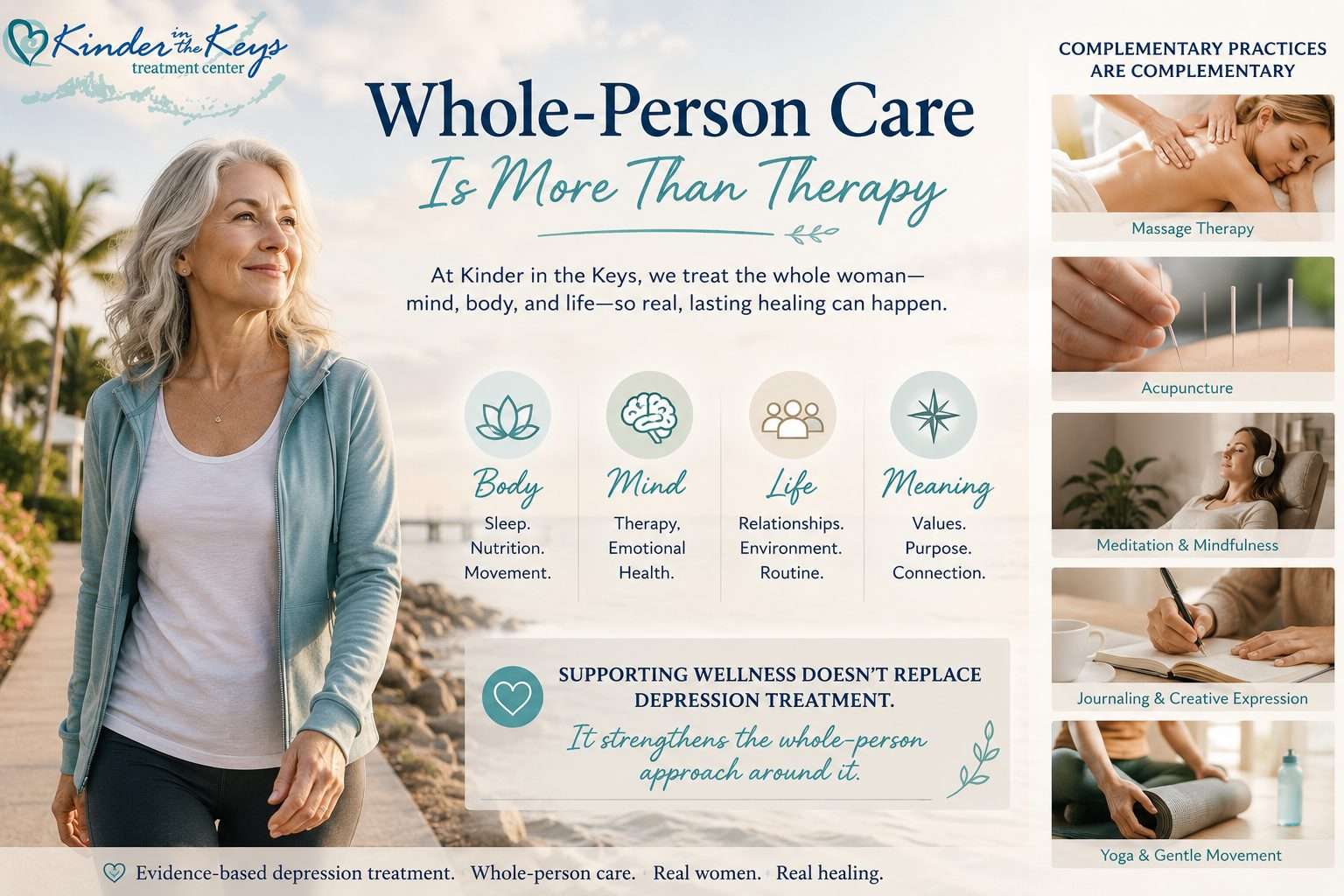
Some women enjoy practices such as:
Yoga
Meditation
Massage
Acupuncture
Time in nature
Creative activities
Relaxation practices
These experiences may support relaxation, enjoyment, body awareness, stress management, or general well-being.
That can be valuable.
But there is an important difference between something that supports well-being and something that treats major depressive disorder.
A relaxing massage may feel wonderful.
A walk outdoors may improve someone’s afternoon.
Yoga may help a woman reconnect with her body.
Those benefits do not require us to claim that the activity cures depression or corrects an underlying biological abnormality.
Complementary practices should complement appropriate treatment—not replace it. The National Center for Complementary and Integrative Health similarly advises that complementary health approaches should not be used to replace conventional depression care or delay evaluation by a healthcare professional.
A Holistic Approach Does Not Mean Treating Everything
Whole-person care also requires knowing what a program is—and is not—appropriate to treat.
Not every psychiatric condition should be folded into a general discussion of holistic depression care.
For example, depressive episodes can occur in bipolar disorders, but bipolar disorder is clinically distinct from major depressive disorder and requires appropriate psychiatric assessment and treatment.
Kinder in the Keys does not provide residential treatment for bipolar disorder.
Likewise, women who require acute psychiatric stabilization, medical detoxification, or another level or type of specialty care need services appropriate to those needs.
Being holistic does not mean claiming to treat everything.
It means understanding the whole woman while remaining clear about diagnosis, scope of care, and appropriate level of treatment.
What Holistic Depression Treatment Looks Like at Kinder
At Kinder in the Keys, whole-person depression treatment begins with the individual woman.
We want to understand:
What symptoms is she experiencing?
How long have they been present?
How significantly are they affecting her life?
What has previous treatment looked like?
What patterns may be maintaining her depression?
How is she sleeping?
How is she eating?
What is happening physically?
What relationships surround her?
Is trauma clinically relevant?
What does her daily environment look like?
What has she stopped doing because of depression?
What does she need in order to begin functioning differently?
Women participate in individual therapy and daily group programming within a small residential environment.
Treatment approaches are selected according to clinical need.
Healthy nutrition, movement, sleep, daily structure, relationships, physical wellness, and meaningful activities are considered alongside psychological treatment because the woman experiencing depression is more than a diagnosis.
That is what holistic means to us.
When Residential Depression Treatment May Be Appropriate
Many women with depression can receive appropriate treatment through outpatient care.
Residential treatment is not necessary simply because someone has depression. Residential depression treatment for women may be appropriate when symptoms significantly interfere with functioning or when a woman needs more structure and therapeutic support than outpatient care can provide.
A higher level of care may be appropriate when depression:
Significantly interferes with daily functioning
Has not improved sufficiently with outpatient treatment
Repeatedly worsens or returns
Occurs alongside other mental health concerns that complicate treatment
Has resulted in substantial withdrawal or loss of daily structure
Requires more therapeutic support than outpatient treatment can provide
Safety always matters.
Women experiencing an acute psychiatric emergency, imminent suicide risk, or medical instability require an appropriate emergency or acute level of care.
The right treatment setting depends on the individual woman’s clinical needs.
Holistic Approach to Depression: Frequently Asked Questions
What is a holistic approach to depression?
A holistic approach to depression considers the whole woman’s psychological health, physical health, sleep, nutrition, movement, relationships, environment, stressors, history, and individual needs while maintaining appropriate evidence-based mental health treatment.
Does holistic depression treatment mean no medication?
No. Medication may be appropriate for some women and should be prescribed and managed by an appropriately qualified healthcare professional. Holistic care means medication is considered within the broader clinical picture rather than being viewed as either the only treatment or something that must always be avoided.
Can nutrition cure depression?
No particular diet should be presented as a cure for major depression. Nutrition supports overall physical and mental health and can be an important component of whole-person care, but it does not replace appropriate depression treatment.
Can exercise treat depression?
Physical activity has evidence supporting its role in depression management and can be an important component of treatment. The appropriate amount and type of movement depend on the individual woman’s health, symptoms, abilities, and clinical needs.
Are supplements a natural alternative to antidepressants?
Supplements should not automatically be considered safer or more appropriate because they are described as natural. Evidence varies, and supplements can cause side effects or interact with medications. Decisions about products intended to affect mood should be discussed with an appropriate healthcare professional.
Is meditation part of holistic depression treatment?
It can be for women who find it useful. Meditation and mindfulness are supportive tools rather than requirements, and they should not be presented as cures for major depressive disorder.
Does holistic treatment include trauma therapy?
Only when trauma is clinically relevant to the individual woman’s symptoms and treatment needs. Depression should not automatically be assumed to result from trauma.
Does Kinder treat bipolar depression?
No. Kinder in the Keys does not provide residential treatment for bipolar disorder. Bipolar disorders require appropriate psychiatric assessment and treatment and should not be treated as interchangeable with major depressive disorder.
Treating the Whole Woman
A holistic approach to depression does not mean choosing between science and wellness.
It means refusing to reduce a woman to one part of herself.
Psychological treatment matters.
Physical health matters.
Sleep matters.
Nutrition matters.
Movement matters.
Relationships matter.
Environment matters.
History matters.
Meaning matters.
And the importance of each of those factors will differ from one woman to another.
Whole-person treatment brings the relevant pieces together without pretending that every wellness practice treats depression or that every woman needs the same combination of interventions.
At Kinder in the Keys, holistic depression treatment means understanding the woman who has the diagnosis—not simply treating the diagnosis in isolation.
Medically Reviewed By
Dr. Laura Tanzini, DrPH, LMFT
Doctor of Public Health | Specialty in Lifestyle Medicine
Licensed Marriage and Family Therapist (Florida & California)
Founder & CEO, Kinder in the Keys
This article has been clinically reviewed for accuracy and consistency with evidence-based behavioral health and whole-person wellness principles. It is intended to provide educational information about holistic depression treatment and does not replace individualized assessment, diagnosis, medical care, or treatment from qualified healthcare professionals.
Medical Disclaimer
This article is for educational and informational purposes only and is not intended to diagnose, treat, cure, or prevent depression or any other medical or mental health condition.
If depression symptoms are persistent, worsening, or interfering with daily functioning, seek evaluation from a qualified healthcare or mental health professional. If there is an immediate risk of self-harm or suicide, call or text 988 in the United States or seek emergency care.