
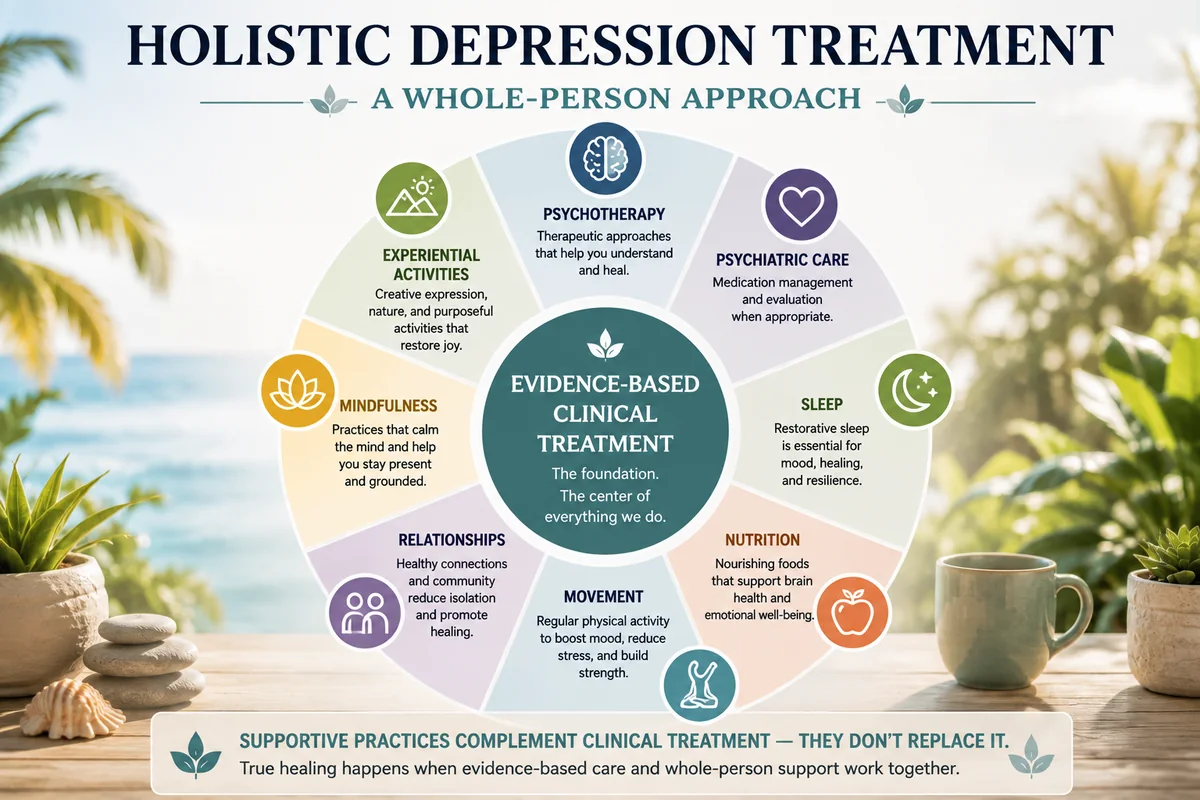
Holistic depression treatment centers take a whole-person approach to mental health care by considering not only depressive symptoms, but also factors such as physical health, sleep, nutrition, movement, relationships, trauma history, daily routines, and the environment to which a person will return after treatment.
The word holistic can mean very different things from one program to another.
At a high-quality mental health treatment center, holistic care should not mean replacing evidence-based psychotherapy, psychiatric care, or appropriate medical treatment with alternative therapies.
Instead, it means integrating evidence-based clinical treatment with supportive interventions that address multiple areas of a person’s health and functioning.
At Kinder in the Keys, our women’s depression treatment center uses an individualized approach in which psychotherapy and other clinically appropriate mental health services remain the foundation of treatment, while nutrition, movement, mindfulness, experiential activities, and other supportive interventions may be incorporated according to each woman’s needs.
Not everyone with depression needs residential care, and a holistic program is not automatically better simply because it uses that label.
This guide explains what to look for when evaluating holistic depression treatment centers, which questions to ask, how to distinguish meaningful whole-person care from marketing language, and when a residential level of care may be appropriate.
What Makes a Depression Treatment Center Holistic?
The term “holistic” is widely used in behavioral health marketing, but there is no single treatment protocol called holistic depression treatment.
A meaningful whole-person approach begins with appropriate clinical care.
Depression treatment commonly involves psychotherapy, medication, or both, depending on the individual’s symptoms, medical situation, needs, and preferences. Other interventions may be considered when standard approaches have not provided sufficient improvement.
A whole-person program may then consider additional areas that can affect recovery and functioning, including:
Sleep and daily routines
Nutrition and physical health
Movement and physical activity
Stress management
Relationships and social support
Trauma history when clinically relevant
Mindfulness or relaxation practices
Creative and experiential activities
The environment to which the person will return after treatment
Discharge and continuing-care needs
These elements should complement clinical treatment rather than replace it.
The most important question is not whether a center describes itself as holistic.
It is whether the program provides qualified clinical care, individualizes treatment, clearly explains what each intervention is intended to accomplish, and stays within appropriate clinical boundaries.
Who Should Consider a Holistic Depression Treatment Center?
Most people with depression do not require residential treatment.
Many can receive appropriate care through outpatient psychotherapy, medication management, or a combination of services while continuing to live at home.
Residential care may be considered when depression has become significantly impairing and outpatient treatment is not providing enough structure or support.
A woman may benefit from evaluation for a residential level of care when she:
Has significant depressive symptoms that interfere with daily functioning
Has not made sufficient progress with a less intensive level of treatment
Is having difficulty consistently participating in outpatient care
Has co-occurring mental health conditions requiring integrated treatment
Needs greater structure and support than weekly outpatient appointments provide
Would benefit from temporarily stepping away from environmental stressors while engaging in treatment
Is medically and psychiatrically appropriate for residential care
Residential treatment is not appropriate for every severe presentation.
Someone experiencing an acute psychiatric emergency, inability to remain safe, or a need for hospital-level stabilization may require inpatient psychiatric care rather than a residential treatment center.
The appropriate level of care should be determined through an individualized clinical assessment.
What to Look for in Holistic Depression Treatment Centers
The word “holistic” alone tells you very little about the quality of a program.
When comparing holistic depression treatment centers, look beyond the photographs, amenities, location, and marketing language.
1. A Strong Clinical Foundation
Evidence-based mental health treatment should remain central to the program.
Ask which psychotherapies are actually provided, who provides them, how clinicians determine which approaches are appropriate, and how treatment plans are individualized.
For depression, established treatment options include approaches such as cognitive behavioral therapy (CBT) and interpersonal psychotherapy (IPT). Other psychotherapies may also be appropriate depending on the individual’s clinical presentation.
A program offering trauma-focused treatment should also be able to explain when that treatment is clinically indicated rather than assuming every person with depression needs trauma processing.
Our guide to the forms of treatment for depression explains the major treatment approaches in greater detail.
2. Appropriate Psychiatric Care
Medication can be an important component of depression treatment for some people.
A whole-person philosophy should not mean being anti-medication.
Ask how psychiatric evaluations are conducted, who manages medications, how side effects and response are monitored, and how medication decisions are coordinated with the rest of the treatment team.
Medication should be prescribed and adjusted according to the individual’s clinical needs rather than a program philosophy that everyone should—or should not—take medication.
3. Individualized Treatment Planning
Depression does not look identical in every woman.
Treatment planning may need to account for symptom severity, previous depressive episodes, trauma history, anxiety, eating-disorder symptoms, medical conditions, sleep, medications, relationships, reproductive transitions, environmental stressors, and previous treatment response.
A good program should be able to explain how the treatment plan changes according to the individual rather than simply listing every therapy the facility offers.
4. Qualified and Licensed Professionals
Ask who actually provides treatment.
Look for appropriately licensed mental health clinicians and qualified psychiatric or medical professionals when those services are part of the program.
Also ask who provides specialized interventions.
For example, art therapy and music therapy are professional clinical disciplines when provided by appropriately trained practitioners. Recreational art or music activities may still be valuable experiences, but they should not automatically be described as psychotherapy.
5. Accreditation and Licensing
Licensing and accreditation can provide useful information when evaluating a behavioral health program.
The Joint Commission accredits behavioral health organizations across multiple settings, including residential treatment and partial hospitalization programs, and evaluates organizations against standards related to quality and safety.
Accreditation should be considered alongside other factors such as appropriate state licensure, clinical staffing, treatment philosophy, transparency, and whether the program is appropriate for the individual’s needs.
6. Nutrition Without Miracle Claims
Depression can affect appetite, energy, motivation, eating patterns, and the ability to prepare regular meals.
Nutrition therefore deserves attention within whole-person care.
But be cautious when a treatment center claims that a particular diet, supplement, ingredient, or food plan treats depression.
At Kinder, the goal is healthy, nutritious food and support for overall wellness—not a claim that an organic, non-GMO, gluten-free, or other specialized diet cures mental illness.
Nutrition can support health while evidence-based mental health treatment addresses the clinical condition.
7. Movement and Physical Wellness
Physical activity can support physical and mental health and may be useful as part of depression care.
Movement does not need to mean intense exercise.
Depending on the individual and the program, appropriate activity might include walking, stretching, yoga, recreational activities, or other forms of movement.
A good program should not promise that exercise will replace psychotherapy or medication, nor should a woman be made to feel that difficulty exercising while severely depressed represents treatment failure.
8. Mindfulness and Stress-Management Skills
Mindfulness, meditation, breathing practices, relaxation strategies, and similar skills may help some people manage stress, rumination, or emotional reactivity.
These can be useful components of a broader treatment plan.
They are not substitutes for appropriate treatment of major depressive disorder.
9. Experiential Activities With Clear Boundaries
Experiential activities can provide opportunities for connection, enjoyment, confidence, mindfulness, creativity, and practicing skills outside the therapy room.
However, treatment centers should be transparent about the difference between a clinical therapy and a supportive or recreational experience.
At Kinder, for example, many women have the opportunity to participate in a guided dolphin encounter near the completion of residential treatment.
Kinder does not describe that experience as dolphin-assisted therapy or claim that dolphins treat depression.
It is an experiential milestone offered within a much larger clinical treatment program.
10. Appropriate Discharge Planning
Residential treatment is one part of a longer recovery process.
Before discharge, the treatment team should work with the client to identify continuing-care needs and provide appropriate recommendations.
The exact plan will differ according to where the woman lives, her clinical needs, available providers, insurance, medications, and the level of support required after discharge.
Be cautious of programs promising that every client leaves with identical services or guaranteed access to particular providers.
Holistic Treatment Does Not Mean “Traditional Treatment Doesn’t Work”
One of the biggest problems with marketing around holistic depression treatment centers is the tendency to create a false choice between “traditional” and “holistic” treatment.
Evidence-based psychotherapy and psychiatric care are not the opposite of whole-person care.
They can be part of it.
A psychiatrist prescribing an antidepressant is not treating a woman as “just brain chemistry.”
A therapist providing CBT is not necessarily ignoring her physical health, relationships, trauma history, or environment.
Likewise, offering yoga, nutrition education, mindfulness, or activities in nature does not automatically make a program more effective.
The better question is:
Does the program integrate appropriate clinical treatment with supportive interventions in a thoughtful, individualized way?
That is a much more meaningful distinction than the label attached to the program.
Residential Treatment vs. Inpatient Hospitalization
When comparing treatment centers, pay attention to how they describe their level of care.
Residential Treatment
Residential mental health treatment provides structured care while the client lives at the treatment facility.
It can be appropriate for someone who needs more support than outpatient treatment provides but who is medically and psychiatrically appropriate for a residential setting.
Inpatient Psychiatric Hospitalization
Inpatient psychiatric hospitalization is a more acute level of care.
It may be necessary when someone cannot remain safe, requires immediate psychiatric stabilization, or has medical or psychiatric needs requiring hospital-level monitoring.
Residential and inpatient treatment are not interchangeable terms.
A reputable treatment center should be able to explain clearly what level of care it provides and which patients it can safely and appropriately serve.
Questions to Ask When Comparing Holistic Depression Treatment Centers
Before choosing a program, ask questions that help you understand what actually happens in treatment.
What mental health conditions do you treat?
Make sure the facility routinely treats depression and any important co-occurring conditions you may have.
What level of care do you provide?
Ask whether the program is residential, inpatient hospital-based, PHP, IOP, or outpatient—and what those terms mean at that particular facility.
Who provides individual therapy?
Ask about clinician licenses, credentials, experience, and how frequently individual sessions occur.
Which therapies do you offer, and how do you decide who receives them?
A long list of modalities does not mean every client needs every therapy.
The answer should involve clinical assessment and individualized treatment planning.
How is psychiatric care handled?
Ask who evaluates medications, how frequently psychiatric follow-up occurs, and what happens if side effects or concerns develop.
What does “holistic” mean at your facility?
Ask for specifics.
Does it refer to nutrition, movement, sleep, mindfulness, experiential activities, physical wellness, or integration with medical care?
A program should be able to define the term without relying on vague promises about “healing the whole person.”
How do you address nutrition?
Look for balanced, realistic nutritional support rather than rigid food rules or claims that specific foods cure depression.
What is a typical week actually like?
Ask how much time is spent in groups, individual therapy, psychiatric appointments, activities, and unstructured time.
This is more useful than assuming every “holistic” facility follows the same daily schedule.
What happens if I need a higher level of care?
A residential program should have a clear process for responding when someone develops acute safety, medical, or psychiatric needs beyond what the facility can appropriately manage.
What happens after discharge?
Ask what the treatment team helps arrange, what remains the client’s responsibility, and how recommendations are communicated.
Are you licensed and accredited?
Ask which organizations license and accredit the program and verify those claims independently when possible.
What Holistic Depression Treatment Looks Like at Kinder in the Keys
Kinder in the Keys is a women-only residential mental health treatment center in Key Largo, Florida.
Our approach is whole-person, but clinical treatment remains the foundation.
Women in residential treatment participate in daily therapeutic groups and receive individual therapy once per week.
Family therapy is available once per week when desired and clinically appropriate.
Because Kinder is a small program, clinicians may also be available outside scheduled individual sessions when additional support is needed.
Psychiatric evaluation and medication management are incorporated when clinically indicated.
EMDR may be used when it is appropriate for the individual woman’s clinical presentation and treatment plan. It is not automatically provided simply because someone has depression or a trauma history.
Supportive components of treatment may include attention to:
Healthy, nutritious eating
Sleep and daily routines
Movement and physical wellness
Mindfulness and emotional-regulation skills
Relationships and boundaries
Experiential and recreational activities
Preparation for continued care after discharge
Kinder no longer requires an organic or non-GMO diet.
Our nutrition philosophy focuses on providing healthy, nutritious food without presenting a particular food philosophy as treatment for depression.
Residential and PHP Care at Kinder
Kinder provides residential treatment with 24/7 on-site coverage while a woman is in residential care.
Kinder is not an acute inpatient psychiatric hospital.
Our Partial Hospitalization Program (PHP) generally provides approximately six hours of programming per day, five days per week.
PHP clients are not supervised by Kinder overnight.
The appropriate level of care is determined according to the woman’s clinical needs, safety, functioning, and treatment progress.
Why a Women-Only Environment?
Some women prefer a gender-specific environment because it allows them to discuss trauma, relationships, caregiving, body image, reproductive experiences, abuse, or other sensitive issues more comfortably.
A women-only setting is not inherently superior to every co-ed program.
It is one treatment-environment option that may be particularly helpful for some women.
Frequently Asked Questions About Holistic Depression Treatment Centers
What is a holistic depression treatment center?
A holistic depression treatment center generally uses a whole-person approach that considers mental health symptoms alongside areas such as physical health, sleep, nutrition, movement, relationships, daily routines, and environment.
The term does not describe one standardized treatment model, so prospective clients should ask each program exactly what “holistic” means there.
Does holistic depression treatment mean no medication?
No.
Whole-person care can include antidepressant medication and other psychiatric treatment when clinically appropriate.
Medication decisions should be individualized and made with qualified prescribing professionals.
Are holistic treatments evidence-based?
That depends on the specific intervention.
Evidence-based psychotherapy and appropriate medication can be integrated into a whole-person program.
Some supportive interventions have evidence for particular uses, while others may primarily support wellness, engagement, connection, or quality of life.
A facility should be able to distinguish clearly between clinical treatment and supportive activities.
How long does residential depression treatment last?
There is no universal length of stay that is appropriate for everyone.
Length of treatment depends on clinical needs, progress, level-of-care requirements, insurance authorization when applicable, and other individual circumstances.
Does insurance cover residential depression treatment?
Coverage varies considerably by insurer and individual plan.
Mental health benefits do not guarantee authorization or payment for residential treatment.
Coverage can depend on medical-necessity criteria, network status, deductibles, authorization requirements, and other plan provisions.
Insurance benefits should be verified before admission, but verification itself is not a guarantee of payment.
Can holistic treatment address depression with anxiety or PTSD?
Depression can occur alongside anxiety disorders, PTSD, and other mental health conditions.
When multiple conditions are present, treatment planning should consider the full clinical picture rather than assuming every symptom comes from one diagnosis.
Integrated care can address co-occurring conditions when the program has appropriate clinical expertise and the client is appropriate for that level of care.
Choosing a Holistic Depression Treatment Center
The best treatment center is not necessarily the one with the longest list of therapies, the most luxurious setting, or the strongest claims about transformation.
Look for a program that can explain:
What it treats
What level of care it provides
Who provides treatment
How treatment is individualized
Which interventions are evidence-based clinical treatments
Which activities are supportive or experiential
How medication is managed
How safety concerns are handled
What happens after discharge
How the program measures and reviews clinical progress
A whole-person approach can be valuable without making promises that one program, diet, therapy, activity, or environment will produce lasting recovery for everyone.
At Kinder in the Keys, our goal is to provide individualized residential mental health treatment for women who need greater structure and support than traditional outpatient care can provide.
For current information about our depression program, visit our women’s depression treatment center page.
Medically Reviewed By
Dr. Laura Tanzini, DrPH, LMFT
Doctor of Public Health | Specialty in Lifestyle Medicine
Licensed Marriage and Family Therapist (Florida & California)
Founder & CEO, Kinder in the Keys
Doctoral Research: Dr. Tanzini’s doctoral research at Loma Linda University examined childhood and adult traumatic events, cumulative trauma exposure, gender, forgiveness, life satisfaction, and long-term well-being.
This article has been clinically reviewed for accuracy and consistency with current behavioral health and evidence-based depression treatment principles. Content is intended to provide general educational information and should not replace individualized evaluation, diagnosis, or treatment by a qualified healthcare professional.
Medical Disclaimer: The information provided in this article is for educational and informational purposes only and is not intended as medical advice, diagnosis, or treatment. Depression symptoms, treatment needs, and appropriate levels of care vary by individual. Treatment decisions should be made with qualified healthcare professionals based on the person’s clinical circumstances.