
Major depressive disorder vs persistent depressive disorder can be confusing because both conditions involve depression, yet the pattern and duration of symptoms can be quite different.
Major Depressive Disorder (MDD) is generally characterized by depressive episodes that significantly affect mood, thinking, behavior, and daily functioning. Persistent Depressive Disorder (PDD) is distinguished primarily by its chronic course, with depressive symptoms continuing for years rather than occurring only during a discrete episode.
Neither condition should be dismissed as simply feeling sad.
And Persistent Depressive Disorder should not be thought of as depression that is automatically less important simply because symptoms may sometimes appear less intense.
Understanding the differences between MDD vs PDD can help women recognize why two experiences of depression may look very different—and why treatment needs to be individualized.
Women who are struggling with persistent or severe depression can also learn more about Kinder’s Women’s Depression Treatment Center and when residential mental health care may be appropriate.
MDD vs PDD: What’s the Main Difference?
The simplest distinction between MDD and PDD is the pattern and duration of depressive symptoms. When comparing MDD vs PDD, duration and the overall pattern of depressive symptoms are two of the most important distinctions.
Major Depressive Disorder involves one or more major depressive episodes. Symptoms must meet established diagnostic criteria and persist for at least two weeks.
Persistent Depressive Disorder involves a much longer pattern of depressed mood and associated symptoms. In adults, the depressive pattern generally persists for at least two years.
That does not mean MDD is always brief or PDD is always mild.
Major depressive episodes can last considerably longer than two weeks, recur over time, or become chronic. Likewise, persistent depressive disorder can cause substantial impairment even when a person’s symptoms do not always appear as severe to others.
The National Institute of Mental Health describes both major depression and persistent depressive disorder as recognized forms of depression, distinguished in part by symptom severity and duration.
MDD vs PDD Comparison
| Feature | Major Depressive Disorder (MDD) | Persistent Depressive Disorder (PDD) |
|---|---|---|
| General pattern | Major depressive episode(s) | Chronic depressive pattern |
| Duration | At least 2 weeks for a major depressive episode | Generally at least 2 years in adults |
| Course | May occur as one episode or recur | Long-lasting symptoms over years |
| Symptom intensity | Can range in severity and may cause substantial impairment | Symptoms may fluctuate and can also cause significant impairment |
| Periods without symptoms | Remission may occur between episodes | Long symptom-free periods are generally not characteristic of PDD |
| Functional impact | Can significantly affect work, relationships, self-care, sleep, and daily functioning | Chronic symptoms can gradually affect relationships, work, self-esteem, motivation, and quality of life |
| Treatment | Individualized according to severity, history, safety, functioning, and other factors | Also individualized; chronicity and previous treatment response are particularly important |
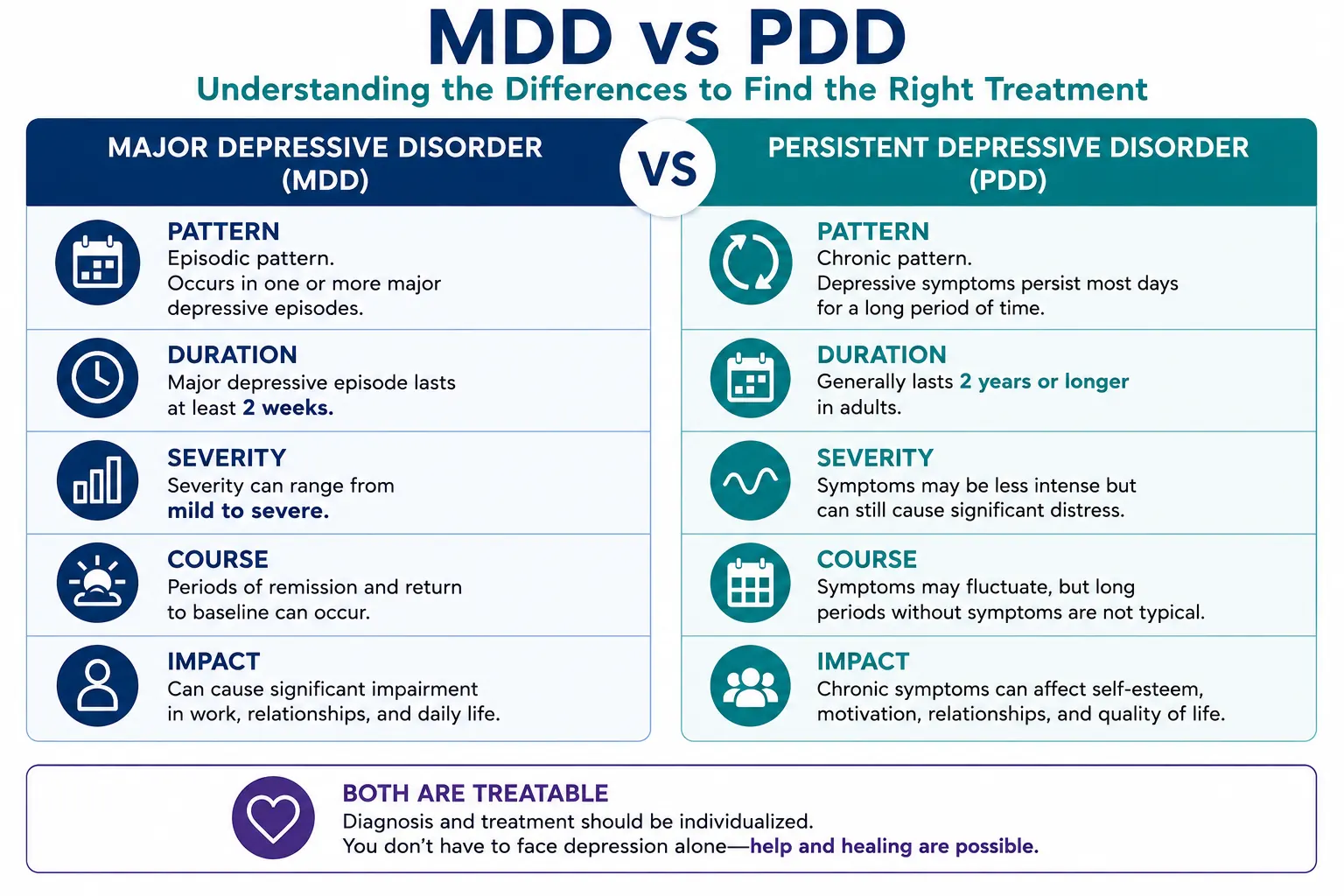
The table provides a useful overview, but diagnosis requires more than comparing symptoms with a checklist.
What Is Major Depressive Disorder?
Major Depressive Disorder is what many people mean when they use the terms major depression or clinical depression.
For an adult to meet diagnostic criteria for a major depressive episode, multiple symptoms must occur during the same period and represent a meaningful change in functioning.
At least one of the central symptoms involves either:
Depressed mood, or
Markedly diminished interest or pleasure in activities
Other symptoms may involve:
Significant changes in appetite or weight
Insomnia or excessive sleeping
Fatigue or loss of energy
Difficulty thinking or concentrating
Indecisiveness
Feelings of worthlessness
Excessive or inappropriate guilt
Observable agitation or slowing
Recurrent thoughts of death or suicide
The symptoms must also cause clinically significant distress or impairment and cannot simply be better explained by another condition, substance, medication, or medical problem.
A history of manic or hypomanic episodes is also clinically important because those symptoms may indicate a bipolar-spectrum condition rather than unipolar major depression.
In an MDD vs PDD comparison, this episodic pattern is an important feature of major depressive disorder.
How Long Does Major Depressive Disorder Last?
The two-week requirement is a minimum diagnostic duration for a major depressive episode—not an expectation that depression disappears after two weeks.
An episode may last weeks or considerably longer.
Some people experience one major depressive episode and recover. Others experience recurrent episodes separated by periods of improvement or remission.
Still others experience a more chronic course.
This variability is one reason diagnosis and treatment should consider the person’s entire history, rather than simply asking whether she currently feels depressed.
What Is Persistent Depressive Disorder?
Persistent Depressive Disorder, sometimes still referred to by its older name dysthymia, is characterized by a chronic pattern of depressive symptoms.
For adults, depressed mood is present for most of the day, for more days than not, over a period of at least two years, together with additional depressive symptoms.
These may include:
Low energy or fatigue
Low self-esteem
Difficulty concentrating or making decisions
Feelings of hopelessness
Changes in appetite
Insomnia or excessive sleeping
The defining feature is persistence.
Someone with PDD may struggle for so long that depression begins to feel like part of her personality rather than a mental health condition.
She may say:
“I’ve always been this way.”
“This is just who I am.”
“I’ve never really been happy.”
That history is clinically important.
Long-standing symptoms should not automatically be interpreted as personality traits or evidence that treatment cannot help.
With MDD vs PDD, the chronic duration of PDD is one of the clearest differences between the two conditions.
Is PDD Just Mild Depression?
No.
This is one of the most important misconceptions to correct when comparing MDD vs PDD.
Some descriptions refer to PDD as involving less severe symptoms than major depression. NIMH, for example, describes PDD as involving depression symptoms that may be less severe but last much longer.
But that does not mean the condition is clinically insignificant.
Severity is only one dimension of mental health.
Duration matters too.
Living with depressive symptoms for years can affect:
Relationships
Career development
Education
Physical health
Motivation
Self-esteem
Social connection
Decision-making
Daily routines
Overall quality of life
A woman who has remained employed, raised children, maintained relationships, or continued functioning while chronically depressed may still be experiencing significant psychological distress.
Outward functioning does not tell us the entire clinical story.
Can Major Depression Become Chronic?
Major depressive symptoms can follow different courses.
Some episodes resolve and never recur.
Some recur.
Others persist for extended periods.
Persistent Depressive Disorder also incorporates chronic depressive presentations that historically were classified differently.
That is one reason statements such as “MDD turns into PDD if it isn’t treated” are too simplistic.
Depressive disorders do not follow one predictable progression.
Duration, recurrence, symptom severity, previous treatment response, genetics, medical factors, psychosocial circumstances, co-occurring conditions, and many other factors may influence the course of depression.
Treatment is important, but we should not tell someone that she developed chronic depression simply because she failed to seek treatment soon enough.
Can MDD and PDD Symptoms Overlap?
Yes.
A person with a long-standing depressive pattern can also experience periods during which symptoms meet the full criteria for a major depressive episode.
Historically, the phrase “double depression” was sometimes used to describe major depressive episodes occurring in someone with dysthymia.
That term may still appear in older articles or informal discussions.
Current diagnostic frameworks describe chronic depressive presentations differently, and clinicians should evaluate the individual’s symptom history, duration, severity, and course rather than relying on the informal phrase “double depression.”
The important clinical point is that depression can change in intensity over time.
A woman who has experienced chronic low mood for years may go through periods when symptoms become substantially more severe.
How MDD and PDD Can Affect Daily Life
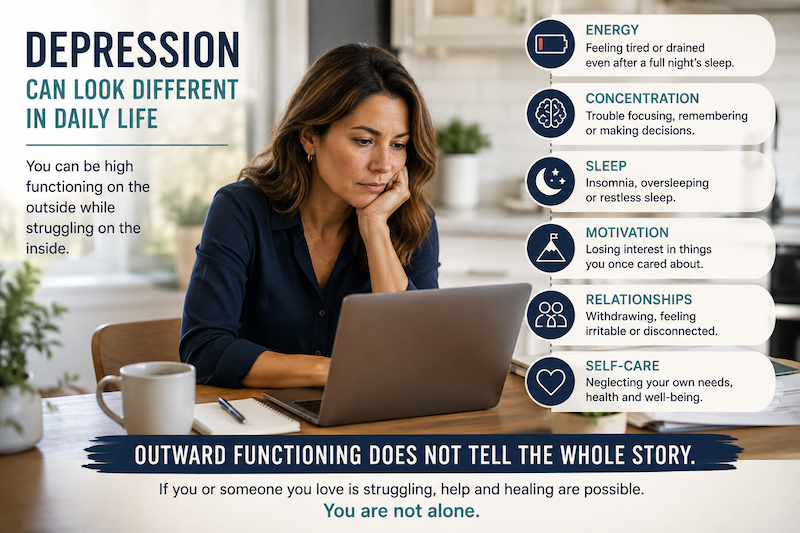
Both disorders can interfere with daily functioning, although the experience may look different.
The impact of MDD vs PDD may look different from woman to woman, and outward functioning does not always reflect the severity of depression.
Living Through a Major Depressive Episode
During a significant major depressive episode, ordinary tasks may become extraordinarily difficult.
Getting out of bed, showering, preparing food, concentrating at work, answering messages, making decisions, or participating in relationships can require enormous effort.
Some women withdraw almost completely.
Others continue functioning externally while experiencing severe symptoms privately.
The severity of the disorder cannot be determined simply by looking at how productive someone appears.
Living With Persistent Depression
PDD may have a different effect because of its duration.
When symptoms have existed for years, a woman may organize her life around them without realizing it.
She may:
Expect very little from herself or her future
Avoid opportunities because failure feels inevitable
Remain socially isolated
Accept chronic exhaustion as normal
Have difficulty identifying what feeling well would even look like
Believe low self-esteem is simply part of her personality
Treatment can involve not only reducing symptoms but helping the woman recognize how chronic depression has influenced the way she understands herself and her possibilities.
What Causes MDD and PDD?
There is no single cause of either disorder.
Depression is associated with a combination of genetic, biological, psychological, environmental, and social factors. NIMH similarly describes depression as involving genetic, biological, environmental, and psychological influences rather than a single cause.
Factors that may be relevant include:
Previous depressive episodes
Trauma and significant adverse experiences
Chronic stress
Medical conditions
Hormonal and reproductive changes
Certain medications
Substance use
Sleep disruption
Relationship difficulties
Major losses or life transitions
Co-occurring mental health conditions
Importantly, depression should not be explained simply as a “chemical imbalance.”
Neurotransmitter systems are involved in mood and behavior, and antidepressant medications affect these systems, but the biology of depression is considerably more complex than saying someone has too little of one brain chemical.
Understanding MDD vs PDD can help clarify the diagnosis, but treatment decisions should always be based on the individual’s complete clinical picture.
MDD vs PDD Treatment
There is no universal treatment formula based solely on whether someone has MDD or PDD.
Treatment planning should consider:
Symptom severity
Duration
Safety
Previous episodes
Previous treatment response
Current functioning
Medical history
Current medications
Co-occurring mental health conditions
Substance use
Trauma history
Pregnancy or postpartum status when relevant
Available support
Patient preferences
Common treatment approaches include psychotherapy, antidepressant medication, or a combination of interventions.
The American Psychological Association identifies several evidence-based psychotherapies for adult depression and also recommends second-generation antidepressants as treatment options. Treatment selection should involve the patient and clinician and reflect the individual clinical situation.
Psychotherapy
Evidence-based psychotherapy may include approaches such as:
Cognitive Behavioral Therapy (CBT)
Behavioral therapy
Cognitive therapy
Interpersonal Psychotherapy (IPT)
Mindfulness-Based Cognitive Therapy
Psychodynamic therapy
Supportive therapy
Different approaches address different aspects of depression.
The appropriate psychotherapy depends on the individual rather than the diagnosis alone.
Medication
Antidepressant medication may also be considered.
Medication selection depends on factors such as:
Symptoms
Previous response
Side effects
Medical conditions
Other medications
Pregnancy or breastfeeding considerations
Patient preference
Finding an effective medication may require adjustment over time.
Medication should be prescribed and monitored by an appropriately qualified healthcare professional.
When Is Residential Depression Treatment Appropriate?
Whether someone has MDD vs PDD is only one consideration when determining the appropriate level of depression treatment.
Many people with MDD or PDD can be successfully treated in outpatient settings.
A diagnosis of either condition does not automatically mean residential treatment is necessary.
Residential treatment may be considered when depression is substantially interfering with functioning and a less intensive level of care is not providing sufficient support.
Factors may include:
Significant impairment in everyday functioning
Insufficient progress with outpatient treatment
Multiple co-occurring mental health conditions
Difficulty consistently participating in outpatient care
Need for greater structure and therapeutic support
Environmental circumstances that interfere with treatment
Need for integrated psychiatric and psychotherapeutic care
Residential care should not substitute for acute inpatient hospitalization when someone requires emergency psychiatric stabilization or hospital-level medical care.
Depression Treatment at Kinder in the Keys
Kinder in the Keys provides residential mental health treatment for adult women in Key Largo, Florida.
Women receiving residential treatment at Kinder participate in:
Individual therapy once per week
Family therapy once per week when desired and clinically appropriate
Daily therapeutic groups
Psychiatric evaluation and medication management when appropriate
Access to clinicians outside scheduled individual sessions when clinically needed
Structured therapeutic programming
Wellness and experiential activities that complement clinical treatment
Treatment is individualized according to the woman’s diagnosis, symptoms, history, functioning, safety, co-occurring conditions, and treatment goals.
A woman with MDD does not automatically receive one treatment protocol while a woman with PDD receives another.
The clinical team evaluates the whole person.
When Should You Seek Professional Help?
Consider speaking with a qualified healthcare or mental health professional when depressive symptoms:
Persist
Interfere with work, school, relationships, or self-care
Cause significant distress
Recur repeatedly
Become increasingly difficult to manage
Are accompanied by significant anxiety or trauma-related symptoms
Do not improve with current treatment
A professional evaluation can also help determine whether symptoms may be related to another psychiatric condition, medication, substance use, or medical condition.
If someone is experiencing an immediate psychiatric emergency, cannot remain safe, or is at imminent risk of harming herself or someone else, emergency evaluation is appropriate.
Frequently Asked Questions About MDD vs PDD
What is the difference between MDD and PDD?
The primary difference involves the pattern and duration of depression.
Major Depressive Disorder involves major depressive episodes meeting established symptom criteria for at least two weeks.
Persistent Depressive Disorder involves a chronic depressive pattern lasting generally at least two years in adults.
Both conditions can significantly affect functioning and quality of life.
Is PDD less serious than MDD?
Not necessarily.
Symptoms associated with PDD may sometimes be less intense than those experienced during a severe major depressive episode, but PDD’s long duration can create substantial cumulative effects.
Clinical significance should be evaluated based on the entire picture—not the diagnostic label alone.
Can someone with PDD experience severe depression?
Yes.
Depressive symptoms can fluctuate in intensity, and someone with a chronic depressive course may experience periods of substantially greater symptom severity.
A clinician can evaluate the history and determine how the presentation should be diagnosed and treated.
Does untreated MDD turn into PDD?
Not as a simple rule.
Depression can become persistent or recurrent, but it is inaccurate to tell someone that untreated MDD inevitably “turns into” PDD.
The course of depression varies considerably among individuals.
How are MDD and PDD diagnosed?
Diagnosis involves a clinical assessment of symptoms, duration, severity, functional impairment, psychiatric and medical history, medications, substance use, and other relevant factors.
Medical evaluation may sometimes be appropriate to identify health conditions or medications that could contribute to depressive symptoms.
A screening questionnaire can provide useful information, but a screening score by itself does not establish a psychiatric diagnosis.
MDD vs PDD: Finding the Right Level of Care
Understanding major depressive disorder vs persistent depressive disorder can help explain why depression looks dramatically different from one person to another.
One woman may experience a severe depressive episode after previously functioning well.
Another may struggle with depressive symptoms for years and barely remember what life felt like before them.
Neither experience should be minimized.
And neither diagnosis tells us everything we need to know about the woman experiencing it.
The most appropriate treatment depends not simply on whether the diagnosis is MDD or PDD, but on severity, duration, safety, functioning, previous treatment, co-occurring conditions, medical needs, personal circumstances, and treatment goals.
Kinder in the Keys provides residential depression treatment for adult women whose symptoms require greater structure and support than traditional outpatient treatment can provide.
The goal is not to fit every woman into the same depression protocol.
The goal is to understand what she is experiencing and provide a level of care appropriate to her individual clinical needs.
Medically Reviewed By
Dr. Laura Tanzini, DrPH, LMFT
Doctor of Public Health | Specialty in Lifestyle Medicine
Licensed Marriage and Family Therapist (Florida & California)
Founder & CEO, Kinder in the Keys
Doctoral Research: Dr. Tanzini’s doctoral research at Loma Linda University examined childhood and adult traumatic events, cumulative trauma exposure, gender, forgiveness, life satisfaction, and long-term well-being.
This article has been clinically reviewed for accuracy and consistency with current behavioral-health and depression-treatment principles.
Medical Disclaimer: This article is provided for educational and informational purposes only and is not intended as medical advice, diagnosis, or treatment. Depression symptoms, diagnoses, treatment response, and appropriate levels of care vary by individual. A qualified healthcare professional can provide an individualized assessment and treatment recommendations.