
Watching someone you care about become severely overwhelmed or unable to function can be frightening, particularly when you are unsure what to do.
Knowing what to do when someone is having a mental breakdown begins with determining whether the person is experiencing severe emotional distress or an immediate psychiatric or medical emergency.
“Mental breakdown” is not a formal diagnosis. People commonly use the term to describe a period when psychological distress becomes difficult to manage and begins interfering substantially with normal functioning.
Your role is not to diagnose the person or solve the underlying problem. Your immediate priorities are to remain calm, assess safety, reduce unnecessary pressure, listen, and help the person access appropriate support.
This guide explains practical steps you can take, what to avoid, and when professional or emergency intervention may be necessary.
Recognizing When Someone Is Severely Overwhelmed
Someone experiencing severe psychological distress may behave very differently from usual.
Possible signs include:
Intense anxiety or panic symptoms
Crying or visible emotional distress
Irritability or agitation
Withdrawal or becoming unusually quiet
Difficulty concentrating or making simple decisions
Feeling unable to cope
Difficulty completing ordinary responsibilities
Significant sleep disruption
Neglecting basic self-care
Expressions of hopelessness
Our comprehensive guide to the signs of a nervous breakdown explains emotional, physical, cognitive, and behavioral changes that may occur during periods of severe distress.
If you are wondering how long severe distress may continue, our guide explaining how long mental breakdowns last discusses why there is no standard clinical timeline.
Severe Distress Is Not Always an Emergency
Someone can be extremely upset, anxious, overwhelmed, or unable to manage normal responsibilities without necessarily requiring emergency psychiatric care.
However, certain symptoms change the situation.
Immediate professional or emergency evaluation may be necessary when someone:
Cannot remain safe
Has suicidal thoughts with intent or a plan
Threatens serious harm to another person
Is experiencing hallucinations, severe paranoia, or significant loss of contact with reality
Is severely confused or disoriented
May have overdosed
May be experiencing dangerous intoxication or withdrawal
Is experiencing severe symptoms of mania that create immediate safety concerns
Has serious medical symptoms
Has access to a weapon during an acute safety crisis
When those circumstances are present, the goal is not simply to calm the person down. The priority is obtaining appropriate emergency evaluation while protecting your own safety and the safety of others.
What to Do When Someone Is Having a Mental Breakdown: Step by Step
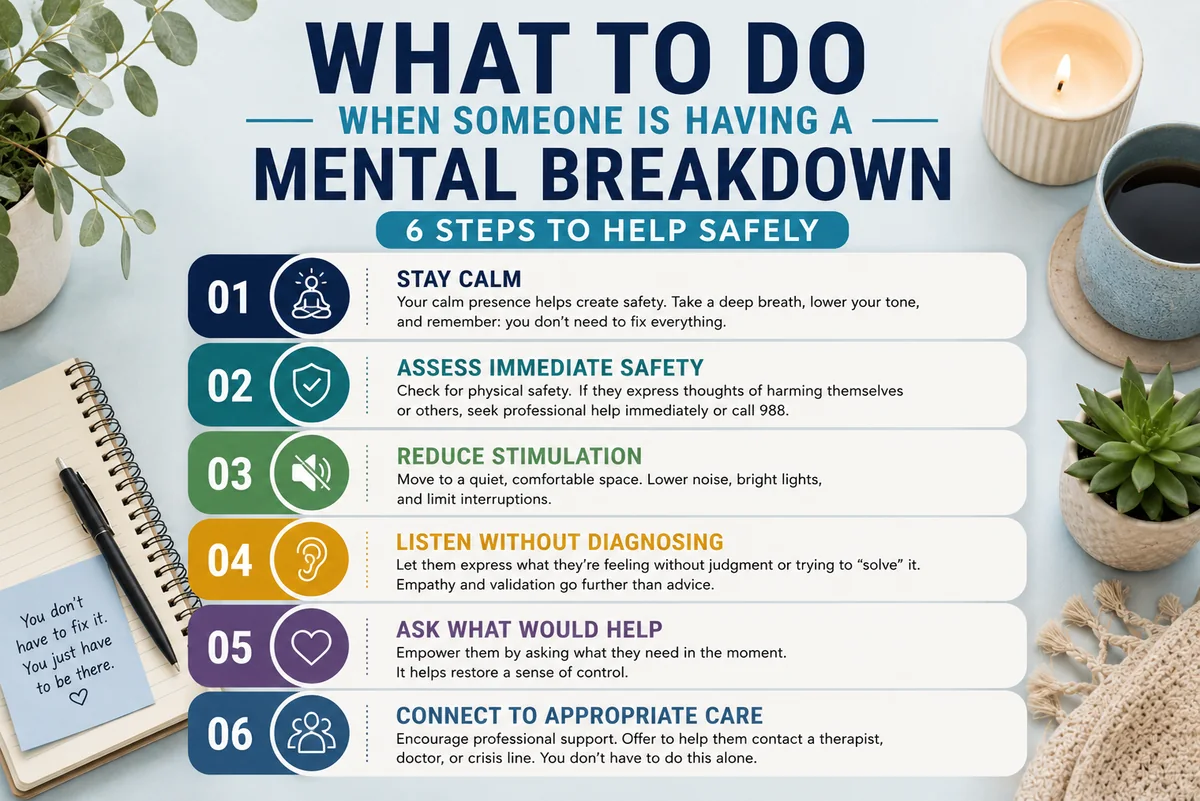
When you are unsure what to do when someone is having a mental breakdown, focus first on safety and then on helping the person feel less overwhelmed while you determine what level of support is needed.
Step 1: Stay Calm
Speak in a calm, steady voice and avoid reacting dramatically to the person’s distress.
You do not need to have the perfect words. Your goal is to communicate that you are present, listening, and willing to help.
Step 2: Assess Immediate Safety
Before doing anything else, determine whether there is an immediate risk of harm.
Ask directly about safety when appropriate. If you are concerned about suicide, it is appropriate to ask whether the person is thinking about killing herself or himself.
Also consider whether the person:
Has threatened another person
Has access to a weapon
May have overdosed
Is severely intoxicated
Is experiencing hallucinations or severe paranoia
Is extremely confused or disoriented
Is behaving in a way that creates immediate danger
If you believe you are personally unsafe, do not place yourself in danger in an attempt to manage the situation alone.
Step 3: Reduce Unnecessary Stimulation
If there is no immediate danger, a quieter environment may be more comfortable for someone who feels overwhelmed.
When practical:
Reduce unnecessary noise
Ask other people to give the person space
Avoid surrounding or crowding the person
Limit competing conversations
Move to a quieter location if the person is comfortable doing so
Do not physically force someone to move or restrain the person unless you are appropriately trained and authorized to intervene in an emergency.
Step 4: Listen Without Trying to Diagnose
Allow the person to describe what she or he is experiencing.
You might say:
“I’m here with you.”
“Tell me what would be most helpful right now.”
“We don’t have to solve everything at once.”
Avoid diagnosing the person or telling her or him what is “really” happening.
If the person expresses a belief that appears delusional or disconnected from reality, acknowledge the emotion without confirming the belief itself.
For example:
“That sounds frightening.”
is different from agreeing that the feared event is actually occurring.
Step 5: Ask What Would Help
When someone is overwhelmed, simple choices may be easier than broad questions.
You might ask:
“Would you like me to sit here with you?”
“Would you like some water?”
“Is there someone you want me to call?”
“Would you like help contacting your therapist or doctor?”
“Would it help if I handled one of these tasks for you?”
Whenever possible, support the person’s autonomy rather than taking control unnecessarily.
Step 6: Help Connect the Person With Appropriate Care
Once immediate safety has been addressed, consider what type of professional support may be needed.
Depending on the situation, that could include:
An existing therapist or psychiatrist
A primary-care provider
An outpatient mental health provider
A crisis service
A mobile crisis team where available
An urgent psychiatric evaluation
Emergency medical services when necessary
The appropriate response depends on the person’s symptoms and level of risk.
Your role is not to provide treatment yourself. It is to help the person reach the appropriate level of professional care when needed.
How to Respond in the Moment
When someone is experiencing severe psychological distress, how you communicate can matter as much as what you say.
Keep your communication simple and avoid overwhelming the person with questions, instructions, or attempts to solve multiple problems at once.
Helpful approaches may include:
Speak calmly and at a normal volume
Use short, clear sentences
Allow time for the person to respond
Listen without interrupting
Give the person reasonable physical space
Ask before touching or hugging
Offer simple choices rather than making demands
Help with one immediate need at a time
Remain present if it is safe and the person wants you there
Encourage professional support when appropriate
You do not need to persuade someone to feel differently in that moment.
Sometimes the most helpful response is simply:
“I can see that you’re overwhelmed. I’m here. Let’s figure out the next step together.”
What to Avoid
Even well-intended responses can increase distress.
Try to avoid:
Saying “calm down,” “snap out of it,” or “you’re overreacting”
Arguing about whether the person’s emotions are justified
Bombarding the person with questions
Demanding an immediate explanation
Crowding or cornering the person
Making sudden physical contact without permission
Threatening consequences in an attempt to gain compliance
Promising secrecy when there is a serious safety concern
Attempting to diagnose the person
Taking responsibility for providing treatment yourself
If someone appears to be experiencing hallucinations, paranoia, or another significant disturbance in reality testing, do not argue aggressively about what is real and do not reinforce the belief as true.
Instead, respond to the person’s emotional experience.
For example:
“I understand that this feels very real and frightening to you.”
Then focus on safety and obtaining appropriate professional evaluation.
Do Not Put Yourself in Danger
Supporting someone does not require placing yourself at risk.
If the person becomes violent, threatens serious harm, has access to a weapon, or behaves in a way that makes you fear for your safety, create distance and seek emergency assistance.
Do not attempt to physically restrain, disarm, or transport someone during a dangerous situation unless you are appropriately trained and authorized to do so.
Your safety matters too.
Helping Someone Having a Mental Breakdown Without Losing Yourself
Supporting someone experiencing severe psychological distress can be emotionally and practically demanding.
You can care about someone without becoming responsible for managing that person’s mental health.
Healthy support may include:
Listening without assuming responsibility for solving the problem
Helping with specific practical tasks when you are able
Maintaining reasonable personal boundaries
Continuing your own routines and responsibilities
Seeking support for yourself when needed
Recognizing when the situation requires professional help beyond what family or friends can provide
If you are repeatedly functioning as someone’s only source of crisis support, that may be a sign that additional professional resources are needed.
Our guide to family support and boundaries discusses how loved ones can remain supportive without assuming responsibility for another person’s treatment.
When to Get Professional Help
Knowing what to do when someone is having a mental breakdown also means recognizing when support from friends or family is no longer enough.
Professional evaluation may be appropriate when symptoms:
Persist or continue to worsen
Significantly interfere with work, school, relationships, or daily responsibilities
Prevent the person from maintaining basic self-care
Include recurrent panic attacks or severe anxiety
Include persistent depression or hopelessness
Involve increasing alcohol or substance use
Include substantial changes in sleep, behavior, thinking, or functioning
Continue despite attempts to reduce stress and obtain support
Because “mental breakdown” is not a clinical diagnosis, professional assessment can help determine whether the person is experiencing depression, an anxiety disorder, PTSD, bipolar disorder, substance-related symptoms, severe stress, a medical condition, medication effects, or another concern.
Treatment should address the condition actually present, rather than simply treating the informal label “mental breakdown.”
Our guide on how to support a depressed or anxious family member may also be useful when depression or anxiety is part of the clinical picture.
When Is a Mental Breakdown an Emergency?
Part of knowing what to do when someone is having a mental breakdown is recognizing when the situation has moved beyond supportive help and requires emergency evaluation.
Severe emotional distress does not automatically mean someone requires emergency hospitalization.
However, some situations require immediate professional or emergency evaluation.
Seek immediate emergency assistance when someone:
Cannot remain safe
Has suicidal thoughts with intent or a plan
Threatens serious harm to another person
Has access to a weapon during an acute safety crisis
Is experiencing hallucinations, severe paranoia, or significant loss of contact with reality
Is severely confused or disoriented
May have overdosed
May be experiencing dangerous intoxication or withdrawal
Has severe symptoms of mania creating immediate safety concerns
Has serious or potentially life-threatening medical symptoms
Do not attempt to manage a dangerous situation alone.
If you believe you are unsafe, create distance and seek emergency assistance rather than attempting to physically control the person.
What About Residential Mental Health Treatment?
Residential treatment and emergency psychiatric care serve different purposes.
Residential mental health treatment may be appropriate for someone who needs greater therapeutic structure and support but is medically and psychiatrically appropriate for a residential level of care.
It is not a substitute for an emergency department or acute inpatient psychiatric hospital when someone requires immediate stabilization, cannot remain safe, or needs hospital-level medical or psychiatric monitoring.
At Kinder in the Keys, we provide residential mental health treatment for adult women who are clinically and medically appropriate for residential care.
Someone experiencing an immediate psychiatric or medical emergency should receive the level of acute care appropriate to that emergency.
What to Do When Someone Is Having a Mental Breakdown: Frequently Asked Questions
What should you say to someone having a mental breakdown?
Keep your language simple, calm, and nonjudgmental.
You might say:
“I’m here with you.”
“You don’t have to figure everything out right now.”
“What would help you feel a little safer or less overwhelmed?”
“Would you like me to help you contact someone?”
Avoid promising that everything will be fine or telling the person how she or he should feel.
Should I ask someone directly if they are suicidal?
Yes. If you are concerned that someone may be thinking about suicide, asking directly about suicidal thoughts is appropriate.
Asking the question does not mean you are encouraging suicide.
If the person reports suicidal thoughts, determine whether there is immediate danger and help connect the person with appropriate professional or emergency support.
Should I take someone to the hospital during a mental breakdown?
Not every episode of severe psychological distress requires an emergency department.
Emergency evaluation may be necessary when someone cannot remain safe, has suicidal intent or a plan, threatens serious violence, is severely psychotic or confused, may have overdosed, is experiencing dangerous intoxication or withdrawal, or has another serious medical or psychiatric emergency.
If the situation is not an emergency, an outpatient mental health professional, existing treatment provider, primary-care clinician, crisis service, or another appropriate resource may be able to help determine the next step.
What if the person refuses help?
Adults generally retain the ability to make their own healthcare decisions unless circumstances meet applicable legal standards for emergency or involuntary intervention.
You can express concern, offer assistance, encourage professional care, and establish your own boundaries.
If the person’s behavior creates an immediate danger or you believe emergency intervention may be necessary, contact the appropriate emergency resources rather than trying to force the person into treatment yourself.
How can I help without making things worse?
Stay calm, listen without judgment, reduce unnecessary pressure, give the person reasonable physical space, and ask what would be helpful.
Avoid arguing, diagnosing, threatening, minimizing, or trying to solve everything at once.
When professional care is needed, helping the person connect with an appropriate provider may be one of the most useful things you can do.
The Most Important Thing Is the Next Safe Step
When someone you care about is overwhelmed, you may feel pressure to say exactly the right thing or somehow make the crisis disappear.
You do not have to do either.
Knowing what to do when someone is having a mental breakdown means focusing on the next appropriate step:
Is everyone safe?
What does this person need right now?
Does this situation require professional or emergency intervention?
Calm, respectful support can be valuable, but friends and family should not be expected to function as mental health professionals.
When symptoms are severe, persistent, worsening, or creating concerns about safety, helping the person reach appropriate professional care is often the most important thing you can do.
Medically Reviewed By
Dr. Laura Tanzini, DrPH, LMFT
Doctor of Public Health | Specialty in Lifestyle Medicine
Licensed Marriage and Family Therapist (Florida & California)
Founder & CEO, Kinder in the Keys
Doctoral Research: Dr. Tanzini’s doctoral research at Loma Linda University examined childhood and adult traumatic events, cumulative trauma exposure, gender, forgiveness, life satisfaction, and long-term well-being.
This article has been clinically reviewed for accuracy and consistency with current behavioral health principles. Content is intended to provide general educational information and should not replace individualized evaluation, diagnosis, or treatment by a qualified healthcare professional.
Medical Disclaimer: The information provided in this article is for educational and informational purposes only and is not intended as medical advice, diagnosis, or treatment. “Mental breakdown” is not a formal psychiatric diagnosis. Mental health and medical emergencies require appropriate professional evaluation. If there is an immediate danger or serious medical or psychiatric emergency, seek emergency assistance.