
Wondering whether you’re seeing signs you need trauma therapy can be confusing, especially when your experiences don’t fit the stereotypical image of trauma.
Many people associate trauma exclusively with catastrophic events such as military combat, serious accidents, natural disasters, or violent assaults. Those experiences can certainly be traumatic, but difficult experiences can affect mental health in many different ways.
You may be functioning at work, maintaining relationships, caring for other people, and handling daily responsibilities while privately struggling with anxiety, avoidance, sleep problems, emotional reactions, difficulty trusting, or a persistent sense that you are never completely safe.
You do not need to compare your experiences with someone else’s to determine whether you deserve support.
The more useful question is:
Are symptoms connected to what you have experienced interfering with the way you want to live now?
If they are, professional assessment may help determine what is happening and what type of treatment may be appropriate.
What Do We Mean by Trauma?
Trauma refers to psychological and emotional responses that can follow experiences that are overwhelming, frightening, threatening, or deeply distressing.
People respond to difficult experiences differently.
Two women can experience similar events and have very different psychological responses. One may develop significant trauma-related symptoms while another may experience temporary distress and recover without developing a mental health disorder.
It is also important to distinguish between traumatic experiences, adverse life experiences, chronic stress, trauma-related symptoms, and PTSD.
These terms are sometimes used interchangeably online, but they do not mean exactly the same thing clinically.
Experiences associated with trauma-related difficulties may include:
-
Physical or sexual violence
-
Childhood abuse or neglect
-
Intimate partner violence
-
Serious accidents
-
Military combat
-
Natural disasters
-
Medical emergencies or frightening medical experiences
-
Witnessing violence
-
Repeated interpersonal abuse
-
Other threatening or overwhelming experiences
Grief, chronic relationship difficulties, emotional neglect, workplace stress, discrimination, financial hardship, and other adverse experiences can also significantly affect mental health even when they do not meet diagnostic criteria for PTSD.
The important question is not simply:
“Was what happened to me bad enough?”
It is also:
“How is what happened affecting my life now?”
7 Signs You Need Trauma Therapy
There is no single symptom that automatically means someone needs trauma therapy.
However, persistent symptoms that interfere with relationships, sleep, work, emotional health, safety, or everyday functioning may indicate that professional evaluation would be helpful.
Here are seven signs you need trauma therapy or should consider talking with a qualified mental health professional.
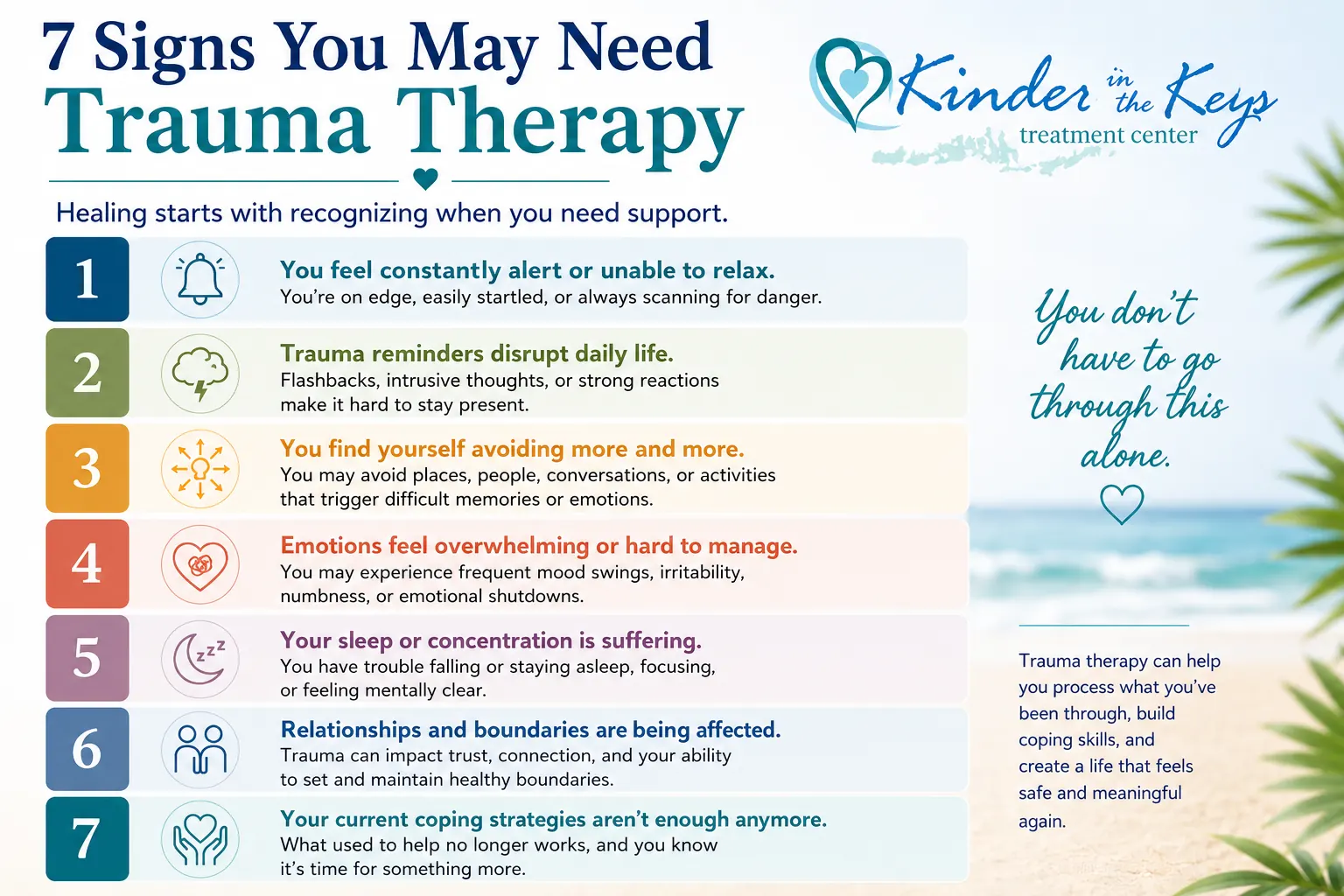
1. You Remain Constantly Alert or Unable to Feel Safe
Some women remain unusually alert even when immediate danger has passed.
This can look like:
-
Constantly scanning the environment
-
Being easily startled
-
Difficulty relaxing
-
Monitoring other people’s moods
-
Feeling uncomfortable when your back is toward a door
-
Preparing for something to go wrong
-
Difficulty sleeping because you cannot fully relax
-
Feeling uneasy in situations that appear objectively safe
This heightened state of alertness is often called hypervigilance.
Hypervigilance can occur in PTSD and other trauma-related presentations, but it can also occur with anxiety and other mental health conditions.
Experiencing it does not automatically establish a trauma diagnosis.
The important issue is whether persistent alertness is interfering with your ability to rest, concentrate, maintain relationships, or participate comfortably in everyday life.
2. Trauma Reminders Are Interfering With Daily Life
Reminders of difficult experiences are not always obvious.
A smell, tone of voice, facial expression, location, anniversary, interpersonal conflict, physical sensation, or feeling of powerlessness may trigger a strong emotional response.
Sometimes a woman immediately understands the connection.
Other times she may think:
“Why did I react so strongly to that?”
Some people use the informal term “emotional flashback” to describe suddenly experiencing intense fear, shame, helplessness, or another emotional state associated with previous experiences without having a visual flashback.
“Emotional flashback” is not itself a separate DSM-5-TR diagnostic symptom.
Strong emotional reactions can occur for many reasons, so recurring or disruptive experiences should be evaluated within the context of a woman’s complete symptoms and history.
3. You Are Avoiding More and More of Your Life
Avoidance is a common response to fear and distress.
A woman may avoid:
-
Particular people
-
Certain places
-
Conversations
-
Memories
-
Conflict
-
Intimacy
-
Medical care
-
Driving
-
Social situations
-
Activities associated with previous experiences
-
Thoughts or feelings that remind her of what happened
Avoidance can provide immediate relief.
The problem occurs when more and more of life becomes organized around preventing discomfort.
Your world may gradually become smaller.
You stop going places.
You avoid relationships.
You change routines.
You decline opportunities.
You remain constantly busy so you never have quiet time to think.
When avoiding distress also means avoiding meaningful parts of life, professional treatment may help.
4. Your Emotional Reactions Feel Difficult to Regulate
Trauma-related difficulties can sometimes affect emotional regulation.
A woman may experience intense anxiety, anger, sadness, fear, or shame that feels difficult to settle once activated.
Others respond in the opposite direction and become emotionally numb or disconnected.
You might notice that a relatively ordinary disagreement produces an unexpectedly strong reaction.
That does not necessarily mean the current event is unimportant, nor does it prove that the reaction was caused by trauma.
Instead, therapy can help explore why certain situations produce particular responses and whether previous experiences are influencing how present situations are interpreted.
Treatment can also help develop strategies for recognizing emotions, tolerating distress, communicating effectively, and responding rather than reacting automatically.
5. Sleep, Concentration, or Physical Stress Symptoms Are Affecting Daily Life
Psychological stress and trauma-related conditions can affect sleep, concentration, energy, muscle tension, appetite, and physiological arousal.
Some women notice that periods of emotional distress are accompanied by:
-
Difficulty falling or staying asleep
-
Nightmares
-
Fatigue
-
Muscle tension
-
Headaches
-
Gastrointestinal discomfort
-
Difficulty concentrating
-
Feeling physically restless or unable to relax
However, physical symptoms should not automatically be attributed to trauma.
These symptoms can have many possible medical and psychological causes.
New, persistent, severe, or worsening physical symptoms deserve appropriate medical evaluation.
Trauma therapy may be helpful when psychological symptoms are also present, but mental health treatment should complement—not replace—appropriate medical care.
6. Relationships and Boundaries Are Being Affected
Trauma, particularly interpersonal trauma, can affect the way some women experience relationships.
A woman may:
-
Have difficulty trusting
-
Fear abandonment
-
Avoid emotional closeness
-
Remain in unhealthy relationships
-
Have difficulty saying no
-
Feel responsible for other people’s emotions
-
Become highly sensitive to disagreement
-
Repeatedly seek reassurance
-
Isolate herself
-
Struggle to identify or maintain boundaries
Some people use terms such as fight, flight, freeze, or appease to describe different responses to perceived threat.
An appeasing response may involve agreeing to prevent conflict, apologizing automatically, prioritizing another person’s emotional state, or having difficulty expressing personal needs.
These behaviors do not automatically indicate trauma.
For some women with histories of interpersonal trauma, however, they may represent patterns that developed within relationships where disagreement, independence, or boundaries once felt unsafe.
Therapy can help determine whether those old patterns are still useful in present relationships.
7. Your Current Coping Strategies Are No Longer Enough
People develop many ways of managing emotional pain.
Some are healthy.
Others provide short-term relief while creating additional problems.
A woman might cope by:
-
Staying constantly busy
-
Avoiding relationships
-
Isolating herself
-
Overworking
-
Using alcohol or other substances
-
Spending excessive time online
-
Avoiding sleep
-
Using food or other behaviors to change emotional states
-
Controlling every possible detail of her environment
-
Refusing help because dependence feels unsafe
The question is not whether you cope.
Everyone does.
The question is whether your coping strategies are helping you build the life you want or merely helping you survive each day.
When your strategies stop working—or begin causing additional problems—it may be time for professional support.
Signs You Need Trauma Therapy Do Not Automatically Mean You Have PTSD
This distinction is important.
Recognizing signs you need trauma therapy does not mean you can diagnose yourself with PTSD.
PTSD is a specific mental health diagnosis with established criteria, including qualifying trauma exposure and a defined pattern of symptoms involving re-experiencing, avoidance, changes in mood or cognition, and heightened arousal or reactivity.
Symptoms must also persist for a specified period and cause clinically significant distress or impairment.
Women can experience meaningful trauma-related symptoms without meeting full diagnostic criteria for PTSD.
Symptoms associated with PTSD can also overlap with:
-
Anxiety disorders
-
Depression
-
Adjustment disorders
-
Sleep disorders
-
Grief
-
Other trauma- and stressor-related conditions
-
Medical conditions
-
Other mental health concerns
This is one reason professional assessment matters.
The goal is not simply to find a label.
The goal is to understand what is happening and determine what treatment may help.
What About Complex PTSD?
Complex post-traumatic stress disorder, or CPTSD, is recognized as a separate diagnosis in the World Health Organization’s ICD-11.
It includes the core features of PTSD along with persistent difficulties involving emotional regulation, negative self-concept, and relationships.
The DSM-5-TR, which is widely used in the United States, does not currently recognize CPTSD as a separate diagnosis.
Instead, the DSM includes a broader PTSD diagnosis that can encompass some symptoms associated with complex trauma.
Repeated or interpersonal trauma is often associated with CPTSD, but the diagnosis is based on an established symptom pattern—not simply on whether someone experienced trauma more than once.
Self-Care Can Help, But It Has Limits
Journaling, movement, mindfulness, supportive relationships, adequate sleep, recreation, and other wellness practices can support emotional health.
These practices can be genuinely helpful, but they have limits.
Self-care is not a replacement for treatment when symptoms are severe, persistent, or significantly interfering with daily functioning.
Professional support may be particularly important when:
-
Symptoms continue despite attempts to manage them independently
-
Avoidance is progressively restricting your life
-
Relationships are repeatedly being affected
-
Sleep is significantly impaired
-
You regularly feel emotionally overwhelmed or disconnected
-
You rely increasingly on alcohol or substances to cope
-
Work, school, parenting, or self-care is deteriorating
-
You are experiencing persistent intrusive memories or nightmares
-
You have thoughts of harming yourself or feel unable to remain safe
Seeking treatment does not mean self-care failed.
It means the problem may require a different level or type of support.
Why the Right Type of Trauma Therapy Matters
Psychotherapy is not one single treatment.
Different therapeutic approaches are designed for different conditions, symptoms, and treatment goals.
For women who meet criteria for PTSD, several trauma-focused psychotherapies have strong research support.
These include:
-
Prolonged Exposure (PE)
-
Eye Movement Desensitization and Reprocessing (EMDR)
These treatments approach trauma differently, but each has evidence supporting its use for PTSD.
Effective trauma treatment can involve thoughts, emotions, behaviors, avoidance patterns, memories, relationships, and physiological responses.
It is therefore inaccurate to suggest that traditional psychotherapy only addresses the “logical brain” or that trauma must be treated exclusively through a body-based approach.
The appropriate therapy depends on the woman’s symptoms, diagnosis, history, preferences, safety, previous treatment, and clinical needs.
What About EMDR?
Eye Movement Desensitization and Reprocessing, or EMDR, is an evidence-based psychotherapy for PTSD.
EMDR involves processing traumatic memories while engaging in bilateral stimulation according to a structured treatment protocol.
It can be helpful for some women with PTSD or clinically appropriate trauma-related symptoms.
It is not automatically appropriate for every woman who has experienced trauma.
At Kinder in the Keys, EMDR is provided when clinically indicated as part of an individualized treatment plan.
What About CBT and DBT?
Cognitive behavioral approaches can help women identify and modify patterns of thinking and behavior contributing to emotional distress.
For PTSD specifically, Cognitive Processing Therapy is one trauma-focused cognitive treatment with strong evidence.
Dialectical behavior therapy, or DBT, focuses on skills involving:
-
Emotional regulation
-
Distress tolerance
-
Mindfulness
-
Interpersonal effectiveness
DBT may be useful when those skills are clinically relevant, although it should not be presented as interchangeable with trauma-focused PTSD treatments.
Different therapies serve different purposes.
Good treatment planning identifies what a particular woman needs rather than giving everyone the same intervention.
What Happens When You Start Trauma Therapy?
Starting trauma therapy does not necessarily mean walking into the first appointment and immediately describing every painful experience in detail.
Initial treatment typically involves assessment.
A clinician may explore:
-
Current symptoms
-
Trauma history
-
Mental health history
-
Physical health
-
Sleep
-
Relationships
-
Safety
-
Substance use
-
Current coping strategies
-
Previous treatment
-
Goals for therapy
Treatment planning can then be based on what the clinician and patient identify together.
Trauma therapy can sometimes involve temporary discomfort when difficult memories, thoughts, or emotions are addressed.
Treatment response and duration vary considerably among individuals.
Progress should be evaluated collaboratively with the treating clinician rather than measured against someone else’s recovery timeline.
When Outpatient Trauma Therapy May Be Enough
Many women with trauma-related symptoms can receive effective treatment through outpatient therapy.
Outpatient care may be appropriate when a woman is able to maintain basic daily functioning and safety while attending regular treatment sessions.
Depending on clinical needs, outpatient treatment may include psychotherapy, psychiatric care, medication management, group treatment, or other services.
Needing trauma therapy does not automatically mean someone needs residential treatment.
The level of care should match the severity of symptoms and the amount of support necessary for safe and effective treatment.
When Residential Trauma Treatment May Be Appropriate
Residential mental health treatment may be considered when trauma-related symptoms significantly interfere with:
-
Daily functioning
-
Relationships
-
Sleep
-
Work or school
-
Self-care
-
Emotional regulation
-
Safety
-
The ability to participate consistently in outpatient treatment
Residential care may also be appropriate when previous outpatient treatment has not provided sufficient improvement or when a more structured and immersive treatment environment is clinically indicated.
At Kinder in the Keys, residential treatment allows multiple areas affecting recovery to be addressed within an individualized treatment plan.
Treatment may include evidence-based psychotherapy and supportive interventions based on each woman’s clinical needs.
These may include:
-
Trauma-focused psychotherapy when clinically appropriate
-
EMDR when indicated
-
Cognitive behavioral approaches
-
DBT skills
-
Individual therapy
-
Group therapy
-
Family therapy when desired and clinically appropriate
-
Psychiatric support
-
Mindfulness and wellness activities
-
Support for sleep, nutrition, movement, and overall health
The purpose of residential treatment is not to remove every possible trigger from a woman’s life.
Ultimately, recovery involves developing enough emotional regulation, coping ability, awareness, and confidence that reminders of the past no longer control how she lives in the present.
How Kinder in the Keys Approaches Trauma Treatment for Women
At Kinder in the Keys, our women-only residential mental health program treats the woman—not simply a diagnosis or a traumatic event.
Two women can experience similar events and need very different treatment.
Our clinicians therefore consider the woman’s symptoms, functioning, history, relationships, goals, strengths, previous treatment, and current needs when developing an individualized treatment plan.
Treatment may address:
-
Trauma-related symptoms
-
PTSD
-
Anxiety
-
Depression
-
Emotional regulation
-
Relationship patterns
-
Boundaries
-
Self-esteem
-
Sleep
-
Avoidance
-
Rebuilding self-trust
Our small residential environment also allows clinicians to know the women they treat as individuals.
The objective is not simply to help a woman understand what happened.
It is to help her understand how those experiences are affecting her now and develop the skills, insight, and treatment necessary to move forward.
You Do Not Need a Dramatic Story to Ask for Help
One reason women delay trauma treatment is the belief that someone else had it worse.
Maybe there was no war.
No catastrophic accident.
No dramatic event that would make everyone immediately understand why you’re struggling.
Mental health treatment is not awarded according to who suffered most.
At the same time, we do not need to label every painful experience as trauma to take emotional distress seriously.
You can seek professional support because:
You are anxious.
You cannot sleep.
Your relationships keep being affected.
You are avoiding parts of your life.
You do not feel like yourself.
Your current coping strategies are no longer enough.
Those concerns deserve attention regardless of which diagnosis ultimately applies.
Moving Forward
Recognizing the signs you need trauma therapy does not mean something is fundamentally wrong with you.
It means symptoms or patterns may be interfering with your ability to live the way you want to live.
Treatment can help determine why those patterns developed, which ones are still serving you, and which ones are now getting in your way.
Recovery does not require forgetting what happened.
It does not require pretending difficult experiences were acceptable.
And it does not require building a life around avoiding every reminder of the past.
The goal is greater freedom.
Freedom to sleep.
Freedom to have relationships.
Freedom to establish boundaries.
Freedom to experience emotions without being controlled by them.
Freedom to make decisions based on the present rather than continually responding to the past.
Frequently Asked Questions
What are signs you need trauma therapy?
Possible signs include persistent hypervigilance, avoidance, intrusive memories, nightmares, emotional dysregulation, sleep disturbance, difficulty trusting, relationship problems, or coping strategies that are no longer working. These symptoms can have multiple causes, so professional assessment is important.
Do I need PTSD to benefit from trauma therapy?
No. A woman may experience clinically meaningful trauma-related symptoms without meeting full diagnostic criteria for PTSD. Treatment should be based on her actual symptoms and needs.
Does trauma cause unexplained physical symptoms?
Psychological stress and trauma-related conditions can affect physical functioning, but symptoms such as pain, fatigue, headaches, digestive problems, and sleep disturbances can have many causes. Physical symptoms should receive appropriate medical evaluation rather than automatically being attributed to trauma.
Is EMDR the best treatment for trauma?
EMDR is an evidence-based treatment for PTSD, but there is no single therapy that is best for every individual. Cognitive Processing Therapy and Prolonged Exposure also have strong evidence for PTSD. Treatment should be individualized.
Can I treat trauma through self-care?
Self-care can support mental health but may not be sufficient for persistent or significantly impairing trauma-related symptoms. Professional therapy may be appropriate when symptoms interfere with daily functioning or continue despite attempts to manage them independently.
Do I need residential treatment for trauma?
Not necessarily. Many women with trauma-related symptoms can be treated effectively in outpatient settings.
Residential treatment may be considered when symptoms significantly interfere with daily functioning, relationships, sleep, work, self-care, emotional regulation, or safety; when outpatient treatment has not provided sufficient improvement; or when a more structured and immersive level of care is clinically appropriate.
The appropriate level of care should be determined through individualized clinical assessment.
How do I know whether my symptoms are actually related to trauma?
It is not always possible to determine that on your own. Anxiety, depression, sleep problems, difficulty concentrating, emotional reactivity, avoidance, physical symptoms, and relationship difficulties can have many possible causes.
A qualified mental health professional can evaluate your symptoms, history, functioning, medical considerations, and previous experiences to help determine what may be contributing to your current difficulties.
What happens during a trauma assessment?
A trauma assessment typically considers more than the traumatic event itself.
A clinician may ask about current symptoms, previous traumatic or stressful experiences, mental health history, sleep, relationships, physical health, substance use, safety, daily functioning, previous treatment, coping strategies, and treatment goals.
The purpose is not simply to determine whether you have PTSD. It is to understand the complete clinical picture and identify the treatment and level of care most appropriate for you.
Medically Reviewed By
Dr. Laura Tanzini, DrPH, LMFT
Doctor of Public Health | Specialty in Lifestyle Medicine
Licensed Marriage and Family Therapist (Florida & California)
Founder & CEO, Kinder in the Keys
Doctoral Research: Dr. Tanzini’s doctoral research at Loma Linda University examined childhood and adult traumatic events, cumulative trauma exposure, gender, forgiveness, life satisfaction, and long-term well-being.
This article has been clinically reviewed for accuracy and consistency with current behavioral health, trauma-informed care, PTSD treatment, and women’s mental health principles. Content is intended to provide general educational information and should not replace individualized evaluation, diagnosis, or treatment by a qualified healthcare professional.
Medical Disclaimer
The information provided in this article is for educational and informational purposes only and is not intended as medical advice, diagnosis, or treatment.
Trauma-related symptoms can overlap with other mental health and medical conditions. If you are experiencing persistent or worsening symptoms, consult an appropriately qualified healthcare professional for individualized assessment and treatment.
If you are experiencing a mental health emergency, are in immediate danger, or are having thoughts of harming yourself or someone else, seek immediate emergency assistance.