
CBT for trauma can help women understand how traumatic experiences continue to influence thoughts, emotions, behaviors, relationships, and reactions long after the original experience has ended.
Trauma can change the way a woman interprets herself and the world around her. She may begin to believe that she is unsafe even when danger has passed, blame herself for something that was not her responsibility, avoid people or situations associated with what happened, or struggle to trust herself and others.
Cognitive behavioral therapy (CBT) is one approach that can help identify these patterns and develop healthier ways of thinking and responding.
However, CBT for trauma is not one single standardized treatment, and it is not appropriate to assume that every woman who has experienced trauma needs the same therapeutic approach. Effective trauma treatment begins with understanding the individual woman, what she experienced, how it affects her today, and whether she has developed PTSD or another trauma-related mental health concern.
At Kinder in the Keys, our women’s trauma treatment center provides individualized residential care for adult women whose trauma-related symptoms require more support and structure than traditional outpatient treatment can provide.
What Is CBT for Trauma?
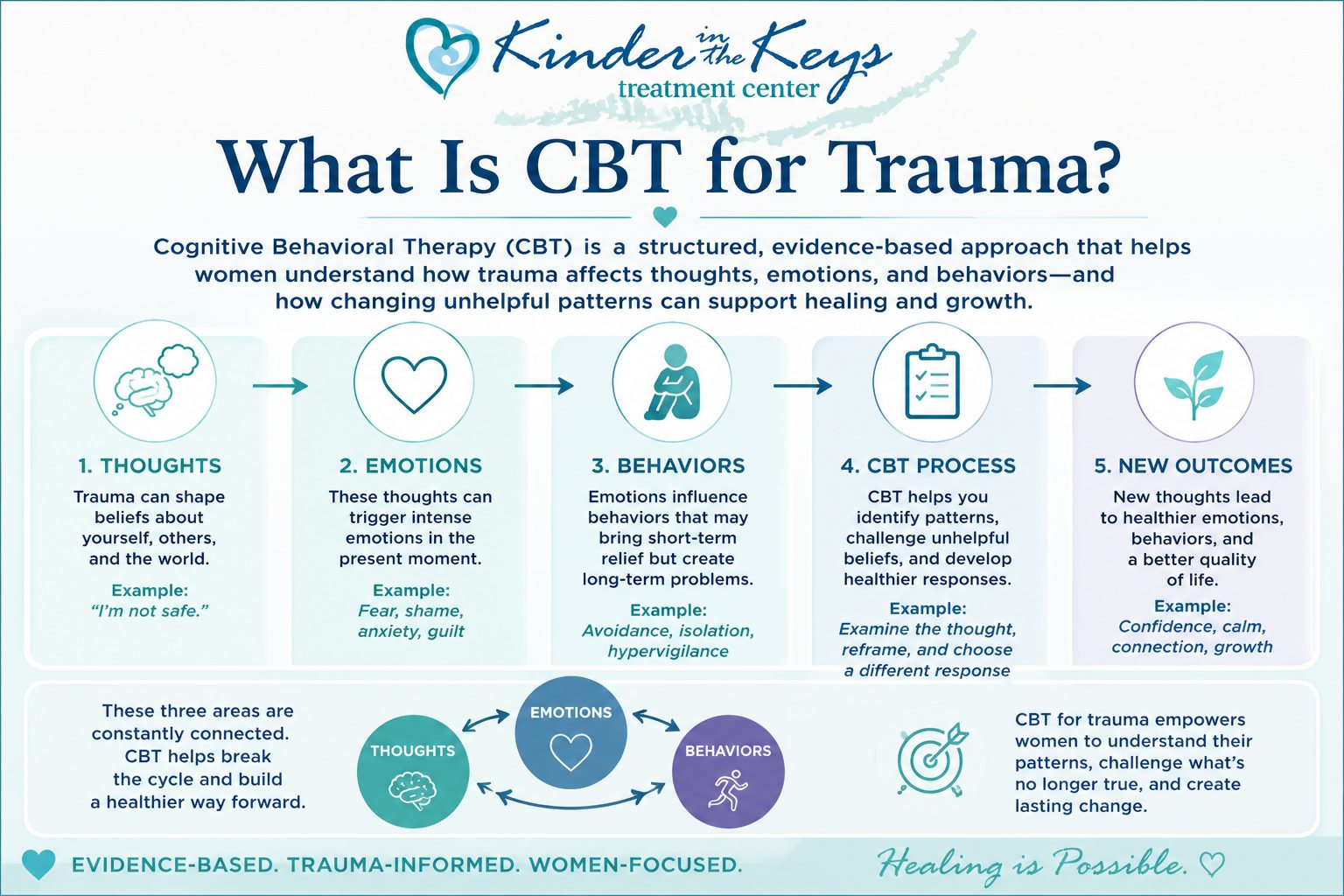
Cognitive behavioral therapy is a form of psychotherapy based on the relationship among thoughts, emotions, and behaviors.
The basic principle is straightforward: how we interpret an experience can influence how we feel and how we respond.
After trauma, some thoughts and behaviors that initially developed as ways to survive or protect oneself may continue even when the original danger is no longer present.
A woman who was repeatedly hurt by someone she trusted, for example, may begin to believe:
I cannot trust anyone.
I should have known what was going to happen.
What happened was my fault.
I am permanently damaged.
The world is never safe.
If I let my guard down, something bad will happen.
I cannot handle reminders of what happened.
These beliefs can feel completely true because they developed in response to real and painful experiences.
CBT does not simply tell a woman that her thoughts are wrong or ask her to “think positively.” Instead, therapy can help her examine whether beliefs developed during or after trauma continue to accurately reflect her present circumstances.
How Trauma Can Affect Thoughts, Emotions, and Behaviors
Trauma can affect much more than memories.
A traumatic experience can influence how a woman thinks about safety, trust, control, responsibility, relationships, and herself.
These changes can affect emotions and behavior.
For example, believing “I am never safe” may contribute to persistent anxiety or hypervigilance.
Believing “It was my fault” may contribute to shame, guilt, depression, or self-punishing behavior.
Believing “I can’t trust anyone” may lead to emotional withdrawal or difficulty developing healthy relationships.
Avoiding reminders of trauma may reduce distress temporarily while also making it harder to learn that certain places, situations, relationships, or emotions can now be experienced safely.
This interaction among thoughts, feelings, physical reactions, and behavior is one reason cognitive behavioral approaches can be useful in trauma treatment.
How CBT for Trauma Works
CBT for trauma is not simply talking repeatedly about what happened.
Treatment depends on the woman’s symptoms, diagnosis, history, current circumstances, and the particular CBT-based approach being used.
Several common elements may be involved.
Identifying Trauma-Related Beliefs
Therapy can help identify beliefs that developed during or after traumatic experiences.
Some may involve self-blame.
Others may involve safety, control, trust, intimacy, worth, or expectations about other people.
The goal is not to invalidate the woman’s experience. It is to determine whether conclusions formed in the context of trauma continue to help her or are now contributing to distress.
Examining Thoughts More Carefully
CBT encourages women to examine the evidence supporting a thought rather than automatically accepting it as fact.
A woman who believes, “I should have prevented what happened,” may explore what she actually knew at the time, how much control she truly had, and whether she is assigning herself responsibility that belongs to the person who harmed her.
Over time, rigid trauma-related beliefs can sometimes become more balanced and accurate.
Recognizing Behavioral Patterns
Trauma can also change behavior.
Avoidance is particularly common. A woman may avoid people, relationships, locations, conversations, emotions, memories, or activities associated with what happened.
Some avoidance can be necessary when a situation remains genuinely unsafe.
But when avoidance continues after danger has passed, it can restrict daily life and reinforce the belief that reminders of the trauma cannot be tolerated.
Treatment can help distinguish actual present-day danger from reminders that feel dangerous because of past experiences.
Developing Healthier Coping Skills
CBT may also help women develop practical skills for responding to distress.
Depending on individual needs, this can involve emotional awareness, problem solving, grounding strategies, behavioral changes, communication skills, and healthier ways of responding to difficult thoughts or emotions.
The objective is not to eliminate every uncomfortable feeling.
It is to help the woman respond to those feelings without automatically returning to patterns that keep her stuck.
CBT for Trauma Is Not the Same as Trauma-Focused CBT for Children
This distinction is important.
CBT for trauma is a broad phrase describing the use of cognitive and behavioral approaches to address trauma-related difficulties.
Trauma-Focused Cognitive Behavioral Therapy (TF-CBT) is the name of a specific structured treatment model developed primarily for children and adolescents who have experienced trauma. TF-CBT also typically involves a parent or caregiver.
These terms should not be used interchangeably.
Kinder in the Keys is a residential mental health treatment center for adult women. We are not a pediatric treatment program, and this article is discussing cognitive behavioral approaches used with adults rather than claiming that Kinder provides pediatric TF-CBT.
CBT for Trauma vs. CBT for PTSD
Trauma and PTSD are also not interchangeable.
A woman can experience significant trauma and emotional distress without meeting diagnostic criteria for post-traumatic stress disorder.
PTSD requires exposure to qualifying traumatic circumstances followed by a particular pattern of symptoms involving areas such as intrusive experiences, avoidance, changes in thoughts or mood, and changes in arousal or reactivity.
For women who have developed PTSD, specific trauma-focused psychotherapies have substantial research support.
CBT for PTSD therefore addresses a more specific clinical question than CBT for trauma generally.
This distinction matters because treatment should be based on what a woman is actually experiencing rather than assuming that every trauma response is PTSD.
What Trauma-Related Problems Can CBT Address?
CBT-based approaches may help address a variety of difficulties associated with traumatic experiences.
These can include:
Persistent self-blame or guilt
Shame
Avoidance
Fear and anxiety
Difficulty trusting other people
Negative beliefs about oneself
Beliefs that the world is universally unsafe
Difficulty establishing healthy boundaries
Behavioral patterns developed in response to trauma
Relationship difficulties
Emotional reactions to trauma reminders
Co-occurring depression or anxiety
The presence of one or more of these concerns does not automatically mean that CBT is the only or best treatment.
A clinical assessment helps determine what is contributing to the symptoms and which therapeutic approaches are most appropriate.
Does CBT Require Reliving the Trauma?
Not necessarily.
“CBT” includes a broad family of therapeutic approaches.
Some trauma-focused cognitive behavioral treatments involve directly processing traumatic memories or gradually approaching safe situations that have been avoided.
Others focus more heavily on beliefs, interpretations, coping strategies, and present-day behavior.
The appropriate approach depends partly on the condition being treated and the particular evidence-based therapy being used.
Trauma treatment should occur within a therapeutic relationship in which the woman understands the purpose of the intervention and participates in decisions about her care.
Is CBT Enough for Every Woman Who Has Experienced Trauma?
No.
There is no single therapy that is appropriate for every woman or every traumatic experience.
Two women can experience similar events and develop very different symptoms afterward.
One may primarily struggle with anxiety and avoidance. Another may experience depression, relationship difficulties, shame, or emotional numbness. Another may meet criteria for PTSD. Some women have experienced repeated or prolonged trauma over many years and present with multiple overlapping concerns.
Treatment therefore needs to consider:
The nature and history of the traumatic experiences
Current symptoms
Whether PTSD or another condition is present
Current physical and emotional safety
Previous treatment experiences
Co-occurring depression, anxiety, or other mental health concerns
Relationships and support systems
Physical health
Coping patterns
The woman’s goals and preferences
The appropriate level of care
CBT can be an important part of trauma treatment without being the entire treatment plan.
Other Evidence-Based Approaches Used in Trauma Treatment
Several evidence-based psychotherapies are used to treat trauma-related conditions, particularly PTSD.
Cognitive Processing Therapy
Cognitive Processing Therapy (CPT) is a specific type of cognitive behavioral therapy developed for PTSD.
CPT focuses heavily on trauma-related beliefs and what are sometimes described as “stuck points” involving areas such as safety, trust, control, self-esteem, and intimacy.
The American Psychological Association describes CPT as a specific cognitive behavioral therapy that helps patients identify and challenge trauma-related beliefs and develop more balanced beliefs about themselves, others, and the world.
The goal is to help individuals examine and modify beliefs that developed as a result of trauma and continue to contribute to distress.
Prolonged Exposure
Prolonged Exposure (PE) is another evidence-based treatment for PTSD.
PE helps individuals gradually approach trauma-related memories, feelings, and objectively safe situations they have been avoiding.
This process is structured and conducted with a trained clinician rather than simply asking someone to confront traumatic memories without preparation or support.
EMDR
Eye Movement Desensitization and Reprocessing (EMDR) is another trauma-focused psychotherapy used in the treatment of PTSD.
The National Center for PTSD identifies EMDR as an evidence-based trauma-focused psychotherapy with strong research support for PTSD.
At Kinder in the Keys, EMDR may be incorporated when clinically indicated. It is not automatically used simply because a woman has experienced trauma.
Treatment decisions depend on the woman’s symptoms, history, clinical needs, readiness, and overall treatment plan.
The National Center for PTSD identifies Cognitive Processing Therapy, Prolonged Exposure, and EMDR among the trauma-focused psychotherapies with the strongest evidence for treating PTSD.
CBT and the Difference Between Coping and Healing
Learning coping skills can be valuable, but trauma treatment should not necessarily stop at helping a woman tolerate symptoms.
A woman can become extremely skilled at functioning while still organizing much of her life around trauma.
She may work, maintain relationships, care for others, and appear successful while remaining hypervigilant, avoiding vulnerability, blaming herself, or repeatedly entering relationships shaped by unresolved patterns.
Effective treatment looks beyond whether a woman can simply “get through the day.”
It asks what continues to drive the distress and what needs to change for healthier functioning to become sustainable.
For some women, CBT helps reveal the beliefs and behavioral patterns that have kept past experiences active in present-day life.
When Residential Trauma Treatment May Be Appropriate
Many women who have experienced trauma can receive appropriate care through outpatient therapy. Recognizing the signs you may need trauma therapy can help you determine when symptoms have moved beyond something you can manage effectively on your own.
Residential treatment is not necessary simply because someone has a trauma history.
A higher level of care may become appropriate when trauma-related symptoms are persistent, significantly interfere with everyday functioning, occur alongside other mental health concerns, or have not improved sufficiently with outpatient treatment.
Residential care may also help when a woman needs greater therapeutic structure or temporary distance from an environment in which established patterns are difficult to change.
In a residential setting, treatment can occur within the context of consistent routines, frequent therapeutic contact, group work, individual therapy, and attention to the broader factors affecting emotional and physical well-being.
CBT and Trauma Treatment at Kinder in the Keys
Kinder in the Keys provides residential trauma treatment for adult women in Key Largo, Florida.
Our approach does not assume that every woman with a trauma history needs the same therapy.
Treatment begins with understanding the individual woman: what she experienced, how those experiences continue to affect her, what symptoms are present, how she has learned to cope, what has or has not helped previously, and what she needs in order to function differently moving forward.
Women in residential treatment participate in individual therapy and daily group programming. Clinicians are also available outside scheduled sessions because of the small size of the program.
Family therapy may be incorporated when desired and clinically appropriate.
CBT-based strategies can be included as part of treatment when they fit the woman’s clinical needs. Other approaches may also be incorporated depending on the individual treatment plan.
The goal is not to force a woman into one therapeutic model.
It is to understand the full pattern of what is keeping her stuck and develop an individualized approach to helping her move forward.
Frequently Asked Questions About CBT for Trauma
What is CBT for trauma?
CBT for trauma refers broadly to cognitive behavioral approaches used to address thoughts, emotions, and behaviors affected by traumatic experiences. CBT can help identify trauma-related beliefs and behavioral patterns and develop healthier ways of responding.
Is CBT for trauma the same as TF-CBT?
No. Trauma-Focused Cognitive Behavioral Therapy (TF-CBT) is a specific structured treatment developed primarily for children and adolescents and typically includes caregiver involvement. CBT for trauma is a broader phrase that can refer to cognitive behavioral approaches used with adults.
Is CBT for trauma the same as CBT for PTSD?
Not necessarily. Trauma exposure does not automatically result in PTSD. CBT-based treatment can address trauma-related difficulties, while PTSD may be treated using specific evidence-based trauma-focused therapies such as Cognitive Processing Therapy or Prolonged Exposure.
Does CBT make you talk about the trauma?
That depends on the specific treatment approach. Some trauma-focused cognitive behavioral therapies involve processing traumatic memories or gradually approaching avoided reminders. Other CBT interventions may focus more heavily on current beliefs, behaviors, and coping patterns.
Can CBT help with self-blame after trauma?
Yes. Examining trauma-related beliefs is an important component of several cognitive approaches. Therapy can help a woman evaluate whether she is assigning herself responsibility for events that were outside her control or were caused by another person’s actions.
Is CBT the best treatment for trauma?
There is no single treatment that is best for every woman who has experienced trauma. Appropriate treatment depends on symptoms, diagnosis, trauma history, safety, co-occurring concerns, previous treatment, preferences, and level-of-care needs.
Can CBT be used with EMDR?
Different therapeutic approaches may sometimes be incorporated within an individualized treatment plan. At Kinder in the Keys, EMDR is used only when clinically indicated. Treatment decisions are based on the woman’s needs rather than automatically combining modalities.
Getting Help After Trauma
Trauma can continue shaping a woman’s life long after the original experience has ended, sometimes in ways she does not immediately recognize.
Treatment can help identify the connection between past experiences and present-day thoughts, emotions, relationships, behaviors, and coping patterns.
If trauma-related difficulties are significantly interfering with your ability to function or outpatient treatment has not provided enough support, a higher level of care may be worth considering.
Kinder in the Keys provides residential trauma treatment for adult women in Key Largo, Florida. Our admissions team can help you understand the program and determine whether residential treatment may be appropriate for your needs.
Medically Reviewed By
Dr. Laura Tanzini, DrPH, LMFT
Doctor of Public Health | Specialty in Lifestyle Medicine
Licensed Marriage and Family Therapist (Florida & California)
Founder & CEO, Kinder in the Keys
This article has been clinically reviewed for accuracy and consistency with current evidence-based behavioral health and trauma-informed treatment principles. It is intended to provide educational information about cognitive behavioral approaches to trauma treatment and does not replace individualized assessment, diagnosis, or treatment by a qualified healthcare or mental health professional.
Medical Disclaimer
This article is for educational and informational purposes only and is not intended to diagnose, treat, cure, or prevent any mental health condition. If trauma-related symptoms are affecting your emotional health, relationships, safety, or ability to function, consider seeking evaluation from a qualified healthcare or mental health professional.