
When someone becomes overwhelmed by psychological distress and begins having difficulty functioning, one of the first questions may be: how long do mental breakdowns last?
There is no single answer because “mental breakdown” is not a medical or psychiatric diagnosis and therefore has no established clinical duration.
People commonly use the term to describe a period of severe emotional or psychological distress that interferes with work, relationships, self-care, decision-making, sleep, or other aspects of everyday functioning.
How long those difficulties persist depends largely on what is actually causing the symptoms.
For one person, severe distress may be associated with an acute stressor or adjustment disorder. For another, symptoms may be related to major depression, an anxiety disorder, panic disorder, PTSD, bipolar disorder, grief, substance use, severe sleep disruption, a medical condition, or several factors occurring together.
Rather than trying to predict how long a “breakdown” should last, it is more useful to identify the underlying symptoms, determine how severely they are affecting functioning, address immediate safety concerns, and evaluate whether professional treatment is needed.
This article explains what can influence the duration of severe psychological distress, what recovery may look like, and when symptoms warrant professional or emergency evaluation.
What Is a Mental Breakdown?
A mental breakdown, sometimes called a nervous breakdown, is an informal expression rather than a clinical diagnosis.
People often use the term when psychological distress becomes difficult to manage and begins substantially interfering with ordinary functioning.
Someone may experience:
Severe anxiety or panic symptoms
Depressed mood or hopelessness
Significant sleep disruption
Exhaustion
Difficulty concentrating or making decisions
Withdrawal from other people
Difficulty maintaining work or household responsibilities
Problems maintaining basic self-care
These symptoms can occur with many different mental health and medical conditions.
Our comprehensive guide to the signs of a nervous breakdown explains the emotional, physical, cognitive, and behavioral changes that may occur during periods of severe distress.
Why Is the Duration Difficult to Predict?
There is no established mental breakdown duration because there is no single disorder called a mental breakdown.
Two people using the same phrase may actually be experiencing very different clinical situations.
Duration may be influenced by factors such as:
The underlying mental health or medical condition
Severity of symptoms
Whether symptoms are acute or longstanding
Ongoing exposure to significant stressors
Sleep disruption
Substance use
Co-occurring mental or physical health conditions
Access to appropriate treatment and support
Individual circumstances and previous mental health history
For that reason, assigning a universal number of days, weeks, or months to a nervous or mental breakdown can be misleading.
The more clinically useful question is why the person is having difficulty functioning and what needs to be addressed
How Long Do Mental Breakdowns Last?
So, how long do mental breakdowns last?
There is no medically established number of hours, days, weeks, or months because a mental breakdown is not a defined clinical condition.
The period of greatest difficulty functioning may be relatively brief for some people and considerably longer for others. Symptoms may also improve unevenly rather than ending at a clearly identifiable point.
For example, someone experiencing severe distress after an acute life event may have a different course than someone whose difficulty functioning is related to major depression, PTSD, bipolar disorder, substance use, persistent anxiety, a medical condition, or several overlapping concerns.
That is why statements such as “a nervous breakdown lasts two weeks” or “recovery takes several months” should not be treated as clinical rules.
Is There a Typical Mental Breakdown Timeline?
No standardized timeline has been established.
People sometimes describe a period of severe distress as involving an initial crisis followed by stabilization and recovery. Those descriptions can be useful for explaining someone’s personal experience, but they are not recognized clinical stages of a nervous breakdown.
Instead of expecting recovery to follow a predetermined sequence, clinicians evaluate factors such as:
Whether the person can safely care for herself or himself
Severity and persistence of symptoms
Ability to work, attend school, or manage ordinary responsibilities
Sleep and substance use
Presence of depression, anxiety, trauma-related symptoms, mania, psychosis, or other psychiatric symptoms
Medical conditions or medication effects
Immediate safety concerns
Response to appropriate treatment
Acute Distress and Longer-Term Recovery Are Not the Same Thing
A person may regain some ability to function while still experiencing symptoms that require treatment.
For example, panic symptoms may become less frequent while significant anxiety remains. Someone experiencing depression may begin sleeping or eating more regularly while still struggling with concentration, motivation, or mood.
For this reason, improved functioning does not necessarily mean the underlying condition has resolved.
Likewise, needing continued treatment does not mean someone is still experiencing a “breakdown.”
The course of recovery should be evaluated according to the actual condition and symptoms present rather than an informal timeline attached to the term mental breakdown.
What Can Affect How Long Severe Distress Lasts?
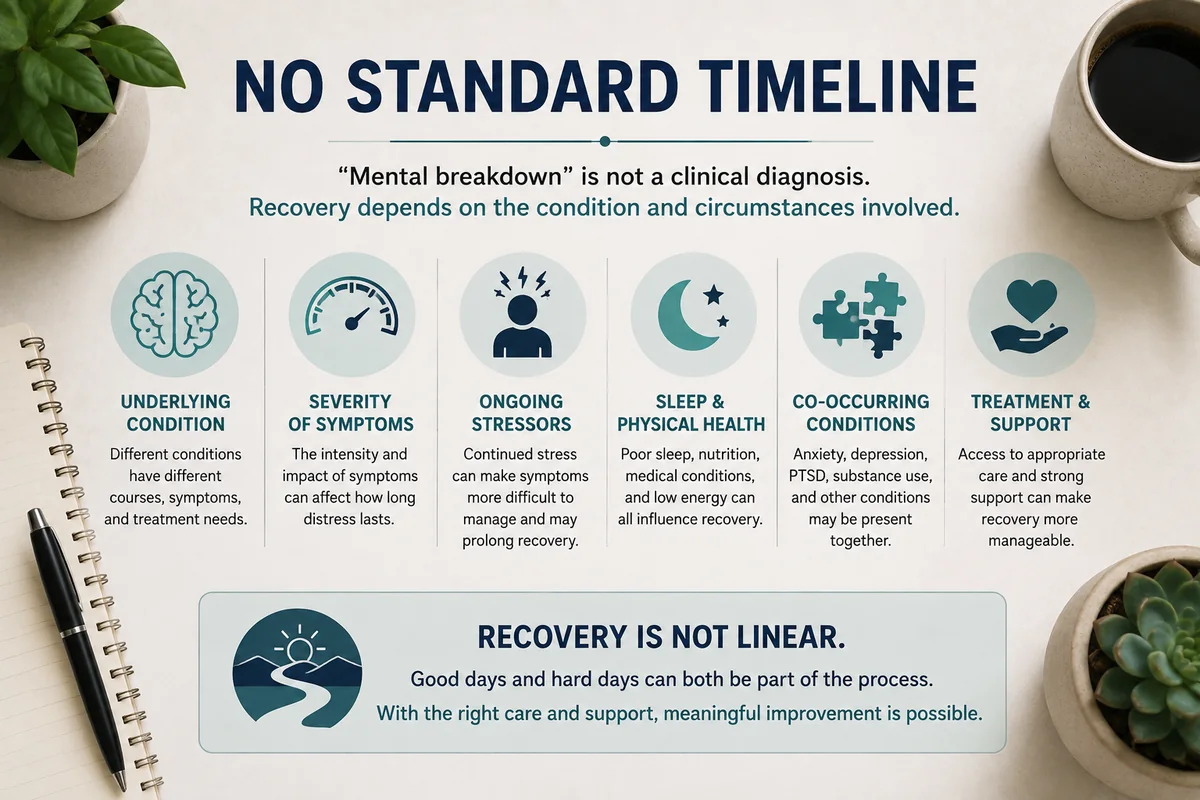
Although there is no standard mental breakdown duration, several factors can influence how long symptoms and difficulty functioning persist.
The Underlying Condition
One of the most important factors is what is actually causing the symptoms.
Depression, panic disorder, PTSD, bipolar disorder, adjustment disorder, grief, substance-related symptoms, severe stress, sleep disorders, and medical conditions can have very different courses and treatment needs.
Our guide to what causes mental breakdowns explains some of the conditions and circumstances that may contribute to severe psychological distress.
Severity of Symptoms
Someone experiencing relatively preserved functioning may have very different needs from someone who cannot work, maintain basic self-care, sleep adequately, or remain safe.
Greater impairment may require more intensive evaluation and support.
Ongoing Stressors
Symptoms may be more difficult to manage when significant stressors remain active.
Examples can include relationship conflict, caregiving demands, financial problems, unsafe living situations, work difficulties, grief, or continuing exposure to traumatic circumstances.
Removing a stressor is not always possible, but understanding the person’s environment can be an important part of treatment planning.
Co-Occurring Conditions
More than one condition may be present at the same time.
For example, someone may experience depression along with an anxiety disorder, PTSD, substance use, sleep disruption, or a medical condition.
Treatment planning should account for the full clinical picture rather than assuming that every symptom belongs to one “breakdown.”
Access to Appropriate Care
Professional assessment can help identify the underlying condition and determine what type and level of treatment may be appropriate.
That does not mean treatment guarantees a particular recovery timeline.
It means that identifying and appropriately treating the actual condition is more useful than trying to predict when an informal “mental breakdown” should end.
What Does Recovery From a Mental Breakdown Look Like?
There is no single definition of recovery from a mental breakdown because the term can describe many different experiences.
For some people, improvement may first appear as a return of basic functioning.
That could include:
Sleeping more consistently
Eating regularly
Resuming basic self-care
Returning gradually to ordinary responsibilities
Improved concentration
Reduced panic or emotional distress
Reconnecting with supportive people
Participating consistently in treatment
Improvement may occur gradually, and symptoms do not necessarily resolve at the same rate.
Someone may return to work while still receiving treatment for depression. Another person may experience fewer panic attacks while continuing to address significant anxiety. Someone recovering from trauma-related symptoms may function better while still participating in ongoing treatment.
Recovery should therefore be evaluated according to the underlying condition, symptoms, functioning, safety, and treatment goals, not according to whether a predetermined amount of time has passed.
What Can Support Recovery?
There is no proven way to make a mental breakdown end on a particular schedule.
However, several practical steps may support someone experiencing significant psychological distress:
Seek appropriate evaluation. Identifying the condition responsible for the symptoms can guide treatment.
Reduce nonessential demands when possible. Temporary adjustments to work, caregiving, household, or social responsibilities may help when functioning is significantly impaired.
Maintain basic routines. Regular meals, hydration, sleep routines, prescribed medications, and medical appointments can become difficult during severe distress but remain important.
Limit alcohol or other substances used to cope. Substance use can complicate psychiatric symptoms, sleep, judgment, and treatment.
Accept practical support. Trusted people may be able to assist with transportation, appointments, meals, childcare, pets, or other immediate responsibilities.
Follow the recommended treatment plan. Treatment may include psychotherapy, medication when clinically appropriate, treatment of co-occurring conditions, or a different level of care depending on individual needs.
Return to responsibilities according to clinical circumstances. There is no universal schedule for resuming work, school, caregiving, or other activities.
The goal is not to “push through” a breakdown or force recovery to happen faster.
The goal is to identify what is causing the impairment and provide the level of support and treatment appropriate for that individual
When to Seek Professional Help
Professional evaluation may be appropriate when psychological distress is persistent, worsening, or significantly interfering with everyday functioning.
Consider seeking professional help when someone is experiencing:
Significant difficulty working, attending school, or managing ordinary responsibilities
Persistent depression, anxiety, panic, or emotional distress
Severe or ongoing sleep disruption
Increasing withdrawal from other people
Difficulty maintaining basic self-care
Increasing alcohol or substance use to cope
Significant changes in thinking, behavior, or functioning
Symptoms that are becoming increasingly difficult to manage
The decision to seek help should not depend on whether symptoms have lasted a particular number of days or weeks.
Because “mental breakdown” is not a diagnosis, waiting for an arbitrary amount of time to pass may delay evaluation of the condition actually causing the symptoms.
When Is Immediate Evaluation Necessary?
Some situations require urgent or emergency evaluation rather than waiting to see whether symptoms improve.
Seek immediate emergency care when someone:
Cannot remain safe
Has suicidal thoughts with intent or a plan
Is experiencing hallucinations, severe paranoia, or significant loss of contact with reality
Is experiencing symptoms of mania that create serious safety concerns
Is severely confused or disoriented
Has experienced an overdose or potentially dangerous substance-related reaction
May be experiencing a serious medical condition
Is behaving in a way that creates an immediate danger to herself, himself, or others
Residential mental health treatment is not a substitute for emergency or acute inpatient psychiatric care when hospital-level stabilization is necessary.
If you are supporting another person experiencing severe psychological distress, our guide on what to do when someone is having a mental breakdown explains how to respond and when more urgent intervention may be necessary.
Frequently Asked Questions About How Long Mental Breakdowns Last
How long do mental breakdowns last?
There is no established duration because a mental breakdown is not a clinical diagnosis.
The period of severe distress or impaired functioning may be relatively brief for some people and persist considerably longer for others.
Duration depends on the underlying condition, symptom severity, ongoing stressors, co-occurring conditions, individual circumstances, and other clinical factors.
Can a mental breakdown last for months?
Symptoms that someone describes as a mental breakdown can persist for months, but prolonged symptoms may indicate an underlying mental health or medical condition that requires evaluation.
For example, depression, anxiety disorders, PTSD, bipolar disorder, substance-related conditions, sleep disorders, grief, and medical conditions can each have different courses.
Rather than assuming someone is experiencing a months-long “breakdown,” persistent symptoms should be evaluated according to the condition actually present.
Can a mental breakdown last only a few days?
A period of severe psychological distress may improve relatively quickly for some people.
However, there is no minimum duration for a nervous or mental breakdown because neither term describes a formal diagnosis.
Even when functioning improves quickly, persistent or recurring symptoms may still warrant evaluation.
Does treatment make a mental breakdown end faster?
There is no established duration against which treatment can be measured because a mental breakdown is not a defined clinical disorder.
Appropriate treatment can address an underlying condition such as depression, anxiety, PTSD, bipolar disorder, substance use, or another mental health concern.
The purpose of treatment is to address the actual condition and improve symptoms and functioning—not to meet a predetermined “breakdown recovery” timeline.
What helps someone recover from a mental breakdown?
What helps depends on what is causing the symptoms.
Professional evaluation may identify an underlying mental health condition, medical issue, sleep problem, substance-related concern, severe stressor, or combination of factors.
Treatment may include psychotherapy, medication when clinically appropriate, supportive interventions, treatment of co-occurring conditions, or a different level of care depending on individual needs.
Practical support with basic responsibilities may also be useful when someone’s functioning is significantly impaired.
When should someone consider a higher level of mental health care?
A higher level of care may be considered when symptoms significantly interfere with functioning, outpatient treatment has not provided sufficient support, co-occurring conditions complicate treatment, or greater therapeutic structure is needed.
The appropriate level of care depends on individualized clinical assessment.
At Kinder in the Keys, we provide residential mental health treatment for adult women who are clinically and medically appropriate for residential care.
Someone who requires emergency psychiatric stabilization, cannot remain safe, or needs hospital-level medical or psychiatric monitoring may require acute inpatient care instead.
The Bottom Line
So, how long do mental breakdowns last?
There is no clinically established timeline.
“Nervous breakdown” and “mental breakdown” are informal terms that can describe many different combinations of symptoms and circumstances.
Instead of focusing on whether the experience should last days, weeks, or months, focus on:
What symptoms are present
What may be causing them
How severely functioning is affected
Whether there are safety concerns
Whether symptoms are improving or worsening
What type of treatment or support is appropriate
When severe psychological distress interferes with everyday life, professional evaluation can help identify the underlying problem and determine the appropriate next step.
Medically Reviewed By
Dr. Laura Tanzini, DrPH, LMFT
Doctor of Public Health | Specialty in Lifestyle Medicine
Licensed Marriage and Family Therapist (Florida & California)
Founder & CEO, Kinder in the Keys
Doctoral Research: Dr. Tanzini’s doctoral research at Loma Linda University examined childhood and adult traumatic events, cumulative trauma exposure, gender, forgiveness, life satisfaction, and long-term well-being.
This article has been clinically reviewed for accuracy and consistency with current behavioral health principles. Content is intended to provide general educational information and should not replace individualized evaluation, diagnosis, or treatment by a qualified healthcare professional.
Medical Disclaimer: The information provided in this article is for educational and informational purposes only and is not intended as medical advice, diagnosis, or treatment. “Mental breakdown” and “nervous breakdown” are not formal psychiatric diagnoses. Symptoms and treatment needs vary by individual. Consult a qualified healthcare or mental health professional for individualized evaluation and treatment. Seek immediate emergency medical care when there is an immediate safety or medical concern.