
Is depression genetic? If depression runs in your family, it is natural to wonder whether you are destined to experience it too.
The short answer is that depression does have a genetic component, but genes are only part of the picture.
Major depression is not inherited in the simple way that some genetic conditions are. There is no single “depression gene,” and having a parent, sibling, or other close relative with depression does not mean that you will develop the condition.
Instead, depression appears to result from a complex interaction among genetic vulnerability, biology, life experiences, psychological factors, environment, physical health, and other influences.
Family history can therefore provide useful information about vulnerability, but it is not a prediction of your future.
At Kinder in the Keys, our depression treatment program for women focuses on understanding the whole person rather than reducing depression to one cause.
Is Depression Genetic? What Research Tells Us
Research provides strong evidence that genetics contribute to susceptibility to major depressive disorder.
Studies involving families, twins, and increasingly large genomic datasets consistently indicate that inherited genetic differences account for some of the variation in who develops depression.
But this needs to be interpreted carefully.
You may see statements saying that depression is approximately 30% to 40% heritable, with estimates varying among studies and populations.
That does not mean that 30% to 40% of one person’s depression was caused by genes and the remaining percentage was caused by the environment.
Heritability is a population-level statistical estimate. It describes how much of the variation in a trait or condition among people in a particular population can be associated with genetic differences under the conditions studied.
It cannot tell an individual woman:
Whether she will develop depression
When depression might occur
How severe it might become
Which life experiences will affect her
Whether treatment will be necessary
How she will respond to treatment
Genetics contribute to vulnerability. They do not provide a personal forecast.
Stanford Medicine’s Depression Genetics research program also describes major depression as having a substantial genetic component while emphasizing that no single gene causes depression in most people.
Is There a Depression Gene?
No single gene has been identified that causes major depressive disorder.
Depression is considered polygenic, meaning that many genetic variants appear to contribute very small effects to overall susceptibility.
Those genetic influences are also part of a much larger biological and environmental picture.
This is fundamentally different from a disorder caused primarily by a single gene mutation.
For depression, researchers are studying large numbers of genetic variants and how they may collectively influence vulnerability. Scientists are also investigating how genetic factors interact with biological processes and environmental experiences.
That complexity is one reason a simple genetic test cannot currently tell a woman whether she will or will not develop depression during her lifetime.
Does Depression Run in Families?
Yes, depression can cluster in families.
People who have close biological relatives with major depression generally have a higher likelihood of experiencing depression themselves compared with people without the same family history.
But family history and genetics are not identical.
Families share more than DNA.
Family members may also share:
Environments
Stressors
Relationship patterns
Socioeconomic circumstances
Health behaviors
Exposure to adversity
Cultural beliefs
Coping patterns
Access to healthcare
Other physical and mental health conditions
That is why researchers do not rely on family studies alone when examining the genetic contribution to depression.
Twin studies, adoption research, molecular genetics, and large genome-wide studies help researchers separate genetic influences from other factors that family members may share.
What Twin Studies Tell Us About Depression
Twin research has played an important role in understanding the heritability of depression.
Identical twins share nearly all of their genetic sequence, while fraternal twins share, on average, about half of the genetic variation that differs among people.
If genetics influence a condition, identical twins would generally be expected to show greater similarity for that condition than fraternal twins.
That pattern has been observed with major depression and supports a genetic contribution.
But there is another important finding:
Identical twins are not perfectly concordant for depression.
In other words, one identical twin can develop major depression while the other does not.
That alone illustrates why genes cannot be the entire explanation.
Even people with extremely similar genetic backgrounds can have different mental health outcomes.
Family History Is a Risk Factor, Not a Diagnosis
Knowing that depression occurs in your family can be useful.
It may tell you that you have greater vulnerability and that recognizing symptoms of depression early is particularly important.
But family history should not become a diagnosis in advance.
A woman should not assume:
“My mother had depression, so I will have depression.”
Nor should someone without a known family history assume:
“Nobody in my family has depression, so this can’t be happening to me.”
Depression can develop in people with no known family history, and many people with significant family histories never develop major depressive disorder.
Family history is one piece of the clinical picture.
Genes and Environment Work Together
The old debate about whether depression comes from “nature or nurture” creates a false choice.
For most women, there is no clean dividing line between biology and experience.
Genes influence biological systems. Experiences influence the brain and body. Physical health affects emotional health. Relationships affect stress. Sleep affects mood and cognitive functioning. Hormones, medications, illness, grief, trauma, chronic stress, and many other factors may contribute to an individual’s clinical picture.
These influences can interact over time.
A woman may have a genetic vulnerability that never results in major depression.
Another woman may have relatively little known family history but develop depression following a combination of significant stressors, biological changes, medical illness, or other circumstances.
Depression is therefore better understood as a multifactorial condition than as something that is either genetic or environmental.
The National Institute of Mental Health similarly describes depression as involving genetic, biological, environmental, and psychological factors rather than a single cause.
Genetic Predisposition Is Not the Same as Genetic Destiny
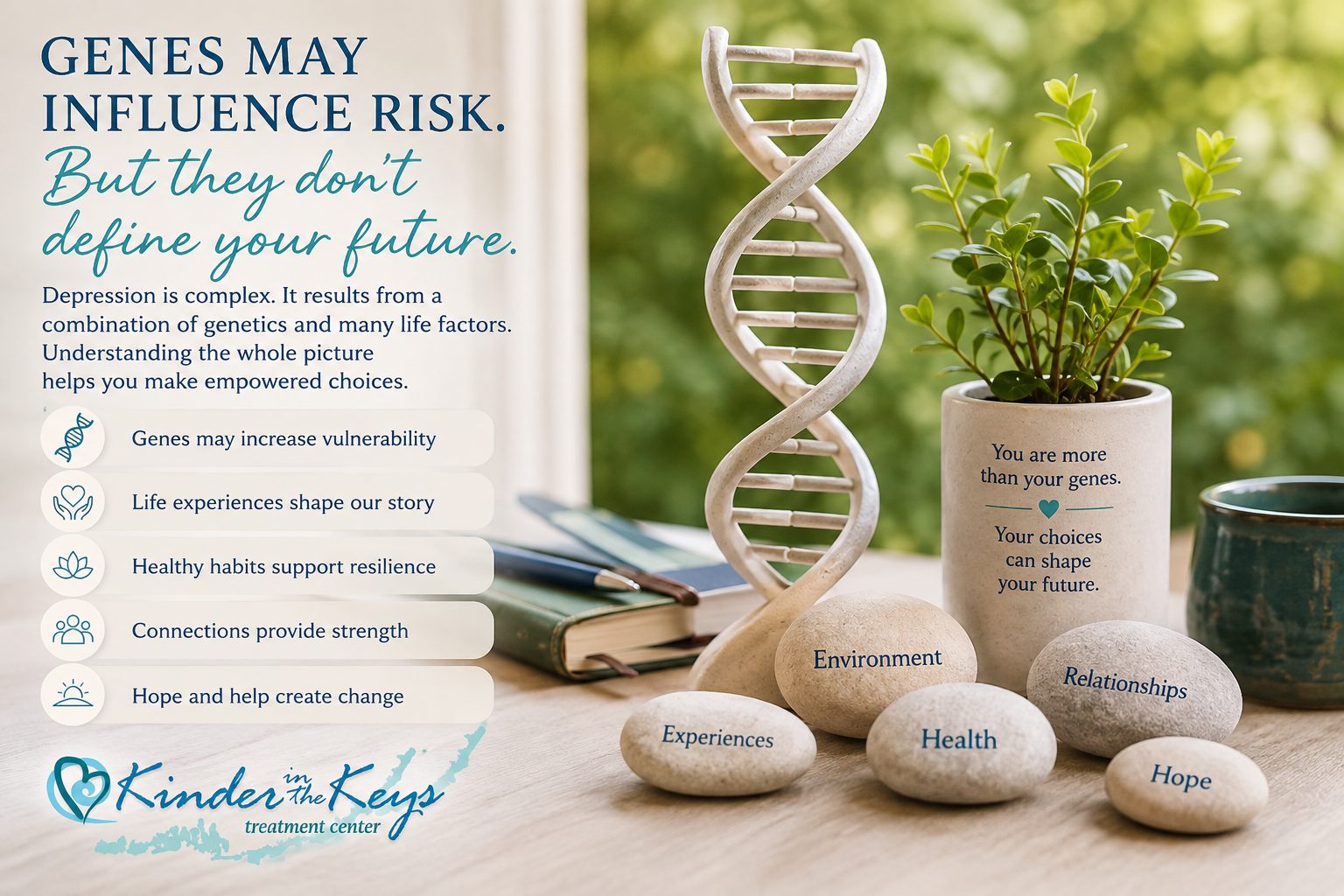
One useful way to understand genetic vulnerability is to distinguish between having a predisposition and actually developing a condition.
In healthcare, this concept can be seen clearly with conditions such as type 2 diabetes. A person may inherit a genetic susceptibility to developing type 2 diabetes, but carrying that susceptibility does not mean that the disease will necessarily develop at the same age—or even develop at all—in every person with that vulnerability.
Lifestyle, physical activity, nutrition, body composition, aging, medical conditions, and other environmental and biological influences can interact with genetic susceptibility and affect disease risk.
People sometimes describe this as a genetic “switch” being turned on.
The switch is a useful teaching metaphor, but human genetics are considerably more complicated. Genes do not simply sit in an “off” position until one particular event turns them “on.”
Depression is even more complex because it is polygenic. There is no single depression gene waiting to be activated.
Instead, many genetic variants may collectively contribute to vulnerability while interacting with biological, psychological, social, and environmental influences.
Stress, physical health, sleep, relationships, trauma, hormonal changes, life experiences, and other factors may all become part of that interaction.
This helps explain something important:
Two people can inherit similar vulnerabilities and still have very different outcomes.
Likewise, two members of the same family can experience similar environments and still respond differently.
Genetic predisposition therefore tells us something about susceptibility, not certainty.
That is why knowing that depression runs in your family should be viewed as useful health information rather than a prediction of what will happen to you.
What Else Can Contribute to Depression?
Genetics are one potential contributor among many.
Factors associated with depression can include:
Family history
Previous episodes of depression
Significant or prolonged stress
Trauma or adverse experiences
Major loss or grief
Chronic medical conditions
Certain medications
Sleep disruption
Social isolation
Relationship difficulties
Major life transitions
Other mental health conditions
Biological and hormonal changes
The presence of one or more risk factors does not mean that depression is inevitable.
Likewise, depression does not require an obvious external cause.
Sometimes women become frustrated because they cannot identify a single event that explains why they feel depressed.
There may not be one.
Clinical assessment looks at the complete picture rather than requiring depression to have one identifiable cause.
Are Genetics Different in Women With Depression?
Women experience major depression more frequently than men, but that difference cannot be explained simply by saying women have “more depression genes.”
Understanding why women are more likely to experience depression requires looking beyond genetics alone at the biological, psychological, social, and environmental factors that may contribute.
The reasons for the difference are complex and likely involve interacting biological, psychological, social, and environmental factors.
Women also experience reproductive hormonal transitions that can affect mood vulnerability at particular times, including the menstrual cycle, pregnancy and postpartum period, and perimenopause.
However, hormonal changes do not affect every woman in the same way, and they should not be treated as a universal explanation for depression in women.
Genetics, hormones, environment, stress, health, relationships, and life experiences can all be relevant depending on the individual woman.
If Depression Runs in My Family, Can I Prevent It?
There is no guaranteed method for preventing major depressive disorder simply because someone knows she has a family history.
Knowing about genetic vulnerability does not mean a woman can guarantee that depression will never develop by exercising enough, eating perfectly, sleeping perfectly, or managing every stressor correctly.
Depression is a medical and mental health condition—not a personal failure to practice enough wellness.
At the same time, lifestyle and environment do matter to overall mental and physical health.
Regular physical activity, adequate sleep, balanced nutrition, supportive relationships, management of physical health conditions, and healthy approaches to stress can support well-being and may influence some of the biological and environmental factors associated with depression.
The important distinction is that these behaviors support health; they do not provide a guarantee against depression.
Family awareness can also provide an opportunity to recognize changes earlier.
If depression runs in your family, it may be helpful to know your own baseline and pay attention to persistent changes involving:
Mood
Interest or pleasure
Sleep
Energy
Concentration
Appetite
Motivation
Feelings of worthlessness or excessive guilt
Social withdrawal
Thoughts of death or suicide
Seeking evaluation when symptoms begin to interfere with everyday functioning can help identify depression and other possible causes of those symptoms.
Does Lifestyle Still Matter?
Yes.
The relationship between genetic vulnerability and environment is exactly why lifestyle should neither be ignored nor overstated.
Sleep, movement, nutrition, relationships, stress management, physical health, and social connection are all relevant to mental and physical well-being.
They can also be important components of treatment and recovery.
What we should avoid is turning that knowledge into blame.
Telling a woman with a family history of depression to simply “live healthier so you don’t become depressed” dramatically oversimplifies a complex disorder.
A better approach is to support overall health, understand personal vulnerabilities, recognize symptoms early, and seek appropriate care when needed.
Can Genetic Testing Predict Depression?
At present, routine genetic testing cannot tell an individual woman whether she will develop major depressive disorder.
Researchers have identified many genetic variants associated with depression, and research into polygenic risk scorescontinues to develop.
But depression is too complex for a simple positive-or-negative genetic test.
A person’s genetic profile exists alongside environmental exposures, medical history, psychological factors, social circumstances, and experiences across a lifetime.
For clinical purposes, a careful personal and family history remains much more meaningful than expecting a consumer genetic test to predict someone’s mental health future.
NIMH advises that genetic information about common mental disorders should be interpreted cautiously and notes that having a close relative with a mental disorder can indicate increased risk without meaning that the individual will necessarily develop the condition.
What If Depression Runs Through Several Generations of My Family?
A strong family history deserves attention, but it still does not make depression inevitable.
It can be useful to tell a healthcare or mental health professional:
Which relatives experienced depression
Whether depression was recurrent
Approximate age when symptoms began
Whether hospitalization occurred
Whether bipolar disorder or another psychiatric condition was diagnosed
Whether suicide attempts or suicide occurred in the family
Which treatments appeared helpful or unhelpful
Family psychiatric history can sometimes provide information that helps clinicians with assessment and treatment planning.
It is particularly important to mention a family history of bipolar disorder, because depressive episodes can occur in bipolar disorders as well as major depressive disorder, and distinguishing between them affects treatment decisions.
When Depression Requires More Support
Many women with depression can be treated successfully in outpatient care.
For others, symptoms become severe enough that more structure and support are needed.
Residential depression treatment for women may be considered when depression significantly interferes with daily functioning, outpatient treatment has not provided sufficient improvement, multiple mental health concerns complicate recovery, or a woman needs a more structured therapeutic environment.
The appropriate level of care depends on the individual woman’s symptoms, safety, functioning, treatment history, and clinical needs—not whether depression appears to run in her family.
Depression Treatment for Women at Kinder in the Keys
Kinder in the Keys provides residential mental health treatment for adult women in Key Largo, Florida.
Our approach recognizes that depression rarely has one simple cause.
Treatment considers the woman’s symptoms, family and personal history, relationships, stressors, physical health, previous treatment, behavioral patterns, and other mental health concerns.
Women participate in individual therapy and daily group programming within a small residential environment. Treatment approaches are selected according to each woman’s clinical needs.
A family history of depression can provide useful information.
But treatment is ultimately based on the woman sitting in front of us—not her genes, her relatives, or a statistical estimate of risk.
Is Depression Genetic? Frequently Asked Questions
Is depression genetic?
Partly. Research shows that genetic differences contribute to susceptibility to major depression, but depression is not caused by one gene and genetics do not determine whether an individual person will develop the disorder.
How heritable is depression?
Research commonly estimates the heritability of major depression at roughly 30% to 40%, although estimates vary among studies and populations. Heritability is a population-level statistical concept and should not be interpreted as the percentage of an individual’s depression that was caused by genes.
If my parent has depression, will I get it?
Not necessarily. Having a close biological relative with depression is associated with increased risk, but many people with a family history never develop major depression. People without a known family history can also develop the disorder.
Is there a depression gene?
No. Major depression is considered polygenic, meaning many genetic variants appear to contribute small effects to susceptibility. There is no single gene that determines whether someone will develop depression.
Can a genetic test tell me whether I will develop depression?
No routine genetic test can currently predict with certainty whether an individual will develop major depressive disorder. Depression results from complex interactions among many genetic and non-genetic influences.
Can depression skip generations?
Depression does not follow a simple inheritance pattern. Because genetic vulnerability involves many variants and interacts with numerous other factors, depression may appear in some family members and not others across generations.
Can I prevent depression if it runs in my family?
There is no guaranteed way to prevent depression based solely on knowing that it runs in your family. Supporting physical and mental health and recognizing symptoms early are worthwhile, but they cannot guarantee that depression will not develop.
Does family history affect depression treatment?
It can provide useful clinical information, particularly when there is a history of recurrent depression, bipolar disorder, suicide, hospitalization, or particular treatment responses. Treatment decisions still need to be based on the individual patient’s diagnosis, symptoms, medical history, and clinical needs.
Genes Influence Risk—They Do Not Define You
Learning that depression has a genetic component can initially feel frightening, especially when you have watched someone you love struggle with the condition.
But inherited vulnerability is not the same as inherited certainty.
Depression develops within a complicated interaction of genetics, biology, health, environment, relationships, stress, and life experience.
Your family history is information.
It is not your future.
If symptoms of depression are significantly affecting your daily life, relationships, ability to function, or sense of well-being, a professional evaluation can help determine what is happening and what level of treatment may be appropriate.
Medically Reviewed By
Dr. Laura Tanzini, DrPH, LMFT
Doctor of Public Health | Specialty in Lifestyle Medicine
Licensed Marriage and Family Therapist (Florida & California)
Founder & CEO, Kinder in the Keys
This article has been clinically reviewed for accuracy and consistency with current evidence-based behavioral health principles. It is intended to provide educational information about depression, genetics, family history, and risk and does not replace individualized assessment, diagnosis, or treatment by a qualified healthcare or mental health professional.
Medical Disclaimer
This article is for educational and informational purposes only and is not intended to diagnose, treat, cure, or prevent depression or any other mental health condition.
If symptoms of depression are persistent, worsening, or interfering with daily functioning, seek evaluation from a qualified healthcare or mental health professional. If there is an immediate risk of self-harm or suicide, call or text 988 in the United States or contact emergency services.