
CPTSD vs BPD can be confusing because the two conditions can share certain symptoms. Both may involve intense emotions, relationship difficulties, problems with self-image, dissociation, and significant psychological distress.
They are not, however, different names for the same condition, nor does one develop into the other.
Complex post-traumatic stress disorder (CPTSD) is a trauma-related diagnosis recognized in the World Health Organization’s ICD-11. Borderline personality disorder (BPD) is a personality disorder characterized by a broader and more pervasive pattern involving emotional regulation, relationships, self-image, behavior, and sensitivity to abandonment.
A woman can have CPTSD without BPD, BPD without CPTSD, or meet diagnostic criteria for both conditions.
The distinction matters because accurate diagnosis helps clinicians understand what is actually driving a woman’s symptoms and determine which treatment approaches may be appropriate.
At Kinder in the Keys, our women’s PTSD treatment program focuses on understanding the individual woman rather than assuming that one diagnosis explains every symptom.
Understanding CPTSD and BPD
Before comparing CPTSD and BPD, it is important to understand each condition on its own.
Although some symptoms can look similar from the outside, their diagnostic requirements and characteristic clinical patterns are different.
What Is Complex PTSD?
Complex PTSD, or CPTSD, is recognized as a distinct diagnosis in the International Classification of Diseases, 11th Revision (ICD-11).
CPTSD includes the core features of PTSD:
Re-experiencing the traumatic event in the present
Avoidance of trauma reminders
A persistent sense of current threat
It also includes three additional areas collectively described as disturbances in self-organization:
Significant difficulties regulating emotions
A persistently negative self-concept
Persistent difficulties maintaining relationships or feeling close to others
CPTSD develops following exposure to extremely threatening or horrific events. It is particularly associated with prolonged or repeated trauma from which escape was difficult or impossible, although diagnosis depends on the complete clinical picture rather than simply how long the trauma lasted.
Examples may include prolonged domestic violence, repeated childhood physical or sexual abuse, torture, trafficking, captivity, or other severe and repeated interpersonal trauma.
Women interested in the condition itself can learn more about complex PTSD in women and how it can affect emotions, relationships, and daily functioning.
Is CPTSD in the DSM-5-TR?
No.
This is an important distinction because mental health professionals may work within different diagnostic systems.
CPTSD is recognized as a separate diagnosis in ICD-11, published by the World Health Organization.
The DSM-5-TR, commonly used by mental health professionals in the United States, does not currently include CPTSD as a separate diagnosis.
The National Center for PTSD also notes that CPTSD is included in ICD-11 but is not a separate diagnosis in the DSM system.
That does not mean the symptoms associated with complex trauma are not recognized or treated in the United States. It means clinicians working within the DSM system may conceptualize or diagnose those symptoms differently.
What Is Borderline Personality Disorder?
Borderline personality disorder (BPD) is a personality disorder characterized by a pervasive pattern of instability involving emotions, relationships, self-image, and behavior.
One of the most important features of BPD is an intense sensitivity to real or perceived abandonment. A situation that feels like rejection, separation, withdrawal, or the possibility that an important person may leave can produce an intense emotional response.
This fear of abandonment can strongly affect relationships.
A person with BPD may initially idealize someone, experiencing that person as exceptionally safe, loving, trustworthy, or important. When rejection or abandonment is perceived, that view can shift dramatically toward anger, disappointment, distrust, or devaluation.
These shifts are sometimes described as moving between idealization and devaluation.
They are not simply someone being intentionally difficult or manipulative. They occur within a broader pattern of difficulty regulating emotions, maintaining a stable sense of self, and navigating relationships when abandonment or rejection feels threatening.
Other features of BPD can include:
Frantic efforts to avoid real or perceived abandonment
Intense and unstable relationships
An unstable or shifting sense of identity
Impulsive or self-damaging behaviors
Significant emotional reactivity
Chronic feelings of emptiness
Intense anger or difficulty regulating anger
Recurrent self-harm or suicidal behavior in some individuals
Temporary stress-related paranoia or dissociative symptoms
Not every person with BPD experiences every feature, and the way the disorder presents can vary considerably.
Importantly, trauma is not required for a diagnosis of BPD.
Some people with BPD have significant histories of childhood adversity, abuse, neglect, or other traumatic experiences. Others do not. A trauma history may be clinically important when it is present, but it should not automatically be treated as the underlying cause of the personality disorder.
This is one of the fundamental differences between BPD and complex PTSD.
CPTSD is organized around traumatic exposure and the symptoms that develop in relation to that trauma. BPD is characterized by a broader and more pervasive pattern involving emotional regulation, identity, interpersonal relationships, impulsivity, and sensitivity to abandonment.
Treatment therefore needs to address the patterns actually driving the person’s difficulties rather than assuming that treating a trauma history will necessarily resolve BPD.
CPTSD vs. BPD: Key Differences
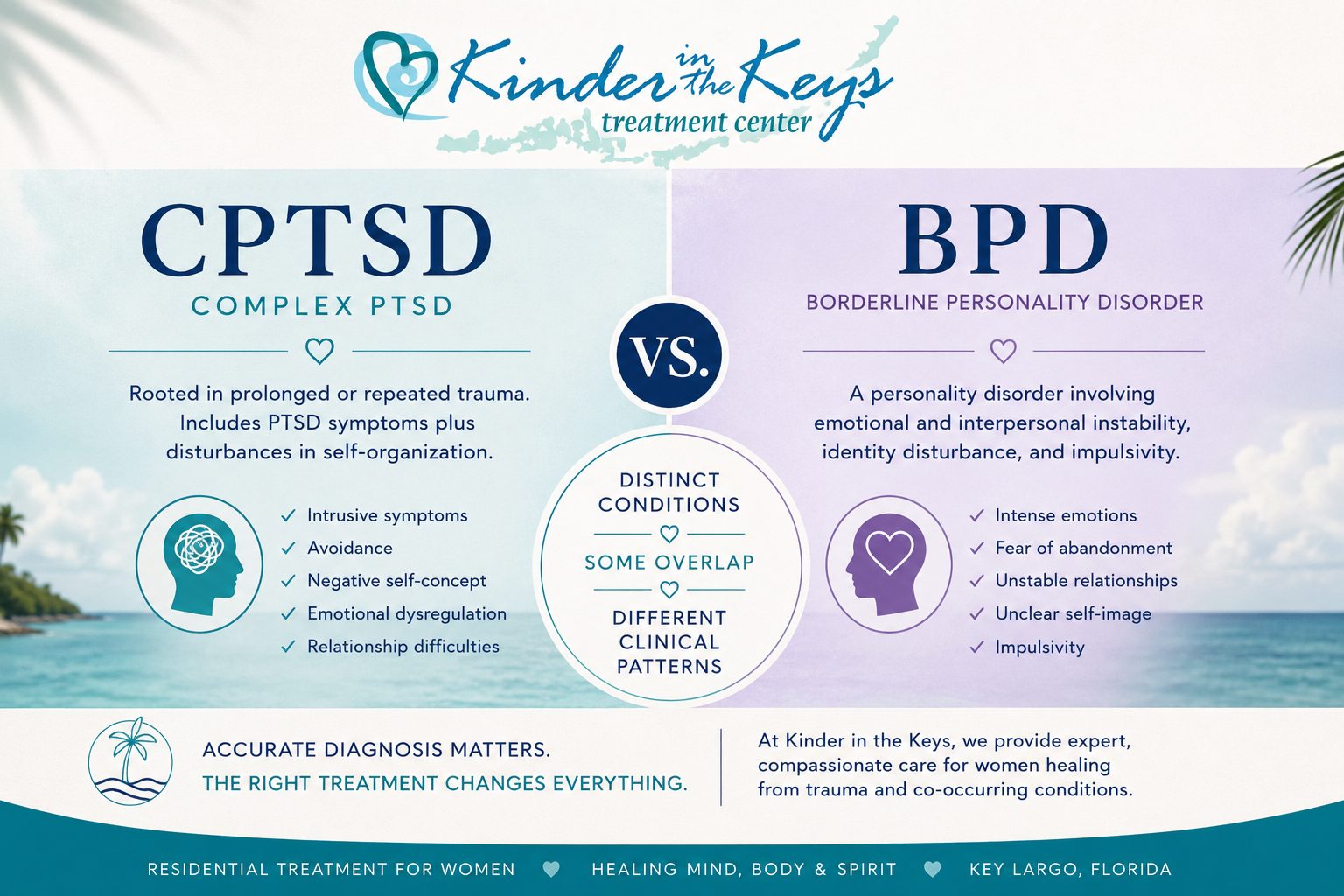
There is no single symptom that always separates CPTSD from BPD.
Clinicians look at the overall pattern of symptoms, trauma exposure, PTSD symptoms, emotional regulation, self-concept, relationships, abandonment sensitivity, impulsivity, and other features over time.
Some general patterns can nevertheless help explain the distinction.
| Feature | Complex PTSD | Borderline Personality Disorder |
|---|---|---|
| Trauma requirement | Requires qualifying traumatic exposure | Trauma may be present but is not required |
| PTSD symptoms | Core PTSD symptoms are required | PTSD symptoms are not required |
| Sense of self | Often persistently negative, shame-based, or characterized by worthlessness | Identity and self-image may be markedly unstable or shift substantially |
| Relationships | Difficulty with closeness, trust, or sustained connection may predominate | Intense and unstable relationship patterns may be strongly influenced by fear of real or perceived abandonment, with shifts between idealization and devaluation |
| Impulsivity | Can occur but is not a defining requirement | Impulsivity is an important diagnostic feature |
| Self-harm/suicidality | Can occur | Can occur and may be particularly prominent in some individuals |
| Emotional dysregulation | Part of disturbances in self-organization | A central feature of the disorder |
These differences describe patterns. They should not be used as a checklist for self-diagnosis.
A woman with CPTSD can fear abandonment. A woman with BPD can have a persistently negative self-image. Either condition can involve dissociation, self-harm, depression, anxiety, relationship problems, or a significant trauma history.
That overlap is why careful clinical assessment matters.
Where CPTSD and BPD Overlap
CPTSD and BPD can share certain symptoms even though they are distinct disorders.
Both may involve:
Difficulty regulating intense emotions
Relationship difficulties
Problems involving identity or self-worth
Dissociation
Feelings of emptiness or disconnection
Shame
Anxiety or depression
Self-harm or suicidal thoughts in some individuals
Histories of childhood adversity or interpersonal trauma in some cases
The presence of one of these symptoms does not tell us which diagnosis is present.
Emotional dysregulation, for example, occurs in many mental health conditions. A trauma history is also not sufficient to distinguish CPTSD from BPD because a person with BPD may have experienced trauma without having CPTSD.
The complete clinical pattern matters.
Can Someone Have Both CPTSD and BPD?
Yes.
CPTSD and BPD are not mutually exclusive.
A woman can meet diagnostic criteria for CPTSD and also meet criteria for borderline personality disorder.
This is one reason it can be misleading to approach the question simply as:
“Is this CPTSD or BPD?”
Sometimes the clinically accurate answer may be both.
Other women may meet criteria for one condition but not the other. Still others may experience trauma-related symptoms, emotional dysregulation, or relationship difficulties without meeting full diagnostic criteria for either disorder.
The purpose of assessment is not to force symptoms into the closest diagnostic label. It is to understand the entire clinical picture.
Why CPTSD and BPD Can Be Difficult to Tell Apart
The difficulty comes primarily from the areas in which symptoms can overlap.
Emotional Regulation
Both conditions can involve difficulty managing intense emotional experiences.
The context and broader pattern matter.
With CPTSD, emotional regulation difficulties occur as part of the disturbances in self-organization associated with the trauma-related disorder.
In BPD, emotional instability is part of a pervasive pattern that can include particularly intense responses to interpersonal events, rejection, or perceived abandonment.
Relationships
Both conditions can affect relationships, but again, the patterns may differ.
A woman with CPTSD may have difficulty trusting others, feeling safe in close relationships, or remaining emotionally connected because of trauma-related beliefs and experiences.
In BPD, relationships may become intensely unstable. Fear of abandonment can contribute to efforts to prevent separation as well as rapid shifts in how another person is perceived.
Someone may be experienced as completely trustworthy and important at one moment and rejecting, uncaring, or harmful when abandonment is perceived.
Self-Concept
CPTSD commonly involves a persistently negative self-concept, including feelings of worthlessness, failure, or shame.
BPD can involve significant instability in identity and self-image.
These patterns can overlap, but they are not necessarily identical.
Dissociation
Dissociative experiences can occur in either condition.
For that reason, dissociation alone cannot reliably distinguish CPTSD from BPD.
Does Trauma Mean Someone Has CPTSD Instead of BPD?
No.
This is one of the most important misconceptions to avoid.
A trauma history does not rule out borderline personality disorder.
Likewise, having BPD does not mean trauma-related symptoms should be ignored when they are present.
Some women have both conditions.
Research has examined the relationship among childhood adversity, complex trauma, CPTSD, and personality disorders. That research is important, but it does not mean that BPD is simply another form of complex trauma.
Nor does it mean that a BPD diagnosis in a woman with a trauma history is necessarily a misdiagnosis.
CPTSD and BPD are distinct clinical syndromes that can overlap and co-occur.
Why Women May Be Concerned About Misdiagnosis
Women searching for information about CPTSD and BPD frequently encounter online claims suggesting that women with trauma are routinely diagnosed with BPD when they “really” have CPTSD.
The clinical picture is considerably more complicated.
BPD has historically carried substantial stigma, and trauma-related experiences have not always been assessed as carefully as they should be. Those realities make comprehensive trauma assessment important.
But automatically replacing a BPD diagnosis with CPTSD creates a different clinical problem.
A woman deserves an assessment that considers:
Her trauma history
Core PTSD symptoms
Emotional regulation
Identity and self-concept
Relationship patterns
Fear of real or perceived abandonment
Idealization and devaluation patterns when present
Impulsivity
Self-harm or suicidal behavior
Dissociation
Co-occurring depression or anxiety
Other mental health conditions
Symptoms across situations and over time
The goal should be diagnostic accuracy, not selecting whichever diagnosis feels less stigmatizing.
CPTSD vs. PTSD vs. BPD
Another source of confusion is the relationship among PTSD, CPTSD, and BPD.
PTSD
PTSD is a trauma-related disorder involving symptoms associated with re-experiencing, avoidance, and a continuing sense of threat following qualifying traumatic exposure.
CPTSD
CPTSD includes the core PTSD features plus disturbances involving emotional regulation, self-concept, and relationships.
Our guide to CPTSD vs. PTSD in women explains the distinction between these two trauma-related conditions in greater detail.
BPD
BPD is a personality disorder involving pervasive difficulties with emotional stability, relationships, identity, impulsivity, and other features.
Fear of abandonment can play a particularly important role in the interpersonal patterns associated with BPD.
Trauma can be part of a person’s history, but trauma exposure and PTSD symptoms are not required for the diagnosis.
How CPTSD and BPD Are Diagnosed
There is no blood test, brain scan, online quiz, or single symptom that can reliably distinguish CPTSD from BPD.
Diagnosis requires a comprehensive clinical evaluation.
A clinician may consider:
The woman’s complete trauma history
Whether core PTSD symptoms are present
How emotions are experienced and regulated
Whether self-concept is persistently negative or markedly unstable
Relationship patterns over time
Fear of rejection or abandonment
Patterns of idealization and devaluation
Impulsive behaviors
Self-harm or suicidal behavior
Dissociation
Co-occurring mental health conditions
How symptoms affect everyday functioning
Assessment may take time, particularly when trauma is extensive or several diagnoses are possible.
Clinicians should also consider whether another condition better explains some symptoms rather than assuming every difficulty belongs to either CPTSD or BPD.
Treatment for CPTSD and BPD
Both CPTSD and BPD can be treated, but treatment planning should follow an accurate assessment.
The fact that some symptoms overlap does not mean the two disorders should automatically receive identical treatment.
Treatment for CPTSD
Treatment for CPTSD may address both the core PTSD symptoms and the additional difficulties involving emotional regulation, self-concept, and relationships.
Depending on the individual woman’s needs, treatment may include evidence-based trauma-focused psychotherapy as well as interventions addressing emotional regulation, relationships, safety, coping, and co-occurring mental health concerns.
Treatment should be individualized rather than assuming that one trauma modality is appropriate for every woman.
Treatment for BPD
Psychotherapy is the primary treatment for borderline personality disorder.
Dialectical Behavior Therapy (DBT) was originally developed specifically for individuals with BPD and teaches skills involving mindfulness, emotional regulation, distress tolerance, and interpersonal effectiveness.
DBT is particularly relevant to BPD because treatment must address more than distress alone.
Emotional dysregulation, impulsive responses, interpersonal instability, and intense reactions to perceived abandonment can reinforce one another. DBT provides structured skills that can help interrupt these patterns.
Treatment may help a woman recognize what happens internally when she perceives rejection or abandonment, tolerate the emotional response without immediately engaging in impulsive or self-damaging behavior, and develop healthier ways of navigating relationships.
Other psychotherapeutic approaches may also be used depending on the individual’s needs.
When trauma is also present, it should be assessed and treated appropriately.
However, the presence of trauma does not mean that trauma treatment alone addresses the core features of BPD.
Likewise, a BPD diagnosis does not mean someone is untreatable or destined to experience unstable relationships indefinitely.
Meaningful improvement is possible with appropriate treatment.
When Residential Treatment May Be Appropriate
Neither CPTSD nor BPD automatically requires residential treatment.
Many women receive appropriate treatment in outpatient settings.
A higher level of care may be considered when symptoms significantly interfere with daily functioning, outpatient treatment has not provided sufficient support, multiple mental health concerns complicate treatment, or greater therapeutic structure is needed.
The appropriate level of care should be based on the individual woman’s clinical needs rather than the diagnostic label alone.
Trauma Treatment for Women at Kinder in the Keys
Kinder in the Keys provides residential trauma treatment for women in Key Largo, Florida.
Our treatment approach begins with understanding the woman rather than reducing her experience to a diagnostic label.
For women with complex trauma, PTSD symptoms, emotional dysregulation, relationship difficulties, depression, anxiety, or overlapping concerns, assessment helps identify what is actually contributing to the difficulties and which treatment approaches are appropriate.
Women participate in individual therapy and daily group programming within a small residential environment.
DBT skills may be incorporated when clinically appropriate, particularly when emotional regulation, distress tolerance, or interpersonal effectiveness need attention. Other therapeutic approaches are selected according to the individual woman’s treatment plan.
If a woman also has a trauma history, that history is evaluated and addressed appropriately rather than automatically assuming that trauma explains every symptom.
The goal is not simply to determine whether a woman fits into the CPTSD or BPD column.
The goal is to understand what is happening, what is driving it, and what needs to change for healthier functioning to become possible.
CPTSD vs. BPD: Frequently Asked Questions
Is CPTSD the same as borderline personality disorder?
No. CPTSD and BPD are distinct conditions from different diagnostic categories. CPTSD requires traumatic exposure and includes core PTSD symptoms. BPD does not require trauma exposure and involves a broader pattern affecting emotional regulation, identity, relationships, behavior, and sensitivity to abandonment.
Is CPTSD in the DSM-5-TR?
No. CPTSD is recognized as a separate diagnosis in ICD-11. The DSM-5-TR does not currently include complex PTSD as a distinct diagnosis.
Can you have CPTSD and BPD at the same time?
Yes. A person can meet diagnostic criteria for both CPTSD and BPD. Having one condition neither causes nor excludes the other.
Does childhood trauma mean I have CPTSD?
No. Childhood trauma can increase vulnerability to several mental health difficulties, but trauma exposure alone does not establish a CPTSD diagnosis. Diagnosis depends on the complete pattern of symptoms.
Does having BPD mean trauma is not involved?
No. Some people with BPD have significant trauma histories and others do not. Trauma should be assessed and treated when present, but it is not required for a BPD diagnosis.
Is fear of abandonment part of BPD?
Yes. Frantic efforts to avoid real or perceived abandonment are among the diagnostic features of BPD. Perceived abandonment can contribute to intense emotional responses and unstable relationship patterns, including shifts between idealization and devaluation.
Is BPD caused by trauma?
A trauma history is common among some people with BPD, but trauma is not required for the diagnosis and should not automatically be assumed to be the primary driver of the disorder. BPD is understood through a broader pattern involving emotional regulation, identity, interpersonal relationships, impulsivity, and other features.
Which is worse, CPTSD or BPD?
Neither diagnosis is inherently “worse.” Both can cause substantial distress and impairment, and severity varies considerably among individuals. The clinically useful question is what symptoms and patterns are present and what treatment the individual needs.
How does a therapist tell CPTSD and BPD apart?
Clinicians examine the complete pattern of trauma exposure, PTSD symptoms, emotional regulation, self-concept, relationships, abandonment sensitivity, impulsivity, idealization and devaluation, dissociation, self-harm, and functioning over time.
No single symptom reliably separates the two conditions.
Getting the Right Diagnosis and Treatment
If you recognize aspects of yourself in descriptions of both CPTSD and BPD, you do not need to determine the diagnosis yourself.
Some symptoms overlap, but the disorders are distinct
A careful clinical evaluation can help distinguish trauma-related symptoms from the broader patterns involving emotional regulation, identity, relationships, abandonment sensitivity, and behavior that may be associated with BPD. It can also identify when more than one condition is present.
The purpose of diagnosis is not simply to give a woman a label. It is to understand what is driving her symptoms so treatment can address the right problems.
For women whose symptoms are significantly interfering with daily life or who need more structure and support than outpatient treatment can provide, residential treatment may be an appropriate option.
Kinder in the Keys provides residential mental health and trauma treatment for adult women in Key Largo, Florida. Our small treatment environment allows care to remain individualized while addressing trauma, emotional regulation, relationship patterns, depression, anxiety, and other concerns according to each woman’s clinical needs.
Medically Reviewed By
Dr. Laura Tanzini, DrPH, LMFT
Doctor of Public Health | Specialty in Lifestyle Medicine
Licensed Marriage and Family Therapist (Florida & California)
Founder & CEO, Kinder in the Keys
This article has been clinically reviewed for accuracy and consistency with current evidence-based behavioral health and trauma-informed treatment principles. It is intended to provide educational information about complex PTSD and borderline personality disorder and does not replace individualized assessment, diagnosis, or treatment by a qualified healthcare or mental health professional.
Medical Disclaimer
This article is for educational and informational purposes only and is not intended to diagnose, treat, cure, or prevent any mental health condition.
If symptoms involving trauma, emotional dysregulation, self-harm, suicidal thoughts, or significant difficulty functioning are present, seek evaluation from a qualified healthcare or mental health professional.
If there is an immediate risk of harm or a mental health emergency, call or text 988 in the United States or contact emergency services.