
How to break a trauma bond begins with understanding that emotional attachment can remain even when you recognize that a relationship is harmful.
Leaving a relationship that hurts you should feel simple, yet for many women, it feels almost impossible. If you keep returning to someone who causes you pain, or you feel an intense pull toward a person you know is harmful, you are not weak, and you are not broken. You may be caught in a trauma bond, a powerful psychological attachment that forms in repeating cycles of harm and affection. At our women’s trauma treatment center, we work alongside women untangling these bonds every day. This guide explains what a trauma bond is, why it grips so tightly, and the concrete steps you can take to free yourself for good.
What Is a Trauma Bond?
A trauma bond is an emotional attachment that develops between a person and someone who harms them, formed through repeated cycles of mistreatment followed by warmth and affection. The term captures the confusing loyalty, longing, and devotion that can tie a victim to an abuser even when leaving would clearly be safer and healthier. It can be influenced by attachment, fear, dependency, hope, isolation, prior experiences, and the repeated alternation between harm and positive experiences. Remaining emotionally attached to someone who has harmed you does not mean the relationship was healthy or that leaving should have been easy.
Trauma bonds can form in many kinds of relationships, including romantic partnerships, families, friendships, and even workplaces. Wherever there is a repeating pattern of harm mixed with intermittent kindness, a bond like this can take root. Understanding the mechanics of trauma bonding in abusive relationships is often the first step toward loosening its hold, because naming what is happening reduces some of the shame that keeps people silent.
Safe, Supportive Trauma Treatment for Women
Heal from trauma in a compassionate, women-centered environment with evidence-based therapies designed to help you feel safe, regain control, and move forward with confidence.
How Trauma Bonds Form
Trauma bonds often develop gradually. Periods of mistreatment, fear, criticism, or control may alternate with affection, apologies, reassurance, promises, or apparent change. That unpredictability can make the relationship emotionally confusing because the person causing distress may also become the person providing comfort or relief.
The cycle can look different from relationship to relationship, but it often includes phases like these, each one tightening the attachment a little more.
| Phase | What Happens | Effect on the Bond |
|---|---|---|
| Idealization | Intense affection, flattery, and love bombing | Creates deep attachment and high hopes |
| Tension building | Criticism, moodiness, walking on eggshells | Anxiety and self-doubt begin to grow |
| Devaluation | Mistreatment, control, blame, or neglect | The victim blames herself and tries harder |
| Reconciliation | Apologies, promises, and renewed warmth | Hope is restored and the bond deepens |
In some abusive relationships, periods of reconciliation are followed by renewed conflict or mistreatment, which can reinforce hope that the relationship will eventually change. Over time, the tension and devaluation phases may grow longer, while the kind phases may become shorter or less convincing. This pattern mirrors the broader stages of narcissistic abuse, where each turn of the wheel leaves the victim more confused and more dependent on the abuser for relief.
Why Trauma Bonds Are So Hard to Break
If breaking free were simply a matter of willpower, abusive relationships would be much easier to leave. In reality, emotional attachment can exist alongside fear, anger, grief, and recognition that a relationship is harmful.
Practical circumstances can make separation even more complicated. Financial dependence, shared children, housing, isolation, threats, limited support, fear of retaliation, and continued emotional attachment may all influence a woman’s ability to leave or remain separated. Leaving is often a process rather than a single decision.
Self-blame deepens the trap even further. Abusers frequently shift responsibility onto their victims, so over time, you may come to believe that the harm is your fault and that trying harder will fix it. This belief keeps you focused on changing yourself rather than questioning the relationship. Layered on top of fear of retaliation or of being alone, it can make staying feel safer than leaving, even when the opposite is true. None of this reflects a weakness in you. Instead, it reflects how effectively the cycle is designed to keep you in place.
Signs You Are in a Trauma Bond
Many women sense that something is wrong long before they have the language for it. A trauma bond can be hard to identify from the inside, because the cycle distorts your sense of what is normal. The following signs are common indicators that a bond may be present:
- You feel unable to leave, even though you know the relationship is harmful
- You make excuses for the other person’s behavior or minimize it to others
- You feel an intense loyalty or protectiveness toward someone who repeatedly hurts you
- You have pulled away from friends and family who express concern
- You experience waves of relief or euphoria when treated kindly, followed by dread
- You believe you could not cope or survive without this person
- You keep hoping they will return to the loving person they seemed to be at the start
If several of these resonate, it does not mean you have failed. It means a powerful psychological pattern has been working against you, and patterns like this can be broken with the right support.
How to Break a Trauma Bond With a Narcissist
Some trauma bonds form with people who display narcissistic or highly controlling traits, where manipulation, control, and a lack of empathy are not occasional slips but consistent tools. Learning how to break a trauma bond with a narcissist often requires extra strategy, because an abusive or controlling partner may escalate their behavior when they sense they are losing control.
A narcissist frequently relies on tactics like gaslighting, guilt, and intermittent affection to keep a partner off balance. They may use coercive control, a slow tightening of restrictions around finances, friendships, and freedom that can be harder to spot than overt aggression. When you begin to pull away, expect what is sometimes called hoovering, where the person suddenly becomes loving again to pull you back in.
Breaking a bond with a narcissist tends to work best when you stop trying to explain, reason, or win their understanding. In an abusive or highly controlling dynamic, repeated explaining, reasoning, or emotional appeals often do not create the change you hope for. Instead, focus on protecting yourself, limiting their access to your emotions, and leaning on outside support rather than trying to change them. If your situation involves any threat to your physical safety, your plan to leave should be made carefully and, when possible, with professional guidance.
When contact is unavoidable because of children, finances, legal matters, employment, or other responsibilities, communication boundaries should reflect the woman’s circumstances and safety needs. In situations involving threats, stalking, intimidation, or risk of retaliation, individualized safety planning with a qualified domestic-violence professional may be appropriate.
Steps to Break a Trauma Bond
The steps to break a trauma bond take patience and repetition, but each one weakens the cycle’s grip. There is no perfect order, and you may move through some of these more than once. What matters is steady forward motion rather than a flawless exit.
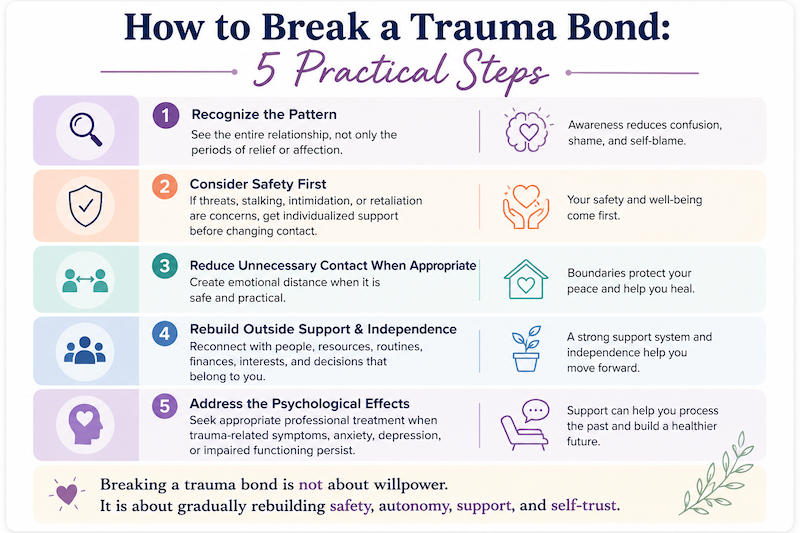
Step 1: Name and Acknowledge the Bond
You cannot break what you will not name. Acknowledging that you are in a trauma bond, rather than a normal rough patch, shifts you from confusion to clarity. Try writing down the pattern as you have experienced it, including the harm and the moments of kindness. Seeing the cycle on paper makes it harder for your mind to minimize or romanticize what is happening.
Step 2: Establish No Contact or Firm Boundaries
Distance is one of the most powerful tools for breaking a trauma bond when it is safe to create it. When it is safe and practical, reducing unnecessary contact may help create emotional distance and reduce repeated exposure to conflict, manipulation, or pressure. If there is any risk of retaliation, make a safety plan before changing contact. If full no contact is not realistic, such as when you share children, aim for low contact with strict boundaries, keeping communication brief, factual, and limited to essentials. Blocking on social media and avoiding their updates protects you from being pulled back in.
Step 3: Rebuild Your Support Network
Isolation is one of the abuser’s most effective tools, so reconnection is one of your most effective remedies. Reach out to the friends and family you may have drifted from, even if you feel embarrassed. Support groups, whether in person or online, can be especially powerful because they connect you with others who understand the pull of a trauma bond without judgment. You do not have to explain everything at once. You only have to let someone back in.
Step 4: Reconnect With Your Own Identity
Trauma bonds often erode your sense of self until your moods rise and fall with someone else’s behavior. Reclaiming your identity means rediscovering what you enjoy, what you value, and what you want for your own life. Small steps count, such as returning to a hobby, spending time in nature, or simply noticing your own preferences again. Each act of self-reconnection reminds your brain that you existed, fully and worthily, before this relationship.
Step 5: Seek Trauma-Informed Therapy
Professional support can be helpful when emotional attachment, trauma-related symptoms, anxiety, depression, safety concerns, or relationship patterns continue to interfere with daily life. A trauma-informed therapist can help you understand what happened, address current symptoms, rebuild self-trust, and develop boundaries appropriate to your circumstances.
Evidence-based treatment should be selected according to the individual’s symptoms, diagnosis, history, preferences, and treatment needs.
Why Separation From a Trauma Bond Can Feel So Difficult
Separation from an abusive relationship can produce intense and sometimes conflicting emotions. You may miss the person, question your decision, remember positive experiences, feel lonely, worry about the other person’s well-being, or experience a strong urge to reconnect. Those feelings do not prove that returning to the relationship is the healthiest or safest choice.
After separation, some women may experience:
- Urges to contact the person
- Anxiety, restlessness, or waves of panic
- Obsessive thoughts and replaying of memories
- Deep loneliness and a sense of emptiness
- Physical symptoms such as trouble sleeping or changes in appetite
- Guilt and a powerful urge to check on or rescue the other person
These symptoms often ease with time, distance, support, and treatment, even though they can feel overwhelming in the moment. Many survivors find it encouraging to learn the signs you are healing from narcissistic abuse, because recognizing progress helps counter the pull to return.
How Long Does It Take to Break a Trauma Bond?
One of the most common questions survivors ask is how long does it take to break a trauma bond. The honest answer is that there is no fixed timeline, because so much depends on the length and intensity of the relationship, how often the cycle is repeated, your support system, and whether you can maintain distance.
Recovery can look different from one person to another. Emotional attachment may lessen gradually, and difficult feelings can temporarily return after contact, anniversaries, legal issues, loneliness, or other reminders. A difficult period does not erase the progress that came before it. The wider journey of recovery, explored in how long it takes to get over narcissistic abuse, reminds us that the goal is not speed but freedom. What matters is the overall direction of your life, not a perfect record.
Healing After Breaking a Trauma Bond
Breaking the bond is the beginning of healing, not the end. Once the immediate pull loosens, deeper work becomes possible. This is the stage where you rebuild self-trust, examine the beliefs that made the bond possible, and learn to recognize healthy relationships when they appear.
Self-compassion is essential here. Many survivors are harder on themselves than anyone else could be, blaming themselves for staying as long as they did. Remember that you were responding to a powerful pattern of harm, attachment, fear, hope, and relationship dynamics, often while isolated and exhausted. Healing also means relearning your own warning signals so that you can trust your instincts again. Over time, the relationship that once consumed your thoughts becomes a chapter rather than the whole story, and your capacity for genuine connection returns.
As you grow stronger, it helps to define what a healthy connection looks like for you, so future relationships are measured against a clear standard rather than against the chaos you came from. Notice how a safe person makes you feel calmer rather than anxious, respects your boundaries without punishment, and remains consistent rather than swinging between extremes. Many survivors also find meaning in helping others or channeling their experience into advocacy, which can transform a painful past into a source of strength and purpose.
When to Seek Professional Support
Trauma bonds are genuinely hard to break alone, and there is no shame in needing help. Professional support is especially important if you feel unable to maintain distance, if the bond is affecting your physical or mental health, or if you have tried to leave before and been pulled back. A trauma-focused treatment program can give you structure, safety, and skilled guidance during the most vulnerable phase of leaving.
If your situation involves any threat to your safety, please prioritize a careful plan and consider contacting a domestic violence advocate or hotline, where trained professionals can help you leave as safely as possible. In the U.S., you can contact the National Domestic Violence Hotline or thehotline.org. Reaching out is not a sign of weakness. It is one of the bravest and most protective things you can do for yourself.
How to Break a Trauma Bond: Frequently Asked Questions
Can you break a trauma bond on your own?
Some people do break a trauma bond alone, but it is far harder without support. Isolation is part of what keeps the bond strong, so reconnecting with others and working with a therapist greatly improves your chances. Professional help is especially valuable when safety is a concern.
How do I know if it is love or a trauma bond?
Healthy love is generally steady, safe, respectful, and mutual, while a trauma bond is organized around an anxious cycle of harm, relief, and hope. If you feel relief rather than security, repeatedly excuse harmful behavior, or cannot leave despite real pain, you may be experiencing a trauma bond rather than love.
Why do I miss someone who hurt me?
Missing an abuser is a normal part of trauma bonding, not a sign you should return. Your brain associates that person with both pain and comfort because of intermittent reinforcement. The longing is part of the attachment and withdrawal-like response created by intermittent reinforcement, and it can fade as you maintain distance and receive support.