
Signs you are healing from narcissistic abuse may begin appearing long before you feel completely recovered. You may notice that you trust your judgment a little more, feel less responsible for another person’s emotions, set a boundary without immediately regretting it, or recognize a trigger without allowing it to control the rest of your day.
Those changes can seem small. They are not.
Recovery from prolonged emotional or psychological abuse is rarely a single moment when everything suddenly feels better. It is usually a gradual process of rebuilding self-trust, emotional stability, healthy boundaries, relationships, and a sense of identity that may have become distorted during an unhealthy or abusive relationship.
Importantly, the term “narcissistic abuse” describes patterns of harmful behavior. A person does not need to diagnose a former partner with narcissistic personality disorder in order to recognize manipulation, gaslighting, coercive control, humiliation, exploitation, or other emotionally abusive behaviors.
If you are wondering whether the work you have been doing is actually helping, these seven signs you are healing from narcissistic abuse can help you recognize progress that may otherwise be easy to overlook.
7 Signs You Are Healing From Narcissistic Abuse
1. You Trust Your Own Perceptions Again
One of the most important changes in recovery is the return of self-trust.
In an emotionally abusive relationship, repeated denial, blame shifting, criticism, manipulation, or gaslighting can leave a person questioning what she saw, heard, felt, or remembered.
You may have become accustomed to asking yourself:
- Am I overreacting?
- Was that really as bad as I thought?
- Maybe this was my fault.
- Did I misunderstand what happened?
Healing does not necessarily mean that you never question yourself. Healthy people reconsider their perceptions sometimes.
The difference is that you no longer automatically assume that someone else’s interpretation must be more accurate than your own.
You become increasingly able to examine a situation, consider the evidence, acknowledge your feelings, and reach your own conclusion. That growing confidence in your judgment is an important sign of recovery.
If you are still trying to understand how prolonged emotional abuse can affect self-trust, anxiety, sleep, relationships, and emotional functioning, read our guide to the long-term effects of narcissistic abuse.
2. Your Boundaries Become Clearer
Another sign you are healing from narcissistic abuse is that boundaries begin to feel less like an act of aggression and more like a normal part of a healthy relationship.
During an abusive or controlling relationship, you may have learned that saying no resulted in anger, withdrawal, criticism, guilt, punishment, or another attempt to change your decision.
Over time, avoiding conflict can become easier than expressing a need.
Recovery often involves relearning that you are allowed to have preferences, limits, privacy, opinions, and needs.
You may notice that you can say:
- No, I’m not comfortable with that.
- I need some time to think.
- That doesn’t work for me.
- I disagree.
- I don’t want to discuss that.
And then something important happens: you do not spend the next six hours constructing a legal defense for why you were allowed to say it.
Healthy boundaries do not require another person’s approval to exist.
3. You Feel Less Responsible for Other People’s Emotions
Women recovering from emotionally abusive relationships sometimes become extremely attentive to other people’s moods.
A change in tone, facial expression, text message, or silence can immediately trigger the question: “What did I do?”
That response can develop after spending significant time trying to anticipate conflict or prevent another person’s reactions.
As healing progresses, you become better able to separate empathy from responsibility.
You can care that someone is disappointed without assuming you caused the disappointment. You can tolerate another person’s frustration without abandoning your boundary. You can recognize that another adult is responsible for managing her or his own emotions and behavior.
That distinction is enormous.
It means your emotional life is no longer organized entirely around keeping someone else emotionally regulated.
4. Triggers Have Less Control Over Your Life
Recovery does not necessarily mean that every reminder of the relationship disappears or that you never experience a strong emotional reaction again.
A more realistic sign of healing is that triggers begin to have less power over what happens next.
You may still notice anxiety, sadness, anger, fear, or physical tension when something reminds you of the relationship. But perhaps the reaction is less intense. Perhaps it passes more quickly. Perhaps you recognize what is happening instead of immediately believing you are back in danger.
Perhaps you can remain present instead of avoiding an entire person, place, activity, or type of relationship because it reminds you of the past.
At Kinder in the Keys, our approach to trauma recovery is not based on teaching women to spend their lives avoiding every possible trigger.
Avoidance can make life progressively smaller.
When trauma symptoms are present, treatment can help women learn to safely process what happened and respond to reminders differently. When someone meets criteria for PTSD, evidence-based trauma-focused treatments may be appropriate.
Learn more about the connection between narcissistic abuse and PTSD.
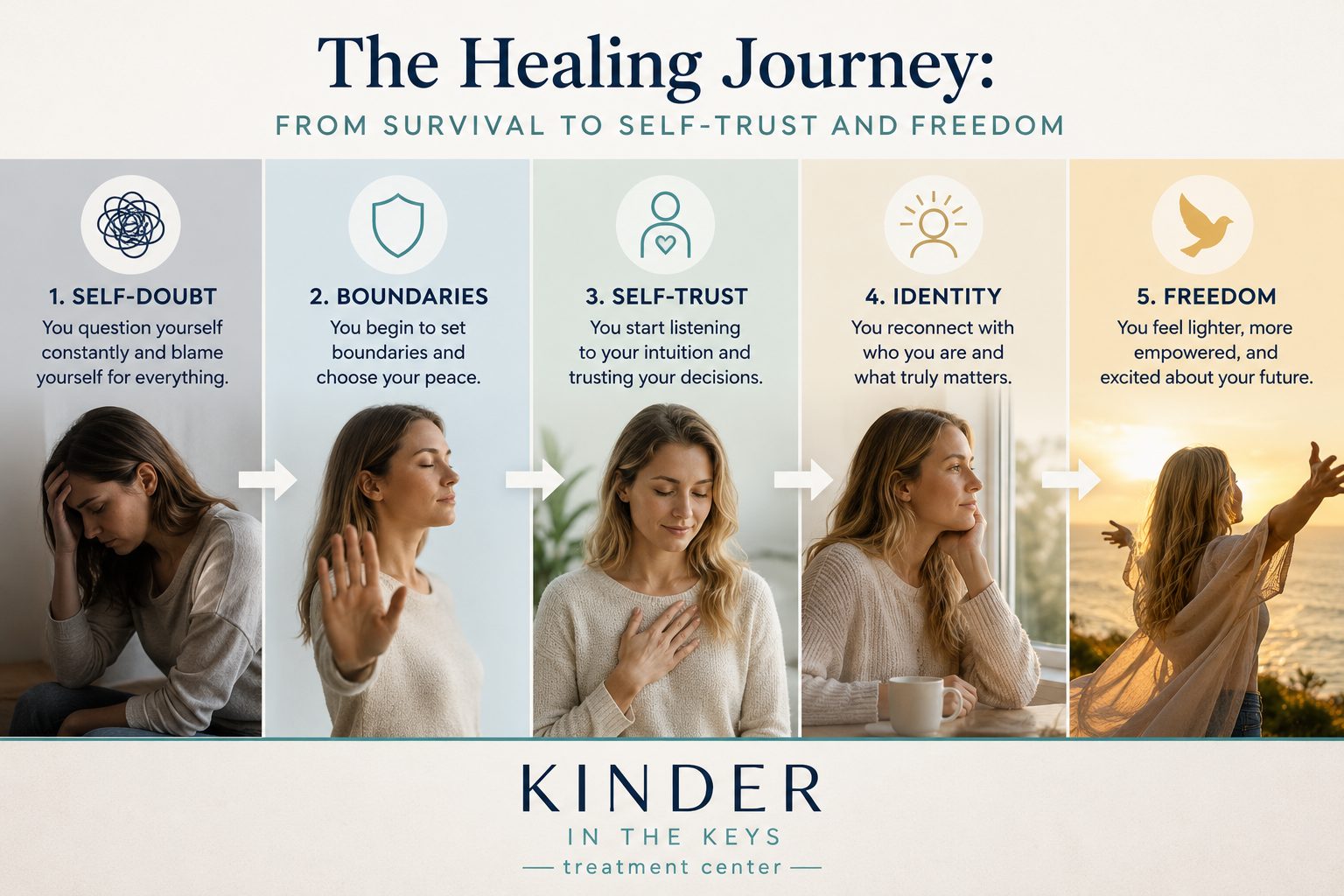
5. Your Identity Begins to Feel Like Your Own Again
Emotional abuse can gradually reorganize a person’s life around another individual’s preferences, reactions, expectations, or criticism.
You may stop doing things you enjoy. You may become disconnected from friends. You may change how you dress, speak, spend money, socialize, or make decisions simply to reduce conflict.
Eventually, a surprisingly difficult question can emerge: “What do I actually want?”
One of the clearest signs of healing is that the answer begins returning.
You may rediscover music you love. You may reconnect with people who matter to you. You may develop new interests. You may make decisions based on your values rather than anticipating someone else’s reaction.
You may even discover that some parts of your identity are different from who you were before the relationship.
Recovery is not necessarily about becoming the person you were before the abuse. It can also mean becoming a woman who understands herself more clearly now.
6. Healthy Relationships Feel Less Suspicious — and Unhealthy Ones Become Easier to Recognize
After an abusive relationship, both trust and distrust can become complicated.
Some women become overly cautious and assume that closeness will eventually become dangerous. Others may recognize familiar relationship patterns only after becoming deeply involved again.
Healing often brings greater discrimination rather than simply “trusting people again.”
You begin paying attention to consistency:
- Do someone’s words match her or his behavior?
- Can that person tolerate disagreement?
- Do they respect boundaries?
- Can they apologize without immediately shifting blame?
- Can you have needs without being punished for them?
You may also become less attracted to emotional intensity simply because it feels familiar.
Healthy relationships are not relationships without disagreement. They are relationships in which disagreement does not require fear.
Understanding the stages of narcissistic abuse can also help you recognize relationship patterns that previously felt confusing.
7. Your Life Becomes About More Than What Happened to You
This may be one of the most meaningful signs of recovery.
For a period of time, understanding the abusive relationship may occupy enormous mental space.
You replay conversations. You search for explanations. You try to understand why someone behaved the way they did. You wonder what was real.
That meaning-making can be part of recovery.
But eventually, healing begins creating room for something else: your future.
You think more about what you want to build than what you need to understand about the other person. Your goals return. Your curiosity returns. Your relationships expand.
Your attention shifts from “Why did this happen to me?” toward “What do I want my life to become now?”
The experience remains part of your history. It simply stops being the organizing principle of your identity.
Healing Does Not Mean You Never Have a Difficult Day
Recovery is not a straight line.
A difficult anniversary, unexpected contact, relationship conflict, legal issue, family interaction, or seemingly ordinary reminder can temporarily bring old emotions back.
That does not erase the progress you have made.
A better way to evaluate healing is to look at patterns over time:
- Are difficult reactions happening less frequently?
- Do you recover more quickly?
- Are you making decisions differently?
- Are your relationships healthier?
- Do you trust yourself more?
- Are you able to tolerate emotions without immediately trying to escape them?
- Is your life becoming larger rather than smaller?
Those changes matter more than whether you occasionally have a difficult day.
If you are wondering about the length of the recovery process, read How Long Does It Take to Get Over Narcissistic Abuse?
When Healing Feels Stuck
Not everyone recovering from narcissistic or emotional abuse needs intensive mental health treatment.
Many women make meaningful progress through outpatient psychotherapy, supportive relationships, education, time, and increased safety.
However, additional treatment may be appropriate when trauma-related symptoms continue to significantly interfere with daily life.
Consider seeking professional evaluation when you continue experiencing problems such as:
- Severe anxiety or depression
- Intrusive memories or nightmares
- Persistent hypervigilance
- Significant sleep disruption
- Emotional numbness
- Inability to function effectively at work or home
- Repeated unhealthy relationship patterns
- Overwhelming emotional reactions
- Severe avoidance
- Difficulty feeling safe even after the relationship has ended
When PTSD is present, trauma-focused psychotherapies such as Cognitive Processing Therapy, Prolonged Exposure, and EMDR are among the treatments with the strongest evidence.
External resource: National Center for PTSD — PTSD Treatment Basics
If you are currently in an abusive or controlling relationship, treatment planning and safety planning are not necessarily the same thing. Personal safety should be considered carefully, particularly when leaving or changing an abusive relationship.
External resource: National Domestic Violence Hotline — Safety Planning
When Residential Treatment May Be Appropriate
Residential treatment is not necessary simply because someone has experienced narcissistic abuse.
A higher level of care may be considered when trauma, PTSD, anxiety, depression, emotional dysregulation, or related symptoms have become severe enough to substantially interfere with daily functioning, or when outpatient treatment has not provided enough support.
At Kinder in the Keys, our women-only residential mental health program addresses the psychological effects that may remain after abusive relationships—including trauma symptoms, PTSD when diagnostic criteria are met, anxiety, depression, self-worth, emotional regulation, relationship patterns, and difficulty rebuilding life after abuse.
Learn more about specialized therapy for narcissistic abuse.
Moving Forward: Recovery Is About Reclaiming Your Life
The most important signs you are healing from narcissistic abuse are not about forgetting what happened.
They are about what has begun happening inside you.
You trust yourself more. Your boundaries become clearer. Other people’s emotions stop determining every decision you make. Triggers have less control. Your identity becomes stronger. Your relationships become healthier.
And gradually, your future begins occupying more space than your past.
Healing does not require another person to apologize, understand what they did, agree with your version of events, or give you closure.
Your recovery belongs to you.
And eventually, the goal is not simply to become better at surviving what happened. It is to build a life that is no longer organized around it.
Frequently Asked Questions About Signs You Are Healing From Narcissistic Abuse
How do I know if I am actually healing from narcissistic abuse?
Look for changes in patterns rather than expecting one dramatic moment. Increased self-trust, stronger boundaries, improved emotional regulation, healthier relationships, reduced avoidance, and a stronger sense of identity can all indicate progress.
Is it normal to still get triggered while healing?
Yes. Experiencing an emotional reaction to a reminder does not necessarily mean recovery has failed. Progress may instead appear as less intense reactions, faster recovery, better coping, or a greater ability to remain engaged with everyday life.
Why do I still doubt myself after the relationship has ended?
Repeated criticism, manipulation, blame shifting, or gaslighting can affect confidence in your own judgment. Rebuilding self-trust may take time and can be an important focus of psychotherapy.
How long does healing from narcissistic abuse take?
There is no universal timeline. Recovery can be influenced by the duration and severity of the relationship, other traumatic experiences, current safety, social support, mental health symptoms, and access to appropriate treatment.
Does everyone who experiences narcissistic abuse develop PTSD?
No. Emotional or psychological abuse can have significant mental health effects without necessarily meeting diagnostic criteria for PTSD. PTSD requires specific diagnostic criteria and should be evaluated by a qualified clinician.
When should I consider professional treatment?
Consider professional support when symptoms are persistent, worsening, causing significant distress, interfering with daily functioning, affecting relationships or work, or when you feel unable to make meaningful progress with your current level of support.
Medically Reviewed By
Dr. Laura Tanzini, DrPH, LMFT
Doctor of Public Health | Specialty in Lifestyle Medicine
Licensed Marriage and Family Therapist (Florida & California)
Founder & CEO, Kinder in the Keys
Doctoral Research: Dr. Tanzini’s doctoral research at Loma Linda University examined childhood and adult traumatic events, cumulative trauma exposure, gender, forgiveness, life satisfaction, and long-term well-being.
This article has been clinically reviewed for accuracy and consistency with current behavioral health and trauma-informed care principles. Content is intended to provide general educational information and should not replace individualized evaluation, diagnosis, or treatment by a qualified healthcare professional.
Medical Disclaimer
The information provided in this article is for educational and informational purposes only and is not intended as medical advice, diagnosis, or treatment. Mental health needs vary by individual. If you are experiencing symptoms of PTSD or another mental health condition, consult a qualified healthcare professional who can evaluate your individual circumstances.