
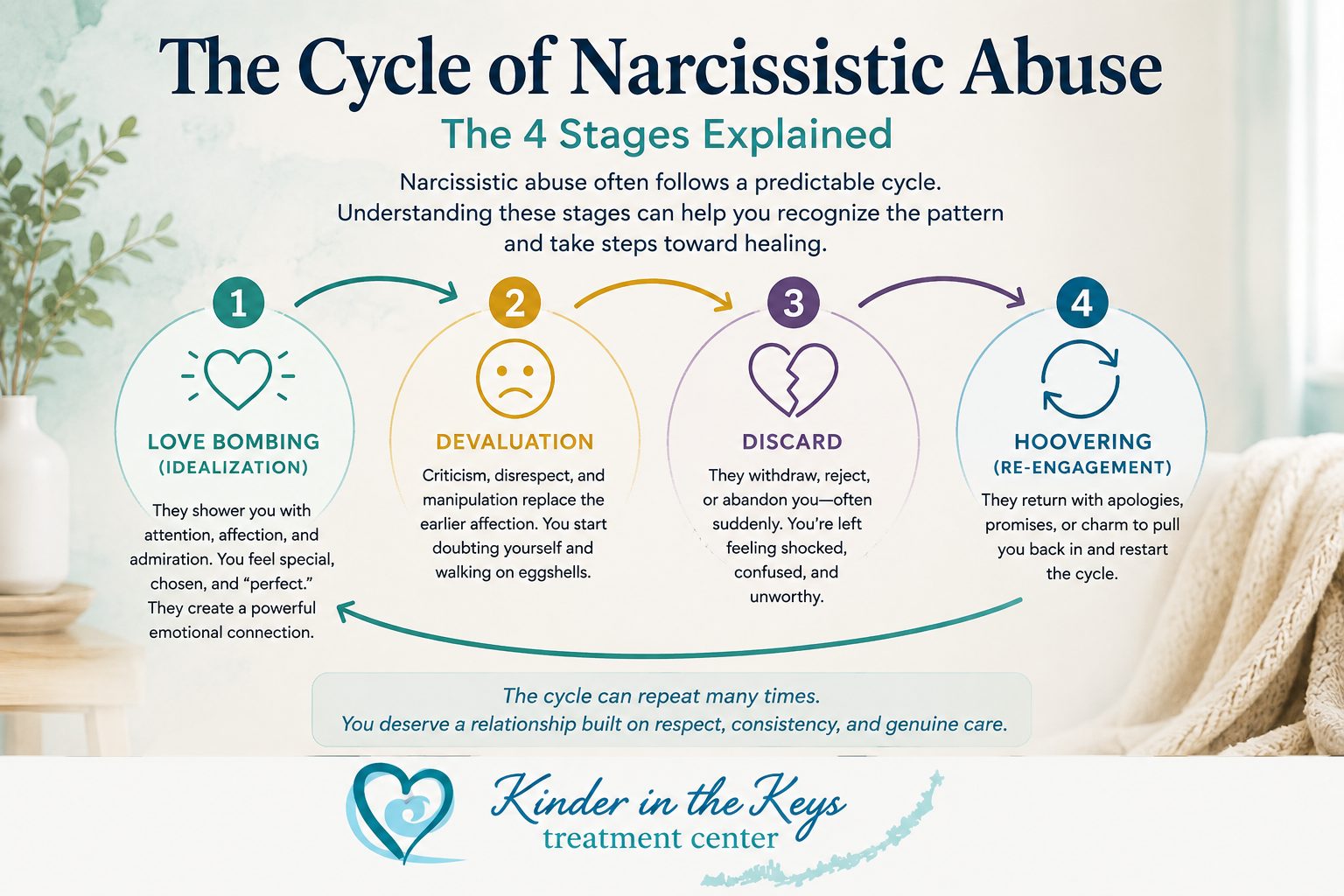
The stages of narcissistic abuse are often described as a repeating pattern of love bombing or idealization, devaluation, discard, and hoovering. Recognizing these patterns can help make sense of a relationship that once felt intensely loving but later became confusing, controlling, or emotionally harmful.
These four stages are not a formal diagnosis, and every abusive relationship does not follow them in the same order or with the same intensity. Some relationships move back and forth between phases, skip a phase entirely, or include other forms of emotional abuse and coercive control.
The term “narcissistic abuse” is commonly used to describe patterns of manipulation, gaslighting, humiliation, exploitation, excessive control, blame shifting, and disregard for another person’s boundaries. Recognizing those behaviors does not require diagnosing the other person with narcissistic personality disorder.
Understanding the pattern is useful because it shifts attention away from trying to determine why another person behaved a certain way and toward a more important question: What has been happening in this relationship, and how has it affected you?
What Is Narcissistic Abuse?
Narcissistic abuse is not a DSM-5-TR diagnosis. It is a commonly used description for emotionally or psychologically abusive relationship patterns that may involve manipulation, gaslighting, intimidation, humiliation, isolation, exploitation, coercive control, or repeated violations of boundaries.
Emotional abuse can occur in relationships whether or not the person engaging in abusive behavior has a personality disorder. For that reason, the clinically useful focus is the pattern of behavior and its impact—not attempting to diagnose another person from a distance.
The American Psychological Association describes psychological aggression and coercive control as forms of intimate partner violence that can include humiliation, isolation, monitoring, threats, financial control, and restricting a partner’s independence. APA information on intimate partner violence
Women exposed to prolonged emotional abuse may experience anxiety, depression, sleep disruption, diminished self-esteem, hypervigilance, difficulty trusting themselves or others, and trauma-related symptoms. These effects vary by individual and do not automatically mean someone has PTSD.
For a fuller discussion of what may persist after an abusive relationship, see Long-Term Effects of Narcissistic Abuse.
The 4 Common Stages of Narcissistic Abuse
The four-stage model can be a helpful way to recognize a recurring relationship pattern. It should be understood as a descriptive framework rather than a universal clinical sequence.
Stage 1: Love Bombing or Idealization
The first stage is commonly described as love bombing or idealization. The relationship may develop with unusual intensity: frequent communication, strong praise, rapid emotional closeness, extravagant attention, gifts, or early conversations about a shared future.
Not every enthusiastic beginning is love bombing. Healthy relationships can begin with excitement and affection. The concern is the larger pattern—especially when intense attention is followed by pressure, control, instability, or punishment when the other person does not respond as expected.
In hindsight, a woman may recognize that the early intensity created a powerful contrast with what came later. She may continue trying to recover the warmth, attention, or security she experienced at the beginning even after the relationship has become harmful.
Stage 2: Devaluation
During devaluation, the tone of the relationship changes. Praise and admiration may be replaced by criticism, contempt, withdrawal, unpredictable affection, blame shifting, humiliation, or repeated questioning of the other person’s perceptions.
Gaslighting may occur when someone repeatedly denies events, rewrites conversations, or dismisses another person’s perceptions in ways that cause her to doubt her own memory or judgment.
A woman may begin monitoring her words, behavior, appearance, friendships, or emotional reactions in an effort to prevent conflict. She may apologize frequently, suppress her needs, or spend increasing amounts of energy trying to determine what she did wrong.
The important issue is not whether every hurtful interaction fits a label. It is whether a persistent pattern of behavior is eroding safety, autonomy, self-trust, or emotional well-being.
Examples of specific abusive behaviors are discussed in 15 Narcissistic Abuse Examples.
Stage 3: Discard or Withdrawal
The third stage is often called discard. This may involve abruptly ending the relationship, withdrawing affection, becoming emotionally unavailable, threatening separation, replacing the relationship with another source of attention, or repeatedly leaving and returning.
The emotional impact can be especially intense when the withdrawal follows a long period of trying to restore the relationship to its earlier state.
Some women respond by trying harder to repair the relationship, accepting responsibility for problems they did not create, or abandoning their own boundaries in hopes of restoring connection.
Attachment does not disappear simply because someone recognizes that a relationship has become unhealthy. Grief, relief, anger, longing, confusion, and fear can coexist after separation.
If you are struggling with the emotional aftermath, our article on signs you are healing from narcissistic abuse explains what recovery may begin to look like.
Stage 4: Hoovering or Re-Engagement
Hoovering is a popular term for attempts to re-establish contact after distance or separation. It may involve apologies, affectionate messages, gifts, promises of change, reminders of positive memories, contact through friends or family, or renewed expressions of commitment.
An attempt to reconnect does not by itself prove manipulation, nor can anyone know another person’s motivation with certainty. What matters is whether the broader pattern has actually changed.
Promises are different from sustained behavior. Meaningful change is demonstrated over time through accountability, respect for boundaries, consistent behavior, and a willingness to accept consequences—not simply through an emotional conversation or temporary return to affection.
When reconciliation is followed by renewed criticism, control, intimidation, or devaluation, the relationship may return to the same harmful cycle.
Why the Cycle Can Be Difficult to Leave
Abusive relationships are not difficult to leave because the person experiencing abuse is weak. Relationships can involve attachment, shared history, children, finances, housing, social isolation, fear, hope, grief, and periods of genuine affection alongside harmful behavior.
Intermittent periods of closeness and distress can make the relationship especially confusing. A woman may continue hoping that the earlier version of the relationship will return, particularly when periods of conflict are followed by apologies or renewed affection.
Coercive control can create additional barriers by limiting access to money, transportation, friends, family, communication, or independent decision-making.
If this pattern sounds familiar, read more about coercive control and emotional abuse.
Recognizing the Pattern Without Diagnosing the Person
One of the most important distinctions in understanding the stages of narcissistic abuse is separating recognition of harmful behavior from diagnosis.
Narcissistic personality disorder is a clinical diagnosis that requires assessment by a qualified professional. A partner may behave selfishly, manipulatively, abusively, or controlling without meeting criteria for NPD.
You do not need another person’s diagnosis to take your own experience seriously.
A more useful set of questions may be:
- Do I feel safe expressing disagreement?
- Are my boundaries respected?
- Am I routinely blamed for another person’s behavior?
- Do I frequently question my memory or judgment after conversations?
- Have I become isolated from supportive people?
- Am I afraid of what will happen if I say no?
- Has my world become smaller because I am constantly trying to prevent conflict?
Those questions focus on what is happening to you rather than requiring certainty about another person’s personality.
What Happens After You Recognize the Cycle?
Recognition can be clarifying, but it can also bring grief. Understanding a harmful pattern may mean reconsidering years of experiences, questioning what was healthy and what was not, and deciding what you want your life to look like moving forward.
Recovery may involve rebuilding self-trust, strengthening boundaries, reconnecting with supportive relationships, processing traumatic experiences, addressing anxiety or depression, and learning to recognize healthier relationship patterns.
There is no universal recovery timeline. See How Long Does It Take to Get Over Narcissistic Abuse? for a discussion of the factors that can affect healing.
When Professional Treatment May Help
Not everyone who experiences emotional or narcissistic abuse needs residential treatment. Many women recover with outpatient psychotherapy, increased safety, supportive relationships, and time.
Professional evaluation may be helpful when symptoms such as anxiety, depression, intrusive memories, nightmares, hypervigilance, severe avoidance, emotional numbness, sleep disruption, or difficulty functioning continue to interfere with everyday life.
PTSD is a specific diagnosis and does not automatically result from narcissistic or emotional abuse. When PTSD diagnostic criteria are met, trauma-focused psychotherapies have strong evidence supporting their use.
The VA National Center for PTSD identifies Cognitive Processing Therapy (CPT), Prolonged Exposure (PE), and Eye Movement Desensitization and Reprocessing (EMDR) among the trauma-focused psychotherapies with the strongest evidence for PTSD. National Center for PTSD — Overview of Psychotherapy for PTSD
Learn more about Kinder’s specialized therapy for narcissistic abuse.
When Residential Treatment May Be Appropriate
A residential level of care may be considered when trauma-related symptoms, PTSD, anxiety, depression, emotional dysregulation, or related difficulties have become severe enough to substantially interfere with sleep, work, relationships, safety, or daily functioning, or when outpatient treatment has not provided enough support.
At Kinder in the Keys, our women-only residential mental health program can address the psychological effects that remain after abusive relationships, including trauma symptoms, PTSD when diagnostic criteria are met, anxiety, depression, diminished self-worth, emotional regulation difficulties, and unhealthy relationship patterns.
Treatment is individualized. EMDR may be used when clinically indicated as part of a broader treatment plan.
Moving Forward After Narcissistic Abuse
Understanding the stages of narcissistic abuse can give language to a relationship that may have felt impossible to explain.
But the purpose of recognizing the cycle is not to spend the rest of your life analyzing another person.
It is to understand what happened well enough that the pattern no longer controls what happens next.
You can rebuild trust in your own perceptions. You can establish boundaries without apologizing for having them. You can learn that disagreement does not have to mean danger. You can build relationships where affection is not repeatedly exchanged for control.
Eventually, recovery can become less about understanding the person who hurt you and more about understanding the life you want to build for yourself.
Frequently Asked Questions About the Stages of Narcissistic Abuse
What are the four stages of narcissistic abuse?
The commonly described four stages are love bombing or idealization, devaluation, discard, and hoovering or re-engagement. This is a descriptive framework, not a formal diagnostic sequence, and not every abusive relationship follows all four stages.
Does every narcissistic relationship follow the same cycle?
No. Relationship patterns vary. Some relationships may move repeatedly between affection and devaluation, while others may involve prolonged control, withdrawal, intimidation, or other forms of abuse without following a predictable sequence.
Is love bombing always abusive?
No. Intense affection at the beginning of a relationship is not automatically abusive. Concern increases when intense attention is part of a larger pattern that later includes manipulation, pressure, control, punishment, or repeated disregard for boundaries.
What is hoovering after narcissistic abuse?
Hoovering is a popular term for attempts to re-establish contact or connection after distance or separation. The important question is not the label or presumed motivation, but whether the relationship demonstrates sustained accountability, respect for boundaries, and meaningful behavioral change.
Do I need to know whether my partner has narcissistic personality disorder?
No. Narcissistic personality disorder requires professional assessment. You can recognize emotional abuse, coercive control, manipulation, or unsafe relationship patterns without diagnosing the other person.
Can narcissistic abuse cause PTSD?
Emotional and psychological abuse can have serious mental health effects, but PTSD is a specific diagnosis with defined criteria. Some abusive relationships include traumatic experiences capable of contributing to PTSD, while others may result in significant trauma-related symptoms without meeting full PTSD criteria.
Medically Reviewed By
Dr. Laura Tanzini, DrPH, LMFT
Doctor of Public Health | Specialty in Lifestyle Medicine
Licensed Marriage and Family Therapist (Florida & California)
Founder & CEO, Kinder in the Keys
Doctoral Research: Dr. Tanzini’s doctoral research at Loma Linda University examined childhood and adult traumatic events, cumulative trauma exposure, gender, forgiveness, life satisfaction, and long-term well-being.
This article has been clinically reviewed for accuracy and consistency with current behavioral health and trauma-informed care principles. Content is intended to provide general educational information and should not replace individualized evaluation, diagnosis, or treatment by a qualified healthcare professional.
Medical Disclaimer
The information provided in this article is for educational and informational purposes only and is not intended as medical advice, diagnosis, or treatment. Mental health needs vary by individual. If you are experiencing symptoms of PTSD or another mental health condition, consult a qualified healthcare professional who can evaluate your individual circumstances.