
Narcissistic abuse examples can include gaslighting, repeated criticism, isolation, financial control, humiliation, blame shifting, manipulation, and other behaviors that gradually undermine a person’s confidence, independence, or sense of reality.
The term “narcissistic abuse” is commonly used to describe patterns of emotional or psychological abuse associated with controlling, exploitative, or narcissistic behaviors. It is not a formal DSM-5-TR diagnosis, and recognizing abuse does not require diagnosing another person with narcissistic personality disorder.
That distinction matters. A person can behave in manipulative, controlling, intimidating, or emotionally abusive ways whether or not she or he has a personality disorder. The clinically important questions are what behaviors are occurring, whether there is a pattern, and how those behaviors are affecting you.
Individual disagreements, insensitive comments, or relationship mistakes do not automatically constitute abuse. Concern increases when harmful behaviors become persistent, repeatedly violate boundaries, or leave one person increasingly afraid, isolated, dependent, or unsure of her own perceptions.
What Is Narcissistic Abuse?
Narcissistic abuse is not a DSM-5-TR diagnosis. It is a commonly used description for emotionally or psychologically abusive relationship patterns that may involve manipulation, gaslighting, intimidation, humiliation, isolation, exploitation, coercive control, or repeated violations of boundaries.
Emotional abuse can occur whether or not the person engaging in abusive behavior has a personality disorder. For that reason, the useful focus is the pattern of behavior and its impact—not attempting to diagnose another person from a distance.
Women exposed to prolonged emotional abuse may experience anxiety, depression, sleep disruption, diminished self-esteem, hypervigilance, difficulty trusting themselves or others, and trauma-related symptoms. These effects vary by individual and do not automatically mean someone has PTSD.
For a fuller discussion, see Long-Term Effects of Narcissistic Abuse.
15 Narcissistic Abuse Examples
1. Gaslighting
Gaslighting involves repeatedly denying, distorting, or rewriting events in ways that cause another person to question her memory, perceptions, or judgment.
Example: You clearly remember a conversation, but the other person repeatedly insists that it never happened, even when there is evidence supporting your memory.
2. Constant Criticism and Belittling
Repeated criticism can move beyond ordinary relationship feedback and become a pattern of attacking a person’s appearance, intelligence, competence, parenting, career, emotions, or worth.
Example: Small mistakes are repeatedly used as evidence that you are incompetent, too sensitive, or incapable of making good decisions.
3. Blame Shifting
Blame shifting occurs when responsibility for harmful behavior is repeatedly transferred to the person who was harmed.
Example: After yelling at you, the other person says that you caused the yelling by upsetting them.
4. Emotional Manipulation
Emotional manipulation may involve guilt, shame, fear, obligation, threats of withdrawal, or other pressure intended to influence another person’s choices.
Example: When you try to spend time with friends, you are told that if you really cared about the relationship, you would stay home.
5. Isolation From Friends and Family
Isolation may occur gradually through criticism of supportive people, conflict before social events, monitoring communication, or making outside relationships increasingly difficult.
Example: Every time you plan to see your family, an argument begins or you are told that your relatives are interfering with the relationship.
6. Financial Control
Financial abuse can include restricting access to money, monitoring every purchase, preventing employment, creating debt in another person’s name, withholding financial information, or making someone financially dependent.
Example: You earn income but are not allowed access to accounts or must justify every basic purchase.
7. Love Bombing Followed by Devaluation
Some harmful relationships involve periods of intense affection or idealization followed by criticism, withdrawal, contempt, or rejection.
Example: Early in the relationship you receive constant attention and praise. Later, affection becomes unpredictable and is repeatedly replaced by criticism or emotional withdrawal.
8. Silent Treatment Used as Punishment
Taking time to cool down can be healthy when communicated respectfully. The silent treatment becomes concerning when prolonged withdrawal is repeatedly used to punish, frighten, control, or force compliance.
Example: After you disagree, the other person refuses to acknowledge you for days and resumes communication only after you give in.
9. Triangulation
Triangulation involves bringing another person into a conflict or relationship dynamic in a way that creates competition, jealousy, insecurity, or pressure.
Example: You are repeatedly compared with an ex-partner in ways that make you feel you must compete for approval.
10. Minimizing Your Accomplishments
A persistent pattern of dismissing or belittling achievements can erode confidence and make positive experiences feel unsafe to share.
Example: You receive a promotion and are told that it is not impressive and anyone could have gotten the job.
11. Using Vulnerabilities Against You
Personal information shared in trust may later be used during arguments to humiliate, intimidate, or wound.
Example: You disclose a painful childhood experience and later have that experience mocked or used to discredit your perceptions.
12. Intermittent Affection and Withdrawal
Affection that repeatedly appears and disappears can create confusion, particularly when warmth returns after periods of criticism, hostility, or emotional withdrawal.
Example: After several days of coldness or conflict, the relationship suddenly becomes intensely affectionate without the underlying problem being addressed.
13. Sabotaging Independence or Success
Controlling behavior may interfere with education, employment, friendships, hobbies, treatment, or other activities that increase independence.
Example: Each time you pursue a new opportunity, the other person creates a crisis, ridicules your ability, or pressures you to abandon it.
14. Public Humiliation
Humiliation may involve insults, ridicule, revealing private information, cruel jokes, or deliberately embarrassing someone in front of others.
Example: Personal information is shared at a social event as a joke, and when you object you are accused of having no sense of humor.
15. Insults Disguised as Jokes or Compliments
Hurtful remarks may be disguised as humor or praise in ways that make them difficult to challenge.
Example: A compliment is paired with a degrading comment about your age, appearance, intelligence, or competence, and your objection is dismissed as being too sensitive.
How to Tell Whether You Are Seeing a Pattern of Abuse
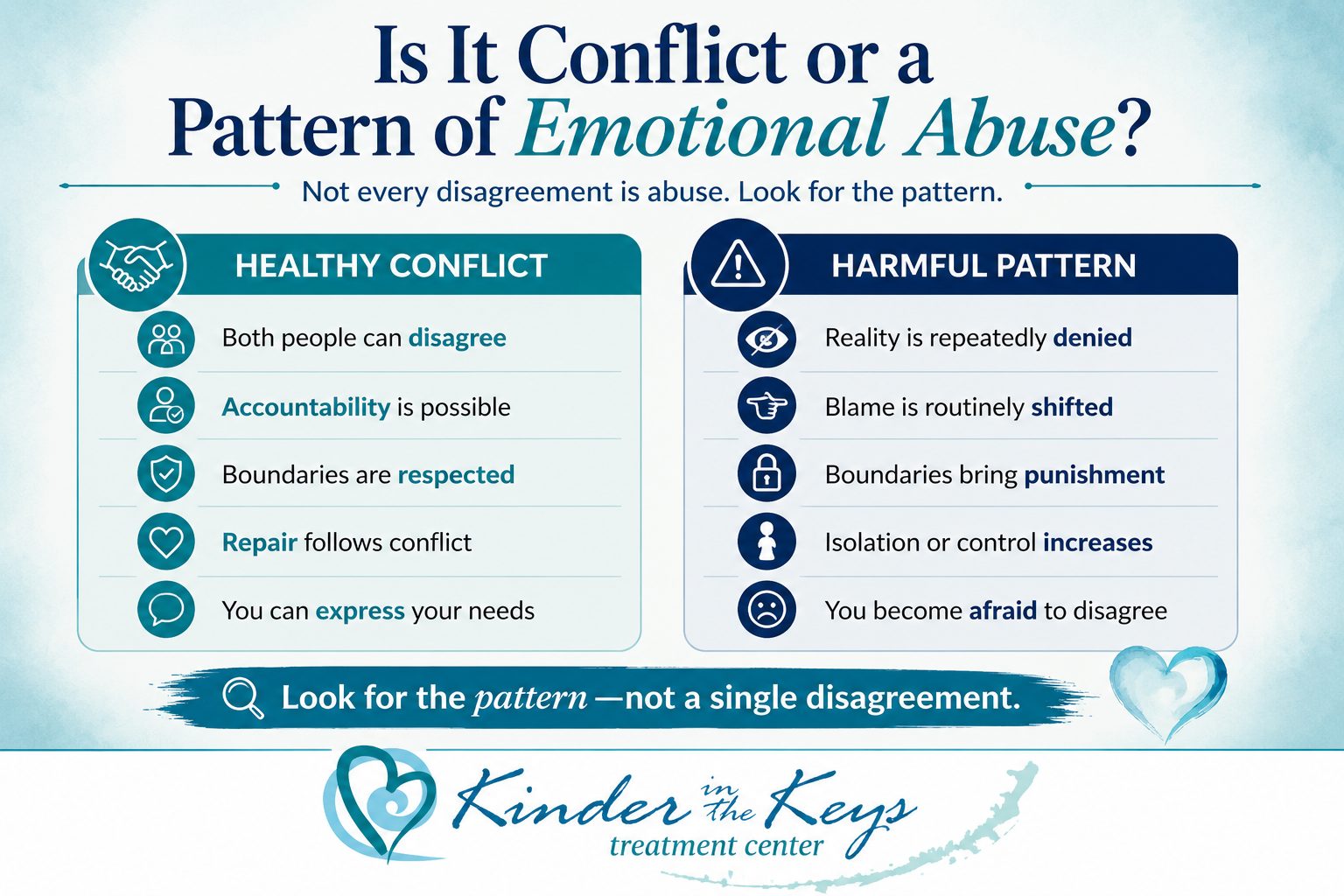
A checklist cannot diagnose a relationship. Context, frequency, severity, fear, power, and the cumulative effect of behavior all matter.
Instead of asking whether one isolated interaction proves narcissistic abuse, consider the broader pattern:
- Do I regularly feel afraid to disagree?
- Are my boundaries repeatedly ignored or punished?
- Do I frequently leave conversations doubting what I remember?
- Have I become isolated from supportive people?
- Am I increasingly dependent on the other person for money, transportation, housing, or social connection?
- Do I routinely accept blame simply to end conflict?
- Has my confidence or sense of identity changed significantly during the relationship?
- Do periods of affection repeatedly alternate with humiliation, control, intimidation, or withdrawal?
Several of these behaviors can also occur within coercive control, a broader pattern in which one person restricts another person’s autonomy through intimidation, monitoring, isolation, financial control, or other forms of domination.
Read more about coercive control.
Narcissistic Abuse Examples vs. the Stages of Narcissistic Abuse
Examples and stages describe two different things. Narcissistic abuse examples describe specific behaviors you may observe, such as gaslighting, blame shifting, isolation, financial control, or humiliation.
The stages of narcissistic abuse describe a commonly discussed relationship pattern over time—often idealization or love bombing, devaluation, discard, and attempts at re-engagement.
To understand that progression, read The 4 Stages of Narcissistic Abuse.
What Narcissistic Abuse Can Do to Self-Trust
One reason emotional abuse can be difficult to recognize is that the person experiencing it may gradually stop trusting her own judgment.
Repeated criticism, reality-denial, blame shifting, isolation, or punishment for setting boundaries can change how a woman evaluates herself and relationships.
She may become highly attentive to another person’s moods, apologize automatically, suppress her own needs, or assume conflict means she has done something wrong.
These responses are not proof of a particular diagnosis. They are reasons to examine the relationship carefully and consider whether professional support would be useful.
For recovery milestones, see Signs You Are Healing From Narcissistic Abuse.
When Safety Is a Concern
Emotional abuse can occur alongside physical violence, sexual violence, stalking, threats, financial abuse, or coercive control.
If you are currently in a relationship where you fear retaliation, violence, stalking, or escalation, safety planning may be more important than confronting the other person about a label.
The National Domestic Violence Hotline provides confidential information and safety-planning resources for people experiencing relationship abuse.
Seeking Professional Help After Narcissistic Abuse
Not everyone who recognizes these narcissistic abuse examples needs intensive mental health treatment. Many women recover through increased safety, supportive relationships, outpatient psychotherapy, and time.
Professional treatment may be helpful when anxiety, depression, intrusive memories, nightmares, hypervigilance, severe avoidance, sleep disruption, diminished self-worth, emotional dysregulation, or relationship difficulties continue to interfere with everyday life.
PTSD is a specific clinical diagnosis and should not be assumed solely because someone experienced emotional abuse. When PTSD criteria are met, evidence-based trauma-focused psychotherapy may be appropriate.
The VA National Center for PTSD identifies CPT, Prolonged Exposure, and EMDR among trauma-focused psychotherapies with strong evidence for PTSD.
Learn more about Kinder’s specialized therapy for narcissistic abuse.
Moving Forward: Recognizing the Behavior Is About Protecting Your Well-Being
Learning narcissistic abuse examples is not about becoming an expert at diagnosing someone else.
It is about becoming better able to recognize behavior that repeatedly harms you.
You are allowed to notice patterns. You are allowed to take your own perceptions seriously. You are allowed to establish boundaries.
And you do not need another person’s diagnosis, agreement, or permission before deciding that a relationship pattern is unhealthy for you.
Recovery can involve understanding what happened, rebuilding trust in yourself, reconnecting with supportive people, and creating relationships in which respect and emotional safety are ordinary rather than something you have to earn.
Frequently Asked Questions About Narcissistic Abuse Examples
What are common examples of narcissistic abuse?
Common examples may include gaslighting, repeated criticism, blame shifting, isolation, financial control, humiliation, manipulation, using vulnerabilities against someone, unpredictable affection and withdrawal, and repeated disregard for boundaries.
Is every selfish or insensitive behavior narcissistic abuse?
No. People can behave selfishly, communicate poorly, or make hurtful mistakes without engaging in an abusive pattern. Abuse is better evaluated by considering repetition, severity, power, control, fear, boundary violations, and cumulative effect.
Can someone be emotionally abusive without having narcissistic personality disorder?
Yes. Emotional abuse is a pattern of behavior, while narcissistic personality disorder is a clinical diagnosis. A person can engage in controlling or abusive behavior without meeting diagnostic criteria for NPD.
Is gaslighting always part of narcissistic abuse?
No. Gaslighting can occur in abusive relationships, but not every emotionally abusive relationship includes gaslighting, and not every disagreement or inaccurate memory is gaslighting.
Why can it be difficult to recognize emotional abuse while it is happening?
Emotional abuse may develop gradually and may occur alongside affection, apologies, shared responsibilities, financial dependence, family ties, or periods when the relationship feels stable. Isolation and repeated questioning of one’s perceptions can make recognition even more difficult.
When should I seek professional help?
Consider professional support when the effects of the relationship are persistent, worsening, causing significant distress, interfering with sleep, work, relationships, or daily functioning, or when you need help evaluating safety and next steps.
Medically Reviewed By
Dr. Laura Tanzini, DrPH, LMFT
Doctor of Public Health | Specialty in Lifestyle Medicine
Licensed Marriage and Family Therapist (Florida & California)
Founder & CEO, Kinder in the Keys
Doctoral Research: Dr. Tanzini’s doctoral research at Loma Linda University examined childhood and adult traumatic events, cumulative trauma exposure, gender, forgiveness, life satisfaction, and long-term well-being.
This article has been clinically reviewed for accuracy and consistency with current behavioral health and trauma-informed care principles. Content is intended to provide general educational information and should not replace individualized evaluation, diagnosis, or treatment by a qualified healthcare professional.
Medical Disclaimer
The information provided in this article is for educational and informational purposes only and is not intended as medical advice, diagnosis, or treatment. Mental health needs vary by individual. If you are experiencing symptoms of PTSD or another mental health condition, consult a qualified healthcare professional who can evaluate your individual circumstances.