
Coercive control is a pattern of behavior used to restrict another person’s freedom, independence, choices, or sense of safety within a relationship. It may involve isolation, intimidation, monitoring, financial restriction, threats, sexual coercion, humiliation, or gradually taking control over ordinary decisions.
Unlike a single argument or one controlling incident, coercive control is about a pattern of power.
A woman may still go to work, socialize occasionally, raise children, manage a household, and appear completely functional to everyone around her while privately organizing much of her life around another person’s reactions.
She may think before making a purchase.
Before calling a friend.
Before choosing what to wear.
Before disagreeing.
Before coming home late.
Before saying no.
Eventually, the question may stop being:
“What do I want?”
and become:
“What can I do without causing a problem?”
That gradual loss of autonomy is one of the defining features of coercive control.
What Is Coercive Control?
Coercive control describes an ongoing pattern in which one person uses behaviors designed to dominate, intimidate, isolate, monitor, exploit, or restrict another person.
The National Domestic Violence Hotline similarly describes abuse as patterns of behavior used to gain or maintain power and control within an intimate relationship.
Physical violence may occur, but it is not required for a relationship to involve serious emotional abuse or coercive control.
The individual behaviors can sometimes appear minor when viewed separately.
A partner wants access to your phone.
Then your passwords.
They dislike one particular friend.
Then several friends.
They question one purchase.
Then begin monitoring the bank account.
They criticize an outfit.
Then tell you what you should wear.
They want to know where you are.
Then require constant updates.
The pattern matters because each restriction can make the next one easier to normalize.
Eventually, a woman may have considerably less freedom than she once did without being able to identify exactly when that changed.
What Does Coercive Control Look Like?
Coercive control does not look identical in every relationship.
Possible behaviors include:
Isolation
A controlling partner may gradually interfere with relationships outside the couple.
This can include:
-
Criticizing friends or family
-
Creating conflict before or after social activities
-
Making a woman feel guilty for spending time away
-
Discouraging outside relationships
-
Interfering with transportation
-
Moving far away from support systems
-
Requiring constant communication while she is away
-
Making social activities so stressful that she eventually stops attending
Sometimes no one explicitly says:
“You are not allowed to see your friends.”
The consequences of seeing them simply become exhausting enough that isolation happens anyway.
Monitoring and Surveillance
Concern and surveillance are not the same thing.
A controlling partner may:
-
Repeatedly demand to know where you are
-
Track your location
-
Read messages
-
Check call histories
-
Require passwords
-
Monitor social media
-
Question who you spoke with
-
Demand immediate responses to texts
-
Review purchases
-
Search belongings
-
Use technology to monitor activity
Technology can make coercive control particularly invasive because monitoring can continue even when the controlling person is physically somewhere else.
Financial Control
Money can become an extremely effective way to restrict someone’s independence.
Financial control may include:
-
Restricting access to bank accounts
-
Requiring permission for purchases
-
Monitoring every expense
-
Preventing or discouraging employment
-
Taking someone’s earnings
-
Creating debt in another person’s name
-
Hiding financial information
-
Providing an inadequate “allowance”
-
Threatening financial consequences
-
Controlling transportation, housing, insurance, or other resources
Financial abuse can make leaving an unhealthy relationship considerably more difficult.
A woman may recognize that she wants to leave while having no independent access to money, housing, transportation, childcare, or other resources she would need to do so safely.
Rules That Only Apply to You
Coercive relationships often contain an unequal set of expectations.
One partner may believe they are entitled to:
-
Privacy while demanding access to yours
-
Spend money while questioning your purchases
-
Socialize freely while restricting your friendships
-
Become angry while criticizing your emotional reactions
-
Make independent decisions while requiring your compliance
-
Say no while treating your no as unacceptable
This is different from two partners negotiating preferences or boundaries.
Healthy relationships allow both people to have autonomy.
Coercive control progressively removes it from one person.
Intimidation and Threats
Not every threat is spoken directly.
Intimidation can include:
-
Destroying property
-
Punching walls
-
Driving dangerously during arguments
-
Standing in doorways or preventing someone from leaving
-
Threatening self-harm to prevent separation
-
Threatening to take children away
-
Threatening pets
-
Threatening financial ruin
-
Threatening humiliation or exposure
-
Making statements designed to imply what could happen if someone disobeys
A woman may begin changing her behavior long before a threat is explicitly stated.
Sometimes the possibility of the reaction becomes enough.
Sexual Coercion
Sexual coercion can also occur within controlling relationships.
This may include persistent pressure after someone says no, guilt, threats, manipulation, intimidation, or making someone feel that refusing sexual activity will result in punishment or retaliation.
Consent within a relationship still requires freedom to choose.
Being married, living together, or having previously consented does not eliminate a person’s right to decline sexual activity.
Control Disguised as Concern
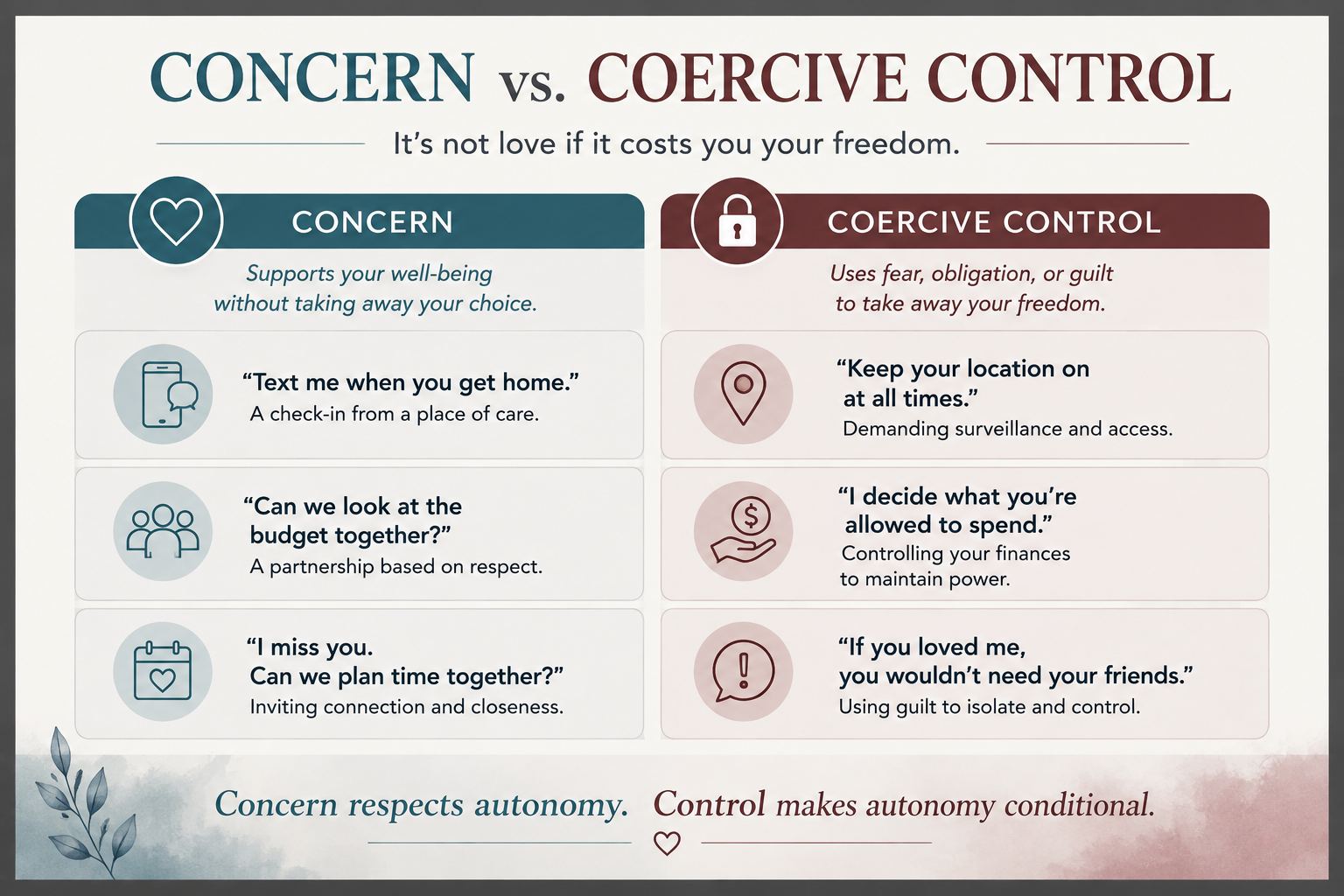
One reason coercive control can be difficult to recognize is that controlling behavior may initially be presented as love, concern, protection, or devotion.
Consider the difference between:
“Text me when you get home so I know you arrived safely.”
and:
“Keep your location on. I need to know where you are at all times.”
Or:
“I’m worried about how much we’ve been spending. Can we look at the budget together?”
versus:
“You can’t be trusted with money. I’ll decide what you’re allowed to spend.”
Or:
“I miss you. Can we plan more time together?”
versus:
“If you really loved me, you wouldn’t need to spend time with your friends.”
Concern respects another person’s autonomy.
Control makes autonomy conditional.
Why Coercive Control Can Be Difficult to Recognize
Most controlling relationships do not begin with a list of rules.
The changes are often gradual.
Early possessiveness may feel flattering.
Constant texting may feel like intense interest.
Jealousy may be interpreted as evidence that someone cares.
Wanting to spend every moment together can initially feel romantic.
A woman may adjust to one small restriction at a time.
By the time the pattern becomes unmistakable, her world may already be much smaller.
This is also why someone looking from outside the relationship may not understand what is happening.
Each incident viewed independently may seem explainable.
The significance becomes clearer when you look at the pattern.
How Coercive Control Changes Your Behavior
One of the clearest indicators of coercive control may not be what the other person does.
It may be what you have started doing in response.
You may notice that you:
-
Check someone’s mood before speaking
-
Rehearse conversations in advance
-
Delete harmless messages to avoid questions
-
Stop seeing particular friends
-
Change clothing to avoid criticism
-
Avoid spending money
-
Ask permission for ordinary decisions
-
Lie about insignificant things to prevent conflict
-
Stop expressing disagreement
-
Apologize automatically
-
Constantly explain where you have been
-
Feel anxious when your phone rings
-
Rush home because you are afraid of the reaction
-
Hide things that should not need to be hidden
-
Question whether your own expectations are reasonable
Over time, these adaptations can begin to feel normal.
They may be evidence that you have learned to organize your behavior around avoiding another person’s reactions.
Coercive Control and Loss of Self-Trust
Chronic control can affect more than behavior.
It can change how much confidence you have in your own judgment.
If your opinions are repeatedly dismissed, your memories questioned, your reactions criticized, and your decisions overridden, you may eventually begin doing the questioning yourself.
You might think:
Maybe I am too sensitive.
Maybe I’m selfish.
Maybe I’m remembering it incorrectly.
Maybe this is normal.
Maybe I really can’t make good decisions.
That loss of self-trust can become one of the most enduring psychological effects of an abusive relationship.
Recovery often involves rebuilding confidence in your ability to observe, evaluate, choose, disagree, and make decisions for yourself.
Coercive Control and Gaslighting
Gaslighting can be one tool within a broader pattern of coercive control.
A person may deny conversations occurred, rewrite events, insist that your memory is unreliable, minimize behavior, or portray reasonable reactions as evidence that you are unstable.
Over time, you may begin relying on the controlling person to tell you what happened and how you should interpret it.
That creates an extraordinary imbalance.
The person causing the confusion also becomes the person defining reality.
Recognizing that pattern can be an important part of restoring self-trust.
Coercive Control and Narcissistic Abuse
Coercive control is frequently discussed alongside narcissistic abuse because some abusive relationships involving narcissistic traits also include domination, isolation, manipulation, entitlement, gaslighting, or attempts to control another person’s behavior.
But these terms should not automatically be treated as interchangeable.
A person does not need a diagnosis of narcissistic personality disorder to engage in coercive or abusive behavior.
And it is generally not possible to diagnose someone’s personality disorder based only on a partner’s description or an internet checklist.
The more important questions are:
What behaviors are occurring?
Are they creating fear?
Is one person’s autonomy being progressively restricted?
Is there a pattern of power and control?
Those questions can be answered without diagnosing the person causing harm.
Is Coercive Control Domestic Violence?
Coercive control can occur within intimate partner violence and domestic abuse.
Domestic violence is not limited to physical assault.
Patterns of intimidation, threats, isolation, financial abuse, sexual coercion, surveillance, psychological abuse, and restriction of independence can cause significant harm even when physical injuries are absent.
This is particularly important for women who tell themselves:
“But they never hit me.”
The absence of physical assault does not automatically mean a relationship is healthy or safe.
Understanding whether narcissistic abuse is domestic violence can also help clarify how psychological abuse, coercion, and patterns of power and control fit within intimate partner violence.
Why “Just Leave” Is Not Good Advice
From outside an abusive relationship, leaving may appear simple.
Inside the relationship, it may be anything but.
A woman may be dealing with:
-
Financial dependence
-
Shared children
-
Housing
-
Pets
-
Immigration concerns
-
Health needs
-
Employment
-
Threats
-
Isolation
-
Legal matters
-
Fear of retaliation
-
Lack of transportation
-
Limited social support
-
Emotional attachment
-
Concern about what will happen during or after separation
Leaving can also be a period of increased danger in some abusive relationships.
For that reason, decisions involving separation should not be reduced to an internet command to “just leave.”
When there are safety concerns, individualized safety planning and support from qualified domestic-violence resources may be appropriate.
Coercive Control and Trauma Bonding
A woman can recognize that a relationship is harmful and still feel strongly attached to the person.
Those realities are not contradictory.
Periods of control, fear, criticism, or humiliation may alternate with affection, remorse, reassurance, gifts, promises, or apparent change.
The person creating distress may also become the person who provides relief from it.
That emotional complexity can contribute to trauma bonding in abusive relationships and can make separation emotionally difficult even when a woman understands intellectually that the relationship is unhealthy.
Leaving does not require you to stop loving someone first.
Psychological Effects of Coercive Control
The psychological effects vary from person to person.
Women may experience:
-
Anxiety
-
Depression
-
Hypervigilance
-
Sleep problems
-
Panic
-
Shame
-
Difficulty concentrating
-
Social withdrawal
-
Emotional numbness
-
Loss of confidence
-
Difficulty making decisions
-
Problems trusting others
-
Problems trusting themselves
-
Trauma-related symptoms
-
Difficulty functioning at work or home
Some women may develop PTSD when the relationship involved qualifying traumatic experiences and the full diagnostic criteria are met.
Others may experience significant trauma-related symptoms without meeting criteria for PTSD.
Clinical assessment matters because anxiety, depression, PTSD, adjustment disorders, and other mental-health conditions can share symptoms.
These experiences may also continue after the relationship ends, as described in our guide to the long-term effects of narcissistic abuse.
What Happens After the Relationship Ends?
Physical separation does not instantly undo adaptations that developed over months or years.
A woman may leave and still:
-
Check her phone anxiously
-
Expect criticism
-
Over-explain herself
-
Apologize unnecessarily
-
Feel guilty when setting boundaries
-
Become uncomfortable making independent decisions
-
Feel anxious during normal disagreements
-
Question whether her perceptions are accurate
These reactions can be confusing because the controlling environment may be gone while the behaviors learned within it remain.
Recovery involves gradually discovering which responses are still necessary and which belonged to circumstances that no longer exist.
Rebuilding Autonomy After Coercive Control
Healing is not simply about understanding the other person’s behavior.
It is also about rebuilding your own life.
That may include rediscovering:
What do I want?
What do I believe?
Who do I want in my life?
How do I want to spend my time?
What are my boundaries?
What decisions belong to me?
For someone accustomed to monitoring another person’s needs and reactions, these questions can initially feel surprisingly difficult.
Small acts of autonomy matter.
Choosing what you wear.
Calling a friend.
Making a purchase.
Going somewhere without providing an explanation.
Expressing a preference.
Saying no.
Changing your mind.
Making plans based on what you want rather than what will prevent someone else’s anger.
These ordinary decisions can become meaningful parts of rebuilding independence.
Healing Does Not Mean Avoiding Every Trigger
After a controlling relationship, avoiding anything associated with conflict or vulnerability can feel protective.
But if avoidance continues expanding, it can begin restricting life in a new way.
Recovery does not require repeatedly exposing yourself to situations that overwhelm you.
It also does not necessarily mean structuring your entire future around avoiding reminders of the past.
With appropriate support, women can learn to recognize triggers, understand their reactions, develop coping strategies, and gradually experience situations that once felt threatening without automatically responding as though the previous relationship is happening again.
The goal is not to erase what happened.
It is for what happened to have less control over what happens next.
When Professional Treatment May Help
Not every woman who experiences coercive control requires mental-health treatment.
Supportive relationships, community resources, domestic-violence services, and outpatient psychotherapy may be appropriate for many women.When trauma-related symptoms are present, treatment should also preserve autonomy rather than recreate controlling dynamics. SAMHSA identifies safety, trustworthiness, collaboration, empowerment, voice, and choice as core principles of a trauma-informed approach.
Professional treatment may be particularly useful when symptoms:
-
Persist over time
-
Become increasingly severe
-
Interfere with work or daily responsibilities
-
Significantly disrupt sleep
-
Cause substantial anxiety or depression
-
Interfere with relationships
-
Produce significant avoidance
-
Affect the ability to make decisions or function independently
-
Include persistent trauma-related symptoms
The appropriate level of care should depend on the woman’s individual clinical needs rather than simply on the fact that an abusive relationship occurred.
If you’re unsure what level of support may be appropriate, the signs you need narcissistic abuse therapy can help you consider when peer support, outpatient therapy, or a higher level of care may be needed.
When Residential Mental Health Treatment May Be Appropriate
Residential treatment is not a domestic-violence shelter and is not necessary simply because someone has experienced abuse.
A residential mental-health level of care may be appropriate when the psychological effects of coercive control have contributed to significant anxiety, depression, PTSD or other trauma-related symptoms, emotional dysregulation, sleep disturbance, or impaired functioning that requires more structure and support than outpatient treatment provides.
At Kinder in the Keys, treatment for women affected by abusive relationships focuses on the woman receiving care—not on diagnosing or treating the person who harmed her.
Treatment may address trauma-related symptoms, anxiety, depression, boundaries, emotional regulation, self-trust, relationship patterns, physical wellness, and rebuilding an independent sense of identity.
Frequently Asked Questions About Coercive Control
What is coercive control?
Coercive control is an ongoing pattern of behaviors used to dominate, intimidate, monitor, isolate, exploit, or restrict another person’s autonomy within a relationship. Individual behaviors vary, but the overall pattern involves power and control.
Does coercive control have to involve physical violence?
No. Physical violence can occur, but coercive control may involve psychological abuse, threats, intimidation, surveillance, isolation, financial restriction, sexual coercion, or other methods of controlling another person’s behavior and independence.
Is jealousy coercive control?
Jealousy by itself does not establish coercive control. The concern is whether jealousy becomes part of a broader pattern of monitoring, accusations, isolation, intimidation, restrictions, or attempts to control another person’s behavior.
Is checking your partner’s phone coercive control?
Context and pattern matter. One incident does not define an entire relationship. Repeatedly demanding access to someone’s devices, accounts, messages, location, or private communications can become part of a larger pattern of surveillance and control.
Why didn’t I realize I was being controlled?
Coercive control often develops gradually. Individual restrictions may initially appear protective, loving, reasonable, or insignificant. As behaviors accumulate, a person’s independence may decrease slowly enough that the overall pattern becomes difficult to recognize.
Can coercive control cause PTSD?
Coercive control itself does not automatically result in PTSD. Some abusive relationships include traumatic experiences that satisfy PTSD’s trauma-exposure criteria, and some women develop PTSD. Others experience anxiety, depression, hypervigilance, or other trauma-related symptoms without meeting full diagnostic criteria.
Can someone use coercive control without having narcissistic personality disorder?
Yes. Coercive or abusive behavior does not require a diagnosis of narcissistic personality disorder. Treatment and safety decisions should focus on the behaviors occurring and their effects rather than relying on an unconfirmed diagnosis of the other person.
How do you recover from coercive control?
Recovery varies. It may involve rebuilding safety, autonomy, self-trust, social relationships, financial independence, boundaries, emotional regulation, and confidence in decision-making. Some women benefit from community support or outpatient therapy, while others may require more intensive mental-health treatment.
Moving From Control Back to Choice
One of the most damaging aspects of coercive control is how many ordinary choices can slowly stop feeling like yours.
Recovery begins returning those choices.
Your relationships.
Your boundaries.
Your clothing.
Your money.
Your time.
Your opinions.
Your body.
Your future.
Healing does not require forgetting the relationship or pretending it did not affect you.
It means reaching a place where another person’s rules, moods, threats, criticism, or expectations no longer determine how you live.
Control progressively narrows a person’s life. Recovery is the process of expanding it again.
If the psychological effects of an abusive or controlling relationship continue to interfere with your daily functioning, relationships, emotional well-being, or ability to feel safe and independent, professional mental health treatment may help.
At Kinder in the Keys, we provide women-only residential mental health treatment for women experiencing trauma-related symptoms, PTSD, anxiety, depression, and psychological effects associated with abusive relationships.
The goal is not simply to understand what someone else did.
The goal is to help you regain the ability to decide what happens next.
Medically Reviewed By
Dr. Laura Tanzini, DrPH, LMFT
Doctor of Public Health | Specialty in Lifestyle Medicine
Licensed Marriage and Family Therapist (Florida & California)
Founder & CEO, Kinder in the Keys
This article has been clinically reviewed for accuracy and consistency with current behavioral health and trauma-informed treatment principles. Dr. Tanzini’s clinical work focuses on trauma, PTSD, anxiety, depression, relationship trauma, and women’s mental health.
Medical Disclaimer: This article is provided for educational and informational purposes only and is not a substitute for individualized evaluation, diagnosis, or treatment by a qualified healthcare or mental health professional.