
Is narcissistic abuse domestic violence? In some relationships, yes—but the answer requires an important distinction.
Narcissistic abuse is a commonly used term for patterns of emotional and psychological harm that may include manipulation, gaslighting, humiliation, coercive control, exploitation, intimidation, isolation, and repeated attacks on another person’s autonomy or sense of reality.
When these behaviors occur within an intimate relationship and are part of a pattern used to gain or maintain power and control over a partner, they may constitute domestic abuse or intimate partner violence.
Physical violence does not have to occur for a relationship to be abusive.
At the same time, having narcissistic traits—or even a diagnosis of narcissistic personality disorder (NPD)—does not automatically make someone abusive. Likewise, a person does not need to have NPD to engage in domestic abuse.
The behavior, the pattern of control, and its impact on the person experiencing it matter more than the label.
What Is Domestic Violence?
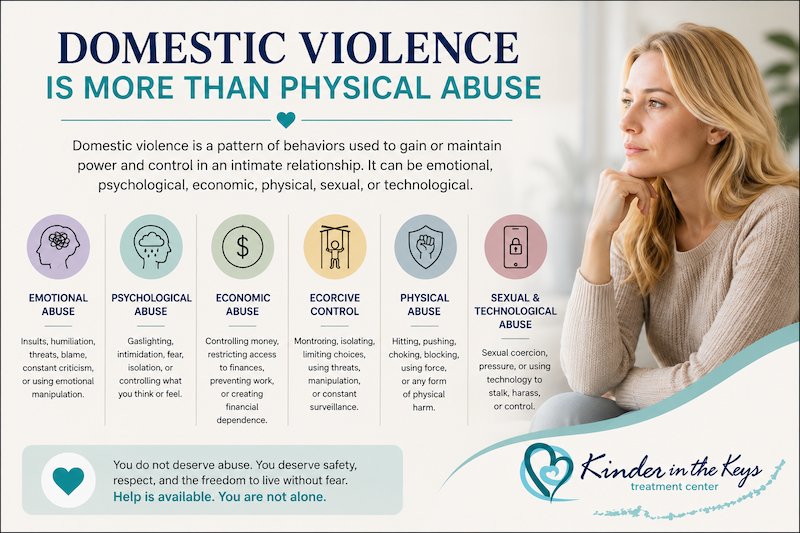
Domestic violence is often associated primarily with hitting, pushing, physical intimidation, or sexual assault.
But domestic violence can involve much more than physical violence.
The U.S. Department of Justice describes domestic violence as a pattern of abusive behavior used by one intimate partner to gain or maintain power and control over another. That behavior may include physical, sexual, emotional, economic, psychological, or technological abuse, as well as other coercive behaviors.
This distinction is important because some women experiencing abuse may believe:
He has never hit me, so maybe this isn’t really abuse.
But physical injury is not the only way one person can exert power and control over another.
Domestic abuse may involve:
Intimidation
Humiliation
Threats
Isolation from family or friends
Financial control
Monitoring or stalking
Sexual coercion
Repeated degradation
Manipulation
Destruction of property
Excessive jealousy
Controlling another person’s activities
Threatening children, pets, family members, or the partner
Psychological tactics intended to create fear or dependence
A relationship should therefore be evaluated by the pattern of behavior, not simply by whether physical violence has occurred.
When Is Narcissistic Abuse Domestic Violence?
Narcissistic abuse may be domestic violence when it occurs within an intimate relationship and involves a continuing pattern of power, control, coercion, intimidation, or abuse.
For example, a partner may:
Control access to money
Monitor calls, messages, or whereabouts
Attempt to isolate a woman from friends or family
Repeatedly humiliate or degrade her
Threaten consequences if she leaves
Use intimidation to control decisions
Prevent or discourage employment
Control transportation or access to resources
Repeatedly violate boundaries
Use children as leverage
Gaslight her about events she remembers
Punish independence or disagreement
Use affection, attention, money, or communication as methods of control
No single behavior automatically establishes domestic violence.
What matters is the broader pattern and function of the behavior.
Is one partner progressively losing autonomy?
Is fear influencing her decisions?
Is she changing her behavior primarily to prevent retaliation, rage, punishment, humiliation, or withdrawal?
Is another person systematically gaining control over her finances, relationships, movements, decisions, or emotional life?
Those questions can be more useful than asking whether a partner fits a particular psychological label.
Narcissistic Personality Disorder Is Not the Same as Domestic Abuse
This distinction deserves its own section because the terms are frequently confused online.
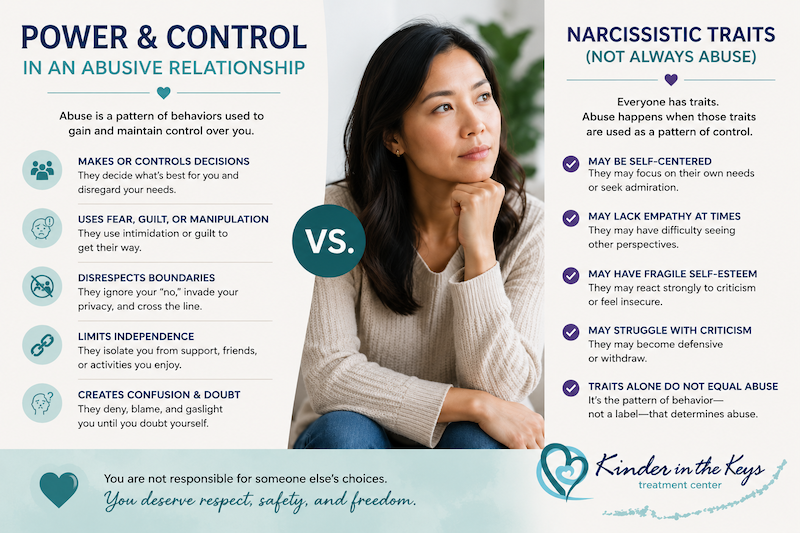
Narcissistic personality disorder is a mental health diagnosis.
Domestic abuse describes behavior within a relationship.
They are not interchangeable.
A person may have narcissistic personality disorder without abusing an intimate partner.
A person may also engage in severe emotional, psychological, physical, sexual, or economic abuse without having narcissistic personality disorder.
The National Domestic Violence Hotline specifically cautions against automatically equating narcissism with abusive behavior.
That means the question should not simply be:
“Is my partner a narcissist?”
A more useful question may be:
“What is happening in this relationship, and how is it affecting my safety, autonomy, and mental health?”
If you are trying to understand the distinction between narcissistic characteristics and an actual clinical diagnosis, see our guide to narcissist symptoms and narcissistic personality disorder.
Emotional Abuse Can Be Domestic Abuse
One of the reasons women may remain uncertain about whether they are experiencing domestic violence is that emotional abuse can be difficult to recognize from inside the relationship.
There may be no bruises.
There may be no police reports.
Friends may never witness an incident.
The partner may even appear charming, successful, generous, or attentive to other people.
Meanwhile, privately, the relationship may look very different.
The National Domestic Violence Hotline describes emotional abuse as nonphysical behavior intended to control, isolate, or frighten another person. Examples can include threats, insults, excessive monitoring, jealousy, manipulation, humiliation, intimidation, and dismissiveness.
Emotional abuse can gradually alter the balance of a relationship.
A woman may begin censoring what she says.
She may stop seeing certain friends because it creates conflict.
She may ask permission for ordinary activities.
She may become increasingly focused on another person’s mood.
She may stop challenging things she knows are untrue because the argument that follows feels unbearable.
She may begin doubting her own judgment.
Over time, accommodating another person’s behavior can begin to feel normal simply because it has become familiar.
Gaslighting and the Loss of Self-Trust
Gaslighting is one behavior frequently discussed in connection with narcissistic abuse.
It involves repeatedly denying, distorting, dismissing, or reframing another person’s experience in ways that cause her to question what she remembers, perceives, or understands.
The National Domestic Violence Hotline identifies gaslighting as a form of emotional abuse that can undermine a person’s ability to trust her own perceptions.
A woman may begin thinking:
Maybe I misunderstood.
Maybe I’m remembering it incorrectly.
Maybe I really am too sensitive.
Maybe this actually is my fault.
One disagreement does not constitute gaslighting.
The concern is a repeated pattern in which reality itself seems continuously negotiable depending on what benefits the other person.
Over time, this can make independent decision-making increasingly difficult.
Coercive Control: When the Relationship Becomes Smaller and Smaller
Some abusive relationships are better understood through the concept of coercive control.
Rather than relying on one dramatic incident, control can develop through numerous smaller restrictions.
A partner may gradually influence:
Who you see
Where you go
What you wear
How you spend money
Whether you work
Who you communicate with
How quickly you answer calls or texts
What you post online
When you leave the house
How you parent
Whether you seek medical or mental health care
Individually, some behaviors may initially be explained away.
Together, they may create a life in which another person increasingly determines what is permitted.
The issue is not whether the controlling partner calls these behaviors “love,” “concern,” “protection,” or “jealousy.”
The issue is whether your freedom and autonomy are progressively disappearing.
Financial Abuse Is Also Abuse
Financial or economic abuse can be particularly powerful because it may make leaving an unhealthy relationship materially difficult.
It may include:
Restricting access to bank accounts
Monitoring every purchase
Preventing employment
Interfering with a partner’s job
Creating debt in another person’s name
Withholding money for necessities
Taking a partner’s earnings
Hiding financial information
Controlling credit cards
Using money as punishment or leverage
Financial dependence can substantially limit a person’s choices.
A woman may know that a relationship is unhealthy while also confronting very real questions about housing, food, transportation, healthcare, children, employment, or debt.
That is one reason simplistic questions such as “Why doesn’t she just leave?” misunderstand the complexity of abusive relationships.
Trauma Bonding Can Make Leaving More Complicated
Abusive relationships are not necessarily abusive every moment.
Periods of criticism, intimidation, rejection, or control may alternate with affection, apologies, promises, attention, or periods of relative calm.
That unpredictability can make the relationship psychologically difficult to understand and emotionally difficult to leave.
A woman may simultaneously recognize that she is being harmed and continue feeling deeply attached to the person harming her.
Other factors can make leaving even more complicated:
Financial dependence
Children
Housing concerns
Isolation
Fear
Threats
Religious or cultural pressures
Diminished confidence
Lack of social support
Hope that the relationship will return to how it once felt
Understanding trauma bonding in abusive relationships can help explain why attachment may persist even after someone recognizes that a relationship is harmful.
Narcissistic Abuse Can Affect Mental Health
Long-term exposure to emotional abuse, coercion, manipulation, intimidation, or instability can affect psychological functioning.
Some women experience:
Anxiety
Depression
Hypervigilance
Difficulty sleeping
Emotional numbness
Problems concentrating
Low self-esteem
Shame or self-blame
Difficulty making decisions
Social withdrawal
Difficulty trusting others
Trauma-related symptoms
These reactions are not specific to narcissistic abuse, and experiencing them does not automatically establish a particular diagnosis.
Some women recover with time, social support, and outpatient therapy.
Others experience symptoms that continue long after the relationship has ended.
Our guide to the long-term effects of narcissistic abuse explores these psychological consequences in greater detail.
Narcissistic Abuse Does Not Automatically Mean PTSD
Another distinction matters here.
Experiencing an abusive relationship does not automatically mean someone has post-traumatic stress disorder.
PTSD is a specific mental health diagnosis with established diagnostic criteria.
Women exposed to abusive relationships may experience significant trauma-related symptoms without meeting full criteria for PTSD, while others may develop PTSD or another mental health condition.
A qualified mental health professional can evaluate symptoms and determine an appropriate diagnosis and treatment plan.
The purpose of recognizing abuse is not to collect as many diagnoses as possible.
It is to understand what happened and determine what you need now.
What to Do If You Think You Are Experiencing Domestic Abuse
If you recognize patterns of power, control, intimidation, coercion, or abuse in your relationship, you do not need to determine whether your partner has narcissistic personality disorder before seeking support.
You can begin by talking with someone qualified to help you evaluate the situation.
Depending on your circumstances, that might include:
A domestic violence advocate
A licensed mental health professional
A physician
A trusted attorney
A local domestic violence organization
A trusted friend or family member
A victim-services organization
If leaving a relationship could increase danger, individualized safety planning may be especially important. Domestic violence organizations can help people consider safety needs, children, finances, housing, transportation, technology, pets, and other practical concerns.
The goal is not to pressure someone into making a particular decision.
The goal is to help her understand her options and make informed decisions as safely as possible.
When Mental Health Treatment May Be Needed
Domestic violence services and mental health treatment serve different—but sometimes complementary—purposes.
Domestic violence advocates may help with immediate safety, shelter, legal resources, safety planning, and community services.
Mental health treatment may address the psychological effects that remain.
Professional treatment may be appropriate when anxiety, depression, trauma symptoms, sleep disturbance, emotional dysregulation, loss of self-esteem, or difficulty functioning continue to significantly interfere with everyday life.
At Kinder in the Keys, treatment for women affected by narcissistic abuse focuses on the woman receiving care—not on diagnosing the person who harmed her.
Treatment may address trauma responses, boundaries, self-trust, emotional regulation, relationship patterns, anxiety, depression, physical wellness, and the process of rebuilding an independent sense of self.
The goal is not to prove that someone else was a narcissist. The goal is to help you recover from what happened to you.
Frequently Asked Questions About Narcissistic Abuse and Domestic Violence
Is narcissistic abuse domestic violence?
Narcissistic abuse can constitute domestic violence when it occurs within an intimate relationship and involves a pattern of behaviors used to gain or maintain power and control. These behaviors may be emotional, psychological, economic, sexual, physical, technological, or coercive.
Does domestic violence have to involve physical abuse?
No. Domestic violence can include nonphysical forms of abuse, including emotional, psychological, economic, and technological abuse and other coercive behaviors.
Does someone have to have NPD to be abusive?
No. A person does not need narcissistic personality disorder—or any other psychiatric diagnosis—to behave abusively.
Are people with narcissistic personality disorder always abusive?
No. Having NPD does not automatically mean a person abuses an intimate partner. A psychiatric diagnosis and abusive behavior are separate issues.
Is gaslighting domestic abuse?
Gaslighting can be a form of emotional abuse. Within an intimate relationship, repeated gaslighting may be one component of a larger pattern of power and control.
Why can it be so difficult to leave an abusive relationship?
Leaving may be complicated by fear, financial dependence, children, housing, isolation, threats, diminished self-confidence, emotional attachment, trauma bonding, or concern that attempting to leave could escalate the situation.
Can therapy help after narcissistic or domestic abuse?
Yes. Mental health treatment can help address psychological consequences such as anxiety, depression, trauma-related symptoms, diminished self-esteem, hypervigilance, relationship difficulties, and loss of self-trust. Domestic violence advocacy may also be important when safety, legal, housing, financial, or other practical concerns are present.
Medically Reviewed By
Dr. Laura Tanzini, DrPH, LMFT
Doctor of Public Health | Specialty in Lifestyle Medicine
Licensed Marriage and Family Therapist (Florida & California)
Founder & CEO, Kinder in the Keys
This article has been clinically reviewed for accuracy and consistency with current behavioral health and trauma-informed treatment principles. Dr. Tanzini’s clinical work focuses on trauma, PTSD, anxiety, depression, relationship trauma, and women’s mental health.
Medical Disclaimer: This article is provided for educational and informational purposes only. It is not intended to provide a legal determination of whether a particular situation constitutes domestic violence, diagnose a mental health condition, or replace individualized medical, mental health, legal, or domestic violence services. Definitions and legal protections related to domestic violence can vary by jurisdiction.