
Many women arrive in therapy convinced that something is wrong with the way they love. They feel responsible for everyone’s emotions, struggle to know where they end and another person begins, and feel a wave of guilt whenever they put themselves first. Often, the root is not a personality flaw but enmeshment trauma, a developmental wound that can form when family relationships lack healthy boundaries. At our women’s trauma treatment center, we see how this early conditioning quietly shapes adult relationships for years before anyone names it.
This article explains what enmeshment trauma is, how to recognize it, and what genuine healing can look like.
What Is Enmeshment Trauma?
Enmeshment trauma describes the lasting emotional harm that can result from growing up in a family system where individual boundaries are blurred or absent. The concept grew out of structural family therapy and family systems theory, which observed that some families fuse so tightly that members are not given enough room for a separate identity, separate feelings, or separate needs.
In an enmeshed home, closeness may feel less freely chosen and more emotionally required. A child may learn that love depends on staying aligned with a parent’s moods, opinions, and expectations. Over time, the child can lose access to their own inner world because survival feels tied to constantly tracking everyone else’s.
Safe, Supportive Trauma Treatment for Women
Heal from trauma in a compassionate, women-centered environment with evidence-based therapies designed to help you feel safe, regain control, and move forward with confidence.
How Enmeshed Family Trauma Develops
Enmeshed family trauma does not always look like obvious abuse. It can hide inside what appears to be a close, devoted family. A parent may overshare adult problems, treat a child as a confidant or emotional caretaker, or react to a child’s independence as betrayal. This is often described as emotional parentification. The harm often comes from chronic boundary violations, role reversal, or emotional pressure, even when there is no obvious cruelty. A child raised this way may grow up praised for being mature, selfless, and easy to be around, while privately having no idea who they are apart from their family role.
Signs of Enmeshment
Recognizing the signs of enmeshment is the first step toward change. These patterns often feel normal because they were present from the very beginning of life, so it can take an outside perspective to notice them. These signs are not diagnostic on their own, but they may suggest enmeshed dynamics.
- Difficulty identifying your own feelings, preferences, or opinions separate from those of others
- Intense guilt or anxiety when setting boundaries or saying no
- Feeling responsible for managing or fixing other people’s emotions
- Fear that independence or success will damage important relationships
- A blurred sense of where your identity ends and a loved one’s begins
- Emptiness, restlessness, or panic when you are not in close contact with family
Enmeshed Mother Trauma
Enmeshed mother trauma is one of the most commonly discussed and least recognized forms. A mother who leans on her daughter for emotional support, treats her child as a best friend or substitute partner, or cannot tolerate the child’s growing autonomy can create a bond that feels loving but interferes with the daughter’s ability to develop a separate identity. Adult daughters often describe feeling guilty simply for having their own lives, careers, or relationships, as though independence were a quiet act of abandonment toward their mother.
Enmeshment Attachment and Adult Relationships
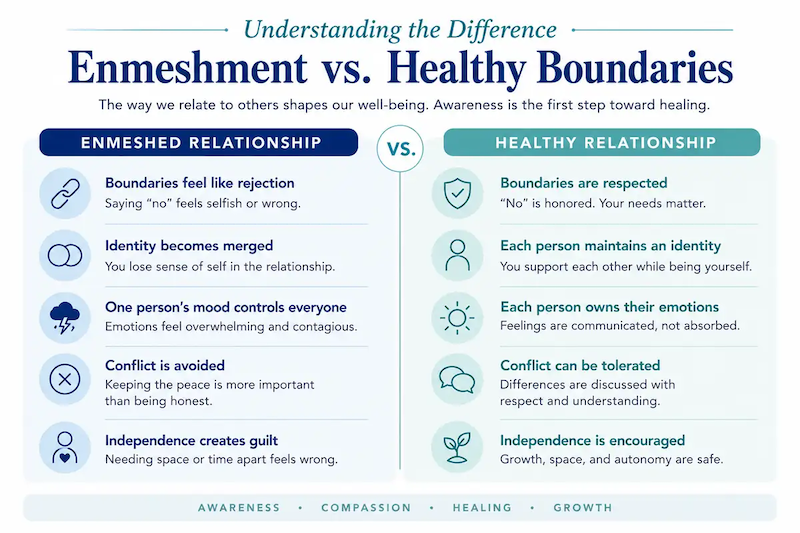
Enmeshment-related attachment patterns can develop when early closeness came at the cost of selfhood. As adults, people with this history may swing between craving deep fusion with a partner and feeling smothered or engulfed by it. They may lose themselves in relationships, then panic when they realize they have disappeared. The table below contrasts enmeshed dynamics with healthier connections, so the differences become easier to see.
| Dimension | Enmeshed Relationship | Healthy Relationship |
|---|---|---|
| Boundaries | Experienced as rejection or betrayal | Respected as normal and necessary |
| Identity | Merged; hard to tell self from other | Distinct; two whole people connect |
| Emotions | One person’s mood controls everyone | Feelings are owned individually |
| Conflict | Avoided at all costs to keep the peace | Tolerated as a part of real intimacy |
| Independence | Triggers guilt, fear, or panic | Encouraged and even celebrated |
Seeing these contrasts side by side helps explain why so many adult relationships feel overwhelming rather than nourishing. The way relationship dynamics affect women’s mental health is often a direct echo of patterns learned in childhood.
How Enmeshment Trauma Shows Up Later in Life
Because enmeshment teaches a person to merge with others, its effects tend to surface in adulthood through relationships. Many women with this history find themselves drawn into codependent partnerships, chronic people pleasing, or roles where they are always the caretaker and never the one cared for. Others struggle with chronic indecision because they were never allowed to develop their own preferences.
Saying no can feel physically distressing. Choosing a partner, a career path, or even a vacation can spark guilt, as if any independent choice betrays the family. For some, the early loss of self compounds into deeper struggles such as complex PTSD in women, particularly when the enmeshment was paired with control, criticism, or unpredictability at home. There is also a strong connection to abandonment fears. When closeness and identity have been tangled together since birth, separation can feel terrifying. Learning how therapy for abandonment trauma works often becomes an important piece of the larger healing picture for women carrying this wound.
Because these patterns took root so early, they can be hard to identify, and reviewing the broader signs of emotional trauma in adults can help you connect present-day struggles to their origins.
Enmeshment Recovery
Enmeshment recovery is the gradual process of building a self that was never given room to form. It is not about cutting off family or learning to stop caring. It is about learning that you can be connected to others while remaining a whole, separate person. Recovery tends to move through several overlapping stages.
- Awareness: Naming the pattern and recognizing that the guilt around boundaries was learned, not earned
- Differentiation: Practicing the difference between your feelings and another person’s feelings
- Boundary building: Learning to say no and tolerate the discomfort that follows
- Self-discovery: Reconnecting with your own preferences, values, and goals
- Relational repair: Building relationships based on choice rather than obligation or fear
Healthy boundaries are central to this work, and many women benefit from concrete guidance on family support and boundaries as they begin to reshape these dynamics. Old wounds also tend to spill out in relationships, and learning what trauma dumping is can help you share your pain in ways that build connection rather than strain it.
When to Seek Professional Support
Some people can begin shifting these patterns on their own, but enmeshment patterns often develop over many years and may be difficult to change through insight alone. If you notice that boundaries leave you flooded with guilt, that your relationships repeatedly cost you your sense of self, or that anxiety and depression have crept in alongside these dynamics, it may be time for help. Reviewing the signs you need trauma therapy can help you decide whether structured, trauma-informed support is the right next step. Working with clinicians who understand developmental and relational trauma can provide a safe environment for practicing boundaries, developing a stronger sense of self, and building healthier relationship patterns.
Enmeshment Trauma Frequently Asked Questions
Is enmeshment trauma the same as having a close family?
No. Healthy closeness allows each person their own identity, feelings, and choices. Enmeshment removes those boundaries, so connection comes at the cost of selfhood. The difference is whether independence is welcomed or treated as rejection and betrayal.
Can you recover from enmeshment trauma in adulthood?
Yes. Although enmeshment forms early, people can change these patterns in adulthood. With awareness, boundary practice, and trauma-informed therapy, adults can rebuild a separate sense of self and form relationships based on genuine choice rather than guilt or fear.
What causes enmeshment in families?
Enmeshment often stems from a parent's unmet emotional needs, anxiety, control, family stress, or their own unresolved trauma. Rather than supporting a child's independence, the parent may rely on the child for stability, blurring boundaries until the child struggles to separate their identity from the family.