
Some of the most interesting facts about anxiety disorder symptoms and diagnoses involve what anxiety actually does to the body, why avoidance can make anxiety stronger, why women experience anxiety disorders more frequently, and why conditions such as PTSD and OCD are no longer classified as anxiety disorders. Understanding interesting facts about anxiety disorder diagnoses can help women recognize the difference between normal anxiety, persistent symptoms, and a condition that may require treatment.
Fact 1: Interesting Facts About Anxiety Disorder Diagnoses
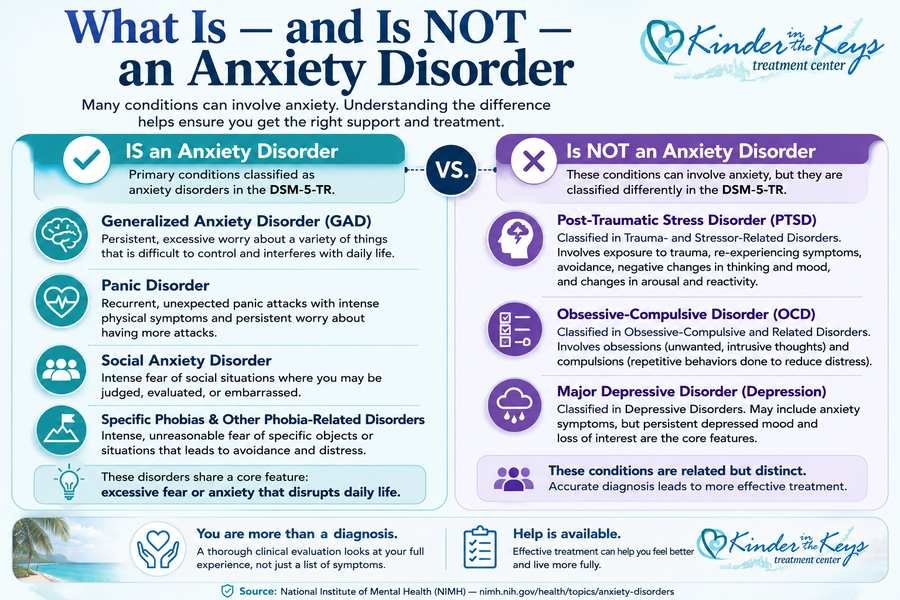
People often say, “I have anxiety,” but clinically there is no single disorder simply called anxiety.
Anxiety disorders are a group of conditions.
They include:
- Generalized anxiety disorder (GAD)
- Panic disorder
- Social anxiety disorder
- Specific phobias and other phobia-related disorders
Different anxiety disorders share features of excessive fear or anxiety, but they do not necessarily look or feel the same.
A woman with generalized anxiety disorder may experience persistent worry across many areas of her life.
Someone with panic disorder may experience recurrent, unexpected panic attacks accompanied by intense physical sensations.
A woman with social anxiety disorder may function comfortably in many areas but experience significant fear when she believes she is being observed, judged, or evaluated.
Understanding the specific pattern matters because treatment should address what is actually happening rather than treating every form of anxiety as identical.
Fact 2: PTSD and OCD Are Not Anxiety Disorders
This is an important correction to older mental-health information—including older articles that still circulate online.
PTSD and obsessive-compulsive disorder can certainly involve intense anxiety.
But that does not make them anxiety disorders diagnostically.
PTSD is classified among trauma- and stressor-related disorders, while OCD belongs to obsessive-compulsive and related disorders.
Major depressive disorder is also not an anxiety disorder; it is classified as a depressive disorder.
Why does that distinction matter?
Because similar symptoms do not necessarily mean two conditions work the same way or require identical treatment.
For example, a woman with PTSD may experience hypervigilance, fear, avoidance, and physical arousal that resemble anxiety. But PTSD treatment also needs to address the role of traumatic exposure, trauma memories, trauma-related beliefs, and avoidance.
Accurate diagnosis helps clinicians understand what is driving the symptoms rather than treating a symptom label alone.
Fact 3: Anxiety Can Be Intensely Physical
One of the most interesting facts about anxiety disorder symptoms is how strongly anxiety can affect the body. Anxiety is not simply “worrying too much.”
The body’s stress-response systems are involved in anxiety, which means symptoms may be very physical.
Depending on the person and the type of anxiety, symptoms can include:
- Racing or pounding heart
- Shortness of breath
- Chest discomfort
- Dizziness
- Trembling
- Sweating
- Muscle tension
- Gastrointestinal distress
- Feeling hot or cold
- Difficulty sleeping
- Fatigue
Panic disorder is a particularly clear example. NIMH describes panic attacks as episodes of intense fear that can include heart palpitations, chest pain, shortness of breath, dizziness, and abdominal distress.
These physical sensations can create a vicious cycle.
A woman notices her heart racing.
She interprets the sensation as evidence that something is seriously wrong.
That interpretation creates more fear.
The additional fear intensifies the physical response.
Understanding that cycle can be an important part of treatment.
Fact 4: Anxiety Disorders Are More Common in Women
Among the most important interesting facts about anxiety disorder prevalence is the difference seen between women and men.
This is particularly important for Kinder because anxiety does not affect women and men at identical rates.
NIMH prevalence data estimate that 23.4% of U.S. women experienced an anxiety disorder during the previous year compared with 14.3% of men in the underlying national survey data.
The pattern appears across individual anxiety disorders as well.
For generalized anxiety disorder, past-year prevalence was estimated at 3.4% among women versus 1.9% among men.
For panic disorder, the corresponding estimates were 3.8% among women and 1.6% among men.
NIMH notes more broadly that anxiety disorders are among the mental disorders diagnosed more commonly in women, while researchers continue to examine the biological and psychosocial factors that may contribute to differences in mental health.
That does not mean every anxious woman has an anxiety disorder.
It means women’s mental health deserves assessment that considers the whole person rather than dismissing persistent anxiety as simply being “stressed.”
Fact 5: Avoiding Anxiety Can Make It Stronger
Another of the interesting facts about anxiety disorder treatment is that repeatedly avoiding feared situations can reinforce anxiety over time.
Avoidance makes sense in the short term.
If something frightens you, staying away from it usually produces immediate relief.
That relief can become the problem.
Imagine that a woman experiences intense anxiety while driving over a bridge.
She decides not to drive over that bridge again.
Her anxiety drops.
Her brain learns:
Avoiding the bridge kept me safe.
Soon she may avoid other bridges.
Then highways.
Then unfamiliar routes.
Eventually, her world becomes smaller—not necessarily because the original danger increased, but because avoidance kept reinforcing the belief that she could not tolerate the feared situation.
This principle is one reason exposure-based strategies are used in the treatment of some anxiety disorders.
The goal is not to recklessly force someone into frightening situations.
Appropriate treatment helps a person gradually develop the ability to experience anxiety without automatically organizing her life around escaping it.
Fact 6: Caffeine Can Feel a Lot Like Anxiety
This is an especially interesting connection because many people consume caffeine specifically to improve energy and concentration.
Caffeine is a stimulant.
For someone who is sensitive to its effects, higher intake can contribute to sensations such as restlessness, jitteriness, increased heart rate, or difficulty sleeping.
Those sensations can overlap with anxiety symptoms.
That does not mean caffeine “causes” every anxiety disorder.
It does mean stimulant use deserves attention when someone is trying to understand why anxiety, panic-like sensations, or sleep problems seem to be worsening.
Someone who is already highly attentive to physical sensations may interpret a racing heart or jitteriness as evidence that something dangerous is happening, potentially escalating the fear response.
Does Caffeine Make Anxiety Worse?
For women who consume significant amounts of caffeine, reducing intake gradually may also be preferable to suddenly stopping, because caffeine withdrawal can produce its own symptoms.
Caffeine Withdrawal Anxiety Disorder
Fact 7: Anxiety Disorders Are Treatable
This may be the most important fact in the entire article.
Having an anxiety disorder does not mean someone has to organize the rest of her life around fear.
Treatment depends on the specific anxiety disorder, symptom severity, other mental-health conditions, medical considerations, previous treatment, and individual needs.
Psychotherapy is a major component of anxiety treatment.
Cognitive behavioral therapy (CBT), for example, can help people recognize relationships among thoughts, emotions, physical reactions, and behavior.
Treatment may also incorporate clinically appropriate exposure-based strategies, coping skills, behavioral changes, medication when appropriate, sleep interventions, movement, stress-management strategies, and other individualized approaches.
Complementary practices can sometimes help with anxiety symptoms, but they should not automatically be treated as substitutes for established care. NCCIH notes that psychotherapy, medication, or both are commonly used for anxiety disorders and that evidence for complementary approaches varies considerably.
Normal Anxiety vs. an Anxiety Disorder
Not every anxious feeling needs treatment.
Anxiety can be adaptive.
It can motivate someone to prepare for an examination, pay attention to danger, meet an important deadline, or think carefully before making a consequential decision.
The clinical question is not:
“Do you ever feel anxious?”
Almost everyone does.
More useful questions include:
- Is the anxiety excessive relative to the situation?
- Is it persistent?
- Is it difficult to control?
- Does it cause substantial distress?
- Is it interfering with relationships?
- Is it affecting work or school?
- Are you avoiding important parts of your life because of it?
- Are physical symptoms or panic attacks changing how you live?
Anxiety becomes more concerning when fear begins controlling the person’s choices rather than simply informing them.
When Anxiety Starts Controlling Your Life
Anxiety can gradually change a person’s life without her realizing how much she has adapted around it.
She may stop traveling.
Avoid driving.
Decline invitations.
Depend heavily on another person for reassurance.
Avoid conflict.
Stop pursuing professional opportunities.
Develop elaborate routines designed to prevent anxiety.
Spend hours anticipating everything that could go wrong.
Or structure her entire life around remaining within a narrow comfort zone.
At that point, simply telling someone to “relax” is unlikely to address the underlying problem.
Treatment is about more than making anxiety disappear.
It can help a woman develop the ability to experience uncertainty, physical arousal, difficult thoughts, and uncomfortable emotions without allowing them to dictate her life.
When Residential Treatment for Anxiety May Be Appropriate
Most people with anxiety disorders do not require residential treatment.
Many respond well to outpatient psychotherapy, medication when indicated, or a combination of approaches.
A higher level of care may be considered when anxiety has become severe enough to substantially impair daily functioning, outpatient treatment has not provided sufficient stabilization, multiple mental-health conditions are occurring together, or a woman needs more intensive therapeutic structure and support.
At Kinder in the Keys, residential mental-health treatment is individualized around each woman’s clinical needs rather than determined by a diagnosis alone.
Women receiving treatment may have anxiety alongside trauma, PTSD, depression, or other concerns that need to be understood together.
DEDICATED ANXIETY TREATMENT PILLAR
Frequently Asked Questions About Anxiety Disorders
What are the main types of anxiety disorders?
Major anxiety disorders include generalized anxiety disorder, panic disorder, social anxiety disorder, and phobia-related disorders. Different anxiety disorders involve different patterns of fear, worry, avoidance, and physical symptoms.
Is PTSD an anxiety disorder?
No. Although PTSD commonly involves anxiety and fear, it is classified as a trauma- and stressor-related disorder rather than an anxiety disorder.
Is OCD an anxiety disorder?
No. OCD was historically grouped with anxiety disorders in older diagnostic systems but is now classified within obsessive-compulsive and related disorders.
Are anxiety disorders more common in women?
Yes. U.S. prevalence data show higher rates of anxiety disorders among women than men. NIMH reports past-year prevalence estimates of 23.4% among women and 14.3% among men in the underlying national survey data.
Can anxiety cause physical symptoms?
Yes. Anxiety can involve cardiovascular, respiratory, gastrointestinal, muscular, sleep-related, and other physical symptoms. Panic attacks can produce particularly intense physical sensations.
Can anxiety disorders be treated?
Yes. Effective treatments are available. The appropriate approach depends on the specific disorder, severity, individual needs, co-occurring conditions, and clinical assessment.Understanding these interesting facts about anxiety disorder symptoms can help women recognize when ordinary anxiety has become something that deserves professional attention.

Anxiety Treatment for Women at Kinder in the Keys
Anxiety can become exhausting when every decision is filtered through:
“What if something goes wrong?”
Women sometimes become exceptionally skilled at arranging their lives so they rarely encounter what frightens them.
From the outside, that may look like coping.
Inside, the woman’s world may be getting smaller.
Treatment can help reverse that process.
Kinder in the Keys provides residential mental-health treatment for adult women in the Florida Keys, including treatment for anxiety disorders when a residential level of care is clinically appropriate.
Our small treatment environment allows care to address the individual woman—not simply the diagnostic label attached to her symptoms.
Learn more about Anxiety Treatment for Women at Kinder in the Keys.
Medically Reviewed By
Dr. Laura Tanzini, DrPH, LMFT
Doctor of Public Health | Specialty in Lifestyle Medicine
Licensed Marriage and Family Therapist (Florida & California)
Founder & CEO, Kinder in the Keys
This article has been clinically reviewed for accuracy and consistency with current behavioral health treatment principles. Dr. Tanzini has extensive clinical experience in trauma, PTSD, anxiety, depression, and women’s mental health.
Doctoral Research: Dr. Tanzini’s doctoral research at Loma Linda University examined childhood and adult traumatic events, cumulative trauma exposure, gender, forgiveness, life satisfaction, and long-term well-being.
Medical Disclaimer
This article is provided for educational and informational purposes only and is not a substitute for individualized evaluation, diagnosis, or treatment by a qualified healthcare professional.