
Where trauma is stored in the body is a common question, particularly for people who notice physical reactions long after a difficult or frightening experience has ended. The important distinction is that trauma is not literally stored in a particular muscle, organ, joint, or area of the body.
What can persist are changes in the way the brain and nervous system respond to stress, perceived danger, memories, and reminders of past experiences. Those responses can produce very real physical effects throughout the body.
A woman may notice muscle tension, jaw clenching, changes in breathing, gastrointestinal symptoms, sleep disturbances, increased heart rate, fatigue, headaches, or physical sensations that seem to appear without an obvious explanation. These experiences are not imaginary. But their location does not provide a reliable map of what happened to her.
Understanding that distinction allows us to take the body’s response to trauma seriously without assigning a predetermined psychological meaning to every ache, tight muscle, or physical sensation.
Does the Body Really Store Trauma?
Not in the literal sense that is sometimes suggested online.
A traumatic memory is not physically stored in the hips, shoulders, throat, pelvis, or another body part. The human nervous system is considerably more complex.
Traumatic experiences can affect the way the brain processes memories and responds to potential threats. When something in the present reminds the brain of an earlier experience, consciously or unconsciously, the nervous system may initiate a physical stress response.
The heart may beat faster. Muscles may tighten. Breathing may become shallow. The stomach may become unsettled. A person may become unusually alert to her surroundings or experience an overwhelming urge to leave.
The original event may have happened years earlier, but the physical response is occurring now.
That is an important difference between saying the body can continue to respond to trauma and saying that trauma itself is physically stored inside body tissue.
Why Trauma Can Feel So Physical
The brain and body are not separate systems. Research on trauma and physical health shows that traumatic stress, particularly when associated with PTSD, can affect physical health through multiple biological, behavioral, and psychological pathways.
When the brain perceives danger, it communicates rapidly with systems throughout the body. Stress hormones and autonomic nervous system activity prepare a person to respond.
This is useful when danger is actually present.
The problem occurs when the threat-response system becomes activated when a person is objectively safe or remains highly reactive long after the original threat has passed.
A sound, smell, facial expression, conflict, physical sensation, location, anniversary, or seemingly unrelated experience may activate a response before the person consciously understands why.
She may know intellectually that she is safe while simultaneously experiencing a racing heart, tight chest, tense muscles, nausea, shaking, sweating, or a powerful desire to escape.
The physical response is real even when the present environment is not dangerous.
Where Trauma Is Stored in the Body: A More Accurate Body Map
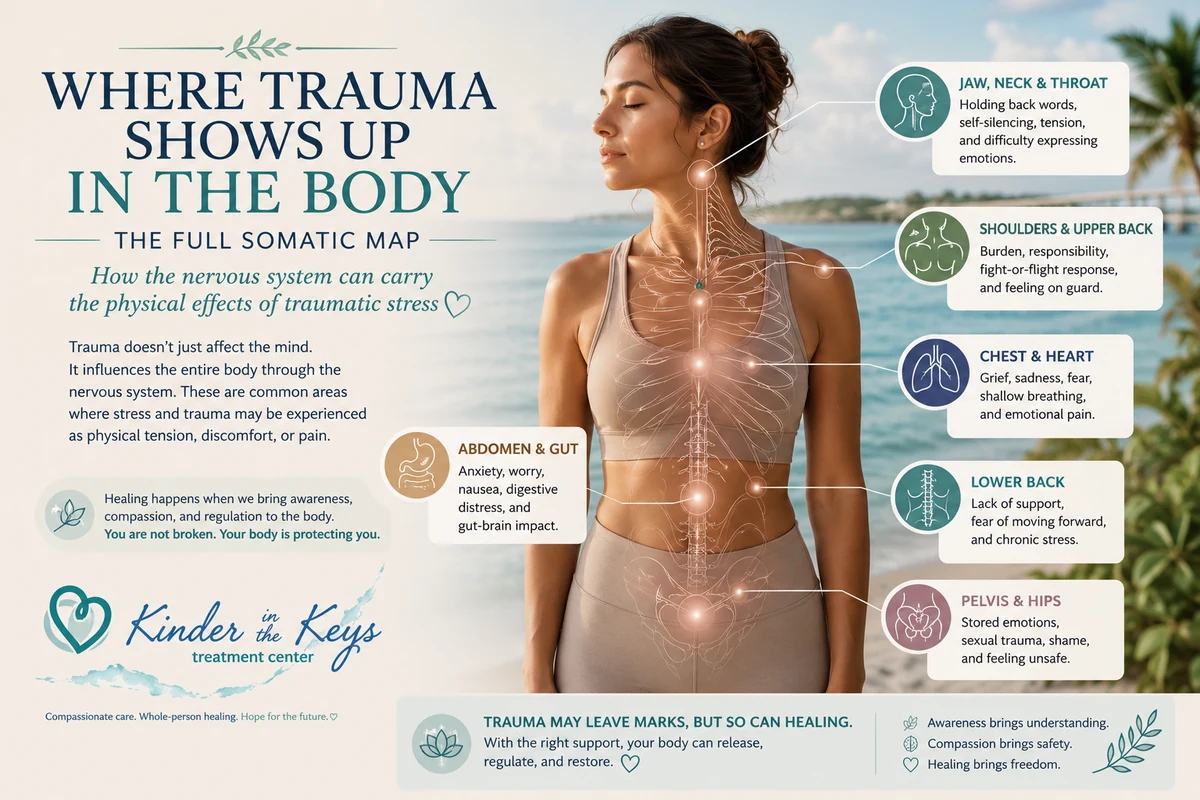
People frequently search for a chart showing where trauma is stored in the body.
A body map can be useful if we are clear about what it represents.
It cannot tell us what traumatic experience occurred. Instead, it can illustrate areas where the physiological effects of prolonged stress or nervous-system activation may sometimes be experienced.
| Body Area | Possible Physical Response | What May Be Contributing |
|---|---|---|
| Jaw, neck and shoulders | Clenching, stiffness, headaches, muscle tension | Stress-related muscle guarding and increased arousal |
| Chest | Tightness, rapid heartbeat, changes in breathing | Autonomic nervous system activation |
| Diaphragm and breathing | Shallow or rapid breathing, frequent sighing | Stress-response changes in breathing patterns |
| Stomach and digestive system | Nausea, digestive changes, abdominal discomfort | Interaction between stress and the gut-brain system |
| Hips and pelvic floor | Muscular tension or guarding | Stress-related muscular activation; meaning varies by individual |
| Back | Tightness, discomfort or muscular guarding | Muscle tension, posture, stress and other physical factors |
| Hands and legs | Trembling, restlessness or muscle tension | Sympathetic nervous system activation |
| Whole body | Fatigue, poor sleep, heightened startle response | Persistent arousal and disrupted stress regulation |
A physical symptom cannot tell a clinician what trauma occurred.
Hip tension does not establish a history of sexual trauma. Lower-back pain does not demonstrate a lack of emotional support. Tightness in the throat does not prove that someone has been unable to speak her truth.
Those interpretations may feel personally meaningful to an individual, but they should not be presented as clinical diagnoses.
Physical symptoms also deserve appropriate medical evaluation. Trauma should never automatically be assumed to be the cause of pain, digestive problems, chest symptoms, headaches, or other physical concerns.
The Nervous System and Trauma
To understand why trauma can affect the body, it helps to understand the autonomic nervous system.
This system regulates many processes that occur without conscious effort, including heart rate, breathing, digestion, blood pressure, and aspects of the body’s stress response.
When danger is perceived, the sympathetic nervous system helps prepare the body for action.
Heart rate may increase. Breathing can accelerate. Muscles tighten. Attention narrows toward possible threats. Digestion may temporarily change as the body prioritizes immediate survival. Physical reactions following trauma can include a pounding heart, rapid breathing, shaking, sweating, sleep problems, fatigue, headaches, and stomach or eating difficulties.
Once the threat passes, the body ordinarily moves back toward its baseline state.
Following trauma, however, some people become more sensitive to potential danger. Their nervous systems may respond strongly to situations that resemble previous experiences even when the current situation is different.
This can contribute to the feeling that trauma is “living in the body.”
Hypervigilance and Muscle Tension
Hypervigilance involves heightened awareness of potential threats.
A woman experiencing hypervigilance may continuously monitor her environment, other people’s facial expressions, changes in tone of voice, doors, exits, noises, or anything that might indicate something is wrong.
That constant state of readiness has physical consequences.
Muscles that repeatedly prepare the body for danger may remain tense. Jaw clenching, neck tension, raised shoulders, headaches, and general muscle discomfort can accompany prolonged stress and anxiety.
This does not mean that a particular muscle contains a traumatic memory.
It means that the body may have developed a habitual physical response to perceived threat.
Trauma, Breathing and the Chest
Breathing often changes rapidly during stress.
Someone who feels threatened may begin breathing faster or more shallowly without consciously choosing to do so. Anxiety and panic can also produce sensations of chest tightness, shortness of breath, dizziness, or difficulty taking a satisfying breath.
Over time, people can become highly attentive to these sensations.
For someone who has previously experienced panic or traumatic stress, noticing a change in breathing may itself become frightening, which can further increase nervous-system activation.
Learning to recognize the interaction between thoughts, physical sensations, and the stress response can therefore be an important part of treatment.
Trauma and the Gut-Brain Connection
Stress can also affect digestion.
The brain and gastrointestinal system communicate continuously through neural, hormonal, and immune pathways. This relationship is commonly referred to as the gut-brain axis.
Periods of intense stress can be accompanied by nausea, appetite changes, abdominal discomfort, diarrhea, constipation, or other gastrointestinal symptoms.
Chronic stress may also exacerbate existing gastrointestinal conditions.
Again, this does not mean trauma is physically stored in the stomach.
It demonstrates how closely psychological stress and physiological functioning are connected.
Trauma, Pain and Physical Health
Traumatic stress can also intersect with pain.
Pain is not produced by a single mechanism. Physical injury, inflammation, nerve function, sleep, emotional state, stress, previous experiences, and the brain’s interpretation of sensory information can all influence how pain is experienced.
People living with prolonged stress may also sleep poorly, maintain chronic muscle tension, become less physically active, or experience increased physiological arousal. Each can affect physical comfort and pain perception.
This is why clinicians should resist both extremes.
It would be incorrect to assume that every unexplained physical symptom is caused by trauma.
It would also be incorrect to assume that psychological stress cannot have meaningful physical effects.
Both the body and the person’s psychological history deserve appropriate evaluation.
Childhood Trauma and Long-Term Stress Responses
Childhood experiences can be particularly influential because the brain and stress-response systems are still developing.
A child growing up in an unpredictable or frightening environment may learn to remain exceptionally alert to changes around her.
She may become highly sensitive to anger, conflict, rejection, facial expressions, or changes in another person’s mood because recognizing those cues once helped her anticipate what was coming.
Years later, that same response may activate in situations that are objectively much safer. Trauma can also affect women differently because biological, psychological, and social factors can influence both exposure to trauma and responses that follow.
The adult woman may understand intellectually that a disagreement with a partner, employer, friend, or therapist is not dangerous while her body reacts as though something significant is about to happen.
Treatment can help identify the connection between the earlier adaptation and the present response.
Are Emotions Stored in Specific Body Parts?
There is no established clinical map demonstrating that individual emotions or traumatic experiences are stored in particular body parts.
That does not mean physical sensations are irrelevant in therapy.
Quite the opposite.
A woman may notice that her shoulders tense whenever conflict begins. Another may feel nausea when she becomes frightened. Someone else may notice jaw clenching when she is angry or a tight chest when she anticipates rejection.
Those observations can provide useful information.
The important clinical question is not:
“What trauma is stored in this body part?”
It is:
“What is happening for this particular person when this physical response occurs?”
That question allows therapy to remain curious rather than assigning meaning before the woman has had an opportunity to understand her own experience.
Somatic Maps, Chakras and Clinical Trauma Treatment Are Not the Same Thing
Body-based and spiritual traditions have long connected different areas of the body with emotional or psychological themes.
Chakra traditions, for example, associate areas of the body with concepts such as safety, connection, personal power, communication, intuition, and spiritual awareness.
Some people find chakra work personally meaningful. Practices involving meditation, breathing, movement, visualization, yoga, or focused attention to bodily sensations may provide opportunities for reflection, relaxation, or greater awareness of one’s internal experience.
That is different from establishing a clinical diagnosis.
A spiritual or symbolic framework can have personal meaning without being presented as anatomical evidence.
For example, someone may find the concept of the throat chakra useful when reflecting on communication or self-expression. Clinically, however, throat tightness cannot establish that someone has been silenced, just as hip tension cannot reveal a history of sexual trauma.
At Kinder in the Keys, mind-body practices can be considered supportive tools when clinically appropriate, while assessment and mental health treatment remain individualized and grounded in established clinical evidence.
What About Somatic Therapy?
The term somatic therapy refers broadly to therapeutic approaches that incorporate awareness of physical sensations and bodily responses into psychological treatment.
Paying attention to physical sensations can sometimes help a person recognize a stress response before it becomes overwhelming.
For example, a woman might begin to notice:
Her shoulders tightening during conflict
Her breathing becoming shallow when she feels trapped
Her jaw clenching when she becomes angry
Her stomach becoming unsettled when she anticipates confrontation
Her heart rate increasing when someone raises their voice
The therapist and client can explore these reactions together.
The purpose is not to assign a universal meaning to the sensation. It is to understand her particular pattern.
Somatic Experiencing and the Evidence Question
Somatic Experiencing is one specific body-oriented approach that focuses on awareness of physical sensations associated with stress and threat responses.
It is important to distinguish between promising or emerging approaches and treatments supported by stronger bodies of evidence.
Some people report finding body-oriented approaches helpful, and research into these methods continues. However, claims that therapy literally “releases trauma from tissues” or discharges traumatic memories stored in specific body areas go beyond what current evidence can establish.
At Kinder in the Keys, treatment decisions should be based on each woman’s clinical needs rather than on the assumption that one particular modality is appropriate for everyone.
EMDR and Trauma Processing
Eye Movement Desensitization and Reprocessing (EMDR) is an evidence-based psychotherapy used in the treatment of trauma-related conditions, including PTSD.
EMDR involves recalling aspects of traumatic experiences while engaging in bilateral stimulation within a structured therapeutic protocol.
The objective is not to remove trauma from a particular body part.
Rather, treatment is designed to help traumatic memories become less distressing and less disruptive in the present.
At Kinder in the Keys, EMDR may be incorporated when clinically indicated as part of an individualized treatment plan.
Movement, Exercise and Body Awareness
Movement can also play a supportive role in mental health treatment.
Regular physical activity can improve sleep, mood, cardiovascular health, stress regulation, and overall well-being. Yoga, stretching, walking, strength training, breathing practices, and other forms of movement may also help some women become more aware of physical tension and changes in their bodies. Research into mind-body practices suggests that approaches such as yoga, meditation, and mindfulness may offer benefits for stress and some mental health symptoms, although the strength of evidence varies considerably by practice and condition.
The benefit does not depend upon believing that exercise physically removes traumatic memories from muscles or tissues.
Movement can simply be one component of caring for a body that has been living under prolonged stress.
Trauma-Informed Care Does Not Mean Avoiding Every Trigger
Understanding trauma-informed care means recognizing the physical effects of trauma without assuming treatment should eliminate every uncomfortable sensation, emotion, or trigger.
Avoidance can sometimes strengthen fear.
When appropriate and clinically safe, therapy can help a woman recognize what has been activated, understand the connection between past and present, tolerate difficult emotions and physical sensations, and develop new responses.
A racing heart does not always mean danger.
Anger does not always mean something terrible is about to happen.
Conflict does not always mean abandonment.
Physical discomfort does not always mean a person is unsafe.
Learning those distinctions can be an important part of recovery.
How the Body’s Response Can Change During Treatment
The nervous system is capable of learning.
As women recognize their patterns and develop new ways of responding, physical reactions may begin to change as well.
Someone who previously became immediately overwhelmed during conflict may begin to notice the first signs of activation and remain engaged.
A woman who automatically interpreted a racing heart as evidence of danger may learn to recognize it as a temporary stress response.
Another may become better able to experience anger without becoming frightened by the emotion itself.
Progress does not require eliminating every uncomfortable physical sensation.
It involves increasing the ability to understand those sensations, respond appropriately, and distinguish between an old alarm and a current threat.
Trauma Treatment at Kinder in the Keys
At Kinder in the Keys, trauma treatment for women considers the relationship between thoughts, emotions, behavior, relationships, past experiences, and physical responses.
Residential treatment also provides opportunities to observe patterns as they occur in everyday life.
A reaction to conflict, boundaries, frustration, closeness, disappointment, or another person’s emotions may reveal patterns that are difficult to recognize during a single outpatient therapy appointment.
Those moments do not automatically represent failures or setbacks.
They can become opportunities to understand what has been activated and work with it therapeutically.
Treatment may include evidence-based psychotherapy, skills development, movement, mindfulness practices, EMDR when clinically indicated, healthy nutrition, structured daily routines, and other interventions selected according to the woman’s individual needs.
The objective is not to locate trauma somewhere inside her body.
It is to understand how past experiences may still be influencing her life today and help her develop responses that serve her better now.
So, Where Is Trauma Stored in the Body?
If we use the phrase where trauma is stored in the body, the most accurate answer requires some clarification.
Trauma is not contained inside one particular muscle, organ, or body region.
Instead, traumatic experiences can influence memory, threat detection, stress physiology, emotional regulation, behavior, and nervous-system responses. Those changes can produce physical experiences throughout the body.
The location of a physical sensation may provide useful information to explore, but it does not reveal a person’s history by itself.
That distinction matters.
We can respect the body’s role in trauma, remain open to personally meaningful complementary practices, and recognize the value of body awareness without turning physical sensations into diagnoses.
The body can tell us that something is happening.
Understanding what that something means requires listening to the individual woman.
Frequently Asked Questions About Where Trauma Is Stored in the Body
Where does the body store trauma?
Trauma is not literally stored in a specific body part. Traumatic experiences can affect memory and nervous-system functioning, producing physical responses such as muscle tension, changes in breathing, digestive symptoms, sleep disruption, or heightened arousal.
Is trauma stored in the hips?
There is no clinical evidence establishing the hips as a storage location for trauma. Some people experience hip or pelvic-floor tension during periods of stress, but that physical finding cannot identify a particular traumatic experience.
Is trauma stored in the neck and shoulders?
Stress and prolonged nervous-system activation can contribute to muscle tension, including tension in the neck and shoulders. That does not mean traumatic memories are physically located inside those muscles.
Can trauma cause physical symptoms years later?
Trauma-related stress can be associated with physical symptoms long after an event occurred. Persistent nervous-system activation, sleep disruption, muscle tension, stress physiology, and changes in pain perception may all contribute. New or persistent physical symptoms should also be medically evaluated rather than automatically attributed to trauma.
Can body-based practices help with trauma recovery?
Some people find movement, breathing practices, yoga, mindfulness, or body-awareness techniques useful as complementary components of treatment. Their usefulness does not mean that trauma is literally being released from a particular body part.
Are chakras part of trauma therapy?
Chakras originate from spiritual traditions rather than clinical psychology or medicine. Some people find chakra-based practices personally meaningful and may use them alongside meditation, yoga, or other wellness practices. Chakra associations should not be used clinically to diagnose a traumatic experience based on a physical sensation or body location.
Medically Reviewed By
Dr. Laura Tanzini, DrPH, LMFT
Doctor of Public Health | Specialty in Lifestyle Medicine
Licensed Marriage and Family Therapist (Florida & California)
Founder & CEO, Kinder in the Keys
This article has been clinically reviewed for accuracy and consistency with current behavioral health and trauma-informed treatment principles. Dr. Tanzini has extensive clinical experience in trauma, PTSD, anxiety, depression, and women’s mental health, including assessment and treatment of trauma-related conditions.
Medical Disclaimer
This article is for educational and informational purposes only and is not intended to diagnose, treat, cure, or prevent any mental health condition. Information provided here should not replace individualized evaluation, diagnosis, or treatment from a qualified healthcare or mental health professional.