
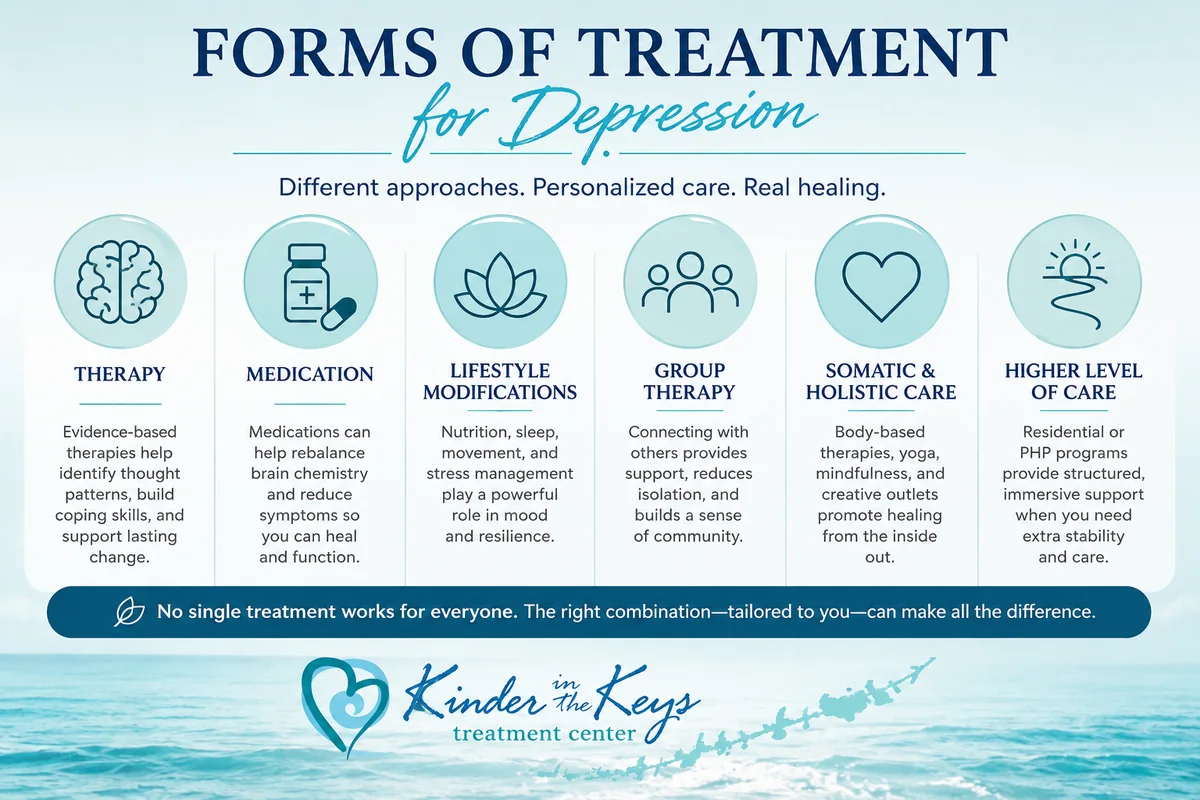
The forms of treatment for depression available today include psychotherapy, medication, lifestyle interventions, higher levels of mental health care, and—in certain circumstances—other medical treatments.
There is no single treatment plan that is appropriate for every person with depression.
The right approach depends on factors such as the type and severity of symptoms, safety concerns, previous treatment response, medical history, co-occurring mental health conditions, current medications, personal preferences, available support, and how significantly depression is interfering with daily functioning.
For women, treatment planning may also need to consider pregnancy or postpartum status, hormonal transitions, trauma history, caregiving responsibilities, relationship dynamics, and other circumstances that can influence both symptoms and treatment decisions.
At Kinder in the Keys, our women’s depression treatment center provides residential mental health treatment for adult women who are clinically appropriate for that level of care.
This guide explains the major forms of treatment for depression, what the evidence supports, how different approaches may be combined, and why choosing the appropriate level of care requires an individualized clinical assessment.
Psychotherapy
Psychotherapy is one of the primary forms of treatment for depression and may be used alone or alongside medication and other interventions depending on the individual’s diagnosis, symptoms, severity, and treatment needs.
“Talk therapy” is not one single treatment. Different therapeutic approaches use different strategies and may be appropriate for different clinical situations.
Cognitive Behavioral Therapy (CBT)
Cognitive behavioral therapy (CBT) is one of the most extensively studied psychotherapies for depression.
CBT helps people identify patterns of thinking and behavior that may contribute to depressive symptoms and develop more balanced and effective ways of responding.
Treatment is generally structured and goal-oriented, but the length of treatment varies according to the individual rather than following one fixed number of sessions.
CBT may be particularly useful when depression involves persistent negative thinking, self-criticism, hopelessness, avoidance, or behavioral patterns that reinforce depressed mood.
Dialectical Behavior Therapy (DBT)
Dialectical behavior therapy (DBT) was originally developed for individuals with borderline personality disorder and chronic suicidal behavior.
DBT is not generally considered a first-line standalone psychotherapy specifically for major depressive disorder. However, DBT skills and treatment strategies may be clinically useful when depression occurs alongside significant emotion dysregulation, self-harm, suicidal behavior, interpersonal difficulties, or other conditions for which DBT is appropriate.
Core DBT skills include mindfulness, distress tolerance, emotion regulation, and interpersonal effectiveness.
The decision to use DBT should therefore be based on the woman’s broader clinical presentation rather than simply the presence of depression.
EMDR (Eye Movement Desensitization and Reprocessing)
EMDR is a trauma-focused psychotherapy with evidence supporting its use in the treatment of PTSD.
For a woman who has both depression and clinically significant trauma-related symptoms, addressing PTSD or traumatic experiences may be an important part of an integrated treatment plan.
EMDR should not, however, be presented as a universal treatment for depression or as evidence that depression is necessarily “rooted” in unresolved trauma.
At Kinder, EMDR may be incorporated when it is clinically indicated based on the woman’s symptoms, history, diagnosis, readiness, and individualized treatment plan.
Our guide to the relationship between PTSD and depression explains why the two conditions can occur together without assuming that one always causes the other.
Psychodynamic Therapy
Psychodynamic therapy explores emotional patterns, relationships, past experiences, and psychological processes that may influence current symptoms and behavior.
Unlike more structured approaches such as CBT, psychodynamic therapy may place greater emphasis on understanding recurring relational and emotional patterns over time.
Whether this approach is appropriate depends on the individual’s clinical needs, treatment goals, preferences, and therapist expertise.
Interpersonal Psychotherapy (IPT)
Interpersonal psychotherapy (IPT) is an evidence-based treatment for depression that focuses on the relationship between depressive symptoms and interpersonal experiences.
Treatment may address areas such as grief, role transitions, interpersonal conflict, and difficulties within important relationships.
IPT may be particularly relevant when depression occurs during a major life transition or alongside significant relational stress.
Who Is Psychotherapy Appropriate For?
Psychotherapy can be an important component of treatment across a range of depression severity.
For some people with mild or moderate depression, psychotherapy may be sufficient without medication.
For others, psychotherapy may be combined with antidepressant medication, psychiatric care, or a higher level of treatment.
The decision depends on the individual’s symptoms, safety, functioning, previous treatment response, co-occurring conditions, medical history, and preferences.
If you are unsure whether the symptoms you are experiencing may reflect depression, our depression checklist can help you organize what you have noticed before discussing it with a qualified healthcare professional.
A self-assessment is not a diagnosis and should not be used by itself to determine which treatment you need
Medication
Antidepressant medication is another of the major forms of treatment for depression.
Medication may be used alone in some circumstances, but it is often combined with psychotherapy, particularly when symptoms are moderate to severe, persistent, recurrent, or significantly affecting daily functioning.
Medication decisions should be individualized. The appropriate choice depends on factors such as symptoms, previous medication response, side effects, other medical conditions, other medications, pregnancy or breastfeeding considerations, and patient preferences.
SSRIs (Selective Serotonin Reuptake Inhibitors)
Selective serotonin reuptake inhibitors, or SSRIs, are commonly prescribed antidepressants.
Examples include fluoxetine (Prozac), sertraline (Zoloft), escitalopram (Lexapro), citalopram (Celexa), and paroxetine (Paxil).
Although SSRIs affect serotonin signaling, depression should not be described simply as a serotonin deficiency that medication “corrects.” The biology of depression and the mechanisms through which antidepressants produce clinical improvement are more complex.
SNRIs (Serotonin and Norepinephrine Reuptake Inhibitors)
SNRIs are another commonly used class of antidepressant medication.
Examples include venlafaxine (Effexor XR), duloxetine (Cymbalta), and desvenlafaxine (Pristiq).
Medication selection is based on the individual clinical picture rather than a simple rule that an SNRI should automatically be used when an SSRI has not worked.
Other Antidepressant Medications
Other antidepressants include medications such as bupropion and mirtazapine, as well as older classes including tricyclic antidepressants and monoamine oxidase inhibitors (MAOIs).
Different medications have different side-effect profiles, interactions, precautions, and monitoring requirements.
A prescribing professional can help determine which options are appropriate based on the individual’s medical and psychiatric history.
What Women Should Know About Antidepressants
Antidepressants do not usually produce their full clinical benefit immediately.
Some symptoms may begin changing earlier than others, and response varies considerably among individuals and medications. Treatment therefore requires appropriate monitoring rather than assuming that every antidepressant should work within one fixed number of weeks.
Side effects can also occur before therapeutic benefits are fully apparent.
Finding an effective medication and dose sometimes requires adjustment, but medication changes should be made with the prescribing professional rather than independently.
Do not abruptly stop or substantially change a prescribed antidepressant without discussing it with the healthcare professional managing your medication.
Medication can be an important tool in depression treatment, but it is not the only one. Depending on the individual’s needs, it may be combined with psychotherapy, lifestyle support, treatment for co-occurring conditions, and other clinically appropriate interventions.
For women receiving residential care at Kinder, psychiatric medication management is available as part of the treatment program when clinically indicated. Residential care also allows the treatment team to observe symptoms, functioning, side effects, and response to treatment more closely than may be possible during widely spaced outpatient appointments.
Lifestyle and Supportive Interventions for Depression
Lifestyle factors can be important components of depression care, but they should not be presented as universal substitutes for psychotherapy, medication, or other clinically indicated forms of treatment for depression.
Sleep, nutrition, physical activity, social connection, stress, and daily routines can influence both physical and mental health. Addressing these areas may support recovery as part of an individualized treatment plan.
Nutrition
Depression can affect appetite, motivation, energy, meal preparation, and eating patterns. At the same time, overall dietary patterns are associated with physical and mental health.
Research has examined dietary approaches such as Mediterranean-style eating patterns in relation to depression, but nutrition should not be presented as a cure for a depressive disorder.
A balanced eating pattern can support overall health while a woman receives appropriate mental health treatment.
Our guide to nutrition and depression explains this relationship in greater detail.
Exercise and Movement
Regular physical activity has evidence supporting its role in reducing depressive symptoms for some people and provides broader benefits for sleep, cardiovascular health, strength, and overall well-being.
The appropriate type and amount of activity varies according to physical health, ability, symptoms, and personal preference.
Exercise should not be described as universally equivalent to antidepressant medication, nor should someone with depression be told that a particular number of minutes of walking should make her feel better.
For some women, even beginning to move regularly can be difficult when depression has significantly affected energy and motivation.
The goal is to incorporate sustainable movement where appropriate—not create another standard she feels she is failing to meet.
Mindfulness and Meditation
Mindfulness-based practices can help some people develop greater awareness of thoughts, emotions, and physical sensations without immediately reacting to them.
These practices may be useful for managing rumination, stress, and emotional reactivity.
Mindfulness and meditation are supportive tools rather than stand-alone cures for major depressive disorder.
Creative and Experiential Activities
Art, music, time in nature, movement, and other experiential activities can provide opportunities for expression, connection, enjoyment, and engagement outside traditional verbal therapy.
Some structured creative approaches, such as art therapy or music therapy, are clinical disciplines when provided by appropriately trained professionals. Other recreational or experiential activities may support well-being without being psychotherapy themselves.
That distinction matters.
At Kinder, experiential activities are incorporated to complement the clinical work taking place in treatment—not to replace evidence-based mental health care.
What Does a Whole-Person Approach Actually Mean?
A whole-person approach to depression treatment considers more than symptoms alone.
It may include psychotherapy, psychiatric care when appropriate, sleep, nutrition, movement, physical health, relationships, trauma history, coping skills, daily routines, and meaningful activities.
The goal is not to label every supportive activity as “therapy.”
It is to recognize that depression affects how a woman functions across many areas of her life and that recovery may require attention to more than one of those areas.
Our guide to a holistic approach to depression explores how these elements can fit within comprehensive mental health treatment.
Clinical treatment remains the foundation. Lifestyle and experiential interventions support that treatment when they are appropriate for the individual
Residential, Inpatient, and Partial Hospitalization Treatment
When outpatient treatment is not providing enough support, a higher level of mental health care may be appropriate.
However, residential treatment, inpatient psychiatric hospitalization, and partial hospitalization are not the same thing.
The appropriate level of care depends on factors such as symptom severity, safety, medical needs, ability to function, co-occurring conditions, previous treatment response, and the amount of structure and supervision a person requires.
Residential Depression Treatment
Residential treatment provides structured mental health care while the client lives at the treatment facility.
At Kinder in the Keys, residential clients receive 24/7 on-site support while in treatment, participate in daily therapeutic groups, and receive individual therapy once per week. Family therapy is also available once per week when desired and clinically appropriate.
Because Kinder is a small program, clinicians may also be available outside scheduled individual sessions when additional support is needed.
Residential care allows a woman to temporarily step away from many of the responsibilities and environmental pressures of everyday life while participating in a structured treatment program.
It may be appropriate when depression is significantly interfering with functioning and outpatient care is not providing sufficient support, but the woman does not require the acute medical or psychiatric stabilization provided by an inpatient hospital.
Inpatient Psychiatric Hospitalization
Inpatient psychiatric hospitalization is a more acute level of care.
It may be necessary when someone is experiencing an immediate psychiatric emergency, cannot remain safe, requires intensive medical or psychiatric stabilization, or needs a level of monitoring that a residential treatment center cannot provide.
Kinder in the Keys is a residential treatment center, not an acute inpatient psychiatric hospital.
That distinction is important when determining the safest and most appropriate level of care.
Who May Benefit From Residential Treatment?
Residential treatment may be considered when a woman:
Has significant depression that is interfering with daily functioning
Has not made sufficient progress with a less intensive level of care
Needs more structure and support than weekly outpatient treatment can provide
Has co-occurring anxiety, trauma-related symptoms, or other mental health conditions that require integrated treatment
Is struggling to maintain healthy routines or participate consistently in outpatient care
Would benefit from temporarily stepping away from environmental stressors while engaging in treatment
Is medically and psychiatrically appropriate for a residential level of care
The decision should be based on an individualized clinical assessment rather than a checklist alone.
Our guide to how long residential depression treatment lasts explains why length of stay varies according to clinical needs, progress, insurance authorization, and other individual circumstances.
Partial Hospitalization Program (PHP)
A partial hospitalization program provides structured treatment during the day without 24-hour residential supervision.
At Kinder, PHP generally involves approximately six hours of programming per day, five days per week.
Clients participating in PHP are not supervised by Kinder overnight.
PHP may be appropriate as a step-down after residential treatment or, depending on the individual’s clinical needs and stability, as another structured level of mental health care.
The appropriate transition between residential, PHP, and outpatient treatment should be based on clinical progress and level-of-care needs rather than a predetermined timeline
Choosing the Right Form of Treatment
With several forms of treatment for depression available, deciding where to begin can feel overwhelming.
There is no reliable formula that says mild depression always requires one treatment, moderate depression requires another, and severe depression automatically requires residential care.
Treatment planning should consider the whole clinical picture.
Important factors include:
Severity and duration of depressive symptoms
Thoughts of suicide or self-harm
Ability to remain safe
Ability to work, attend school, maintain relationships, or complete daily responsibilities
Previous treatment and how well it worked
Current medications and previous medication response
Co-occurring mental health conditions
Substance use
Physical health and medical needs
Available support at home
Pregnancy or postpartum considerations
Patient preferences
Whether the current level of care provides enough structure and support
When Outpatient Treatment May Be Appropriate
Outpatient psychotherapy may be appropriate when a person can safely remain at home and symptoms can be managed with regularly scheduled professional care.
Depending on the individual, outpatient treatment may include psychotherapy, medication management, or both.
When a More Structured Level of Care May Be Needed
PHP or residential treatment may be considered when depression is substantially interfering with functioning, symptoms have not improved sufficiently with outpatient treatment, co-occurring conditions complicate care, or the person needs more structure and therapeutic support than outpatient treatment can provide.
Residential treatment is not automatically required simply because someone has been diagnosed with severe depression.
When Inpatient Hospitalization May Be Necessary
Acute inpatient psychiatric care may be necessary when there is an immediate safety concern, inability to remain safe, severe psychiatric instability, or medical needs requiring hospital-level monitoring and stabilization.
A residential treatment center should not be used as a substitute for acute hospitalization when hospital-level care is clinically necessary.
What If Previous Depression Treatment Has Not Worked?
Not improving with one or more treatments does not mean depression is untreatable.
A clinician may need to reconsider the diagnosis, medication strategy, psychotherapy approach, co-occurring conditions, medical contributors, treatment adherence, psychosocial stressors, or level of care.
For some people, this may eventually include evaluation for treatment-resistant depression and consideration of additional interventions.
The important point is that treatment should be reassessed, not simply repeated indefinitely because it was the first approach chosen.
Treating Co-Occurring Conditions
Depression frequently occurs alongside other mental health conditions.
Anxiety disorders, PTSD, eating disorders, substance use disorders, and other conditions may affect treatment planning and level-of-care decisions.
Integrated treatment means recognizing and appropriately addressing the conditions that are actually present—not assuming every symptom comes from depression or that one treatment will automatically resolve everything.
If you are unsure whether what you are experiencing may be depression, our guide on how to tell if you are depressed explains common symptoms and when professional evaluation may be appropriate
Why Gender-Specific Depression Treatment May Matter
Women can experience depression in the context of biological, psychological, relational, and social factors that may influence both symptoms and treatment needs.
Reproductive transitions—including pregnancy, the postpartum period, and perimenopause—can be relevant for some women. Trauma history, caregiving responsibilities, relationship dynamics, body-image concerns, and other life experiences may also affect the clinical picture.
These factors do not mean that every woman experiences depression in the same way or that women always require a gender-specific program.
For some women, however, a women-only treatment environment may provide benefits.
A woman with a history of sexual assault, domestic violence, coercive relationships, or other interpersonal trauma may feel more comfortable discussing certain experiences in a women-only setting.
Other women may simply find it easier to speak openly about relationships, caregiving, reproductive health, body image, sexuality, aging, or other personal experiences when treatment occurs among women.
Our guide to depression in women explores some of the ways depression symptoms and life circumstances can differ across individuals.
At Kinder in the Keys, the women-only environment is one component of treatment—not a claim that women cannot recover successfully in co-ed programs.
What matters most is whether the treatment setting allows the individual woman to feel safe enough to participate honestly, engage in clinical work, and receive care appropriate to her needs.
Frequently Asked Questions About Depression Treatment
What are the main forms of treatment for depression?
The main forms of treatment for depression include psychotherapy, antidepressant medication, lifestyle and supportive interventions, and different levels of mental health care when greater structure or stabilization is needed.
Some people may also be candidates for additional medical treatments when depression is severe, persistent, or has not responded adequately to standard approaches.
The appropriate combination depends on the individual’s diagnosis, symptoms, safety, medical history, previous treatment response, co-occurring conditions, and preferences.
What is the best treatment for depression in women?
There is no single treatment that is best for every woman with depression.
One woman may respond well to outpatient psychotherapy. Another may benefit from psychotherapy combined with medication. Someone with significant trauma-related symptoms may need treatment that appropriately addresses both conditions, while another woman may require a higher level of care because depression has substantially impaired her ability to function.
Treatment should be individualized rather than selected solely on the basis of gender or symptom severity.
Can depression be treated without medication?
Yes. Some people with depression improve with psychotherapy without antidepressant medication.
Whether medication should be considered depends on factors such as symptom severity, duration, previous episodes, safety, functional impairment, treatment history, medical considerations, and patient preference.
Lifestyle interventions may support recovery, but they should not automatically be treated as substitutes for appropriate clinical care.
Medication decisions should be made with an appropriately qualified healthcare professional.
How do I know which form of treatment is right for me?
A clinical evaluation is the best way to determine which forms of treatment for depression may be appropriate.
A clinician can consider:
Your current symptoms
How long symptoms have been present
How significantly they interfere with daily functioning
Previous depressive episodes
Previous therapy or medication
Safety concerns
Physical health
Other mental health conditions
Substance use
Current medications
Available support
Your treatment preferences
Our depression checklist can help you organize symptoms you have noticed before speaking with a professional.
A checklist or self-assessment should not be used by itself to diagnose depression or determine the appropriate level of care.
What is the difference between outpatient, residential, and inpatient depression treatment?
Outpatient treatment allows a person to continue living at home while attending scheduled psychotherapy, medication-management appointments, or other services.
Residential treatment provides a structured therapeutic environment in which the client lives at the treatment facility while participating in mental health treatment.
Inpatient psychiatric hospitalization provides acute hospital-level care and may be necessary when someone cannot remain safe, requires psychiatric stabilization, or has medical or psychiatric needs that cannot appropriately be managed in a residential setting.
The terms residential and inpatient should not be used interchangeably.
Does insurance cover depression treatment?
Many health insurance plans provide benefits for mental health treatment, but coverage varies substantially according to the insurance company, individual plan, level of care, medical-necessity criteria, network status, authorization requirements, deductibles, and other factors.
Coverage for residential treatment is not guaranteed simply because a plan includes mental health benefits.
Kinder’s admissions team can verify available insurance benefits and explain the information provided by the insurer before admission.
Insurance verification is not a guarantee of payment or authorization for treatment
Choosing the Next Step in Depression Treatment
Understanding the forms of treatment for depression can make the options easier to navigate, but choosing treatment should not require you to diagnose yourself or determine your own level of care.
If you have been managing depression on your own, have not improved with previous treatment, or are unsure whether your current treatment provides enough support, a professional evaluation can help clarify the next step.
For many people, outpatient psychotherapy or medication management may be appropriate.
Others may benefit from a partial hospitalization program or residential treatment.
And when someone is experiencing an acute psychiatric emergency or cannot remain safe, hospital-level care may be necessary.
The goal is not to choose the most intensive treatment available.
The goal is to choose the level of care that safely and appropriately matches the person’s clinical needs.
At Kinder in the Keys, our depression treatment center for women provides residential mental health treatment for adult women whose depression and related mental health symptoms require greater structure and support than traditional outpatient treatment can provide.
Our program combines individualized psychotherapy, daily therapeutic groups, psychiatric care when clinically indicated, supportive lifestyle interventions, and a women-only residential environment.
Treatment planning is individualized because depression does not look the same in every woman—and neither should depression treatment.
Medically Reviewed By
Dr. Laura Tanzini, DrPH, LMFT
Doctor of Public Health | Specialty in Lifestyle Medicine
Licensed Marriage and Family Therapist (Florida & California)
Founder & CEO, Kinder in the Keys
Doctoral Research: Dr. Tanzini’s doctoral research at Loma Linda University examined childhood and adult traumatic events, cumulative trauma exposure, gender, forgiveness, life satisfaction, and long-term well-being.
This article has been clinically reviewed for accuracy and consistency with current behavioral health and evidence-based depression treatment principles. Content is intended to provide general educational information and should not replace individualized evaluation, diagnosis, or treatment by a qualified healthcare professional.
Medical Disclaimer: The information provided in this article is for educational and informational purposes only and is not intended as medical advice, diagnosis, or treatment. Depression symptoms, treatment response, medication needs, and appropriate levels of care vary by individual. Treatment decisions should be made with qualified healthcare professionals based on the person’s clinical circumstances. Seek immediate emergency medical care if you are unable to remain safe or believe you may act on suicidal thoughts.