
Feeling anxious does not automatically mean you have an anxiety disorder. Anxiety is part of the human stress-response system. It can sharpen your attention before an important meeting, make you prepare more carefully for a difficult conversation, or alert you when something in your environment needs attention.
The difference between normal anxiety vs anxiety disorder is not simply how nervous you feel. The more important questions are how often the anxiety occurs, how intense it becomes, whether it matches the situation, how long it lasts, and how much it begins to interfere with the way you live.
At Kinder in the Keys, we work with women whose anxiety has moved beyond occasional worry and begun shaping their sleep, relationships, work, physical health, decision-making, and daily routines. Understanding where normal anxiety ends and an anxiety disorder may begin can help you recognize when additional support may be appropriate.
What Is Normal Anxiety?
Normal anxiety is usually connected to something identifiable.
You may feel anxious before:
A job interview
A medical appointment
A major financial decision
Traveling somewhere unfamiliar
Speaking in front of a group
Having a difficult conversation
Waiting for important news
Going through a significant life change
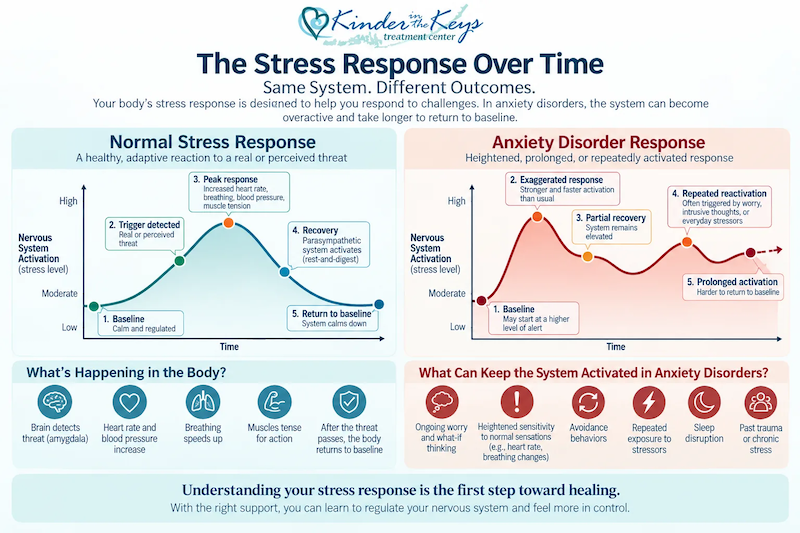
In situations like these, anxiety can actually serve a purpose. Your body becomes more alert. Your attention narrows. Your heart rate may increase. You may think through possible outcomes or prepare more carefully.
Most importantly, normal anxiety tends to settle when the situation passes or when the uncertainty is resolved.
You may still dislike the feeling, but it does not usually take control of your life.
The National Institute of Mental Health explains that occasional anxiety is a normal part of life, while anxiety disorders involve more persistent fear or worry that may occur across situations and worsen over time.
What Makes an Anxiety Disorder Different?
An anxiety disorder is not simply “more worrying.”
The anxiety begins to take on a life of its own.
You may logically know that you are safe while your body continues responding as though something is wrong. You may find yourself anticipating problems long before they happen, repeatedly seeking reassurance, avoiding situations that once felt manageable, or organizing your day around preventing anxiety.
For some women, the anxiety becomes so familiar that they stop recognizing how much of their life has changed around it.
You might think:
I have always been a worrier.
I just need to get better at handling stress.
Everyone feels like this.
But an anxiety disorder can gradually change what you do, where you go, how you sleep, whom you see, and what you believe you are capable of handling.
That is when anxiety stops being only an emotion and starts becoming a pattern.
Normal Anxiety vs Anxiety Disorder: The Key Differences
One of the easiest ways to understand the difference is to look at proportion, persistence, control, and impairment.
Normal anxiety generally has a clear trigger
You know what you are nervous about.
Maybe you have a flight tomorrow, your child is having surgery, or you are waiting to hear whether you got a job.
An anxiety disorder may involve worry that continues even when there is no immediate problem to solve. You may also move quickly from one worry to another.
The situation changes, but the anxiety remains.
Normal anxiety usually decreases when the stressor passes
If the interview ends or the medical test comes back normal, your nervous system begins to settle.
With an anxiety disorder, reassurance may provide only temporary relief.
Your mind may quickly find another possibility to worry about.
Normal anxiety does not usually shrink your life
You may feel nervous about getting on an airplane and still get on the plane.
An anxiety disorder may lead you to stop flying entirely.
Then perhaps you stop traveling. Then you turn down work opportunities that require travel. Then family members begin making plans around what you can and cannot tolerate.
This gradual narrowing is one of the most important signs that anxiety has become clinically significant.
Normal anxiety remains somewhat proportional to the situation
Being nervous before surgery makes sense.
Feeling intense dread for hours because you have to make a routine phone call may signal something more.
People with anxiety disorders often recognize that their reaction seems larger than the situation, but knowing that intellectually does not necessarily stop the physical and emotional response.
An anxiety disorder may feel difficult to control
You may tell yourself to stop worrying.
You may know the thought is unlikely.
You may even have reassurance from other people.
And yet the loop keeps going.
That loss of control over worry is one of the features associated with generalized anxiety disorder.
Anxiety Is Not Only in Your Thoughts
One of the reasons anxiety disorders are often misunderstood is that anxiety is not purely cognitive.
It is also physical.
Your nervous system participates in the experience.
Anxiety may show up as:
A racing or pounding heart
Tightness in the chest
Shortness of breath
Muscle tension
Nausea or digestive discomfort
Dizziness or lightheadedness
Headaches
Sweating
Difficulty concentrating
Feeling restless or unable to relax
Trouble falling asleep or staying asleep
Exhaustion after long periods of hyperarousal
A woman may therefore say, “I don’t even feel anxious,” while describing a body that has been operating on high alert for months.
That matters because effective treatment cannot always be reduced to telling yourself to think differently. For many women, healing requires addressing the thoughts, behaviors, emotional patterns, physical responses, and experiences that keep the anxiety cycle active.
When Worry Becomes Generalized Anxiety
Generalized anxiety disorder often looks less dramatic than people expect.
There may not be one obvious fear.
Instead, the mind repeatedly scans ordinary life for potential problems.
You may worry about:
Your health
Your children’s health
Finances
Work performance
Relationships
Being late
Making the wrong decision
Something bad happening
Whether other people are upset with you
Tasks you have already completed
Things that may never happen
The subject changes, but the process remains the same.
Some women become extremely capable on the outside because they use overpreparation and control to manage anxiety internally.
They make lists. They arrive early. They check everything twice. They rehearse conversations. They anticipate everyone else’s needs.
From the outside, this can look like competence.
On the inside, it can be exhausting.
What About Panic Attacks?
Panic can look very different from generalized worry.
A panic attack involves a sudden surge of intense fear or physical distress. Symptoms may include a racing heart, difficulty breathing, dizziness, trembling, nausea, chest discomfort, numbness or tingling, and an overwhelming feeling that something terrible is happening.
Having one panic attack does not automatically mean someone has panic disorder.
The problem often develops when the attack itself becomes something you begin fearing.
You may start wondering:
What if it happens while I’m driving?
What if I cannot get out?
What if I have one in front of people?
What if I wake up with one tonight?
Then behaviors begin changing around the possibility of another attack.
You avoid highways. You sit near exits. You stop exercising because a rapid heartbeat feels frightening. You avoid caffeine. You hesitate to travel. You monitor your breathing.
Eventually, the fear of panic can become almost as disruptive as the attacks themselves.
We are going to explore this in much more depth in our upcoming articles on recovering from panic disorder, why panic attacks can occur during sleep, and why panic attacks sometimes keep returning.
Anxiety Can Become a Cycle
Anxiety often survives because of what we do in response to it.
Imagine that you feel suddenly dizzy in a grocery store.
Your first thought may be:
Something is wrong.
Your heart begins racing.
Now you notice the racing heart.
You think:
I’m going to faint.
The fear increases the physical response.
You leave the store.
Within minutes, you begin feeling better.
Your brain may then learn something very powerful:
Leaving kept me safe.
The next time you enter the grocery store, your nervous system remembers.
Eventually, avoidance becomes part of the anxiety cycle.
This can happen with driving, crowds, elevators, restaurants, social situations, exercise, travel, work meetings, medical appointments, or even being home alone.
Avoidance often lowers anxiety temporarily.
But that short-term relief can unintentionally teach the nervous system that the avoided situation really was dangerous.
How Do You Know When Anxiety Is Interfering With Your Life?
Instead of asking only, “How anxious am I?” ask:
What has anxiety caused me to change?
That question can be far more revealing.
Consider whether anxiety has caused you to:
Avoid situations you previously handled
Cancel plans frequently
Need constant reassurance
Lose sleep regularly
Miss work or struggle to concentrate
Avoid driving or traveling
Withdraw socially
Stop exercising because physical sensations frighten you
Depend on another person to feel safe
Constantly monitor your body for symptoms
Spend large amounts of time researching symptoms
Structure your routines around avoiding anxiety
Use alcohol or other substances to calm yourself
Feel unable to relax even when nothing is wrong
Experience repeated panic attacks
Feel exhausted from constantly anticipating problems
The number of symptoms matters less than how much anxiety is controlling your choices.
High-Functioning Does Not Mean Mild
Many women with significant anxiety continue functioning exceptionally well.
They raise families.
They run companies.
They maintain careers.
They take care of aging parents.
They keep appointments and meet deadlines.
That does not necessarily mean the anxiety is mild.
Sometimes it means the woman has become exceptionally skilled at functioning around it.
The cost may appear elsewhere: chronic tension, insomnia, irritability, digestive problems, perfectionism, overcontrol, emotional exhaustion, panic attacks, or an inability to ever truly relax.
Treatment does not have to wait until your life completely falls apart.
When Is Outpatient Therapy Enough?
Many anxiety disorders respond well to outpatient treatment.
Evidence-based approaches can include cognitive behavioral therapy, exposure-based interventions when appropriate, medication management, and other individualized therapeutic approaches.
For mild to moderate anxiety, weekly therapy may provide enough structure and support.
But there are situations in which someone needs more.
A higher level of care may be appropriate when:
Anxiety or panic substantially interferes with daily functioning
Symptoms continue despite outpatient treatment
Avoidance has significantly restricted daily life
Depression, trauma, PTSD, or eating-disorder symptoms are occurring alongside anxiety
Sleep is chronically disrupted
Panic attacks are frequent or debilitating
Someone cannot consistently apply treatment skills in her everyday environment
Daily responsibilities and stressors leave little room for stabilization
Symptoms have become persistent enough that more concentrated treatment is needed
For women who need more support than weekly therapy can provide, a structured women’s anxiety treatment centercan offer the time and clinical support needed to understand the patterns maintaining anxiety and work on them consistently.
How Anxiety Is Treated at Kinder in the Keys
At Kinder in the Keys, we do not view anxiety as one isolated symptom that needs to be suppressed.
We want to understand why the system continues responding as though danger is present.
Treatment may involve exploring:
Thought patterns that amplify threat
Avoidance and safety behaviors
Panic and fear of physical sensations
Trauma and learned survival responses
Relationship patterns
Perfectionism and overcontrol
Sleep and nervous-system regulation
Lifestyle factors that may intensify symptoms
Co-occurring depression or PTSD
The situations a woman has gradually stopped trusting herself to handle
Our women’s residential mental health treatment program provides an immersive environment in which women can step away from daily demands and focus more fully on treatment.
For some women, anxiety is also closely connected with unresolved traumatic experiences. When that is part of the clinical picture, treatment may also include work addressing those experiences through our women’s trauma treatment program.
The goal is not to construct a life in which you never feel anxious again.
Normal anxiety is part of being human.
The goal is to reach a place where anxiety no longer decides how you live.
Can You Recover From an Anxiety Disorder?
Anxiety disorders are treatable, and meaningful improvement is possible.
Recovery does not necessarily mean never experiencing anxiety.
It means anxiety becomes proportional again.
You can feel nervous and still move forward.
You can notice physical sensations without immediately assuming danger.
You can tolerate uncertainty without spending hours trying to eliminate it.
You can travel, sleep, work, socialize, exercise, and make decisions without building your entire life around preventing anxiety.
That is a much more meaningful goal than simply trying to “calm down.”
When to Consider Professional Help
You do not need to wait until anxiety becomes unbearable before asking for help.
Consider speaking with a qualified mental health professional if anxiety:
Has persisted for weeks or months
Is becoming more intense
Causes repeated panic attacks
Interferes with sleep
Is affecting work or relationships
Causes significant avoidance
Makes everyday responsibilities increasingly difficult
Continues despite attempts to manage it on your own
And if outpatient treatment has not been enough, it may be worth discussing whether a more structured level of care would provide the intensity and consistency you need.
At Kinder in the Keys, we provide residential mental health treatment exclusively for women in Key Largo, Florida. Our intentionally small program allows treatment to be highly individualized, with care for anxiety, panic disorder, depression, trauma, PTSD, and related mental health concerns.
The Difference Is Not Whether You Ever Feel Anxious
Everyone experiences anxiety.
The question is whether anxiety arrives when it makes sense and eventually settles—or whether it has begun running in the background of your life, influencing decisions long after the actual danger has passed.
When anxiety begins controlling where you go, what you do, what you avoid, how you sleep, or how much you trust yourself, it deserves attention.
You do not have to eliminate every anxious feeling to recover.
You need to learn that anxiety can show up without being in charge.
If anxiety has become difficult to manage despite outpatient support, learn more about residential anxiety treatment for women at Kinder in the Keys.
Frequently Asked Questions
Is it normal to have anxiety every day?
Some periods of life can involve frequent anxiety, particularly during prolonged stress. However, persistent anxiety that is difficult to control, seems disproportionate to circumstances, or begins interfering with daily functioning may warrant evaluation by a mental health professional.
What is the main difference between normal anxiety and an anxiety disorder?
Normal anxiety generally occurs in response to a specific stressor and decreases when the situation resolves. An anxiety disorder tends to be more persistent, difficult to control, disproportionate to actual danger, or disruptive to everyday life.
Can you have an anxiety disorder and still function normally?
Yes. Some people with significant anxiety continue working, parenting, socializing, and fulfilling responsibilities. Functioning does not necessarily indicate that symptoms are mild.
Can anxiety cause physical symptoms?
Yes. Anxiety can be associated with symptoms such as increased heart rate, muscle tension, dizziness, stomach discomfort, sweating, shortness of breath, trembling, headaches, and sleep problems.
Is having a panic attack the same as having an anxiety disorder?
No. A person can experience an isolated panic attack without having panic disorder. Panic disorder involves recurrent unexpected panic attacks along with persistent concern or behavioral changes related to additional attacks.
When does anxiety need residential treatment?
Residential treatment may be considered when anxiety significantly interferes with functioning, persists despite outpatient care, causes substantial avoidance or repeated panic, occurs alongside other significant mental health symptoms, or requires a more intensive and structured level of support
Medically Reviewed By
Dr. Laura Tanzini, DrPH, LMFT
Doctor of Public Health | Specialty in Lifestyle Medicine
Licensed Marriage and Family Therapist (Florida & California)
Founder & CEO, Kinder in the Keys
This article has been clinically reviewed for accuracy and consistency with current behavioral health and trauma-informed care principles. Content is intended to provide general educational information and should not replace individualized evaluation, diagnosis, or treatment by a qualified healthcare professional.
Doctoral Research: Dr. Tanzini’s doctoral research at Loma Linda University examined childhood and adult traumatic events, cumulative trauma exposure, gender, forgiveness, life satisfaction, and long-term well-being.
Medical Disclaimer: The information provided in this article is for educational and informational purposes only and is not intended as medical advice, diagnosis, or treatment. Mental health needs vary by individual. If you are experiencing symptoms of an anxiety disorder or another mental health condition, consult a qualified healthcare professional who can evaluate your individual circumstances.