
Nutrition and anxiety can interact in meaningful ways, but the relationship is more complicated than saying certain foods cause anxiety or that eating the right diet can cure an anxiety disorder.
Food affects the body.
It influences energy availability, hydration, gastrointestinal function, metabolic health, nutrient status, sleep, and many other physiological processes. Some of those processes can influence how a woman feels physically and emotionally.
Certain dietary exposures—particularly caffeine—can also produce sensations such as jitteriness, restlessness, a faster heartbeat, or difficulty sleeping that may resemble or intensify anxiety symptoms in susceptible people.
At the same time, anxiety itself can change appetite, digestion, eating patterns, and food choices.
That makes the relationship bidirectional.
At Kinder in the Keys, nutrition is considered one part of whole-person mental health care. It can support physical and emotional well-being, but nutrition does not replace appropriate assessment and treatment for an anxiety disorder.
For women whose symptoms require more support, our anxiety treatment program for women addresses the underlying anxiety while considering physical health, sleep, nutrition, and other factors that may affect recovery.
How Are Nutrition and Anxiety Connected?
There is no single nutritional pathway that explains anxiety.
Instead, several different relationships may be relevant depending on the individual woman.
These can include:
Caffeine and other stimulants
Irregular eating or inadequate food intake
Hydration
Alcohol use
Nutrient deficiencies when actually present
Physical health conditions
Gastrointestinal symptoms
Sleep
Overall dietary patterns
The gut-brain axis
Research examining diet and anxiety has found associations between dietary patterns, individual nutrients, and anxiety symptoms, but much of the evidence remains observational and relatively few intervention studies have specifically involved people diagnosed with anxiety disorders.
The importance of each factor varies considerably.
One woman may notice that caffeine reliably intensifies her anxiety.
Another may become shaky and uncomfortable when she goes long periods without eating.
Another may have gastrointestinal symptoms that become worse when she is anxious.
Another may eat an excellent diet and still have generalized anxiety disorder.
That last point matters.
Anxiety disorders are not simply nutritional problems.
Food Can Affect How You Feel Without Causing an Anxiety Disorder
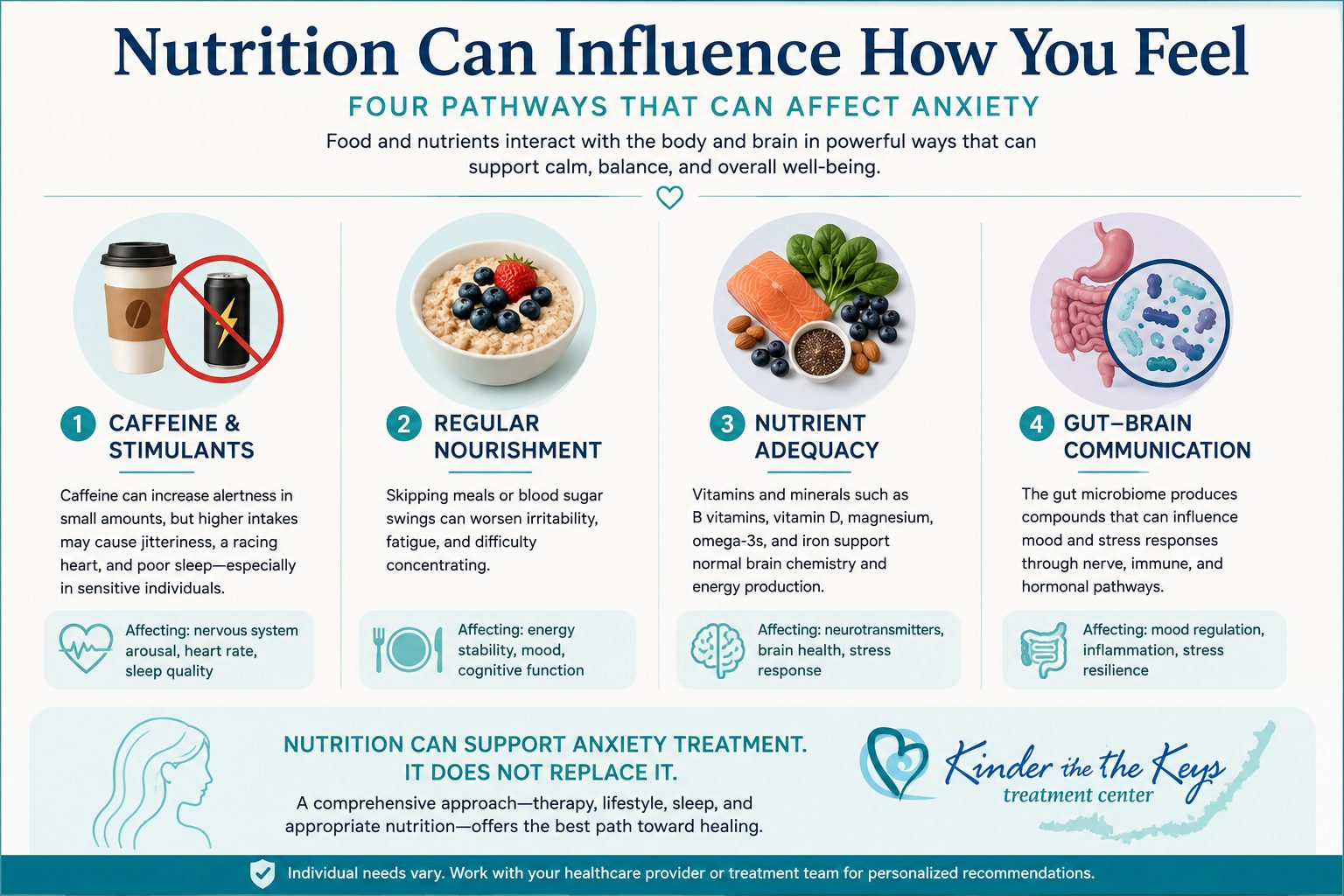
There is an important difference between something affecting anxiety symptoms and something causing an anxiety disorder.
For example, caffeine can increase heart rate, restlessness, alertness, and jitteriness.
Those sensations can feel remarkably similar to anxiety.
For someone already sensitive to physical arousal or prone to panic, those sensations may become particularly uncomfortable.
That does not mean caffeine created the underlying anxiety disorder.
Likewise, hunger, dehydration, inadequate sleep, illness, medication effects, or other physiological states can sometimes make a person feel shaky, irritable, lightheaded, uncomfortable, or unable to concentrate.
Those sensations may increase distress.
But they should not automatically be interpreted as the cause of someone’s psychiatric condition.
Understanding the distinction helps women identify physical factors that may be contributing to symptoms without reducing anxiety to food.
Caffeine and Anxiety
Caffeine is one of the clearest examples of a dietary substance that can influence anxiety symptoms.
Caffeine stimulates the central nervous system.
Depending on dose and individual sensitivity, it can contribute to:
Jitteriness
Restlessness
Increased heart rate
Palpitations
Difficulty sleeping
Gastrointestinal discomfort
Feeling unusually alert or “wired”
Some women tolerate caffeine without difficulty.
Others notice anxiety symptoms after relatively small amounts.
Dose, habitual caffeine use, medications, sleep, health conditions, genetics, and other factors can influence individual response.
For women who suspect caffeine is affecting their anxiety, looking at how much they consume, when they consume it, and what happens afterward can be more useful than assuming everyone with anxiety must stop drinking coffee.
A 2024 meta-analysis found that caffeine intake was associated with increased anxiety, with substantially larger effects at doses above 400 mg, reinforcing the importance of both dose and individual response.
Caffeine deserves its own discussion because its effects are substantially better established than many of the nutritional claims commonly made about anxiety.
Our guide to whether caffeine can make anxiety worse takes a closer look at dose, individual sensitivity, palpitations, sleep, and caffeine withdrawal.
Energy Drinks and Anxiety
Energy drinks deserve particular attention for women experiencing anxiety.
Many energy drinks contain substantial amounts of caffeine, and some contain additional stimulant ingredients. Serving sizes and caffeine amounts can also vary considerably between products, making it easy to consume more caffeine than someone realizes.
For a woman already experiencing anxiety, the resulting physical stimulation can complicate treatment.
Increased heart rate, jitteriness, restlessness, difficulty sleeping, and feeling “wired” can overlap with or intensify the same physical sensations we are trying to help her learn to manage.
At Kinder in the Keys, energy drinks are not included on the approved shopping list.
That decision came from clinical experience. We found it extremely difficult to accurately assess and treat anxiety symptoms when women were regularly consuming highly caffeinated energy drinks.
If a stimulant is repeatedly producing or amplifying physical arousal, it becomes harder to determine what belongs to the underlying anxiety disorder and what is being intensified by caffeine.
Removing energy drinks does not treat the anxiety disorder by itself.
It removes a potentially significant and unnecessary stimulant so treatment can focus more clearly on the woman’s underlying symptoms, triggers, thought patterns, behaviors, sleep, and other contributing factors.
Women who regularly consume large amounts of caffeine may also experience withdrawal symptoms if caffeine intake is reduced abruptly, so significant changes in habitual caffeine consumption should be approached thoughtfully.
Regular Eating and Physical Sensations
Going long periods without eating can make some people feel physically uncomfortable.
Depending on the individual and circumstances, symptoms may include:
Hunger
Weakness
Irritability
Difficulty concentrating
Lightheadedness
Shakiness
For someone prone to anxiety, uncomfortable physical sensations can sometimes become part of the anxiety experience.
A person who is highly sensitive to changes in heart rate, dizziness, trembling, or other body sensations may interpret those changes as signs that something is wrong.
That can increase anxiety further.
This does not mean every episode of anxiety between meals is caused by low blood sugar.
Blood-glucose regulation is complex, and symptoms such as shakiness, sweating, dizziness, or palpitations can have many possible causes.
Persistent or concerning symptoms deserve appropriate medical evaluation rather than an automatic assumption that food—or anxiety—is responsible.
Blood Sugar and Anxiety: Avoiding an Oversimplified Explanation
The internet frequently describes a simple sequence:
Eat sugar → blood sugar spikes → insulin overshoots → blood sugar crashes → adrenaline surges → anxiety.
Human physiology is not that predictable.
Blood glucose does rise after carbohydrate-containing meals, and the body releases insulin to help regulate it. But a normal rise and fall in glucose after eating should not automatically be described as a dangerous “crash.”
Some people do experience clinically meaningful glucose abnormalities, including hypoglycemia, and symptoms can include shakiness, sweating, weakness, palpitations, or confusion.
Those symptoms deserve proper medical evaluation.
For women without a diagnosed glucose disorder, the more useful nutritional message is much simpler:
Regular, adequately nourishing meals can support stable energy and physical well-being.
We do not need to diagnose an insulin problem to recommend eating consistently.
Hydration Matters Too
Dehydration can affect physical and cognitive functioning.
A woman who is not drinking enough fluid may experience fatigue, headache, dizziness, difficulty concentrating, or other uncomfortable symptoms.
Those sensations can be particularly unpleasant for someone already experiencing anxiety.
Again, hydration is not an anxiety treatment.
It is basic physical healthcare.
That distinction is central to a responsible whole-person approach.
Supporting normal physical functioning can remove unnecessary physiological stressors while appropriate mental health treatment addresses the anxiety itself.
Alcohol and Anxiety
Alcohol deserves particular attention because it can initially feel calming.
Alcohol depresses activity in the central nervous system, and some people use it to reduce tension or social discomfort.
But alcohol can also disrupt sleep and may contribute to worsening anxiety as its effects wear off.
Using alcohol repeatedly to manage anxiety can create additional problems, including increasing reliance on alcohol as a coping strategy.
For a woman receiving treatment for anxiety, understanding the relationship between alcohol, sleep, mood, medications, and anxiety symptoms can be an important part of the clinical picture.
Nutrient Deficiencies: Test Rather Than Guess
Nutrients are essential for normal brain and body function.
Iron, vitamin B12, folate, vitamin D, magnesium, and many other nutrients participate in biological processes relevant to energy, neurological functioning, blood formation, muscle function, metabolism, and overall health.
But that does not mean anxiety indicates a nutrient deficiency.
And it does not mean every woman with anxiety should begin taking supplements.
When symptoms or medical history suggest a possible deficiency, appropriate evaluation can determine whether one actually exists.
This is a much safer approach than assuming:
“I’m anxious, so I must be magnesium deficient.”
or:
“My mood is low, so I need vitamin D.”
If a clinically significant deficiency exists, correcting it is appropriate healthcare.
If it does not, adding increasingly large numbers of supplements may provide no benefit and can sometimes create risks of their own.
Magnesium and Anxiety
Magnesium is frequently marketed as a natural treatment for anxiety.
Magnesium is an essential mineral involved in many normal physiological processes, including nerve and muscle function.
Researchers have studied relationships between magnesium status, supplementation, stress, and anxiety.
But the evidence does not justify describing magnesium as a universal anti-anxiety treatment or claiming that anxiety means someone’s GABA or cortisol system is malfunctioning because she lacks magnesium.
Women with a confirmed deficiency should receive appropriate guidance about correction.
For everyone else, obtaining adequate nutrients through a balanced dietary pattern is a more reasonable starting point than treating anxiety through unsupervised supplementation.
Omega-3 Fatty Acids
Omega-3 fatty acids are important components of a nutritious dietary pattern and play roles in normal cellular and neurological function.
They are found in foods such as:
Salmon
Sardines
Mackerel
Walnuts
Chia seeds
Flaxseeds
Omega-3s have also been studied in relation to mental health.
Some research suggests potential benefits in particular populations, but findings should not be translated into the claim that omega-3s treat anxiety by reducing neuroinflammation.
Eating foods containing healthy fats can be part of good nutrition.
That is valuable without requiring us to turn every nutrient into a psychiatric intervention.
Complex Carbohydrates and Anxiety
Whole grains, legumes, fruits, vegetables, and other carbohydrate-containing foods can provide energy, fiber, vitamins, minerals, and other nutrients.
Complex carbohydrates are sometimes promoted for anxiety because of their relationship to serotonin.
That explanation is usually oversimplified.
The brain’s serotonin system is influenced by complex biological processes, and eating oatmeal or sweet potatoes should not be presented as a way to directly increase brain serotonin and treat anxiety.
The stronger reason to include minimally processed carbohydrate sources is that they can contribute to a balanced, nutritionally adequate dietary pattern.
Again:
Good nutrition does not need a magical mechanism to be worthwhile.
What Is the Gut-Brain Axis?
The gut-brain axis is a real biological concept.
It refers broadly to the two-way communication between the gastrointestinal system and the brain.
That communication involves several systems, including:
Neural pathways
The autonomic nervous system
The immune system
Hormonal signaling
Microbial metabolites
The gut microbiome
The vagus nerve is one pathway involved in communication between the brain and internal organs.
Researchers are increasingly studying how the gut microbiome may influence physical and mental health.
This is an exciting area of science.
It is also an area where wellness marketing frequently gets ahead of the evidence.
Does the Gut Produce Serotonin?
A large proportion of the body’s serotonin is produced in the gastrointestinal tract.
That fact is frequently used online to claim that improving gut health will increase brain serotonin and improve depression or anxiety.
That is not how the system works.
Serotonin produced in the gut does not simply travel into the brain and raise brain serotonin levels.
Peripheral serotonin has important functions in the gastrointestinal system and elsewhere in the body.
The microbiome may influence neurological and psychological functioning through several indirect pathways, and researchers continue studying those relationships.
But the statement:
“Most serotonin is made in your gut”
does not mean:
“Fix your gut and you’ll fix your anxiety.”
Those are very different claims.
Can the Microbiome Affect Anxiety?
Possibly—and this is an active area of research.
Studies have identified associations among gut microbial composition, diet, gastrointestinal health, stress, and mental health.
Researchers are also investigating whether probiotics, prebiotics, fermented foods, dietary patterns, or other interventions can meaningfully influence anxiety symptoms.
Results remain variable.
Recent reviews of probiotics, prebiotics, and other microbiome-targeted approaches show why caution is appropriate: some studies report modest improvements in anxiety symptoms, while results across studies remain inconsistent and methodological quality is often limited.
At present, we do not have enough evidence to prescribe one microbiome composition, probiotic, fermented food, or “gut-healing” diet as a treatment for an anxiety disorder.
That does not make the research meaningless.
It means the science is still developing.
Good healthcare distinguishes between an interesting emerging mechanism and an established clinical treatment.
What About Inflammation?
Inflammation is another area of active mental health research.
Researchers have identified associations between inflammatory processes and several psychiatric conditions, including depression and anxiety.
But inflammation is an extremely broad biological process.
We should not tell a woman:
“Your anxiety is caused by inflammation.”
Nor should we assume that removing a particular food will “reduce neuroinflammation” and resolve anxiety.
Dietary patterns can influence overall metabolic and cardiovascular health, and some patterns are associated with differences in inflammatory markers.
Those findings are scientifically interesting.
They do not yet provide a simple anti-inflammatory diet prescription for treating an anxiety disorder.
Food Sensitivities and Anxiety
Food sensitivities are another area where internet explanations frequently become exaggerated.
A woman who consistently experiences gastrointestinal or other physical symptoms after eating particular foods should discuss those symptoms with an appropriate healthcare professional.
But anxiety should not automatically be attributed to an unidentified food sensitivity.
And foods such as gluten or dairy should not be eliminated simply because someone has anxiety.
For people with diagnosed conditions such as celiac disease, appropriate dietary restriction is medically necessary.
For other women, unnecessary restriction can make eating more complicated without addressing the underlying anxiety.
At Kinder in the Keys, gluten-free dietary needs are accommodated when medically indicated, including for women with celiac disease. We do not assume that eliminating gluten treats anxiety.
Probiotics and Fermented Foods
Foods such as yogurt, kefir, kimchi, and sauerkraut can be part of a varied diet.
Probiotics and fermented foods are also being studied for possible effects on the gut microbiome and mental health.
But a probiotic yogurt is not an anxiety medication.
Different probiotic strains have different biological effects, research findings vary, and commercially available products are not interchangeable.
Women can certainly enjoy fermented foods as part of their diet if they tolerate them.
We simply should not promise that doing so will treat an anxiety disorder.
Can Certain Foods Make Anxiety Worse?
There is no universal list of foods that everyone with anxiety must avoid.
However, particular dietary exposures can affect particular people.
The clearest example is caffeine, especially highly caffeinated energy drinks.
Alcohol may also affect anxiety and sleep.
Some women may notice that long periods without eating leave them feeling physically uncomfortable.
Others may have genuine medical conditions or food intolerances that require individualized dietary management.
What we should avoid is creating a fear-based list of:
“Foods that cause anxiety.”
That can encourage unnecessary restriction and distract from understanding what is actually driving the woman’s symptoms.
Can Certain Foods Reduce Anxiety?
No individual food should be marketed as an anxiety treatment.
Salmon does not cure generalized anxiety disorder.
Dark chocolate does not regulate someone’s nervous system.
Sauerkraut does not repair an anxious brain.
And a smoothie cannot replace psychotherapy.
What food can do is provide the energy, protein, fats, carbohydrates, vitamins, minerals, fiber, and other components the body needs for normal functioning.
A dietary pattern containing a variety of:
Vegetables
Fruits
Whole grains
Legumes
Nuts and seeds
Appropriate protein sources
Healthy fats
Adequate fluids
can support overall physical health.
For mental health treatment, that is the appropriate claim.
Building a Supportive Eating Pattern

A nutrition pattern that supports overall health does not need to be complicated or perfect.
For many women, useful goals may include:
Eat Regularly
Avoiding extremely long gaps between meals can help maintain energy and reduce uncomfortable hunger-related symptoms.
Include Protein
Protein-containing foods can contribute to satiety and nutritional adequacy.
Include Fiber-Rich Foods
Vegetables, fruits, whole grains, legumes, nuts, and seeds provide fiber and other important nutrients.
Include Healthy Fats
Foods such as fish, nuts, seeds, avocado, and olive oil can contribute to an overall nutritious dietary pattern.
Stay Hydrated
Adequate fluid intake supports normal physical functioning.
Pay Attention to Caffeine and Energy Drinks
If caffeine consistently increases anxiety, jitteriness, palpitations, or sleep problems, consider reducing the amount or changing the timing.
Highly caffeinated energy drinks can be particularly problematic because they may produce substantial physiological stimulation while also disrupting sleep.
Caffeine intake can also affect sleep, which is why sleep and anxiety should be considered alongside nutrition when a woman is trying to identify factors that may be intensifying her symptoms.
Be Thoughtful About Alcohol
Alcohol can affect sleep, mood, medications, and anxiety.
Avoid Unnecessary Restriction
A mental health diagnosis is not a reason to eliminate entire categories of food without a legitimate medical or nutritional indication.
Nutrition Should Not Become Another Source of Anxiety
This point is especially important.
A woman who already struggles with anxiety does not need to become anxious about eating perfectly.
Nutrition information online can easily turn into:
Don’t eat sugar.
Don’t eat gluten.
Don’t eat dairy.
Fix your microbiome.
Take these six supplements.
Never drink coffee.
Eat these foods to lower cortisol.
That is not whole-person mental healthcare.
Food should support health—not become another complicated set of rules a woman is afraid to break.
A healthy dietary pattern has room for flexibility, enjoyment, culture, preference, social connection, and real life.
Can Nutrition Treat an Anxiety Disorder?
Nutrition can support anxiety treatment. It does not replace it.
Generalized anxiety disorder, panic disorder, social anxiety disorder, and other anxiety disorders require appropriate clinical assessment.
Depending on the woman, treatment may involve psychotherapy, medication management when appropriate, behavioral interventions, trauma treatment when clinically relevant, or another individualized approach.
Nutrition can support physical health during that process.
It may also help identify specific contributors—such as excessive caffeine, inadequate intake, alcohol use, or an actual nutritional deficiency—that are making symptoms harder to manage.
But treating those factors is not necessarily the same thing as treating the anxiety disorder itself.
Anxiety and Nutrition at Kinder in the Keys
At Kinder in the Keys, nutrition is part of our broader whole-person approach to women’s mental health.
We do not prescribe an “anti-anxiety diet.”
We do not tell women that anxiety is caused by poor food choices.
And we do not use supplements, probiotics, restrictive diets, or wellness trends as substitutes for appropriate mental health treatment.
Nutrition can support physical health during residential anxiety treatment for women, but it is one component of a broader individualized treatment plan rather than a treatment for the anxiety disorder itself.
Instead, we look at the individual woman.
Questions may include:
Is she eating regularly?
Is she getting adequate nutrition?
How much caffeine is she consuming?
Is she using energy drinks?
How is she sleeping?
Is alcohol affecting her symptoms?
Are gastrointestinal or other physical symptoms present?
Is there a diagnosed medical condition requiring dietary modification?
Has anxiety itself changed the way she eats?
Those questions help us understand the whole clinical picture.
Nutrition supports treatment because the woman receiving mental health care also has a body that needs appropriate nourishment and care.
Nutrition and Anxiety: Frequently Asked Questions
Can poor nutrition cause anxiety?
Poor nutrition can affect physical health and may contribute to symptoms such as fatigue, weakness, irritability, difficulty concentrating, or other physical sensations that can overlap with anxiety.
But anxiety disorders are complex mental health conditions and should not be reduced to poor diet.
A woman can eat an excellent diet and still have an anxiety disorder.
Does caffeine make anxiety worse?
It can.
Caffeine stimulates the central nervous system and can increase jitteriness, restlessness, heart rate, palpitations, and sleep disruption in some people.
For women who are particularly sensitive to physical arousal or who experience panic symptoms, these sensations may be especially uncomfortable.
Individual sensitivity varies considerably, which is why the amount consumed and the woman’s own response matter.
Why doesn’t Kinder allow energy drinks on the shopping list?
At Kinder in the Keys, energy drinks are not included on the approved shopping list because many contain substantial amounts of caffeine and sometimes additional stimulant ingredients.
In our clinical experience, it became extremely difficult to accurately assess and treat anxiety when a woman was regularly consuming highly caffeinated energy drinks.
Removing energy drinks does not treat the underlying anxiety disorder.
It removes a potentially significant source of physiological stimulation so clinicians and clients can more clearly evaluate the anxiety symptoms themselves.
Does sugar cause anxiety?
Eating sugar does not simply cause an anxiety disorder.
Blood glucose normally changes after eating, and those normal changes should not automatically be described as dangerous blood-sugar “spikes and crashes.”
Some people have medical conditions that affect glucose regulation, and clinically significant hypoglycemia can produce symptoms such as shakiness, sweating, weakness, confusion, or palpitations.
Persistent or concerning symptoms require appropriate medical evaluation rather than assuming sugar or anxiety is responsible.
Can skipping meals make anxiety feel worse?
For some women, yes.
Going long periods without eating can produce hunger, weakness, irritability, lightheadedness, shakiness, or difficulty concentrating.
For someone already sensitive to physical sensations associated with anxiety or panic, those sensations may increase distress.
Regular nutrition can support physical stability, but eating regularly should not be presented as treatment for an anxiety disorder.
Can magnesium cure anxiety?
No.
Magnesium is an essential mineral, and a clinically significant deficiency should be corrected when present.
Research has examined magnesium and anxiety, but current evidence does not support assuming that every person with anxiety is magnesium deficient or treating anxiety universally with magnesium supplements.
Are probiotics good for anxiety?
Researchers are actively studying relationships among the gut microbiome, probiotics, diet, and mental health.
Some findings are promising, but results vary considerably.
At present, probiotics should not be considered an established treatment for an anxiety disorder.
Is the gut-brain axis real?
Yes.
The gastrointestinal system and brain communicate through neural, immune, hormonal, metabolic, and microbial pathways. This communication is commonly referred to as the gut-brain axis.
The existence of this system does not mean that anxiety originates in the gut or that changing the microbiome will cure an anxiety disorder.
The clinical implications of gut-brain research are still developing.
Does most of the body’s serotonin come from the gut?
A large proportion of the body’s serotonin is produced in the gastrointestinal tract.
However, serotonin produced in the gut does not simply cross into the brain and increase brain serotonin.
This is an important distinction because the statistic is frequently used to make exaggerated claims about treating depression or anxiety by “fixing the gut.”
Should I eliminate gluten or dairy if I have anxiety?
Not simply because you have anxiety.
People with diagnosed conditions requiring dietary modification should follow appropriate medical and nutritional guidance.
For example, a woman with celiac disease requires a gluten-free diet.
But anxiety alone is not evidence that someone has a gluten or dairy sensitivity, and unnecessary food restriction can create additional problems without addressing the underlying anxiety.
What foods are best for anxiety?
There is no specific food that treats an anxiety disorder.
A varied dietary pattern that provides adequate energy, protein, healthy fats, carbohydrates, fiber, vitamins, minerals, and fluids supports overall physical health.
That can include vegetables, fruits, whole grains, legumes, nuts and seeds, appropriate protein sources, healthy fats, and adequate hydration.
The goal is adequate, balanced nutrition—not a perfect anti-anxiety diet.
Can nutrition replace anxiety treatment?
No.
Nutrition can support physical and mental health and may help identify factors such as excessive caffeine, inadequate intake, alcohol use, or an actual nutrient deficiency that are contributing to how a woman feels.
But generalized anxiety disorder, panic disorder, social anxiety disorder, and other anxiety disorders require appropriate clinical assessment and treatment.
The Bottom Line on Nutrition and Anxiety
The relationship between nutrition and anxiety is real, but it is not simple.
Food affects the body, and the body affects how we feel.
Caffeine can increase physiological arousal.
Irregular eating can leave some women feeling physically uncomfortable.
Hydration matters.
Alcohol can affect anxiety and sleep.
Nutrient deficiencies matter when they actually exist.
The gastrointestinal system and brain communicate through a real and complex gut-brain network that researchers are continuing to study.
And overall nutrition is an important part of physical health.
None of that means anxiety can be reduced to a particular food, nutrient, microbiome, inflammatory pathway, or dietary rule.
At Kinder in the Keys, we believe nutrition belongs within mental health treatment because women are whole people.
Their psychological health matters.
Their physical health matters.
Their sleep matters.
Their nutrition matters.
Their relationships, environment, history, and daily habits matter.
But those pieces need to be understood in context.
The goal is not to give an anxious woman another list of things she must eat perfectly.
It is to support her physical health while providing appropriate treatment for the anxiety disorder itself.
Good nutrition supports treatment. It does not replace it.
Medically Reviewed By
Dr. Laura Tanzini, DrPH, LMFT
Doctor of Public Health | Specialty in Lifestyle Medicine
Licensed Marriage and Family Therapist (Florida & California)
Founder & CEO, Kinder in the Keys
This article has been clinically reviewed for accuracy and consistency with current behavioral health, lifestyle medicine, and evidence-informed nutrition principles. It is intended to provide educational information about nutrition and anxiety and does not replace individualized medical, nutritional, psychiatric, or mental health assessment and treatment.
Medical Disclaimer
This article is for educational and informational purposes only and is not intended to diagnose, treat, cure, or prevent an anxiety disorder or any other medical or mental health condition.
If anxiety symptoms are persistent, worsening, or interfering with daily functioning, seek evaluation from a qualified healthcare or mental health professional. New or concerning physical symptoms—including significant palpitations, fainting, severe dizziness, or symptoms suggestive of a medical condition—should receive appropriate medical evaluation.
If there is an immediate risk of self-harm or suicide, call or text 988 in the United States or seek emergency care.