
Dating after narcissistic abuse can feel very different from dating before it. You may want companionship and connection while simultaneously wondering whether you can trust another person—or even trust your own judgment about them.
There is no required amount of time you must wait before dating again. There is also no point at which you have to be completely “healed” before you are allowed to have another relationship.
A better question is:
Are the effects of your previous relationship still driving the decisions you make about new ones?
Being ready to date again is less about reaching a particular date on the calendar and more about regaining enough self-trust, emotional stability, independence, and confidence in your boundaries that you can evaluate a new relationship for what it actually is.
You are not trying to guarantee that you will never be hurt again. No one can do that.
You are trying to enter your next relationship without abandoning yourself in the process.
Dating After Narcissistic Abuse Can Feel Complicated
An emotionally abusive or highly controlling relationship can change the way you approach closeness.
You may become suspicious of attention that once would have felt flattering. A delayed text might trigger anxiety. A disagreement may feel much more threatening than the situation warrants. You may question whether a boundary is reasonable or worry that saying no will cause someone to leave.
Some women become extremely cautious.
Others move quickly toward closeness because reassurance and affection feel especially powerful after a relationship in which those things were unpredictable or conditional.
Neither reaction tells you that something is fundamentally wrong with you.
What matters is recognizing how your previous experiences may be influencing what you expect, tolerate, fear, or pursue now.
Understanding the long-term effects of narcissistic abuse can also help explain why trust, confidence, and emotional safety may feel different after the relationship ends.
You Don’t Have to Be “Fully Healed” to Date Again
This deserves to be said clearly.
You do not have to resolve every emotional wound before entering another relationship.
Human beings continue growing while they are in relationships.
You may still have moments of insecurity. You may encounter triggers. You may occasionally question yourself. You may still be working through grief or learning what healthier relationships look like.
The issue is not whether every effect of the past has disappeared.
The more useful question is whether those effects are controlling your choices.
For example, there is an important difference between:
“I sometimes feel anxious when I’m getting close to someone, but I can recognize it, talk about it, and make thoughtful decisions.”
and:
“I am so afraid of being abandoned that I ignore behavior I know makes me uncomfortable.”
Readiness is not perfection.
It is having enough awareness and stability to remain connected to yourself while becoming connected to someone else.
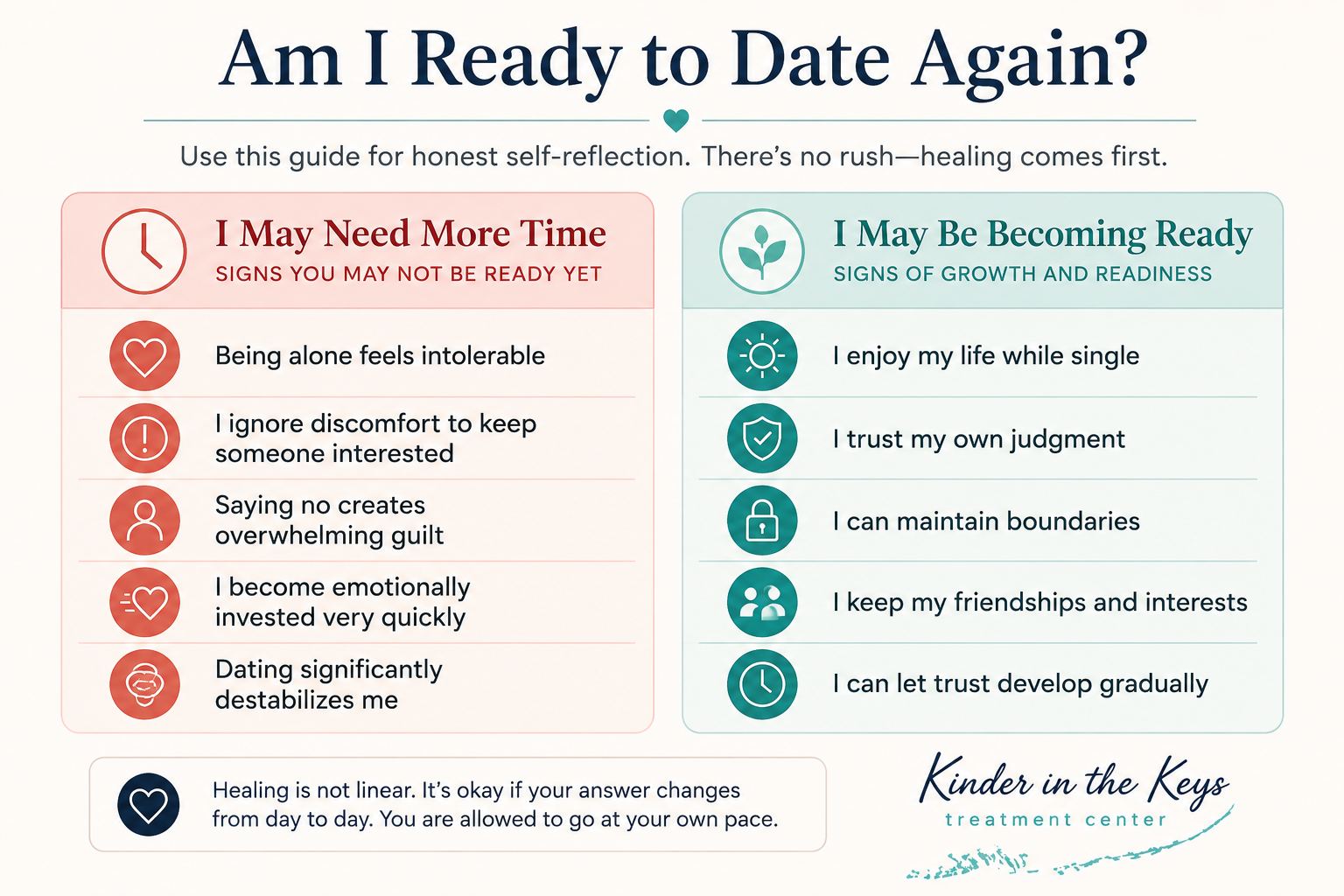
Signs You May Not Be Ready to Date Again Yet
There is nothing wrong with deciding that you are not ready.
In fact, recognizing that you need more time can be an act of good judgment.
You may want to wait if:
Being alone feels so intolerable that almost any relationship seems preferable
You need a new partner to reassure you that you are lovable or worthy
You consistently ignore your own discomfort to avoid disappointing someone
You have difficulty saying no or maintaining boundaries
You feel compelled to explain or justify every boundary you set
Normal disagreement immediately feels dangerous
You are intensely suspicious of everyone you meet
You find yourself repeatedly comparing a new person with your former partner
You become emotionally invested before you have had enough time to actually know someone
You are overlooking concerning behavior because you desperately want the relationship to work
Dating is significantly worsening existing anxiety, depression, or trauma-related symptoms
None of these means you should never date.
They may simply mean that right now, strengthening your relationship with yourself deserves more attention than beginning a relationship with someone else.
Signs You May Be Becoming Ready
Readiness can also show up in subtle ways.
You may be moving toward a healthier place for dating when:
You can enjoy your life without being in a romantic relationship
You trust your observations more than you once did
You can say no without becoming overwhelmed by guilt
You recognize that another person’s disappointment does not automatically mean you did something wrong
You maintain friendships, interests, goals, and routines outside a relationship
You are willing to let trust develop gradually
You can tolerate uncertainty without immediately seeking reassurance
You notice concerning behavior instead of automatically explaining it away
You understand your non-negotiable boundaries
You are comfortable leaving a situation that repeatedly violates those boundaries
You want a relationship rather than feeling that you need one to feel whole
These are not boxes you have to check before accepting a dinner invitation.
They are signs that your sense of self is becoming less dependent on how another person responds to you.
Rebuild Self-Trust Before You Focus on Trusting Someone Else
Women recovering from narcissistic abuse often talk about difficulty trusting future partners.
But there is another kind of trust that may need attention first:
Trust in yourself.
Can you recognize when something makes you uncomfortable?
Can you take your own reaction seriously without immediately talking yourself out of it?
Can you change your mind?
Can you leave?
Can you disagree?
Can you decide that someone is not right for you even if that person wants the relationship to continue?
Self-trust does not mean believing that every instinct is automatically correct. Feelings can be influenced by previous experiences, anxiety, assumptions, and many other factors.
It means being willing to listen to yourself, examine what you are experiencing, and make deliberate decisions rather than automatically deferring to someone else.
That is very different from trying to predict perfectly whether another person will ever disappoint you.
Learn the Difference Between Attraction and Safety
Strong attraction can feel exciting.
It is not the same thing as emotional safety.
Intensity is not the same thing as intimacy.
Constant communication is not the same thing as commitment.
Someone wanting to spend every available moment with you is not automatically evidence of compatibility.
And feeling an immediate, powerful connection does not tell you how that person will behave when frustrated, disappointed, jealous, stressed, or told no.
When dating after narcissistic abuse, it can be helpful to give yourself enough time to observe a person across different situations.
Pay attention to what happens when:
You disagree
You have plans that do not include them
You set a boundary
You ask for something you need
You say no
You spend time with friends or family
They make a mistake
You make a mistake
Plans change
They do not get what they want
Healthy relationships are not defined by the absence of disagreement.
They are partly defined by what happens during and after disagreement.
Boundaries Are Information, Not Punishment
The original relationship may have taught you that boundaries lead to arguments, withdrawal, guilt, retaliation, or accusations that you are selfish.
That can make setting boundaries in a new relationship uncomfortable.
But boundaries are not punishments.
They communicate information about what you will participate in, what you need, and what you will do when a limit is crossed.
A boundary might sound like:
“I’m not ready to spend every night together.”
“I already have plans with my friends tonight.”
“I don’t share passwords.”
“I’m not comfortable being spoken to that way.”
“I need some time before we make that decision.”
The important information isn’t merely that you can state the boundary.
Watch what the other person does with it.
A healthy partner does not have to like every boundary you establish. But repeated pressure, ridicule, punishment, manipulation, or attempts to wear down reasonable limits provide valuable information about the relationship.
Keep the Life You Rebuilt
One of the strongest protections against losing yourself in another relationship is having a life that exists independently of it.
Keep your friendships.
Keep your interests.
Keep pursuing your professional and personal goals.
Maintain time alone.
Continue doing things that belong only to you.
The original version of this article encouraged women to rediscover interests and passions after narcissistic abuse, and that remains valuable. Reconnecting with hobbies, relationships, goals, and activities can help restore an identity that may have become overshadowed during an abusive relationship.
But there is another step:
Don’t abandon those things simply because you begin dating someone new.
A healthy relationship should become part of your life.
It should not require you to surrender the rest of it.
Let a New Relationship Develop Slowly Enough to Observe It
You do not need an arbitrary rule about how many dates must occur before becoming emotionally or physically close to someone.
But pace matters.
Time allows you to gather information. The National Domestic Violence Hotline also recommends taking new relationships slowly after abuse, allowing time to develop trust and observe whether the relationship is respectful and mutually beneficial.
Someone can behave beautifully for a few dates.
Character becomes easier to evaluate over time, particularly when life becomes less convenient.
You get to see whether words match actions.
Whether apologies lead to changed behavior.
Whether boundaries are respected consistently.
Whether affection remains available when you disagree.
Whether the person has relationships and interests outside of you.
Whether you feel increasingly comfortable being yourself—or increasingly careful about who you are.
There is no prize for reaching commitment quickly.
You are allowed to take enough time to know what you are agreeing to.
Don’t Turn Every Imperfection Into a Red Flag
There is another side to this.
After an abusive relationship, it can be tempting to analyze every behavior for evidence that history is repeating itself.
A new partner can be inconsiderate occasionally without being abusive.
Someone can become defensive during an argument and later take responsibility.
People can communicate poorly, make mistakes, misunderstand each other, feel jealous, or need reassurance without having narcissistic personality disorder.
The goal is not to become an expert at diagnosing everyone you date. Understanding the difference between narcissistic traits and narcissistic personality disorder can help you evaluate behavior without trying to diagnose a new partner.
Look for patterns.
Does the person accept responsibility?
Can problems be discussed?
Do you feel free to disagree?
Are boundaries generally respected?
Is there reciprocity?
Can both people’s needs exist in the relationship?
Does conflict eventually lead to understanding or resolution—or consistently to punishment, confusion, intimidation, or control?
You are evaluating the quality of the relationship, not conducting a personality-disorder assessment.
Pay Attention to Green Flags Too
Women who have spent significant time studying narcissistic abuse sometimes become extremely knowledgeable about red flags. Healthy relationships are generally characterized by communication, respect, trust, equality, boundaries, and the freedom for both partners to maintain their individuality.
Green flags deserve attention too.
Healthy relationship behaviors may include:
Consistency between words and actions
Respect for your time and independence
Genuine interest in your thoughts and experiences
Ability to apologize without immediately shifting blame
Respect for boundaries
Comfort with your friendships and outside interests
Ability to tolerate disagreement
Mutual decision-making
Emotional reciprocity
Willingness to communicate directly
No expectation that you constantly manage their emotions
Gradual development of trust rather than pressure for immediate intimacy
Healthy relationships can initially feel less intense than dysfunctional ones.
That does not make them less meaningful.
Sometimes stability simply feels unfamiliar.
What If Dating Brings Old Symptoms Back?
Dating can activate emotions you did not notice while you were single.
You may discover that closeness brings up anxiety, hypervigilance, fear of abandonment, difficulty trusting, or a strong urge to withdraw.
That does not automatically mean you should stop dating.
It does mean you have learned something useful about where additional healing may be needed.
Ask:
Can I recognize what’s happening and manage it without abandoning myself or controlling the other person?
If yes, you may be able to continue dating while working through those reactions.
If dating repeatedly causes substantial emotional destabilization or interferes with your functioning, taking more time or seeking professional support may be appropriate.
Our guide to signs you need narcissistic abuse therapy explains when persistent symptoms may warrant professional treatment and how support groups, outpatient therapy, and higher levels of care serve different needs.
You Are Allowed to Decide Someone Isn’t Right for You
This sounds obvious.
After a controlling relationship, it may not feel obvious at all.
You do not need a courtroom-level case proving that someone is toxic.
You don’t have to diagnose them.
You don’t need everyone else to agree.
And you don’t need the other person to accept your reasons.
Dating is partly a process of determining compatibility.
“This relationship isn’t right for me” is enough.
Someone can be a perfectly decent human being and still not be the right partner for you.
Learning that distinction can be particularly important after a relationship in which your right to make independent decisions was repeatedly challenged.
When Professional Support May Help
Some women return to dating with little difficulty.
Others find that new relationships activate unresolved effects from previous abuse.
Professional mental health treatment may be useful when anxiety, depression, trauma-related symptoms, diminished self-esteem, difficulty setting boundaries, or problems trusting your own judgment continue interfering with relationships or everyday life.
Treatment should focus on your functioning, needs, goals, and recovery—not on spending every session trying to diagnose your former partner.
At Kinder in the Keys, treatment for women affected by narcissistic abuse may address trauma-related symptoms, anxiety, depression, boundaries, self-trust, emotional regulation, relationship patterns, and rebuilding an independent sense of identity.
Frequently Asked Questions About Dating After Narcissistic Abuse
How long should I wait before dating after narcissistic abuse?
There is no universal timeline. Readiness depends more on your emotional stability, functioning, self-trust, boundaries, and reasons for dating than on the number of weeks or months since a relationship ended.
Do I need to be completely healed before dating again?
No. People continue healing and growing throughout their lives and relationships. The more important issue is whether unresolved effects of the previous relationship are significantly controlling your decisions or preventing you from evaluating a new relationship realistically.
Why am I afraid to trust someone new?
Difficulty trusting can develop after experiences involving manipulation, betrayal, unpredictability, or repeated boundary violations. Rebuilding self-trust and allowing trust in another person to develop gradually may be more realistic than expecting yourself to immediately feel completely secure.
What are good boundaries when dating again?
Useful boundaries may involve emotional pacing, communication, privacy, physical intimacy, time with friends and family, finances, personal space, and maintaining independent activities. The specific boundaries should reflect your needs and values.
How can I tell whether I’m seeing a red flag or reacting to my past?
One behavior rarely tells the whole story. Look for repeated patterns, consider the context, give yourself time to observe behavior, and pay attention to whether the person can accept responsibility, respect boundaries, tolerate disagreement, and participate in a reciprocal relationship.
What if I start dating and realize I’m not ready?
You can stop.
Beginning to date does not obligate you to continue. Discovering that you need more time is information—not failure.
Medically Reviewed By
Dr. Laura Tanzini, DrPH, LMFT
Doctor of Public Health | Specialty in Lifestyle Medicine
Licensed Marriage and Family Therapist (Florida & California)
Founder & CEO, Kinder in the Keys
This article has been clinically reviewed for accuracy and consistency with current behavioral health and trauma-informed treatment principles. Dr. Tanzini’s clinical work focuses on trauma, PTSD, anxiety, depression, relationship trauma, and women’s mental health.
Medical Disclaimer: This article is provided for educational and informational purposes only and is not a substitute for individualized evaluation, diagnosis, or treatment by a qualified healthcare or mental health professional.