
Depression treatment outcomes can be difficult to understand from testimonials alone. A person’s experience of treatment matters, but standardized outcome measures can provide another way to examine whether symptoms are changing over time.
At Kinder in the Keys, our depression treatment for women includes ongoing clinical assessment, with the Patient Health Questionnaire-9 (PHQ-9) used as one component of symptom monitoring. We recently reviewed aggregate PHQ-9 data from discharged clients to better understand how depressive symptoms changed between their first and most recent recorded assessments.
The results showed a substantial overall decrease in depressive symptom scores. This article explains what we found, what those numbers mean, and just as importantly, what they do not tell us.
What Is the PHQ-9?
The Patient Health Questionnaire-9 (PHQ-9) is a standardized questionnaire used to assess the severity of depressive symptoms. Its nine questions address symptoms such as depressed mood, loss of interest or pleasure, changes in sleep and appetite, fatigue, difficulty concentrating, feelings of worthlessness, changes in movement or restlessness, and thoughts of death or self-harm. Depression can also appear in everyday experiences, such as crying frequently or feeling emotionally overwhelmed, although no single symptom by itself confirms depression.
Each question is scored from 0 to 3 according to how frequently a symptom has occurred during the previous two weeks. The responses produce a total score ranging from 0 to 27.
PHQ-9 scores are commonly interpreted using the following ranges:
0–4: Minimal depression
5–9: Mild depression
10–14: Moderate depression
15–19: Moderately severe depression
20–27: Severe depression
Its value is that it gives clinicians a consistent measure that can be repeated over time.
The PHQ-9 does not replace a comprehensive clinical assessment, nor does a score by itself establish everything a clinician needs to know about a woman’s mental health. Its value is that it gives clinicians a consistent measure that can be repeated over time.
What Our Depression Treatment Outcomes Show
To evaluate our depression treatment outcomes, we examined aggregate PHQ-9 data from discharged clients who had both a first and a most recent PHQ-9 assessment available.
Across the analyzed group:
Average first PHQ-9 score: 14.32
Average most recent PHQ-9 score: 6.17
Average decrease: 8.15 points
87.7% had a lower PHQ-9 score at their most recent assessment
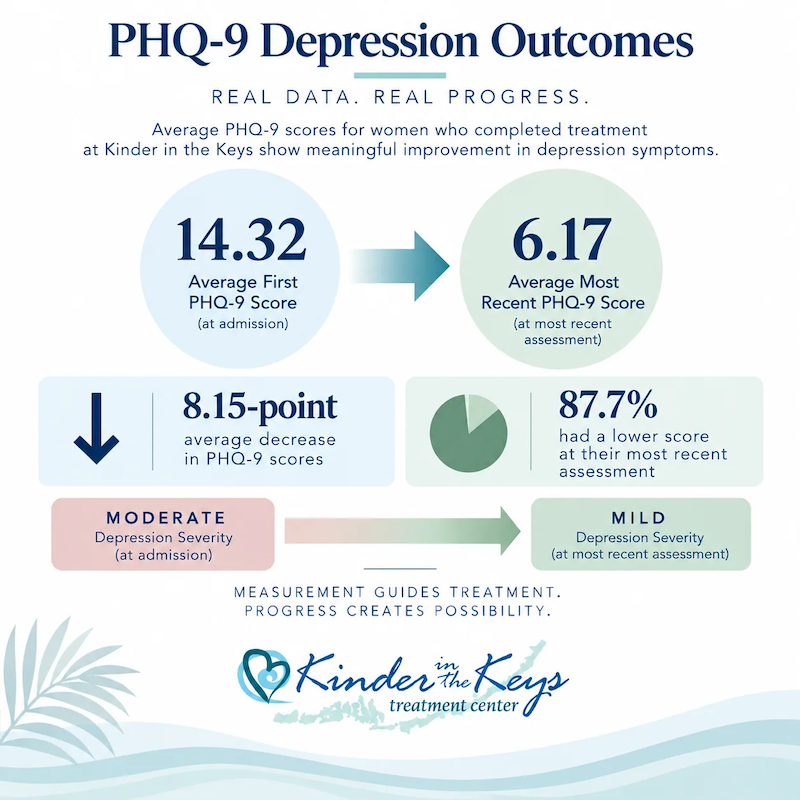
The average first score fell within the moderate depression range and was close to the threshold for moderately severe depression. The average most recent score fell within the mild depression range.
The change was not limited to the group average. Nearly nine out of ten clients included in the analysis had a lower score at their most recent assessment than at their first.
Why Does the Change in PHQ-9 Scores Matter?
A numerical change becomes more useful when there is context for interpreting its magnitude.
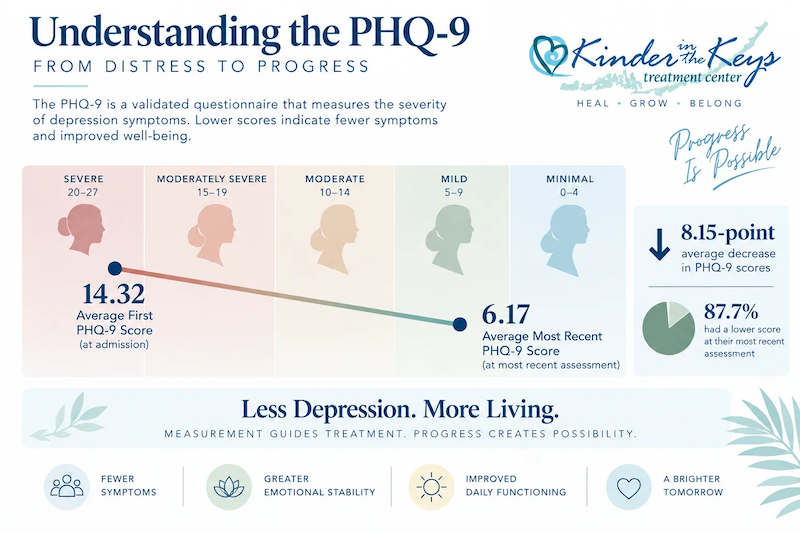
Research evaluating the PHQ-9 has found that changes of approximately 5 points can represent meaningful differences in depression severity. The average change observed in our aggregate outcomes exceeded that amount.
However, an average never tells the entire story.
Some women experienced larger reductions in symptoms, while others experienced smaller changes or had higher scores at their most recent assessment. Depression recovery is rarely a perfectly straight line. Symptoms can fluctuate in response to stress, relationships, sleep, physical health, medication changes, trauma reminders, and events occurring during treatment. Depression can affect mood, thinking, sleep, appetite, energy, concentration, and everyday functioning.
For that reason, Kinder does not define recovery by a PHQ-9 score alone.
Measuring Progress During Mental Health Treatment
When evaluating depression treatment outcomes, standardized measures provide a way to look beyond a single clinical encounter
Someone may have an especially difficult morning on the day she meets with her therapist. Another woman may feel substantially better that day but still be struggling in important areas of her life. A standardized measure provides another piece of information that can be considered alongside those experiences.
At Kinder in the Keys, clinical progress is evaluated more broadly. Clinicians consider symptoms, emotional regulation, functioning, treatment participation, behavioral patterns, individual goals, and the woman’s own description of what is changing.
Outcome measures can help identify improvement, but they can also alert the treatment team when symptoms remain elevated or begin moving in the wrong direction.
That information can become part of the ongoing clinical conversation.
What These Results Can — and Cannot — Tell Us
Real-world treatment outcome data need to be interpreted carefully.
The depression treatment outcomes presented here come from routinely collected clinical PHQ-9 data. This was not a randomized clinical trial, and there was no untreated comparison group. Because of that, the results should not be interpreted as proof that treatment at Kinder in the Keys alone caused the observed improvement.
Many factors can influence depressive symptoms during a period of treatment.
What the data can tell us is that, among the discharged clients represented in this outcomes analysis, depressive symptom scores were substantially lower on average at the most recent measurement than they were at the first measurement.
That distinction matters.
Our goal in sharing outcomes is not to promise a particular result or suggest that every woman will respond to treatment in the same way. It is to provide transparent information about what our routine clinical measurements are showing.
Why Individual Outcomes Still Matter
Two women can enter treatment with identical PHQ-9 scores and have very different clinical needs.
One may be struggling primarily with depression following a significant loss. Another may have depression occurring alongside trauma, anxiety, relationship difficulties, chronic stress, or longstanding patterns that have developed over many years
Even their individual PHQ-9 questions may look very different despite producing the same total score.
Effective mental health treatment therefore cannot simply focus on lowering a number. The underlying experiences, thoughts, emotions, behaviors, relationships, and circumstances contributing to distress also need attention.
This is one reason outcome measures work best as tools within treatment rather than definitions of treatment success.
Depression Treatment at Kinder in the Keys
Kinder in the Keys provides residential and partial hospitalization mental health treatment for women. Treatment is structured and intensive, with therapeutic programming designed to address mental health symptoms as well as the emotional and behavioral patterns that may contribute to them.
When evaluating depression treatment outcomes, it is important to consider the full range of care a woman receives. Treatment may include individual therapy, group therapy, psychiatric and medical support when appropriate, skills development, and evidence-based therapeutic approaches selected according to individual clinical needs.
Our clinical philosophy is not based on finding one technique that works for everyone. Depression can develop in very different circumstances, and treatment needs to consider the woman behind the symptoms rather than treating a questionnaire score as the whole story.
The PHQ-9 gives us one standardized way to measure change. The work of treatment extends considerably beyond that measurement.
A Data-Informed Approach to Depression Treatment
Our depression treatment outcomes provide an encouraging picture of symptom change among the discharged clients included in our analysis. Average PHQ-9 scores moved from the moderate range at the first assessment into the mild range at the most recent assessment, and the large majority of clients recorded lower scores over time.
Those results are meaningful to us because measurement creates accountability. It allows us to examine what is happening across the program rather than relying only on impressions or individual success stories.
At the same time, responsible outcome reporting requires acknowledging limitations. Aggregate results cannot predict how any particular woman will respond to treatment, and symptom improvement can never be attributed to a single factor based on observational clinical data alone.
For Kinder in the Keys, depression treatment outcomes are one part of an ongoing process of evaluating care, monitoring symptoms, and understanding whether the women we serve are moving toward greater emotional health and functioning.
If you or someone you care about is struggling with depression that has become difficult to manage through outpatient care alone, learning whether residential mental health treatment for women may be appropriate can be an important first step.
Medically Reviewed By
Dr. Laura Tanzini, DrPH, LMFT
Doctor of Public Health | Specialty in Lifestyle Medicine
Licensed Marriage and Family Therapist (Florida & California)
Founder & CEO, Kinder in the Keys
Dr. Laura Tanzini is the Founder & CEO of Kinder in the Keys, a residential mental health treatment center specializing in trauma, PTSD, depression, anxiety, and co-occurring mental health disorders. She oversees the clinical team and is committed to ensuring all educational content reflects evidence-based practices, trauma-informed care, and current behavioral health research. Each article is clinically reviewed for accuracy and designed to provide trustworthy, compassionate information for individuals and families seeking mental health treatment.
Doctoral Research: Dr. Tanzini’s doctoral research at Loma Linda University examined childhood and adult traumatic events, cumulative trauma exposure, gender, forgiveness, life satisfaction, and long-term well-being.
Medical Disclaimer
This content is for educational and informational purposes only and is not intended to provide a diagnosis, replace professional medical or mental health advice, or substitute for individualized care from a qualified healthcare provider.