
Trauma bonding in abusive relationships can create one of the most confusing experiences a woman may face: knowing that a relationship is hurting you while still feeling deeply attached to the person causing the harm.
You may recognize the manipulation.
You may know the relationship is unhealthy.
You may have left—and returned.
You may even understand intellectually that you deserve something different while emotionally feeling unable to let go.
That conflict does not mean you wanted the abuse or that the relationship was healthy. Abusive relationships can create complicated patterns of attachment, fear, hope, relief, grief, and dependency that make leaving—and staying away—far more difficult than outsiders sometimes understand.
Understanding those patterns can be an important part of recovery.
What Is Trauma Bonding in Abusive Relationships?
Trauma bonding in abusive relationships refers to a powerful emotional attachment that can develop within a relationship characterized by abuse, coercion, manipulation, or significant power imbalance.
The relationship may alternate between periods of distress and periods of affection, remorse, promises, calm, attention, or apparent change.
Those positive periods matter.
If a relationship were painful every moment of every day, recognizing the need to leave might be much easier.
Instead, the person causing harm may also be the person who provides comfort after the harm.
That contradiction can create an extraordinarily confusing attachment.
You are not simply remembering the painful moments.
You are also remembering the good ones.
And you may continue hoping the good version of the relationship will eventually become permanent.
What Trauma Bonding Is Not
Trauma bonding does not simply mean two people bonded because they experienced something traumatic together.
It also does not mean that every difficult, unstable, or unhealthy relationship involves a trauma bond.
The term is generally used to describe attachment that develops or persists within an abusive or coercive dynamic.
And importantly, trauma bonding is not a formal mental health diagnosis.
It is a way of describing a relationship pattern that can help survivors and clinicians understand why emotional attachment may persist despite significant harm.
The focus should not be on applying a label to every troubled relationship.
The focus should be on recognizing patterns of abuse, control, fear, manipulation, and their effects.
Why Is It So Hard to Leave an Abusive Relationship?
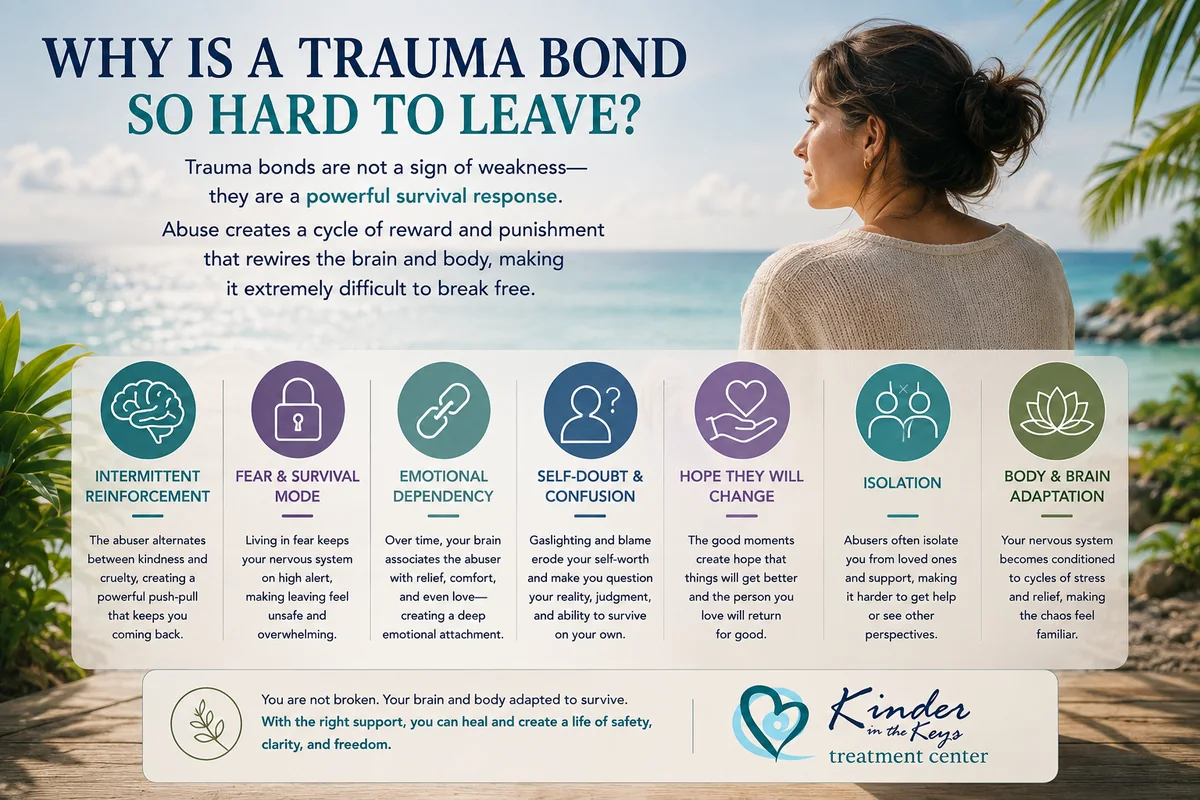
Understanding trauma bonding in abusive relationships helps explain why leaving can be far more complicated than simply deciding that a relationship is unhealthy. People looking from the outside often ask:
“Why doesn’t she just leave?”
That question assumes leaving is a simple decision.
It often isn’t.
A woman may be navigating emotional attachment, fear, financial dependence, children, housing, threats, isolation, shame, cultural or family pressures, concerns about pets, loss of social support, or fear of what will happen if she tries to leave.
She may also still love the person.
Those realities can exist at the same time as abuse.
Leaving does not require someone to stop having feelings first.
And having feelings for an abusive partner does not mean the abuse was acceptable.
The Cycle of Harm and Relief
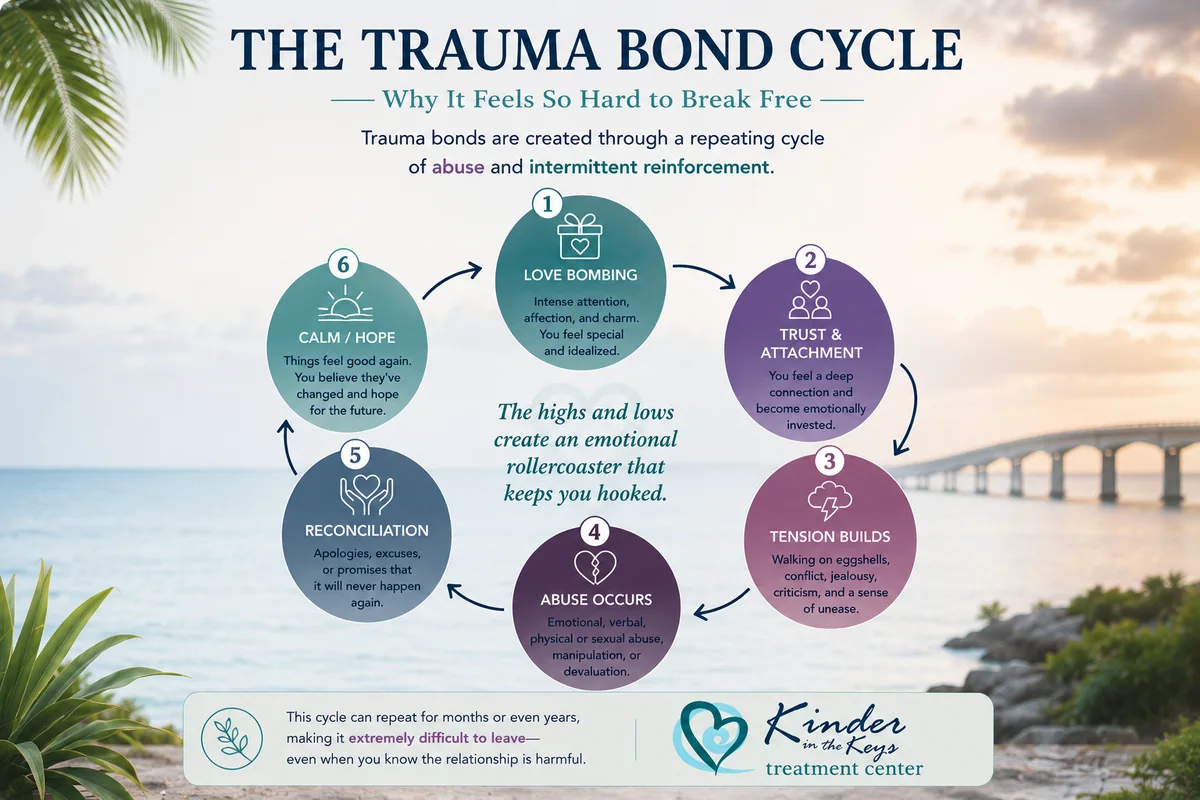
One of the patterns that can strengthen attachment is the alternation between distress and relief.
The relationship may include periods of:
- criticism
- humiliation
- threats
- emotional withdrawal
- intimidation
- controlling behavior
- blame
- explosive conflict
followed by periods of:
- affection
- apologies
- promises
- gifts
- emotional closeness
- reassurance
- calm
- apparent change
The relief after a painful period can feel extraordinarily powerful.
A woman may think:
“This is the person I fell in love with.”
“Maybe this time things really will change.”
“I knew the good person was still there.”
That hope can become one of the strongest forces keeping someone emotionally invested.
Intermittent Reinforcement and Unpredictability
Psychology uses the term intermittent reinforcement to describe rewards that occur unpredictably rather than consistently.
In relationships, unpredictability can intensify attention.
When affection, approval, safety, or closeness is uncertain, a person may become increasingly focused on figuring out how to get the positive version of the relationship back.
She may begin monitoring everything:
What mood are they in?
What did I do wrong?
What can I do differently?
How do I get us back to the way we were?
Eventually, enormous amounts of emotional energy can become devoted to maintaining the relationship.
This is one reason it is too simplistic to describe trauma bonding as merely a “chemical addiction.”
Human attachment, learning, fear, dependency, hope, power, trauma history, and relationship circumstances are far more complicated than a single hormone or brain chemical.
Gaslighting Can Make the Bond Harder to Recognize
Gaslighting can cause a person to question her own perception of events.
An abusive partner may deny things that happened, minimize hurtful behavior, rewrite previous conversations, blame the other person for the conflict, or insist that she is overly sensitive or irrational.
Over time, a woman may begin relying less on her own judgment and more on the other person’s interpretation of reality.
She may think:
“Maybe I am overreacting.”
“Maybe I caused this.”
“Maybe it wasn’t really that bad.”
“Maybe I’m the problem.”
That erosion of self-trust can make leaving even more difficult.
If you no longer trust your own perception, how do you trust yourself to make a life-changing decision?
Internal link: Narcissistic Abuse: When Love Was Never the Goal
Isolation Can Increase Dependence
Abusive and controlling relationships frequently become increasingly isolating.
Sometimes the isolation is obvious.
A partner may directly interfere with friendships or family relationships.
Other times it happens gradually.
Perhaps every visit with a friend causes an argument.
Maybe family members are constantly criticized.
Perhaps the partner becomes jealous whenever you spend time away.
Eventually, staying home may feel easier than dealing with the consequences.
Over time, your world gets smaller.
And as other relationships disappear, the abusive relationship can become increasingly central.
The person creating the fear may also become the person you depend on most.
Signs of Trauma Bonding in an Abusive Relationship
The signs of trauma bonding in abusive relationships can vary, but certain patterns appear repeatedly. Trauma bonding can look different from one relationship to another, but possible signs include:
- repeatedly returning to a relationship you know is harmful
- minimizing or defending abusive behavior
- focusing heavily on the partner’s positive qualities after episodes of abuse
- believing that if you change enough, the relationship will improve
- feeling responsible for the other person’s behavior
- experiencing intense distress at the thought of separation
- hiding what happens in the relationship from people you trust
- becoming isolated from friends or family
- feeling unable to trust your own judgment
- constantly monitoring the other person’s mood
- confusing periods of relief with evidence that the abuse has permanently ended
- believing no one else will understand the relationship
- feeling guilty for considering leaving
- repeatedly accepting apologies without meaningful behavioral change
One sign alone does not establish that someone is in an abusive relationship.
Patterns matter.
“But They Can Be Wonderful”
Yes.
That is part of what makes abusive relationships so confusing.
People who behave abusively are not necessarily abusive every minute of every day.
There may be laughter.
There may be affection.
There may be vacations, birthdays, family memories, tenderness, sex, inside jokes, and moments that felt completely genuine.
Recognizing abuse does not require pretending that every memory was terrible.
You can acknowledge that some experiences felt loving while also recognizing that the overall relationship became unsafe or harmful.
Both can be true.
Why You May Miss Someone Who Hurt You
Missing someone does not prove that leaving was a mistake.
Grief after an abusive relationship can involve several losses at once.
You may be grieving:
- the person
- the good moments
- the relationship you hoped it would become
- the future you imagined
- the family structure you wanted
- the person you believed your partner could be
- the time and emotional investment you made
- the version of yourself that existed before the relationship
Sometimes what a woman misses most is not the relationship as it actually existed.
She misses what she kept hoping it would become.
Understanding that distinction can be powerful.
Trauma Bonding and Narcissistic Abuse
Trauma bonding is often discussed in connection with narcissistic abuse because relationships involving manipulation, gaslighting, devaluation, control, and unpredictable affection can produce many of the dynamics described above.
But it is important not to diagnose an abusive partner from a distance.
A person does not need to have narcissistic personality disorder for a relationship to be emotionally abusive.
The behavior and its impact matter.
If a relationship repeatedly leaves you frightened, controlled, humiliated, isolated, or questioning your reality, those concerns deserve attention regardless of the other person’s diagnosis.
Understanding the Long-Term Effects of Narcissistic Abuse
Trauma Bonding and PTSD
Not everyone who experiences an abusive relationship develops post-traumatic stress disorder.
However, intimate partner violence—including psychological abuse and coercive or controlling behavior—is associated with PTSD, depression, anxiety, substance misuse, and other significant mental-health consequences.
After an abusive relationship, a woman may experience:
- intrusive memories
- nightmares
- hypervigilance
- exaggerated startle responses
- sleep problems
- anxiety
- depression
- shame
- emotional numbness
- difficulty trusting
- avoidance
- difficulty concentrating
Sometimes the relationship also activates earlier trauma.
A woman may discover that what happened in adulthood connects with patterns of fear, abandonment, abuse, or instability that began much earlier in life.
External link: VA National Center for PTSD — Intimate Partner Violence
Why “No Contact” Isn’t Always Simple
You may hear that the solution to trauma bonding is simply to go “no contact.”
For some people, ending contact may indeed be helpful.
But real life can be more complicated.
People may share children, finances, property, businesses, legal responsibilities, workplaces, or social networks.
Some women may also face increased safety risks when attempting to leave an abusive relationship.
That means advice should not be reduced to:
“Just block them.”
Safety, circumstances, and individual needs matter.
When abuse or coercive control is ongoing, safety planning and support from qualified domestic-violence resources can be particularly important.
Rebuilding Trust in Yourself
One of the deepest injuries caused by chronic manipulation can be the loss of trust in your own perceptions.
Recovery often involves rebuilding that trust.
You may need to rediscover:
What do I think?
What do I feel?
What do I want?
What are my boundaries?
What behavior am I willing to accept?
Those questions can initially feel uncomfortable.
For years, your attention may have been directed toward someone else’s reactions.
Recovery begins turning some of that attention back toward you.
Healing From Trauma Bonding
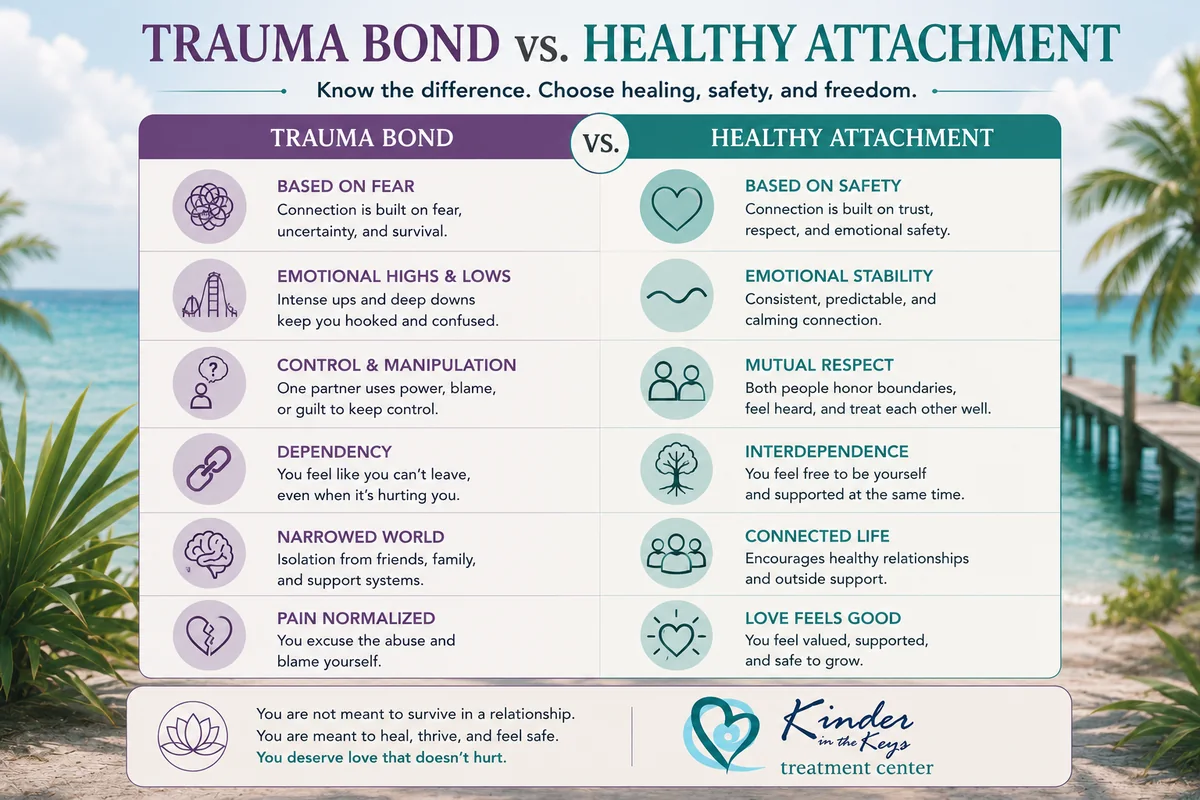
Healing from trauma bonding in abusive relationships is not simply a matter of “getting over” another person.
It can involve understanding abuse patterns, processing traumatic experiences, rebuilding self-trust, addressing PTSD or other mental-health symptoms, reconnecting with supportive relationships, establishing boundaries, and learning to recognize healthy relationship dynamics.
For some women, outpatient therapy and community support provide enough help.
Others experience more severe trauma-related symptoms that significantly affect daily functioning.
Treatment should be individualized.
There is no single therapy that is appropriate for every survivor of an abusive relationship.
Trauma-Informed Treatment Matters
A trauma-informed approach emphasizes physical and psychological safety, trust, collaboration, empowerment, and the survivor’s voice and choices.
That matters particularly after a relationship in which control has been taken away.
Effective treatment should not recreate the same dynamic by telling a woman what she must feel or what her recovery must look like.
Treatment can help her understand what happened, develop tools for managing trauma responses, rebuild confidence in her perceptions, and make choices from a position of greater clarity and strength.
External link: SAMHSA — Trauma-Informed Approaches and Programs
You Don’t Have to Avoid Every Trigger Forever
After an abusive relationship, avoidance can feel protective.
Avoid the places.
Avoid relationships.
Avoid conflict.
Avoid vulnerability.
Avoid anything that reminds you of what happened.
But if avoidance continues expanding, trauma can begin determining the boundaries of your life.
At Kinder in the Keys, our approach to trauma recovery is not built around teaching women to spend their lives running away from reminders of their past.
A trigger can eventually become something you recognize and manage rather than something that controls your behavior.
The objective is not to erase your history.
It is to reduce the power that history has over your present.
When Residential Treatment May Help
Residential treatment is not necessary simply because someone has experienced an abusive relationship or trauma bond.
Many women recover successfully through outpatient treatment and community support.
A residential level of care may be appropriate when trauma-related symptoms, PTSD, anxiety, depression, sleep disturbance, emotional dysregulation, or relationship difficulties have become severe enough to significantly interfere with everyday functioning—or when previous outpatient treatment has not provided enough support.
For some women, recovering from trauma bonding in abusive relationships also means addressing PTSD, anxiety, depression, or other effects of prolonged emotional abuse. A residential setting can provide structure and allow several aspects of recovery to be addressed together.
At Kinder in the Keys, women can receive treatment addressing trauma and PTSD alongside anxiety, depression, emotional regulation, relationship patterns, physical wellness, and other factors affecting recovery.
Residential Trauma and PTSD Treatment for Women
Breaking the Pattern Does Not Mean Erasing the Past
Recovery does not require convincing yourself that you never loved the person.
It does not require pretending the good moments never existed.
And it does not require hating someone forever in order to move forward.
It means learning to see the entire relationship rather than only the moments that kept hope alive.
It means understanding that love does not require surrendering your safety, identity, boundaries, or reality.
It means learning that peace does not have to be the brief period between crises.
Eventually, you can stop organizing your life around another person’s moods.
You can trust your perceptions.
You can establish boundaries without believing you are cruel.
You can experience disagreement without automatically experiencing danger.
You can build relationships in which love and safety exist at the same time.
Frequently Asked Questions About Trauma Bonding
What is trauma bonding in abusive relationships?
Trauma bonding describes a powerful attachment that can develop or persist within an abusive or coercive relationship. Alternating periods of harm and positive behavior, along with fear, hope, dependency, isolation, and other factors, can make separation emotionally difficult.
Why do I still love someone who abused me?
Emotional attachment does not automatically disappear when you recognize abuse. A relationship may have included meaningful positive experiences alongside harmful ones. Love, grief, fear, hope, and recognition that a relationship is unsafe can exist simultaneously.
Is trauma bonding the same as Stockholm syndrome?
No. The terms should not be treated as interchangeable. Trauma bonding is commonly used to describe attachment within abusive or coercive relationships, while “Stockholm syndrome” has a different history and is not a formal psychiatric diagnosis.
Is trauma bonding a mental health diagnosis?
No. Trauma bonding is not a diagnosis in the DSM-5-TR or ICD-11. It is a descriptive term used to discuss attachment patterns that may occur in abusive relationships.
Can trauma bonding cause PTSD?
Trauma bonding itself is not considered a cause of PTSD. However, traumatic experiences within an abusive relationship can be associated with PTSD and other mental-health difficulties.
How long does it take to break a trauma bond?
There is no universal timeline. Recovery can depend on the duration and severity of the relationship, ongoing contact, safety, previous trauma, social support, mental-health symptoms, financial or family circumstances, and access to appropriate treatment.
Do I need residential treatment to recover from trauma bonding?
Not necessarily. Many women can recover with outpatient therapy and appropriate community support. Residential treatment may be considered when trauma-related symptoms or co-occurring mental-health conditions significantly impair functioning or when a lower level of care has not been sufficient.
Support for Women Recovering From Abusive Relationships
If the effects of an abusive relationship continue to control your emotions, relationships, sense of self, or ability to function, treatment can help.
Kinder in the Keys provides women-only residential mental health treatment in the Florida Keys for trauma, PTSD, anxiety, depression, narcissistic abuse, and related mental-health concerns.
Recovery is not about forgetting what happened.
It is about reaching the point where what happened no longer determines what comes next.
Women’s Trauma and PTSD Treatment at Kinder in the Keys
Medically Reviewed By
Dr. Laura Tanzini, DrPH, LMFT
Doctor of Public Health | Specialty in Lifestyle Medicine
Licensed Marriage and Family Therapist (Florida & California)
Founder & CEO, Kinder in the Keys
This article has been clinically reviewed for accuracy and consistency with current behavioral health and trauma-informed treatment principles. Dr. Tanzini has extensive clinical experience in trauma, PTSD, anxiety, depression, and women’s mental health, including assessment and treatment of trauma-related conditions.
Medical Disclaimer
This article is for educational and informational purposes only and is not intended to diagnose, treat, cure, or prevent any mental health condition. Information provided here should not replace individualized evaluation, diagnosis, or treatment from a qualified healthcare or mental health professional.