
How long does it take to get over narcissistic abuse? There is no clinically established recovery timeline that applies to everyone.
You may find articles online describing recovery in stages—three months for one phase, a year for another, or several years before someone is supposedly “fully healed.” Recovery from an emotionally abusive or controlling relationship does not follow a predictable calendar.
Some women begin feeling substantially better within a relatively short period after a relationship ends. Others continue experiencing anxiety, self-doubt, grief, hypervigilance, depression, difficulty trusting, or trauma-related symptoms for much longer.
Neither experience tells you that you are recovering correctly or incorrectly.
A more useful way to think about recovery is not:
“How many months should this take?”
but:
“How is what happened affecting my life now, and is that changing over time?”
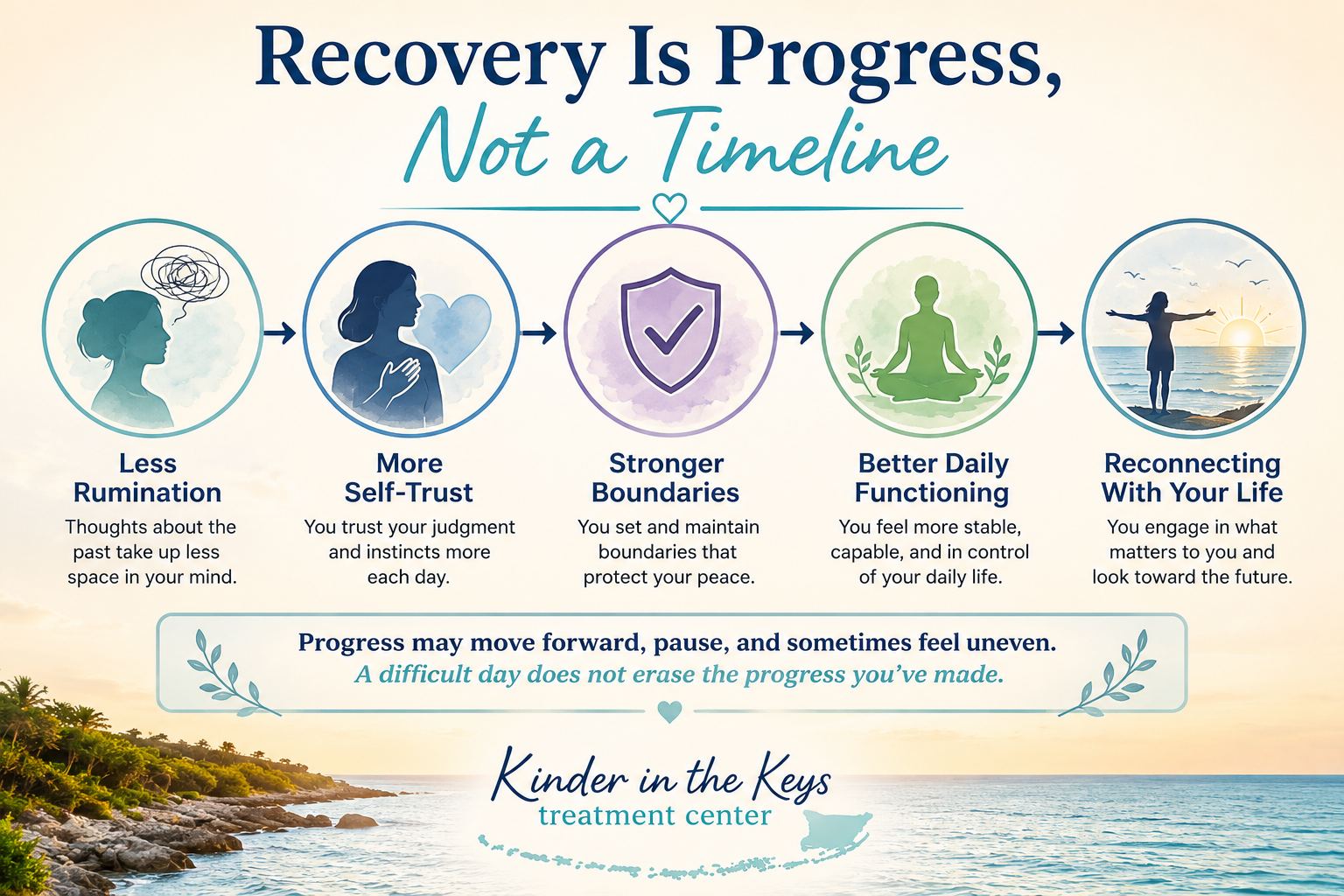
Healing is better measured by changes in your functioning, relationships, emotional stability, self-trust, boundaries, and ability to engage with your present life than by reaching a particular date on the calendar.
Why There Is No Standard Narcissistic Abuse Recovery Timeline
The term narcissistic abuse is commonly used to describe patterns of manipulation, emotional abuse, gaslighting, coercive behavior, exploitation, degradation, or control associated with someone displaying narcissistic traits.
But the experiences described by that term can vary enormously.
A six-month dating relationship and a twenty-year marriage are not the same experience.
A relationship that has completely ended is different from one in which former partners continue interacting because they share children.
A woman who has independent finances, stable housing, supportive relationships, and no ongoing contact with the former partner faces different circumstances from someone dealing with financial dependence, legal proceedings, custody disputes, harassment, or continued exposure to the person who harmed her.
Women also enter these relationships with different histories, resources, mental health needs, responsibilities, and support systems.
SAMHSA similarly notes that responses to potentially traumatic experiences vary from person to person and that not everyone experiences the same lasting effects.
For all of these reasons, there is no reliable formula that can tell you how long your recovery should take.
What Can Affect How Long Recovery Takes?
Although there is no fixed timeline, several circumstances can influence how complicated recovery becomes.
The Duration and Nature of the Relationship
Longer relationships may involve more shared history, routines, finances, friendships, family relationships, housing, parenting responsibilities, and identity.
But duration alone does not determine psychological impact.
A shorter relationship involving severe intimidation, coercion, violence, or instability may have substantial effects, while another person may recover relatively well after a much longer unhealthy relationship.
The question is not simply how long the relationship lasted, but what happened within it and how those experiences affected you.
Whether the Abuse or Contact Is Still Ongoing
Recovery can be more complicated when the source of stress has not completely disappeared.
You may still need contact because of:
Shared children
Legal matters
Financial obligations
Property
Employment
Family relationships
Court proceedings
Other practical circumstances
Continued contact does not mean healing is impossible.
It does mean that recovery may involve learning how to protect your emotional health and maintain appropriate boundaries while navigating circumstances you cannot simply eliminate.
When safety concerns or domestic abuse are ongoing, individualized safety planning may also be appropriate.
Your Current Mental Health Symptoms
Two women can experience similar relationships and have very different responses afterward.
One may primarily experience grief and loss.
Another may develop substantial anxiety.
Someone else may experience depression, panic, sleep disruption, hypervigilance, intrusive memories, or other trauma-related symptoms.
The long-term effects of narcissistic abuse vary, and the severity of current symptoms can influence what recovery requires.
Experiencing trauma-related symptoms does not automatically mean that someone has PTSD. PTSD is a specific diagnosis with established criteria and should be evaluated by a qualified mental health professional.
Your Ability to Function Day to Day
One of the most useful measures of recovery is functioning.
Ask yourself:
Am I sleeping reasonably well?
Can I concentrate?
Am I able to work or manage normal responsibilities?
Can I make decisions without excessive reassurance?
Am I maintaining relationships?
Can I experience enjoyment?
Am I able to regulate difficult emotions?
Is what happened dominating most of my thoughts?
Do I feel able to participate in my current life?
You do not need to answer yes to every question to be recovering.
The point is to notice whether functioning is gradually improving, remaining unchanged, or becoming more difficult.
“Getting Over It” Does Not Mean Forgetting What Happened
The phrase “get over narcissistic abuse” can create an unrealistic expectation that successful recovery means reaching a point where the experience no longer matters.
That is not necessarily what healing looks like.
You may always remember what happened.
You may still feel sadness or anger when thinking about particular experiences.
Certain situations may occasionally remind you of the relationship.
Recovery does not require erasing the past.
A healthier goal is for the past to become part of your history without continuing to organize your present life around it.
You can remember what happened without spending every day reliving it.
You can learn from the relationship without allowing it to determine every future relationship.
You can understand someone’s behavior without needing to continue studying, monitoring, or explaining that person indefinitely.
Signs You May Be Healing From Narcissistic Abuse
Because there is no universal timeline, signs of progress can be more useful than dates.
You Think About the Person Less Often
Early in recovery, thoughts about the relationship may consume substantial mental space.
You may replay conversations, search for explanations, remember incidents, or wonder whether you misunderstood what happened.
Over time, you may notice hours—and eventually days—when the person simply is not occupying your thoughts.
That change can be meaningful.
You Need Fewer Explanations
It is understandable to want to understand why someone behaved the way they did.
But recovery may eventually involve recognizing that you do not need to solve another person’s psychology before you can continue living your life.
You may become less interested in determining whether every behavior was narcissistic, intentional, manipulative, or diagnostic.
The focus gradually moves from:
“Why did they do this?”
to:
“What do I need now?”
You Trust Your Judgment More
After prolonged criticism, manipulation, or gaslighting, some women become accustomed to questioning themselves.
Progress may look like:
Making decisions without repeatedly asking others for reassurance
Taking your own discomfort seriously
Recognizing when something does not feel right
Changing your mind without excessive guilt
Accepting that another person can disagree with you without automatically making you wrong
Self-trust does not mean assuming that every thought or feeling is unquestionably accurate.
It means no longer automatically treating someone else’s interpretation as more valid than your own.
Your Boundaries Become Easier to Maintain
At first, setting a boundary may produce significant anxiety or guilt.
With time, you may become more comfortable saying:
No.
I’m not comfortable with that.
That doesn’t work for me.
I need time to think about it.
I’m not discussing this further.
The important change is not simply learning boundary language.
It is becoming more willing to act consistently with the boundaries you establish.
Your Emotional Reactions Become More Proportionate to the Present
A raised voice, disagreement, delayed text, criticism, or change in someone’s mood may initially trigger a reaction connected to previous experiences.
As recovery progresses, you may become better able to distinguish:
“This reminds me of what happened before”
from:
“The same thing is happening again.”
That distinction can make current relationships feel less governed by past ones.
Your Life Begins Expanding Again
Abusive or controlling relationships can make life increasingly narrow.
Recovery may involve reconnecting with:
Friends
Family
Interests
Work
Education
Travel
Creativity
Physical activity
Community
Personal goals
Activities you stopped doing during the relationship
A powerful sign of healing is when your life becomes increasingly about your present interests and future goals rather than your former partner.
Recovery Does Not Always Move in a Straight Line
You can have a very good month and then unexpectedly struggle.
An anniversary, legal issue, unexpected message, new relationship, family event, song, location, or other reminder may bring emotions back temporarily.
That does not mean you have returned to the beginning.
Progress in mental health is rarely perfectly linear.
Think about recovery over a longer period.
Compared with three or six months ago:
Are difficult periods less frequent?
Do they last less time?
Can you recover from them more effectively?
Are you functioning better?
Do you understand your reactions more clearly?
Are you making decisions differently?
Those changes may be more informative than whether you had a difficult day this week.
Does No Contact Make Recovery Faster?
There is no responsible way to promise that no contact will produce recovery within a particular amount of time.
For some people, ending unnecessary contact can reduce exposure to conflict, manipulation, or emotional distress.
For others, complete no contact may not be practical or possible because of children, legal matters, finances, employment, or family circumstances.
Safety also matters. Decisions about communication or leaving an abusive relationship should be based on the individual’s circumstances rather than a universal internet rule.
The goal is not to follow someone else’s recovery formula.
It is to determine what boundaries and level of contact are appropriate and safe for your situation.
What Can Support Recovery?
There is no shortcut that guarantees faster healing.
But several things may support psychological recovery and overall functioning.
Reestablish Predictability
After prolonged instability, ordinary routines can be valuable.
Regular sleep, meals, work schedules, physical activity, appointments, social contact, and other predictable activities can help rebuild a sense of structure.
Reconnect With Safe Relationships
Isolation can make recovery more difficult.
Supportive friends, family members, peer groups, and other healthy relationships may provide perspective, connection, and practical assistance.
A narcissistic abuse support group may be useful for women who are functioning reasonably well but want connection with people who understand similar experiences.
Take Care of Your Physical Health
Mental and physical health affect one another.
Sleep, nutrition, appropriate physical activity, medical care, and reducing harmful coping behaviors can all be relevant parts of recovery.
These things do not erase psychological trauma.
They support the broader system in which recovery is occurring.
Consider Professional Treatment When Symptoms Persist
Not everyone who experiences narcissistic abuse needs psychotherapy or intensive mental health treatment.
But professional evaluation may be appropriate when symptoms remain severe, persist over time, or significantly interfere with daily functioning.
Our guide to the signs you need narcissistic abuse therapy explains when support alone may not be enough and how outpatient therapy differs from a higher level of mental health care.
When Recovery Feels Stuck
Sometimes time passes, but functioning does not improve.
You may still be:
Experiencing substantial anxiety or depression
Unable to sleep adequately
Having frequent panic
Avoiding large portions of your life
Struggling to work or maintain responsibilities
Experiencing persistent trauma-related symptoms
Unable to trust your own decisions
Using alcohol, drugs, or other potentially harmful behaviors to cope
Finding that relationships continue to be substantially affected
At that point, the question may no longer be:
“Why am I not over this yet?”
A more useful question is:
“What is keeping me from moving forward, and what kind of help might address it?”
That is a clinical question worth exploring.
Current APA guidance on trauma-related care also emphasizes evaluating symptoms in the context of the person’s functioning, circumstances, safety, and individual needs.
When a Higher Level of Care May Be Appropriate
Some women are able to recover with time, social support, and outpatient therapy.
Others experience symptoms severe enough to interfere substantially with everyday functioning.
A higher level of mental health care may be considered when symptoms are severe or persistent, multiple mental health concerns are occurring simultaneously, functioning has significantly declined, or appropriate outpatient treatment has not provided enough support.
At Kinder in the Keys, therapy for narcissistic abuse focuses on the woman receiving treatment—not on diagnosing the person who harmed her.
Treatment may address anxiety, depression, trauma-related symptoms, emotional regulation, boundaries, self-trust, relationship patterns, physical wellness, and rebuilding an independent sense of identity.
The appropriate level of care should always be based on an individual’s clinical needs.
Frequently Asked Questions About Narcissistic Abuse Recovery
How long does it take to get over narcissistic abuse?
There is no clinically established amount of time. Recovery varies based on the nature of the relationship, ongoing stressors, current symptoms, functioning, safety, support, and individual circumstances. Progress is better evaluated through changes in functioning and well-being than by reaching a particular number of months or years.
Can you recover from narcissistic abuse in six months?
Some people may feel substantially better within six months, while others may continue experiencing significant effects. Six months is not a clinical benchmark for recovery.
Why am I still struggling a year later?
Continued symptoms do not necessarily mean you are failing to recover. Ongoing contact, legal or financial stress, co-parenting, trauma-related symptoms, anxiety, depression, isolation, or other circumstances may continue affecting recovery. Persistent impairment may be a reason to consider professional evaluation.
Does a longer abusive relationship mean recovery will take longer?
Not necessarily. Relationship duration is only one factor. The severity and nature of what occurred, current circumstances, mental health symptoms, ongoing contact, safety, and available support can all influence recovery.
Can I heal if I still have contact with the person?
Yes. Complete separation is not possible for everyone. Recovery may involve developing appropriate boundaries and strategies for necessary contact while addressing the psychological effects of the relationship.
How do I know if I’m actually getting better?
Look for changes such as improved functioning, less rumination, greater self-trust, stronger boundaries, better emotional regulation, reconnection with interests and relationships, and an increasing ability to focus on your present life rather than the former relationship.
Do I need therapy to recover from narcissistic abuse?
Not necessarily. Some women recover with time and appropriate support. Professional treatment may be beneficial when symptoms are severe, persistent, worsening, or interfering significantly with daily life.
Recovery Is Not a Deadline
There is no date by which you are supposed to be “over” narcissistic abuse.
And there is no prize for recovering faster than someone else.
The goal is not to erase what happened.
The goal is for what happened to occupy less of your present life.
You may notice that you trust yourself more.
You maintain boundaries that once felt impossible.
You think about the relationship less often.
You reconnect with people and activities you had lost.
You begin making decisions based on what you want rather than anticipating another person’s reaction.
Those changes matter.
Recovery is not about reaching Month 6, Year 1, or Year 2. It is about gradually becoming more able to live your own life again.
Medically Reviewed By
Dr. Laura Tanzini, DrPH, LMFT
Doctor of Public Health | Specialty in Lifestyle Medicine
Licensed Marriage and Family Therapist (Florida & California)
Founder & CEO, Kinder in the Keys
This article has been clinically reviewed for accuracy and consistency with current behavioral health and trauma-informed treatment principles. Dr. Tanzini’s clinical work focuses on trauma, PTSD, anxiety, depression, relationship trauma, and women’s mental health.
Medical Disclaimer: This article is provided for educational and informational purposes only and is not a substitute for individualized evaluation, diagnosis, or treatment by a qualified healthcare or mental health professional.