
A victim mindset can keep a woman focused on who hurt her, who failed her, and who is responsible for the problems in her life today. At Kinder in the Keys, we sometimes describe this pattern as victim energy.
Being a victim and living in victim energy are not the same thing.
That distinction matters.
A woman can be the victim of abuse, assault, betrayal, neglect, violence, coercive control, childhood trauma, or another devastating experience through absolutely no fault of her own.
What happened to her was real.
It may have changed how she sees herself, other people, relationships, safety, and the world around her.
She deserves to have that experience acknowledged.
But acknowledgment is not where healing ends.
Sometimes, long after the immediate danger has passed, a person’s identity can remain organized around what happened to her. Her attention stays focused on who hurt her, who failed her, who owes her an apology, who triggered her, who does not understand her, and everything she believes she cannot do because of what someone else did.
At Kinder in the Keys, we sometimes describe this pattern as victim energy.
Victim energy is not a psychiatric diagnosis. It is a plain-language description of a pattern in which a person increasingly blames other people or circumstances for what is wrong in her life while resisting examination of her own choices, behaviors, reactions, and responsibility for change.
A person can have been genuinely victimized and still eventually become stuck in this mindset.
Recognizing that is not victim-blaming.
It can be the beginning of taking your life back.
What Is Victim Energy?
At its core, victim energy is about externalizing responsibility.
Everything is somebody else’s fault.
My mother made me this way.
My father ruined my childhood.
My ex destroyed my ability to trust.
My partner makes me angry.
My family doesn’t support me.
My boss is the problem.
My therapist triggered me.
Treatment didn’t work because nobody understood me.
People always hurt me.
People always abandon me.
Nothing ever works for me.
The common denominator is always somewhere else.
Some of those statements may contain truth.
Your mother may have hurt you.
Your ex may have betrayed you.
Your family may genuinely have failed you.
A therapist may make a mistake.
Someone may behave unfairly.
Victim energy does not require inventing mistreatment.
The problem begins when other people’s behavior becomes the explanation for nearly everything in your present life and the reason you believe you cannot change it.
The underlying message becomes:
“I cannot be okay until everyone else changes.”
And that creates an enormous problem.
Because as long as everyone else is responsible for your life, everyone else also holds the power to change it.
What Victim Energy Is Not
This distinction is essential.
Victim energy is not the same thing as:
- having PTSD
- grieving
- feeling angry about something unjust
- experiencing fear after trauma
- struggling emotionally
- needing time to recover
- setting boundaries
- acknowledging abuse
- talking about trauma
- seeking accountability
- experiencing triggers
- having depression or anxiety
- needing validation
- struggling during treatment
- recognizing that another person behaved badly
Trauma can affect thoughts, emotions, relationships, sleep, concentration, physical responses, and behavior.
Recovery is not accomplished by telling someone to “get over it.”
Immediately after trauma—or while abuse is still occurring—the priority may appropriately be safety, stabilization, protection, validation, grief, and understanding what happened.
Victim energy is different.
It develops when being harmed moves from something that happened to you into an organizing principle for how you understand almost everything that happens afterward.
Being Victimized Is Different From Building an Identity Around Being the Victim
There are times when the word victim is completely accurate.
Someone did something to you.
You may have had no control over it.
That is not the same as developing a victim identity.
A victim describes what happened in a situation.
A victim identity begins describing who you believe you are.
You can say:
“I was abused.”
without concluding:
“I will always be defined by being abused.”
You can say:
“What happened changed me.”
without concluding:
“What happened controls who I become.”
You can acknowledge:
“My childhood affected how I relate to people.”
while also saying:
“Now that I understand that pattern, I can work on changing it.”
One recognizes the wound.
The other begins recovery.
What Does Victim Energy Sound Like?
Victim energy often becomes easy to recognize when you listen to the language surrounding it.
It can sound like:
“I can’t have a healthy relationship because my ex ruined my ability to trust.”
“That’s just how I am because of my childhood.”
“You triggered me, so what happened afterward is your fault.”
“Nothing ever works for me.”
“People always hurt me.”
“Everyone leaves me.”
“Nobody understands what I’ve been through.”
“Every therapist eventually turns against me.”
“I shouldn’t have to change. I’m not the person who caused the problem.”
“My family ruined my life.”
“I keep attracting narcissists.”
“My partner made me behave that way.”
“Treatment didn’t work because the program was the problem.”
Again, some of these statements may contain legitimate pain.
The issue is the conclusion:
“Therefore, there is nothing meaningful for me to examine or change.”
That is where victim energy becomes a barrier to healing.
What Victim Energy Looks Like in Everyday Life
Victim energy does not always look passive.
It isn’t always someone sitting quietly saying, “Poor me.”
It can be loud.
It can be angry.
It can be demanding.
It can be argumentative.
It can be controlling.
And it can become exhausting for the people around the person.
A woman operating from victim energy may repeatedly ask for advice and reject every possible solution.
There is always a reason something cannot work.
She may tell the same story about what someone did to her repeatedly but become angry when the conversation shifts toward what she can do now.
Every conflict becomes evidence that someone else mistreated her.
A disagreement becomes disrespect.
A boundary becomes rejection.
Feedback becomes criticism.
Accountability becomes blame.
Someone saying “no” becomes abandonment.
A therapist challenging an unhealthy behavior becomes:
“You don’t understand trauma.”
She may expect everyone around her to regulate her emotions, avoid every trigger, tolerate poor behavior, or make constant accommodations because of what happened to her.
And when someone eventually says:
“Your trauma matters, but your behavior is affecting other people,”
she may experience that as another injury rather than information worth considering.
Victim Energy Can Look Like Anger and Entitlement
This is one of the most misunderstood forms of victim energy.
People often imagine a victim mindset as someone who appears sad, helpless, or passive.
Sometimes it looks like that.
But sometimes victim energy says:
“Because I was hurt, I am entitled to behave however I want.”
A person can become chronically angry, accusatory, hostile, demanding, or entitled.
She may speak cruelly to others and then justify it because she was triggered.
She may behave aggressively and focus entirely on the other person’s reaction.
She may demand accommodations from everyone around her without considering their needs.
She may struggle to apologize because apologizing feels like admitting that she is no longer the innocent party.
She may create conflict and then focus exclusively on how badly everyone responded to her.
Eventually, trauma can become the explanation for behavior that is hurting other people.
This is where an important distinction belongs:
Trauma can explain behavior without excusing behavior.
A person’s history deserves compassion.
Her behavior still matters.
Responsibility Is Not Blame
This may be the most important distinction in the entire conversation about victim energy.
Responsibility is not blame.
If someone abused you, you did not cause the abuse.
If someone assaulted you, you did not become responsible for the assault.
If you were neglected or abused as a child, the responsibility belonged to the adults.
If someone betrayed you, their decision belonged to them.
None of that changes because you enter treatment.
But eventually another question has to be asked:
Who is responsible for your life now?
That answer cannot permanently remain the person who harmed you.
You can have zero responsibility for being abused and still have responsibility for your recovery.
Those ideas do not contradict each other.
Blame asks:
“Whose fault is this?”
Responsibility asks:
“What can I do about it now?”
Blame keeps attention in the past.
Responsibility creates choices in the present.
Victim Energy vs. Healing and Agency
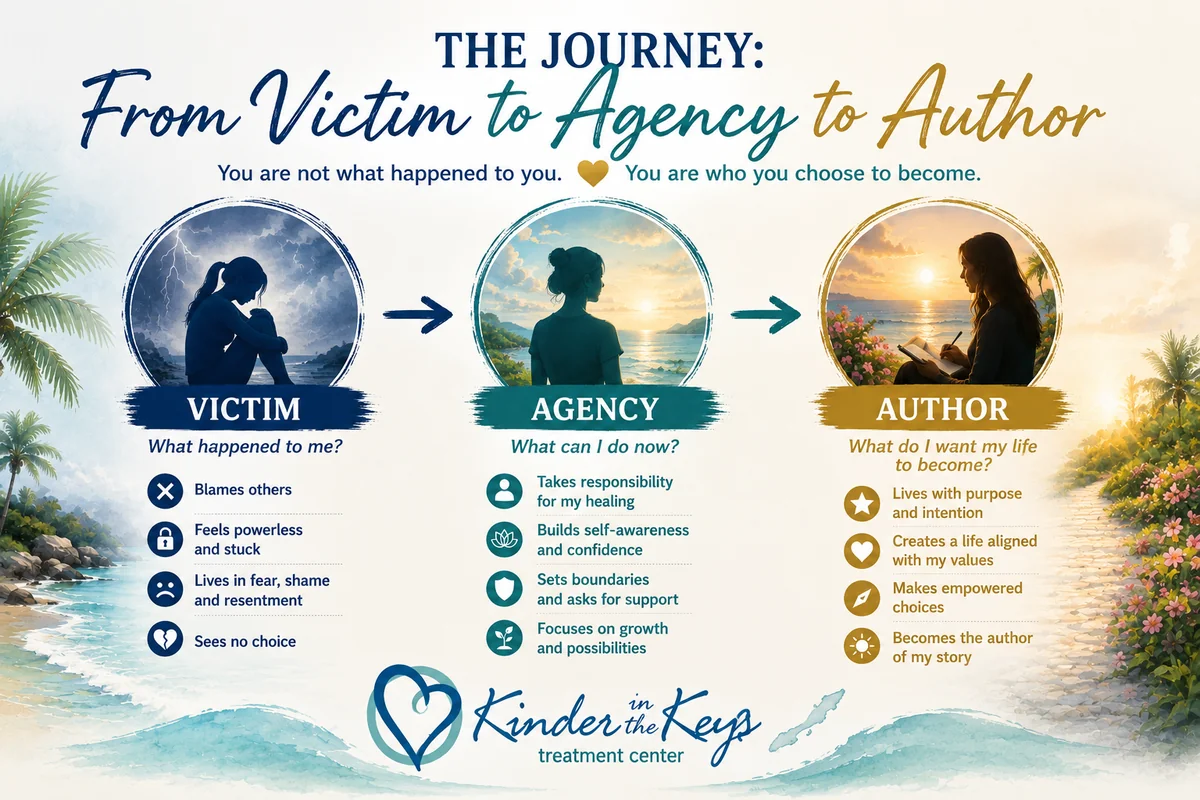
| Victim Energy | Healing and Agency |
|---|---|
| “Look what they did to me.” | “What happened matters. What can I do now?” |
| “They made me this way.” | “They affected me, but they don’t get to define me.” |
| “You triggered me.” | “I was triggered. What happened inside me?” |
| “My ex ruined my ability to trust.” | “Trust is difficult for me now, and I can work on rebuilding it.” |
| “Nothing ever works for me.” | “What haven’t I tried yet?” |
| “Everyone abandons me.” | “What patterns in my relationships do I need to understand?” |
| “I keep attracting narcissists.” | “What warning signs or relationship patterns do I need to recognize?” |
| “My therapist doesn’t understand me.” | “What am I struggling to hear or communicate?” |
| “I wasn’t the problem, so I shouldn’t have to change.” | “I did not cause the harm, but healing will require change from me.” |
| “They need to apologize before I can move on.” | “I deserve accountability, but my recovery cannot depend on receiving it.” |
| “They made me act that way.” | “Their behavior affected me. I am still responsible for my response.” |
The right side does not excuse anyone who hurt you.
It puts you back into your own life.
The Connection Between Victim Energy and Learned Helplessness
Psychology has long recognized a phenomenon called learned helplessness.
Repeated experiences of having little or no control can teach a person that trying is pointless.
The person begins learning:
Nothing I do matters.
I have no control.
Bad things happen regardless of what I choose.
There is no reason to try.
That response may once have made sense.
A child trapped in an abusive home may truly have very little power.
A woman experiencing coercive control may have very limited safe choices.
Someone experiencing repeated trauma may genuinely feel powerless.
But circumstances can change while the belief remains.
The person may now have choices she did not have before, yet continue living as though she has none.
Part of healing is discovering:
“I have choices now that I did not have then.”
Why Victim Energy Can Feel Safer Than Change
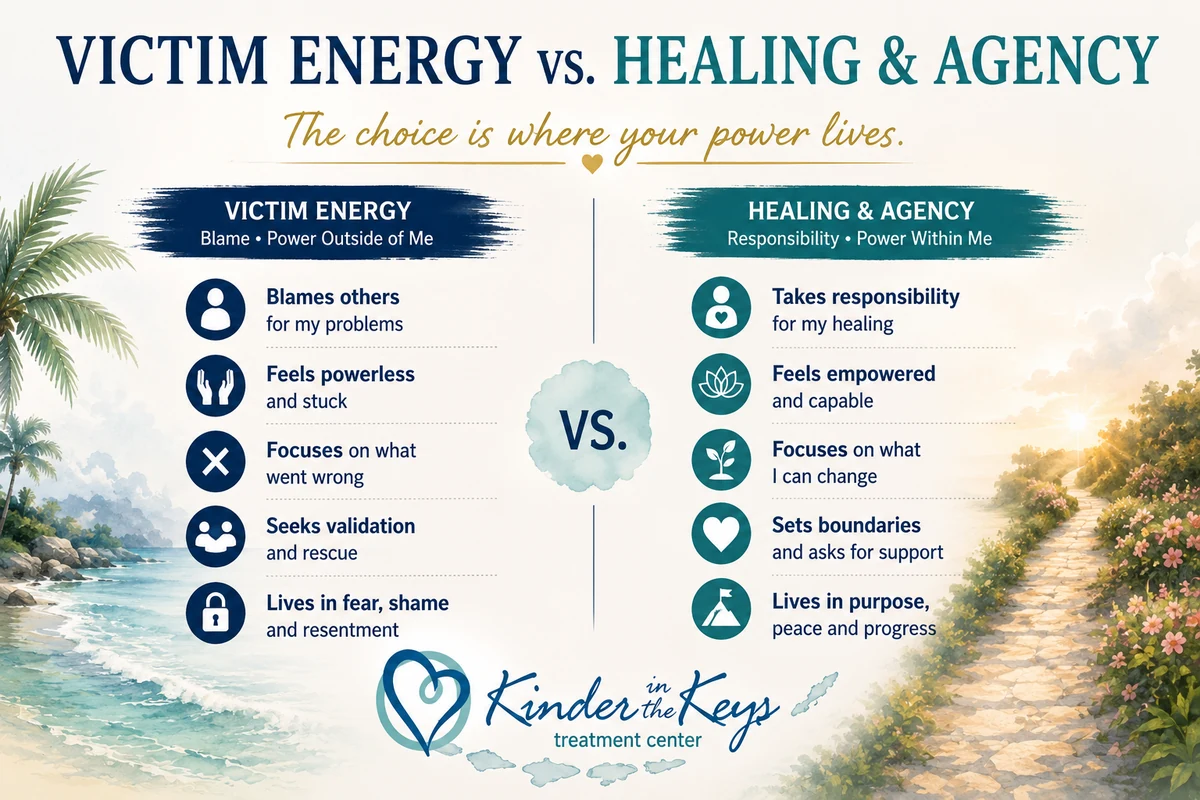
Agency sounds empowering.
It can also be frightening.
If everything is someone else’s fault, I never have to risk being wrong.
If nothing is within my control, I cannot fail.
If my trauma explains every behavior, I don’t have to risk responding differently.
If every unhealthy relationship happened only because I “attract narcissists,” I don’t have to examine how I select partners, recognize warning signs, set boundaries, or decide when to leave.
If every treatment failure belongs to the therapist or program, I don’t have to ask whether I resisted something important.
Self-examination can hurt.
It can expose uncomfortable patterns.
It may reveal that although you did not cause the original trauma, you are now participating in behaviors that continue creating pain.
That realization can feel threatening.
But it also contains tremendous hope.
Because:
You cannot change what you refuse to own.
And if some part of a present-day pattern belongs to you, some part of the power to change it belongs to you too.
Why Staying in Victim Energy Can Keep Treatment From Working
A woman can be physically present in treatment without actually entering recovery.
She can attend every session.
She can participate in groups.
She can learn the terminology.
She can tell her trauma story.
She can identify her triggers.
She can understand attachment theory.
She can explain narcissistic abuse, trauma bonding, PTSD, boundaries, coping skills, and every reason she behaves the way she does.
And she can remain stuck.
Because insight is not the same thing as change.
Treatment becomes especially difficult when a person remains committed to the belief that nearly every problem belongs to someone else.
Every therapeutic challenge becomes invalidation.
Every boundary becomes rejection.
Every request for personal responsibility becomes blame.
Every uncomfortable feeling means someone else did something wrong.
Every conflict confirms that other people are the problem.
Treatment can then become another place to rehearse the injury rather than recover from it.
This does not mean that every person who struggles in treatment is operating from victim energy.
Treatment can be unsuccessful for many reasons, including poor treatment fit, severe symptoms, inadequate treatment, safety concerns, co-occurring conditions, medical issues, therapeutic relationship problems, or simply needing a different approach.
But when a person consistently refuses to examine her own role in her present behavior and relationships, meaningful treatment becomes extremely difficult.
Because therapy eventually requires more than explaining what happened.
It requires asking:
What are you doing now?
When “My Therapist Doesn’t Understand Me” Becomes a Pattern
Sometimes a therapist genuinely gets it wrong.
Sometimes a clinician is not a good fit.
Sometimes treatment needs to change.
Patients should absolutely be able to advocate for themselves.
But there is another pattern worth recognizing.
A woman begins therapy.
The therapist listens to what happened.
The therapist validates the pain.
The woman feels understood.
Treatment feels wonderful.
Then the therapist eventually asks:
What are you avoiding?
What happens when someone tells you no?
Why do you repeatedly return to this relationship?
How are you behaving when you’re triggered?
Why does this pattern keep occurring?
What part of this situation is within your control?
What behavior needs to change?
Suddenly the therapist “doesn’t understand.”
So she finds another therapist.
The next therapist validates her experience.
Everything feels good again.
Eventually that clinician begins asking similar questions.
Now this therapist is wrong too.
If this happens repeatedly, there may come a point when the question needs to change from:
“Why do I keep finding terrible therapists?”
to:
“What happens when treatment asks me to examine something I don’t want to see?”
That question can be uncomfortable.
It can also change everything.
Treatment Cannot Work If All Responsibility Remains Outside of You
Treatment requires participation.
A therapist can help you understand trauma.
A therapist can teach coping strategies.
A treatment team can create structure.
Clinicians can help identify patterns.
Medication may help certain symptoms.
Residential care can provide a safe and supportive environment.
But treatment cannot do your recovery to you.
Eventually you have to participate in change.
A person who remains committed to blaming everyone else may struggle enormously in treatment because meaningful therapy requires self-examination.
There comes a point when treatment must move from:
“What did they do to you?”
to:
“What are you doing now?”
What patterns are you repeating?
What choices are keeping you stuck?
How do you respond when you’re uncomfortable?
What are you avoiding?
What boundaries do you need?
What behaviors are damaging your relationships?
What do you need to learn?
What do you need to practice?
What needs to change in you—not because you caused your trauma, but because you are the person who now has the power to create your recovery?
Validation Is Necessary. It Is Not the Finish Line.
Trauma treatment needs validation.
Sometimes a woman needs someone to finally say:
Yes, that happened.
Yes, it was wrong.
Yes, it affected you.
No, you did not deserve it.
That can be profoundly important.
But imagine if treatment stopped there.
Then we would have successfully explained why someone hurts without helping her build a life in which she hurts less.
Validation should open the door to recovery.
It should not become the room where someone lives forever.
Eventually treatment has to ask:
Now what?
How do you respond differently?
How do you reduce avoidance?
How do you manage triggers?
How do you challenge beliefs created by trauma?
How do you build healthier relationships?
How do you tolerate uncomfortable emotions?
How do you establish boundaries?
How do you repair when your behavior hurts someone?
How do you make decisions from the present instead of automatically responding from the past?
Validation says:
“Your pain makes sense.”
Healing adds:
“And you are capable of doing something with it.”
Treatment Cannot Give You Agency While You Are Fighting to Prove You Have None
If every problem in your life is caused by somebody else, then every solution must also come from somebody else.
Your mother must apologize.
Your father must admit what happened.
Your ex must take accountability.
Your family must understand.
Your partner must stop triggering you.
Your therapist must validate you.
Everyone around you must behave correctly.
The world has to become safe enough.
Then you can be okay.
That leaves you powerless.
Agency asks a completely different question:
“Regardless of who caused this, what can I do now?”
That question does not excuse the person who hurt you.
It stops requiring that person to participate in your healing.
Triggers Are Real—and You Still Have Responsibility for Your Response
Trauma triggers are real.
A smell, tone of voice, expression, location, disagreement, physical sensation, or situation may activate memories and intense emotional or physiological responses.
The reaction can feel immediate and overwhelming.
But there is a profound difference between saying:
“You triggered me, so you are responsible for what I did.”
and:
“Something triggered me. I need to understand my response and decide what I want to do with it.”
One gives the trigger control.
The other begins building agency.
This does not mean someone should tolerate abuse.
Present danger and trauma reminders are not the same thing.
If someone is harming you, safety matters.
But if your entire life eventually becomes organized around ensuring that nothing ever triggers you, trauma continues determining where you go, whom you see, what relationships you have, and what experiences you allow yourself to have.
At Kinder in the Keys, we do not believe recovery should mean spending the rest of your life running away from every possible trigger.
The goal is to become strong enough that the trigger no longer runs your life.
Victim Energy in Relationships
Victim energy can profoundly damage relationships.
The person may become hyperfocused on what everyone else is doing wrong while losing curiosity about her own impact.
Every disagreement becomes a courtroom.
Somebody must be guilty.
Somebody must be innocent.
But healthy relationships require something much more complex.
Two people can both have something to work on.
Someone else can behave poorly without making your behavior healthy.
You can be hurt and still apologize.
You can have PTSD and still respect another person’s boundaries.
You can be triggered and still repair after an argument.
You can have a traumatic childhood and still ask:
“How did my behavior affect you?”
That question does not weaken you.
It means your identity is strong enough to tolerate responsibility.
Victim Energy and Trauma Bonding
Trauma bonding can make abusive relationships extraordinarily difficult to leave.
A woman can intellectually understand that a relationship is harming her while remaining emotionally attached.
Understanding that pattern matters.
But recovery eventually needs to move from:
“Now I understand why I stayed.”
to:
“How do I recognize the pattern earlier next time?”
How do I establish boundaries?
How do I tolerate separation?
How do I rebuild self-trust?
How do I recognize warning signs?
How do I choose differently?
Understanding explains the pattern.
Agency changes it.
Trauma Bonding in Abusive Relationships
Victim Energy After Narcissistic Abuse
Narcissistic abuse can leave a woman questioning her judgment, memories, boundaries, and sense of reality.
Healing from that can take time.
But eventually there is another danger.
The abusive person can remain psychologically central long after the relationship ends.
Every conversation is about them.
Every relationship is compared with them.
Every emotional reaction is attributed to them.
Every decision is shaped by what they did.
They may be physically gone while continuing to occupy enormous psychological space.
Recovery means making your life larger than the abuse.
Narcissistic Abuse: When Love Was Never the Goal; Long-Term Effects of Narcissistic Abuse
The Victim-Rescuer Cycle: When Helping Keeps Someone Stuck
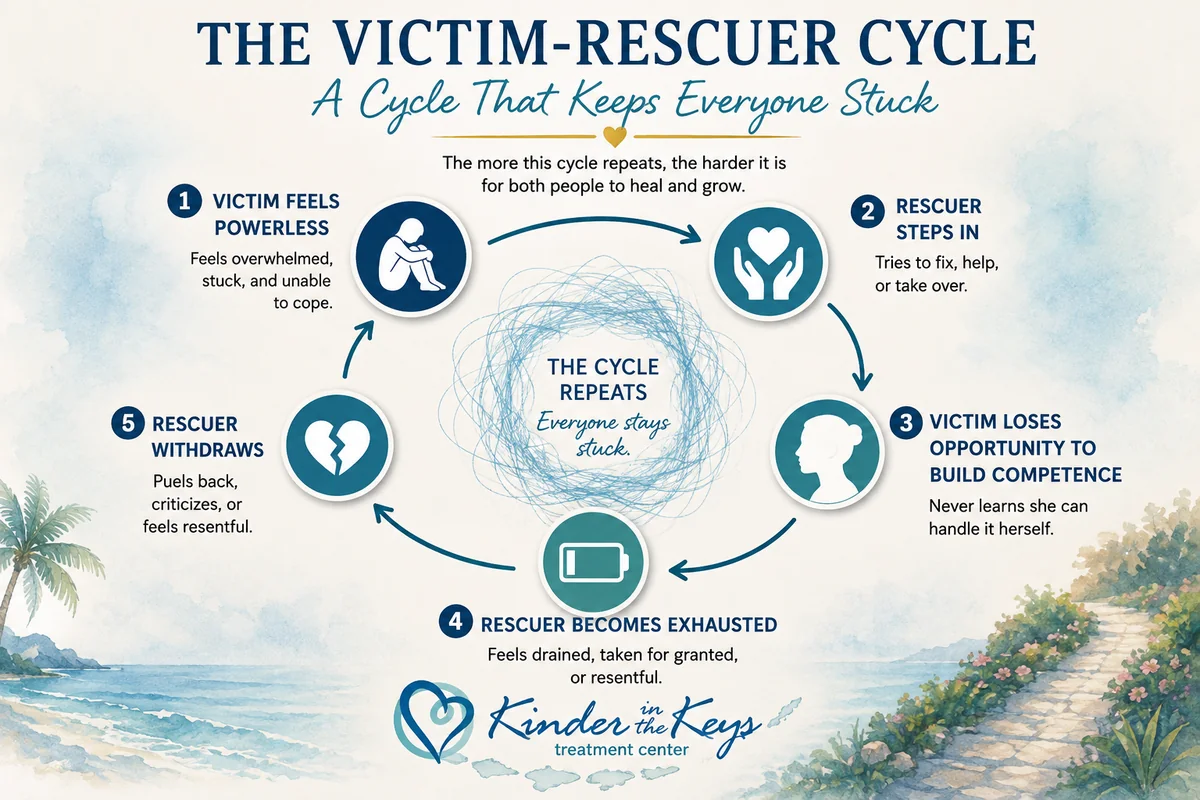
Victim energy rarely exists in isolation.
It often creates a relationship with another role:
The rescuer.
The victim communicates, directly or indirectly:
“I can’t handle this.”
The rescuer responds:
“I’ll handle it for you.”
Initially, this can look like compassion.
A family member fixes the problem.
A partner takes over the responsibility.
A friend intervenes in every conflict.
Someone repeatedly provides money, makes excuses, removes consequences, speaks on the person’s behalf, or rushes in whenever she becomes distressed.
Even helping professionals can fall into a rescuing role when they begin doing for a patient what the patient is capable of learning to do for herself.
The problem is that rescuing can unintentionally confirm the very belief that needs to change:
“I am not capable.”
Then a cycle develops.
The more helpless the victim feels, the more the rescuer does.
The more the rescuer does, the fewer opportunities the victim has to experience herself as competent.
The fewer opportunities she has to develop competence, the more she believes she needs rescuing.
Eventually, both people can become invested in their roles.
The Rescuer Gets Something From the Dynamic Too
This is important because the victim is not the only person participating in the cycle.
Rescuers can derive their own sense of identity from being needed.
They may feel valuable when they are fixing problems.
They may feel guilty saying no.
They may confuse love with taking responsibility for another adult.
They may fear that setting a boundary is abandonment.
They may believe:
“If I don’t fix this, something terrible will happen.”
“She can’t handle this without me.”
“I have to protect her.”
“It would be cruel to let her struggle.”
But there is an enormous difference between supporting someone and rescuing someone.
Support says:
“I’m here while you do something difficult.”
Rescuing says:
“I’ll do the difficult thing so you don’t have to.”
That difference matters enormously in recovery.
Rescuing Can Feel Like Love While Reinforcing Powerlessness
Imagine a woman repeatedly experiences conflict at work.
Every time it happens, she calls a family member and explains how terribly her coworkers are treating her.
The family member immediately agrees.
Everyone at work is unreasonable.
The boss is terrible.
She should quit.
None of the conflict has anything to do with her.
That response may feel supportive.
But what if this is the fifth workplace where the same pattern has occurred?
At some point, genuine support may sound different:
“I believe you that this interaction hurt. But this pattern keeps happening. Can we look at what happens in these conflicts and whether there’s anything you could do differently?”
That is not abandonment.
That is refusing to participate in helplessness.
The Victim-Rescuer Cycle Can Eventually Produce Anger
There is another side of rescuing that people rarely discuss.
Rescuers can eventually become exhausted.
They have solved problems, absorbed crises, made accommodations, provided reassurance, defended the person, and repeatedly attempted to make everything better.
Eventually the rescuer may begin thinking:
“Nothing I do is ever enough.”
Resentment develops.
The person who once rushed in to help becomes frustrated, critical, angry, or withdrawn.
The person in victim energy experiences that withdrawal as further evidence:
“See? Everyone eventually abandons me.”
And the cycle reinforces itself again.
This is why constantly rescuing someone is not necessarily compassionate.
Sometimes the more loving response is:
“I care about you. I will support you. But I am not going to take responsibility for something you are capable of learning to handle yourself.”
Treatment Must Be Careful Not to Become the Rescuer
This dynamic can occur in mental health treatment too.
Trauma treatment should provide safety, compassion, structure, and support.
But treatment should not communicate:
“You are too fragile to tolerate discomfort.”
“Everyone around you must change so that you never become triggered.”
“You cannot handle difficult emotions.”
“Someone else needs to solve this for you.”
That may look trauma-informed on the surface, but it can inadvertently reinforce powerlessness.
Effective treatment should increasingly communicate:
“We understand why this is difficult—and we also believe you are capable.”
Sometimes clinicians support.
Sometimes they teach.
Sometimes they comfort.
Sometimes they challenge.
And sometimes the therapeutic thing to do is not rescue.
Because every time a woman successfully does something she believed she could not do, she receives evidence that contradicts victim energy:
“Maybe I am capable.”
Then:
“I handled that.”
Then:
“I can trust myself.”
And eventually:
“I don’t need someone else to run my life.”
That is agency.
When Therapy Accidentally Reinforces Victimhood
There is a difficult balance in trauma treatment.
Too little validation can feel dismissive.
But never challenging a patient creates a different problem.
Trauma-informed care does not mean:
Never challenge.
Never confront avoidance.
Never allow discomfort.
Never establish boundaries.
Never question a belief.
Never expect responsibility.
That would confuse comfort with safety.
Good trauma treatment creates enough psychological safety that difficult work becomes possible.
A woman should feel respected enough to be challenged.
Capable enough to be expected to grow.
Strong enough to tolerate discovering that some of her current patterns need to change.
Compassion does not require pretending a person’s behavior has no consequences.
Why Some Women Resist Leaving Victim Energy
Sometimes victimhood has become part of identity.
If I have spent years understanding myself through what happened to me, who am I without that story in the center?
If anger has protected me, what happens when I stop organizing my life around anger?
If other people have always rescued me, what happens when they stop?
If I stop blaming my ex, my parents, my therapist, or my family, does that mean what they did was okay?
No.
Leaving victim energy does not rewrite history.
It changes who controls the present.
And sometimes that is frightening.
Because empowerment comes with responsibility.
When you have choices, you have decisions to make.
When you have agency, you can no longer wait indefinitely for somebody else to fix your life.
But that is also where freedom begins.
How Do You Know You’re Moving Out of Victim Energy?
Your questions start changing.
Instead of:
Why does this always happen to me?
you begin asking:
What can I do differently?
Instead of:
Why won’t they change?
you ask:
What will I do if they don’t?
Instead of:
Why do I keep attracting terrible people?
you ask:
What warning signs am I missing?
Instead of:
Why did my therapist upset me?
you ask:
Why was that so hard for me to hear?
Instead of:
How can I make everyone understand me?
you ask:
Do I need everyone to understand before I move forward?
Instead of:
Who is going to fix this?
you ask:
What is my next move?
That is the movement from blame to agency.
Taking Your Power Back Does Not Mean Pretending You Were Never Hurt
Empowerment is not denial.
You do not have to pretend something terrible was secretly good for you.
You do not have to forgive someone who harmed you.
You do not have to reconcile.
You do not have to stop being angry because someone else thinks you should.
You do not have to deny your PTSD.
You do not have to erase your history.
Taking your power back means:
Your history no longer gets the final vote.
From Victim to Agency to Author
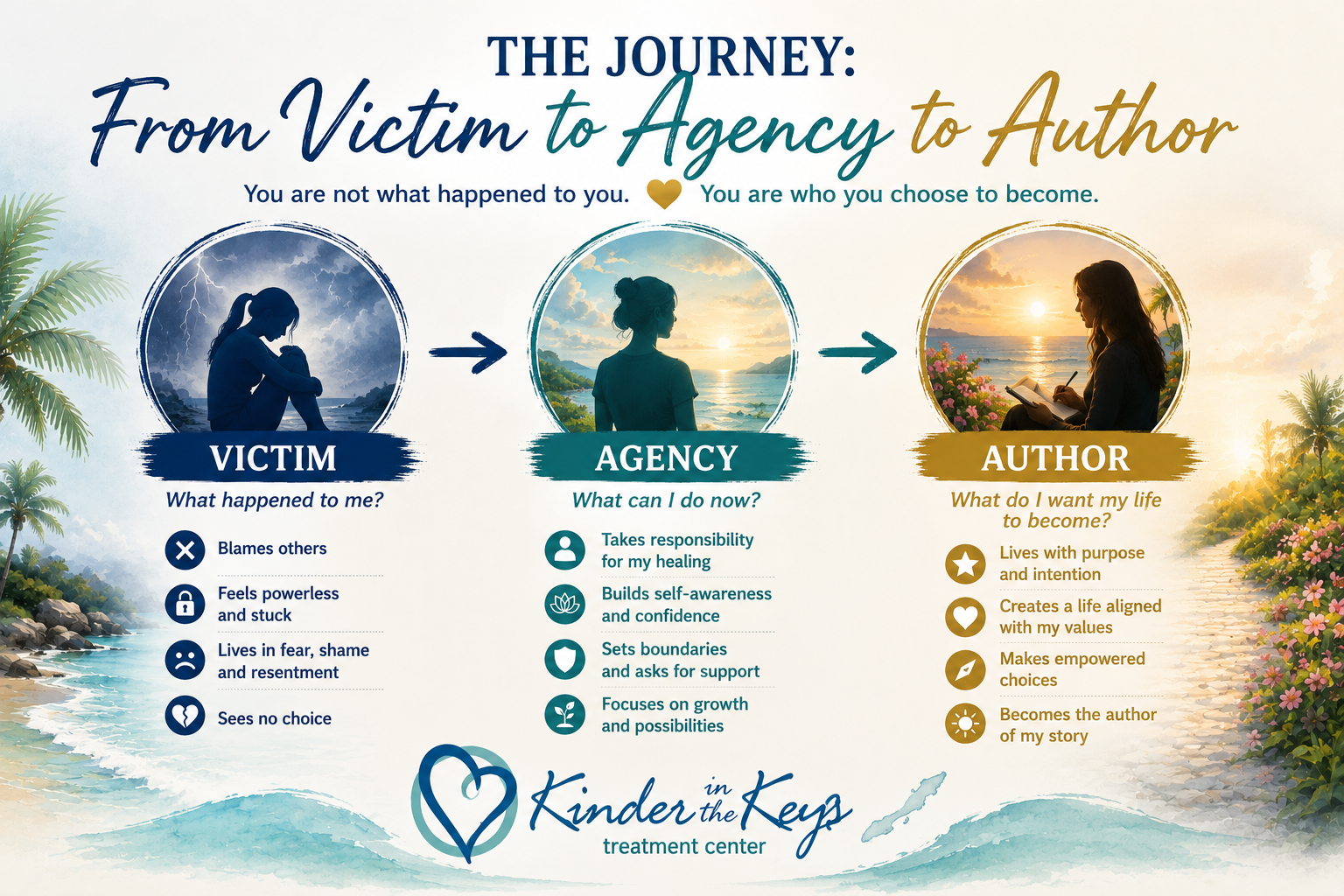
There may be a time when victim is exactly the correct word.
Something happened to you.
But that does not have to become your permanent identity.
There can be another stage:
Agency.
You begin recognizing that although you cannot rewrite what happened, you can influence what happens next.
And eventually there is something beyond agency.
You become the author.
Not the author of the trauma.
You cannot rewrite that chapter.
But you can participate in writing the chapters that follow.
You decide whom you allow into your life.
You learn your warning signs.
You establish boundaries.
You understand how trauma affects you.
You practice responding differently.
You take healthy risks.
You tolerate discomfort.
You repair relationships when you make mistakes.
You leave relationships that repeatedly harm you.
You build competence.
You experience peace.
You discover strength.
You begin having experiences that have nothing to do with trauma at all.
And slowly, your life becomes bigger than what happened to you.
The Person Who Hurt You Should Not Get the Rest of Your Life
Someone may have taken something from you.
Safety.
Trust.
Childhood.
Confidence.
Years.
A relationship.
A sense of yourself.
That deserves acknowledgment.
But if the rest of your life remains organized around what that person did, they continue occupying extraordinary space in your future.
Healing changes that.
You do not take your power back by pretending the trauma didn’t matter.
You take your power back when the trauma stops making your decisions.
The person who harmed you should not determine:
Who you love.
Where you go.
What you attempt.
Whether you trust.
How you respond.
Whether you experience peace.
How you see yourself.
Whether you build a future.
They have already taken enough.
Residential Trauma Treatment: Moving From Blame to Agency
Not every woman struggling with trauma or a victim mindset needs residential treatment.
But when PTSD, anxiety, depression, avoidance, emotional dysregulation, relationship patterns, or other symptoms significantly interfere with everyday functioning, a higher level of support may be appropriate.
At Kinder in the Keys, trauma treatment is not meant to become an endless retelling of everything that went wrong.
Understanding the past matters.
It helps explain the present.
But then treatment has to ask:
What do we do with that understanding?
How do you experience peace?
How do you experience strength?
How do you develop a different relationship with triggers?
How do you stop organizing your life around avoidance?
How do you identify unhealthy patterns?
How do you rebuild relationships?
How do you tolerate accountability without experiencing it as an attack?
How do you reconnect with your own ability to make decisions?
How do you begin experiencing yourself as capable rather than powerless?
That is where healing becomes more than understanding trauma.
It becomes building a life.
Internal link: Women’s Trauma and PTSD Treatment at Kinder in the Keys
Frequently Asked Questions About Victim Energy and Victim Mindset
What is victim energy?
Victim energy is a nonclinical term used here to describe a pattern in which a person repeatedly blames other people or circumstances for problems in her life while resisting examination of her own choices, responses, behaviors, and responsibility for change.
Is victim mentality a mental health diagnosis?
No. “Victim mentality,” “victim mindset,” and “victim energy” are not psychiatric diagnoses. They are descriptive terms. Some patterns involving helplessness, avoidance, trauma responses, depression, or other psychological conditions may overlap with aspects of what people informally call a victim mindset, but these concepts are not interchangeable.
Is having PTSD the same as being in victim energy?
No. PTSD is a recognized trauma-related mental health disorder. Experiencing PTSD symptoms does not mean someone has a victim mentality.
Is talking about trauma the same thing as staying in victim energy?
No. Talking about trauma can be an important part of treatment.
The concern is not discussing what happened.
The concern is remaining so focused on what others did that there is little willingness to examine present choices, patterns, coping strategies, relationships, or behavioral change.
Does taking responsibility mean admitting the abuse was my fault?
Absolutely not.
Responsibility for abuse belongs to the person who committed it.
Responsibility for recovery means recognizing what is within your control now.
Can I be triggered and still be responsible for my behavior?
Yes.
A trigger can cause genuine distress and a powerful trauma response.
Understanding the trigger is important.
But treatment can also help you learn how to respond in ways that protect yourself and the people around you.
Can staying in victim energy make treatment unsuccessful?
Victim energy can become a significant barrier to treatment.
Treatment requires some willingness to examine patterns, tolerate appropriate challenge, practice different responses, and identify areas in which change is possible.
A person who consistently believes that every problem belongs to other people may struggle to engage in that work.
However, treatment failure should never automatically be attributed to victim energy. People may struggle or fail to improve for many clinical and personal reasons.
Can a therapist challenge me and still be trauma-informed?
Yes.
Trauma-informed care does not mean eliminating every uncomfortable conversation.
A good therapist can validate what happened to you while also helping you examine avoidance, beliefs, behaviors, relationship patterns, boundaries, and responsibility for change.
Compassion and accountability can exist together.
Healing Is Where Your Power Lives
What happened to you matters.
Who hurt you matters.
What you lost matters.
Your pain matters.
But none of those things should be given permanent ownership of your future.
Eventually the question can begin changing from:
“Why did this happen to me?”
to:
“What am I going to do with my life now?”
That question is not cruel.
It does not minimize trauma.
It does not excuse abuse.
It is an invitation back into your own life.
You are not responsible for the trauma someone inflicted on you.
You are responsible for your recovery.
You cannot change what you refuse to own.
And the goal of trauma treatment is not to turn a woman into a better historian of everything that has hurt her.
The goal is to help her become the author of what happens next.
Medically Reviewed By
Dr. Laura Tanzini, DrPH, LMFT
Doctor of Public Health | Specialty in Lifestyle Medicine
Licensed Marriage and Family Therapist (Florida & California)
Founder & CEO, Kinder in the Keys
This article has been clinically reviewed for accuracy and consistency with current behavioral health and trauma-informed treatment principles. Dr. Tanzini has extensive clinical experience in trauma, PTSD, anxiety, depression, and women’s mental health, including assessment and treatment of trauma-related conditions.
Medical Disclaimer
This article is for educational and informational purposes only and is not intended to diagnose, treat, cure, or prevent any mental health condition. Information provided here should not replace individualized evaluation, diagnosis, or treatment from a qualified healthcare or mental health professional.