
Choosing between residential vs PHP vs IOP for women is about much more than deciding how many hours a week someone will attend therapy. The appropriate level of mental health care depends on how significantly symptoms are affecting daily life, whether a woman can remain stable outside of treatment, the support available in her home environment, her ability to use coping skills independently, and how much clinical structure she needs to make meaningful progress.
For women struggling with trauma, PTSD, depression, anxiety, or other complex mental health concerns, weekly outpatient therapy may sometimes provide enough support. At other times, symptoms have become too disruptive, persistent, or overwhelming for traditional outpatient treatment alone.
Understanding the differences between residential treatment, partial hospitalization programs (PHP), and intensive outpatient programs (IOP) can help women and their families ask better questions and make more informed treatment decisions.
Residential vs PHP vs IOP for Women: What Is the Difference?
Residential treatment, PHP, and IOP exist along a continuum of behavioral health care. The primary differences involve the treatment environment, amount of structure, intensity of clinical support, and level of independence a woman has outside treatment hours.
A higher level of care is not a punishment, nor does needing residential treatment mean someone has “failed” outpatient therapy.
Sometimes it simply means that healing requires more support than can realistically be provided during one or two therapy appointments each week.

Residential Mental Health Treatment
In residential mental health treatment, a woman temporarily lives in a therapeutic environment while participating in an organized treatment program.
The value of residential care is not simply that treatment occurs more frequently. Residential care creates continuity.
Instead of attending therapy and immediately returning to the same environment, responsibilities, relationship dynamics, or triggers that may be contributing to distress, a woman has time and space to focus intensively on stabilization and recovery.
Depending on the program and the individual’s treatment plan, residential treatment may incorporate individual therapy, group therapy, psychiatric services, medication management when indicated, trauma-focused interventions, psychoeducation, experiential therapies, wellness activities, and other forms of clinical support.
Residential treatment may be considered when symptoms are substantially interfering with daily functioning, previous outpatient treatment has not produced sufficient improvement, the home environment is not supportive of recovery, or a woman needs a greater degree of structure to stabilize and engage effectively in treatment.
Residential mental health treatment should not be confused with psychiatric hospitalization. Acute inpatient hospitalization is designed for individuals requiring hospital-level psychiatric or medical stabilization. Residential care serves a different role within the behavioral health continuum.
What Is a Partial Hospitalization Program (PHP)?
A Partial Hospitalization Program, commonly called PHP, provides intensive treatment during the day without requiring the individual to live in the treatment setting.
Women generally participate in structured clinical programming for a significant portion of the day and then return home or to an appropriate supportive living environment.
PHP can be particularly valuable as a step-down level of care after residential treatment. It can also be appropriate for some women who need considerably more support than routine outpatient therapy but who can safely and successfully function outside treatment hours.
A PHP may include individual and group therapy, psychiatric care, medication management when needed, skills training, psychoeducation, and other structured therapeutic services.
The key question is not simply whether a woman is willing to attend PHP.
The question is whether she can maintain sufficient stability during the hours she is not in programming.
What Is an Intensive Outpatient Program (IOP)?
An Intensive Outpatient Program, or IOP, provides more therapeutic structure than standard outpatient treatment while allowing considerably more independence than residential treatment or PHP.
IOP programming usually occurs several times during the week rather than occupying most of the treatment day.
This level of care may be appropriate for women who are sufficiently stable to manage much of their daily lives independently but still benefit from consistent therapeutic support, accountability, skills development, and continued treatment.
IOP can also serve as another step in the transition from more intensive treatment back into everyday life.
For example, a woman might progress from residential treatment to PHP, then to IOP, and eventually to traditional outpatient therapy as her stability, functioning, confidence, and ability to manage symptoms independently improve.
Treatment does not always follow that exact sequence. Level-of-care decisions should be individualized.
How Do Clinicians Determine the Appropriate Level of Care?
When comparing residential vs PHP vs IOP for women, these clinical factors are more important than simply comparing the number of treatment hours each program provides.
One of the biggest weaknesses in simple residential vs PHP vs IOP comparisons is that they make the decision sound like choosing between three products.
Clinical care does not work that way.
A comprehensive assessment looks at the whole person, not simply her diagnosis.
Two women can both meet criteria for PTSD, for example, while requiring very different levels of treatment.
Important considerations may include:
- Severity and persistence of psychiatric symptoms
- Current safety and stability
- Ability to perform activities of daily living
- Degree of impairment at work, school, home, or in relationships
- Previous treatment history and response to treatment
- Ability to apply coping skills outside therapy
- Co-occurring mental or physical health concerns
- Medication and psychiatric needs
- Trauma history and current trauma-related symptoms
- Family and social support
- Stressors within the living environment
- Ability to participate consistently in treatment
- Whether a lower level of care has been sufficient
The goal is generally to provide a level of treatment that is intensive enough to meet the woman’s clinical needs while supporting increasing independence as she becomes more stable.
Signs Residential Treatment May Be Appropriate
Residential treatment may be worth discussing with a qualified clinician when mental health symptoms have begun to dominate daily life.
A woman may still appear functional from the outside while struggling considerably internally.
She may continue going to work, caring for family members, or maintaining responsibilities while using enormous amounts of energy simply to get through each day.
Signs that a more intensive evaluation may be appropriate can include:
- Depression or anxiety that continues despite outpatient treatment
- Women experiencing persistent depression may benefit from learning more about depression treatment for women and when a higher level of care may be appropriate.
- Severe trauma or PTSD symptoms interfering with everyday functioning
- Increasing difficulty managing emotions
- Significant disruption in sleep, eating, concentration, relationships, or daily routines
- Repeated crises or deterioration between therapy appointments
- Difficulty using coping skills without substantial support
- An environment that repeatedly interferes with recovery
- Multiple unsuccessful attempts at lower levels of care
- A need for concentrated trauma treatment that cannot realistically occur during occasional outpatient sessions
No single item automatically means residential treatment is necessary. These are reasons to seek a professional assessment.
When Might PHP Be the Better Choice?
In a residential vs PHP vs IOP for women comparison, PHP occupies an important middle ground between the structure of residential treatment and the greater independence of intensive outpatient care.
PHP may be appropriate when a woman needs substantial therapeutic structure but does not require a residential environment.
She may be able to maintain stability overnight and outside treatment hours while still benefiting from intensive daytime programming.
PHP can also provide an important bridge between residential treatment and independent living.
That transition matters.
Leaving an intensive therapeutic environment and immediately returning to minimal outpatient support can be a dramatic change. A structured step-down allows women to begin applying what they have learned while maintaining meaningful clinical support.
When Might IOP Be Appropriate?
Understanding residential vs PHP vs IOP for women also means recognizing that IOP is designed for women who can manage greater independence while continuing to receive structured therapeutic support.
IOP may make sense when a woman is able to function with greater independence but still needs more support than traditional weekly outpatient therapy provides.
At this stage, treatment often focuses increasingly on integrating therapeutic skills into everyday life.
Women may be returning more fully to work, school, relationships, family responsibilities, and community life while continuing structured therapy several times each week.
The goal is not simply to attend fewer treatment hours.
The goal is to demonstrate that recovery skills can increasingly be used outside the treatment environment.
Why the Home Environment Matters
When comparing residential vs PHP vs IOP for women, the home environment is an important part of determining which level of care may be appropriate. What happens when treatment ends for the day can significantly affect a woman’s ability to maintain stability and continue making progress.
One factor that is sometimes overlooked when comparing residential vs PHP vs IOP for women is what happens when treatment ends for the day.
A woman may participate successfully in several hours of therapy, but recovery can become much more difficult if she returns each evening to an environment characterized by conflict, abuse, instability, substance use, overwhelming responsibilities, or persistent triggers.
Conversely, a stable and supportive home environment may make outpatient levels of care more realistic for some women.
This is why level-of-care decisions should consider not only symptoms but also the environment in which recovery is expected to occur.
Trauma Can Complicate Level-of-Care Decisions
Trauma treatment deserves particular attention.
Women with histories of childhood abuse, sexual trauma, domestic violence, narcissistic abuse, traumatic loss, or other prolonged traumatic experiences may develop coping strategies that once helped them survive but later interfere with relationships, emotional regulation, self-worth, and daily functioning.
Trauma may also coexist with depression, anxiety, panic, sleep disturbance, dissociation, or other symptoms.
Effective treatment therefore cannot always focus on a single symptom in isolation.
For some women, residential treatment provides the time, consistency, and therapeutic environment necessary to begin addressing these interconnected patterns without repeatedly returning to the circumstances that reinforce them.
For others, PHP or IOP provides sufficient structure.
The correct answer depends on the individual woman.
What If Outpatient Therapy Hasn’t Worked?
Not improving in outpatient therapy does not automatically mean therapy itself has failed.
Sometimes the dose and structure of treatment are insufficient for the complexity of the problem.
One hour of therapy each week represents only a very small portion of a woman’s life. She then spends the remainder of the week navigating the same thoughts, behaviors, triggers, relationships, and environmental pressures she is trying to change.
For women with significant trauma histories or persistent psychiatric symptoms, more concentrated treatment can create opportunities to identify patterns, practice new responses repeatedly, and receive feedback and support while those changes are occurring.
NIMH notes that treatment should be tailored to the individual’s needs and clinical situation. If someone has participated in treatment for a reasonable period without improving, discussing different approaches or providers with a mental health professional may be appropriate.
Does Insurance Determine Residential, PHP, or IOP Treatment?
Insurance coverage can affect access to treatment, but insurance benefits and clinical recommendations are not necessarily the same thing.
Behavioral health insurers may use medical-necessity criteria when authorizing residential, PHP, IOP, or other treatment services. Coverage varies substantially by policy, insurer, diagnosis, clinical circumstances, and treatment provider.
Before entering treatment, women and families should ask the treatment center to explain the insurance verification and authorization process, expected financial responsibility, and what happens if the insurer authorizes a different level or duration of care than anticipated.
Clinical treatment decisions should ultimately be based on an individualized assessment rather than choosing a program simply because one level sounds more convenient.
Treatment Should Change as Recovery Progresses
The decision between residential vs PHP vs IOP for women may therefore change as symptoms improve, stability increases, and a woman becomes more confident managing daily life outside of treatment.
The appropriate level of care today may not be the appropriate level of care several weeks from now.
Good treatment continually evaluates progress.
As symptoms improve and a woman becomes more capable of managing emotions, maintaining stability, using coping strategies, navigating triggers, and functioning independently, she may be ready for a less intensive setting.
Likewise, if symptoms worsen or the current level of treatment is not providing enough support, a more intensive level of care may need to be considered.
Stepping down is not simply receiving less treatment. It is practicing greater independence while maintaining enough support to protect the progress already made.
Women’s Mental Health Treatment at Kinder in the Keys
Kinder in the Keys provides a treatment environment specifically designed for adult women experiencing mental health challenges, including trauma-related conditions, PTSD, anxiety, and depression.
Women do not arrive at treatment as diagnoses.
They arrive with histories.
Those histories may include trauma, relationships, family experiences, chronic stress, loss, fear, unhealthy coping patterns, disrupted self-worth, and years of functioning in survival mode.
Treatment should therefore look beyond symptom reduction alone.
At Kinder in the Keys, the goal is to help women understand what has happened, recognize the patterns that continue to affect their lives, develop healthier responses, reconnect with their own strength, and build skills that can continue beyond treatment.
For some women, that process requires the structure of residential care. Others may be appropriate for a less intensive level of treatment.
The first step is determining what level of support the woman actually needs.
Residential vs PHP vs IOP for Women: Which Is Right for You?
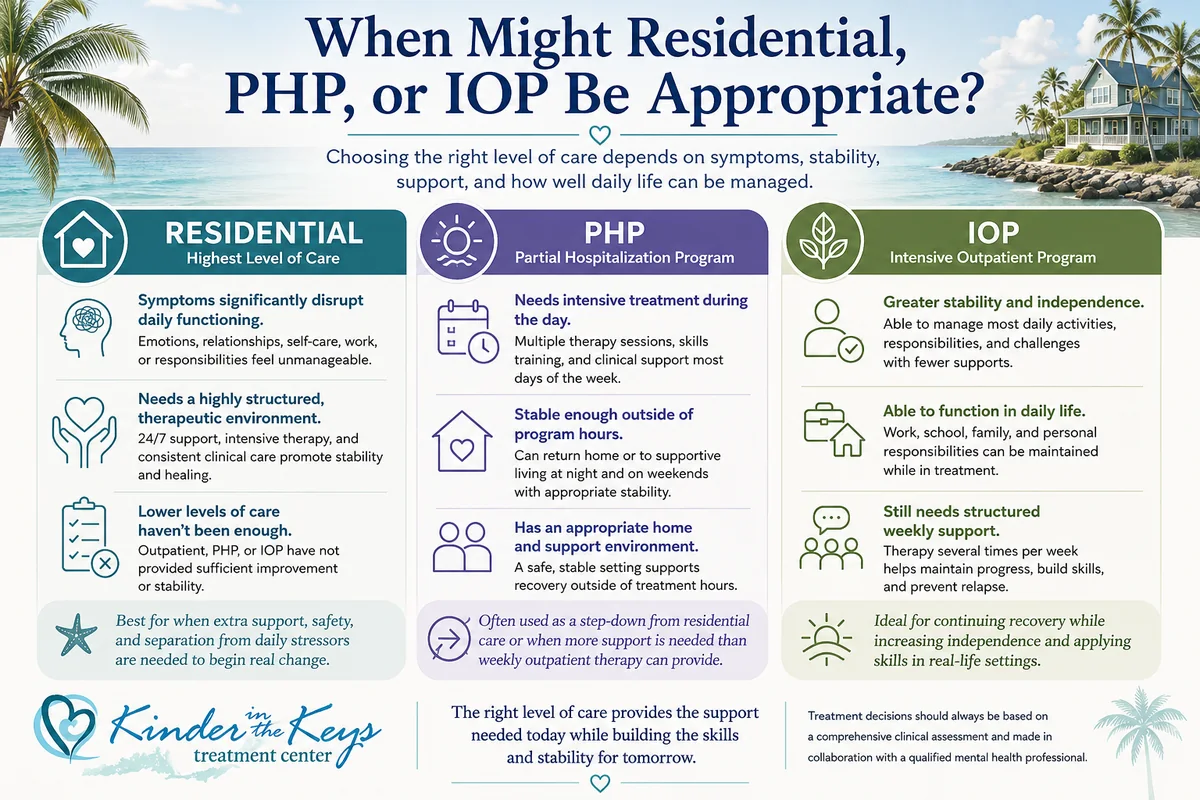
There is no universally “best” level of mental health treatment.
There is only the level that is appropriate for a woman’s current clinical needs.
Residential treatment provides the greatest separation from everyday demands and a highly structured therapeutic environment. PHP allows intensive daytime treatment while providing greater independence outside programming. IOP offers continued structured treatment while allowing women to spend more of their lives in their usual community environment.
If symptoms are significantly interfering with daily functioning, treatment has repeatedly failed at a lower level of care, trauma is overwhelming existing coping skills, or maintaining stability outside treatment has become increasingly difficult, a comprehensive clinical assessment can help determine whether more intensive care should be considered.
The question is not:
“How little treatment can I get by with?”
A better question is:
“What level of support gives me the best opportunity to actually get well?”

Frequently Asked Questions
Is residential treatment the same as inpatient psychiatric hospitalization?
No. Residential mental health treatment and acute inpatient psychiatric hospitalization serve different purposes and operate at different levels of medical and psychiatric intensity. Hospitalization is generally used when hospital-level stabilization is required, while residential programs provide structured treatment in a non-hospital residential environment.
Is PHP considered residential treatment?
No. PHP is generally a nonresidential level of care. Participants attend intensive programming during the day but do not live in the treatment program.
Is IOP more intensive than PHP?
Generally, no. PHP typically involves more treatment hours and structure, while IOP allows greater independence and fewer weekly programming hours.
Can someone go directly into PHP or IOP without residential treatment first?
Yes. Not every woman needs residential treatment. A clinician should recommend the level of care based on the individual’s symptoms, functioning, safety, environment, treatment history, and other clinical factors.
Can someone move from residential treatment to PHP and then IOP?
Yes. A gradual transition through less intensive levels of care can be appropriate for some women as they become more stable and independent. The exact treatment pathway should be individualized.
How do I know whether outpatient therapy is enough?
If symptoms continue to substantially interfere with daily functioning, worsen between sessions, or fail to improve despite appropriate outpatient treatment, it may be worth discussing a higher level-of-care assessment with a qualified mental health professional.
Authoritative Resources
For additional information about mental health treatment and behavioral healthcare:
- National Institute of Mental Health (NIMH): Information about psychotherapy, mental health conditions, and finding treatment.
- The Joint Commission: Information about behavioral health care settings and accreditation standards.
Medically Reviewed By
Dr. Laura Tanzini, DrPH, LMFT
Doctor of Public Health | Specialty in Lifestyle Medicine
Licensed Marriage and Family Therapist (Florida & California)
Founder & CEO, Kinder in the Keys
This article has been clinically reviewed for accuracy and consistency with current behavioral health practices. It is intended to provide educational information about mental health treatment and levels of care and should not replace an individualized assessment by a qualified healthcare professional.
Medical Disclaimer
The information provided in this article is for educational and informational purposes only and is not intended to diagnose, treat, cure, or prevent any mental health or medical condition. Treatment recommendations and the appropriate level of care depend on individual clinical circumstances. Anyone experiencing significant mental health symptoms should consult a qualified healthcare professional for an individualized assessment.