
Narcissistic abuse can leave psychological effects that continue long after an abusive relationship has ended. For some women, those effects include anxiety, hypervigilance, intrusive memories, difficulty trusting others, emotional numbness, sleep problems, and other trauma-related symptoms.
This can lead to an important question:
Can narcissistic abuse cause PTSD Be Connected?
The relationship between narcissistic abuse and PTSD is more complicated than a simple yes-or-no answer.
Psychological and emotional abuse can be deeply traumatic. However, post-traumatic stress disorder is also a specific clinical diagnosis with defined diagnostic criteria. Not everyone who experiences narcissistic abuse develops PTSD, and not every emotionally abusive experience by itself meets the trauma-exposure criterion required for a PTSD diagnosis.
At the same time, abusive relationships may involve threats, physical violence, sexual violence, coercive control, or other traumatic experiences that do meet PTSD criteria. Women may also experience significant trauma symptoms even when they do not meet the full diagnostic criteria for PTSD.
Understanding that distinction can help women make sense of what they are experiencing without minimizing the very real psychological impact of abuse
What Is Narcissistic Abuse?
“Narcissistic abuse” is a commonly used term describing patterns of emotional and psychological abuse that may include manipulation, gaslighting, coercive control, exploitation, intimidation, degradation, and attempts to undermine another person’s independence or perception of reality.
A person does not need to have a formal diagnosis of narcissistic personality disorder for a relationship to be emotionally abusive.
In fact, determining whether another person has a psychiatric diagnosis is often less important than recognizing the behaviors occurring within the relationship.
Common patterns may include:
- Gaslighting
- Persistent criticism or humiliation
- Blame shifting
- Controlling behavior
- Isolation from friends or family
- Emotional withdrawal or silent treatment
- Intense idealization followed by devaluation
- Manipulation through guilt or fear
- Repeated boundary violations
- Unpredictable cycles of affection and rejection
Over time, a woman may begin organizing her behavior around preventing conflict or predicting the other person’s reactions.
That adaptation can continue even after the relationship ends.
therapy for narcissistic abuse
Can Narcissistic Abuse Cause PTSD?
PTSD requires more than experiencing significant emotional distress.
Under current diagnostic criteria, PTSD involves exposure to actual or threatened death, serious injury, or sexual violence, followed by a specific pattern of symptoms involving intrusion, avoidance, changes in thoughts or mood, and changes in arousal and reactivity.
Therefore, narcissistic abuse does not automatically equal PTSD.
However, narcissistically abusive relationships can also involve experiences such as physical violence, sexual violence, threats of serious harm, or other traumatic events that satisfy the trauma-exposure requirement.
And regardless of whether someone ultimately meets the diagnostic criteria for PTSD, chronic psychological abuse can produce substantial emotional distress and trauma-related symptoms that deserve treatment.
A comprehensive clinical assessment matters because symptoms can overlap among PTSD, anxiety disorders, depression, adjustment disorders, and other trauma- and stressor-related conditions.
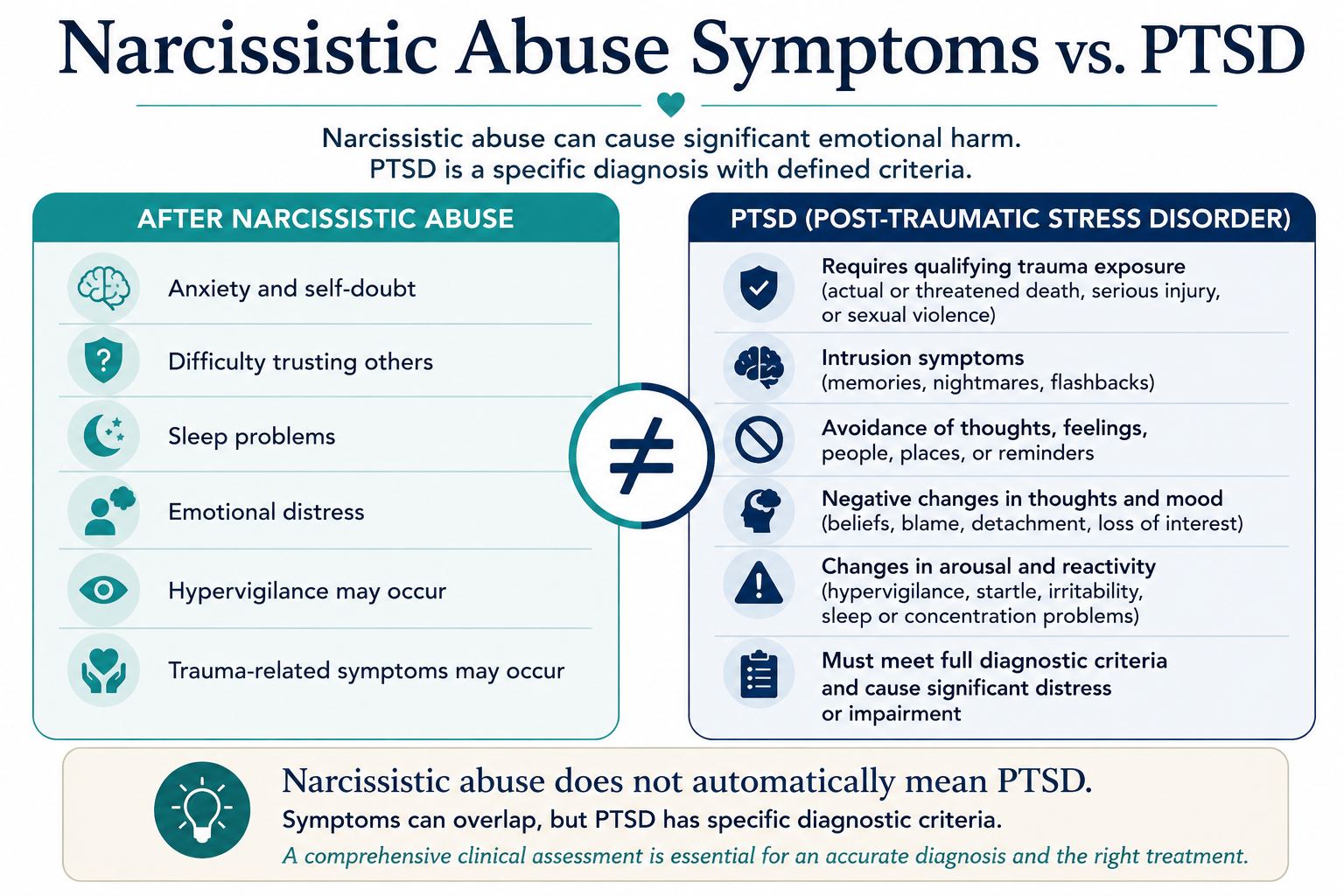
This is an excellent authority link for this article. The National Center for PTSD summarizes the current adult diagnostic criteria and notes that DSM-5-TR did not change those PTSD criteria.
Why Narcissistic Abuse Can Feel Traumatic
Trauma isn’t only about remembering what happened.
It can also change what a person learns to expect.
Imagine repeatedly trying to determine:
What mood is she or he in?
Did I say something wrong?
Is this going to turn into an argument?
Should I bring this up or keep quiet?
Am I remembering what happened correctly?
Why am I apologizing when I don’t think I did anything wrong?
When someone spends a prolonged period monitoring another person’s moods and reactions, remaining alert can become habitual.
Even after the relationship ends, the mind and body may continue responding as though another threat is coming.
Hypervigilance After Narcissistic Abuse
Hypervigilance is one of the symptoms commonly associated with PTSD.
Someone experiencing hypervigilance may feel constantly alert for danger, even when she intellectually knows she is safe.
After an abusive relationship, this may appear as:
- Closely monitoring someone’s tone of voice
- Becoming anxious when another person becomes quiet
- Expecting anger after making a mistake
- Feeling uncomfortable during disagreements
- Being easily startled
- Repeatedly asking whether someone is upset
- Having difficulty relaxing
- Feeling that something bad is about to happen
These reactions can be confusing because the person may recognize that the present situation is safe while still experiencing a strong emotional or physical response.
That is one reason trauma treatment involves more than simply telling someone that she is safe.
Gaslighting and Loss of Trust in Yourself
One particularly damaging component of some narcissistically abusive relationships is gaslighting.
Repeatedly having your perceptions denied or distorted can eventually affect confidence in your own judgment.
A woman may begin thinking:
Maybe I’m too sensitive.
Maybe I misunderstood.
Maybe it really was my fault.
What if I’m remembering it wrong?
Eventually, she may begin relying on other people to determine whether her own reactions are reasonable.
Healing therefore isn’t simply about learning to trust other people again.
It can also involve learning to trust yourself again.
That means recognizing your perceptions, identifying your needs, making decisions, setting boundaries, and tolerating disagreement without automatically assuming you have done something wrong.
Intrusive Memories and Emotional Triggers
Some women experience unwanted memories or strong emotional reactions to reminders of an abusive relationship.
A particular tone of voice, phrase, location, smell, facial expression, or type of disagreement may trigger an unexpectedly intense reaction.
These experiences can sometimes feel irrational because the current situation may be completely different from the previous one.
But the reaction often makes more sense when understood in context.
Something occurring now has become associated with something painful that happened before.
The goal of trauma treatment is not necessarily to eliminate every possible reminder from someone’s life.
It is to help reduce the power those reminders have over the present.
Avoidance Can Keep Trauma Powerful
After trauma, avoiding anything associated with what happened can feel protective.
Someone may avoid certain places, conversations, relationships, memories, emotions, or situations because encountering them produces distress.
In the short term, avoidance can reduce anxiety.
But persistent avoidance is also one of the core symptom clusters of PTSD.
This is an important part of Kinder’s approach to trauma recovery.
Healing does not necessarily mean building a life around avoiding every trigger.
When clinically appropriate and supported by qualified treatment, understanding and working through triggers can help a woman discover that a reminder does not have to hold the same power it once did.
The goal isn’t to repeatedly overwhelm someone.
The goal is to reach a place where the past can be remembered without continually controlling the present.
Narcissistic Abuse, Trauma Bonding, and PTSD
Another important piece of this relationship is trauma bonding.
People sometimes struggle to understand why someone remains emotionally attached to a person who repeatedly hurts her.
But abusive relationships aren’t always abusive every moment.
Periods of affection, reassurance, attention, promises, or reconciliation may alternate with criticism, withdrawal, manipulation, or fear.
That unpredictability can create a powerful attachment.
Leaving may therefore involve more than ending a relationship. A woman may simultaneously recognize that the relationship was harmful and still deeply miss the person.
trauma bonding in abusive relationships
PTSD Symptoms After an Abusive Relationship
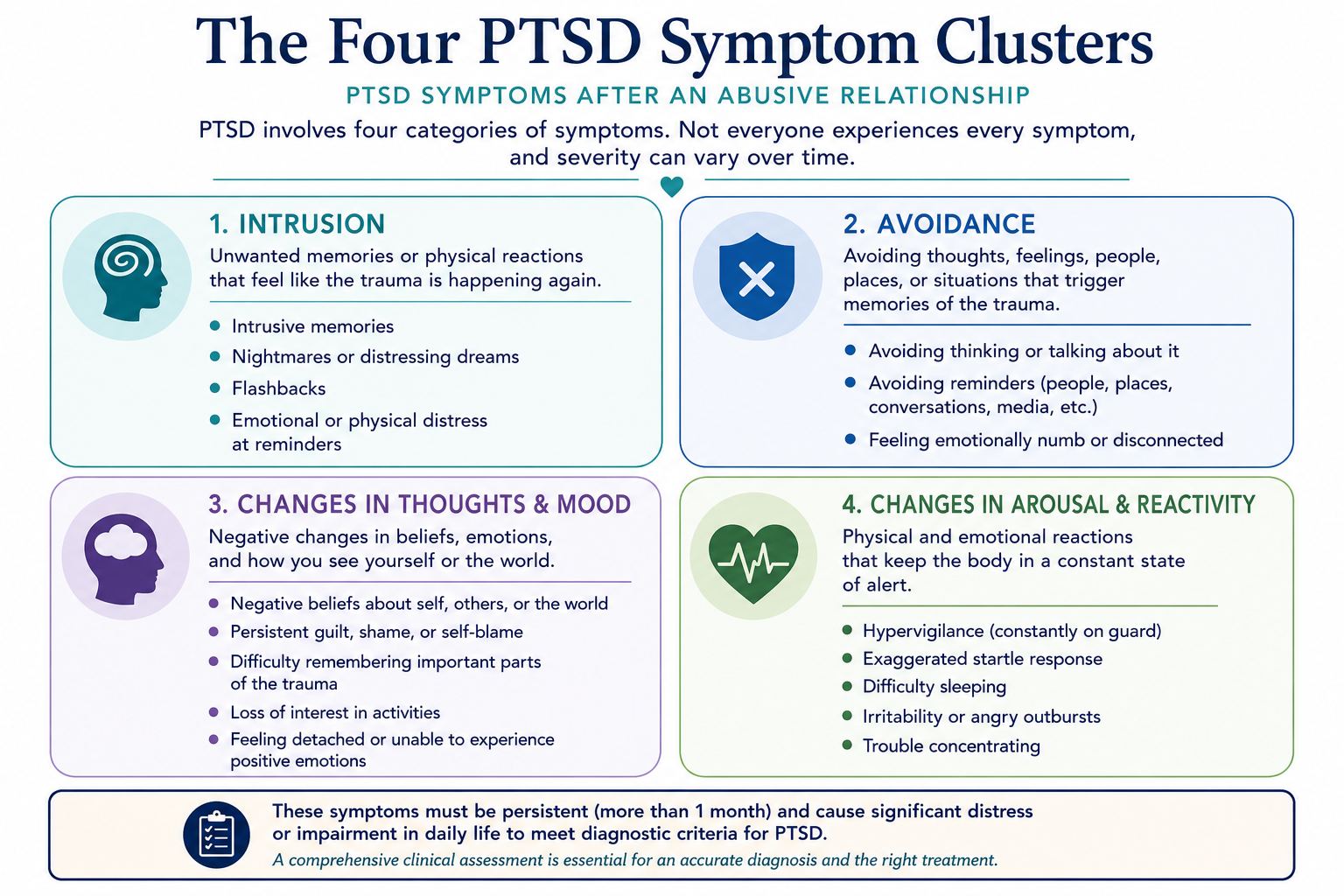
When someone meets diagnostic criteria for PTSD, symptoms generally fall into four broad categories.
Intrusion Symptoms
These may include unwanted memories, nightmares, flashbacks, emotional distress when reminded of the trauma, or physical reactions to reminders.
Avoidance
A person may avoid thoughts, feelings, conversations, people, places, or other reminders associated with the traumatic experience.
Changes in Thoughts and Mood
PTSD can involve persistent negative beliefs, self-blame, diminished interest in activities, emotional detachment, difficulty experiencing positive emotions, or difficulty remembering aspects of the trauma.
Changes in Arousal and Reactivity
Symptoms may include irritability, hypervigilance, exaggerated startle response, difficulty concentrating, sleep disturbance, or reckless behavior.
A clinician evaluates the entire pattern of symptoms rather than diagnosing PTSD based on one symptom alone.
Narcissistic Abuse and PTSD Symptoms Can Overlap With Anxiety and Depression
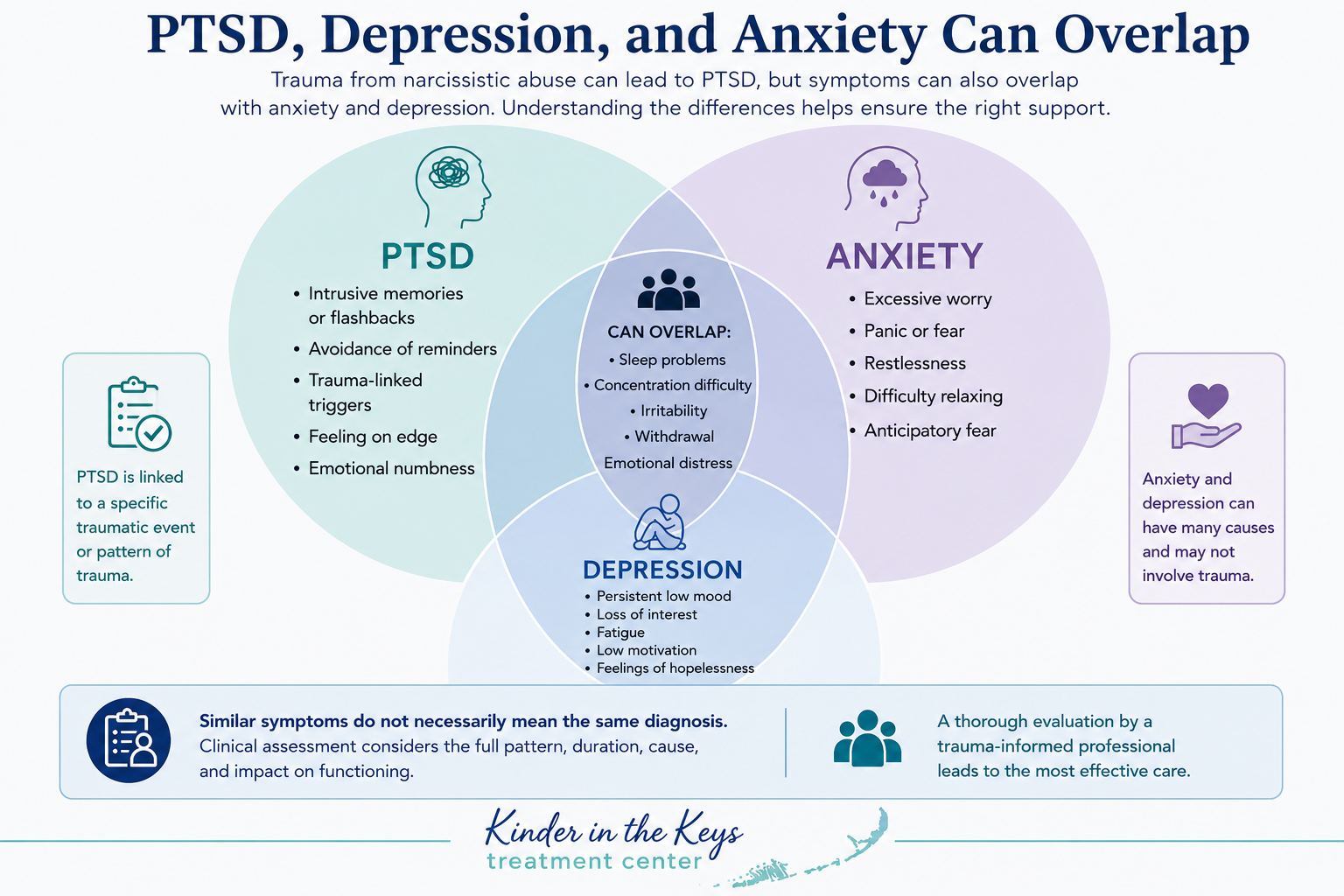
The relationship between narcissistic abuse and PTSD can be difficult to evaluate because trauma-related symptoms frequently overlap with other mental health conditions.
A woman may experience:
- Persistent anxiety
- Panic
- Depression
- Sleep problems
- Difficulty concentrating
- Emotional numbness
- Social withdrawal
- Shame
- Loss of confidence
- Difficulty functioning at work
- Relationship problems
Someone can experience several of these symptoms without meeting diagnostic criteria for PTSD.
Conversely, a woman with PTSD may also have depression or an anxiety disorder.
Treatment should therefore address the individual woman rather than simply treating a label.
What About Complex PTSD?
You will also hear the term complex PTSD, or C-PTSD, used frequently in discussions about prolonged abuse.
This is another area where precision matters.
Complex PTSD is recognized as a distinct diagnosis in the World Health Organization’s ICD-11. It is not a separate diagnosis in the DSM-5-TR, which is commonly used for psychiatric diagnosis in the United States.
The concept is particularly relevant to discussions of prolonged or repeated interpersonal trauma because it recognizes difficulties that may extend beyond the traditional PTSD symptom pattern, including problems involving emotional regulation, self-concept, and relationships.
A clinician can help determine which diagnosis, if any, best describes an individual’s symptoms.
Women experiencing significant post-traumatic stress symptoms can learn more about PTSD treatment for women.
Healing From Narcissistic Abuse and PTSD
Healing from narcissistic abuse and PTSD requires an individualized approach because symptoms, diagnoses, experiences, and treatment needs differ from woman to woman.
Recovery is not about pretending the relationship never happened.
Nor is it about returning someone to exactly who she was before it happened.
For many women, healing involves understanding what happened, recognizing the adaptations they developed to survive it, and deciding which of those patterns they no longer need.
Treatment may involve:
- Processing traumatic experiences
- Reducing PTSD symptoms
- Challenging internalized criticism
- Rebuilding self-esteem
- Developing emotional regulation skills
- Establishing healthy boundaries
- Learning to tolerate appropriate conflict
- Reconnecting with supportive relationships
- Improving sleep and physical well-being
- Recognizing unhealthy relationship patterns
- Rebuilding confidence in personal judgment
- Developing a stronger sense of identity
For PTSD specifically, trauma-focused psychotherapies are among the treatments recommended by major clinical guidelines.
When Is Residential Trauma Treatment Appropriate?
Not everyone recovering from narcissistic abuse needs residential treatment.
Many women can recover successfully through outpatient psychotherapy and supportive relationships.
Residential treatment may be considered when symptoms have become severe enough to significantly interfere with daily functioning or when someone needs more structure and therapeutic support than outpatient care can provide.
At Kinder in the Keys, our women-only residential program treats women experiencing PTSD, trauma-related symptoms, anxiety, depression, and psychological effects associated with abusive relationships.
Treatment may incorporate trauma-focused therapy alongside approaches such as CBT, DBT, EMDR, psychodynamic therapy, psychoeducation, and experiential therapies based on an individual’s treatment plan.
residential trauma treatment for women
Frequently Asked Questions About Narcissistic Abuse and PTSD
Understanding the connection between narcissistic abuse and PTSD can help women recognize when trauma-related symptoms warrant professional evaluation.
Can narcissistic abuse cause PTSD?
Narcissistic abuse can occur within relationships that also involve traumatic experiences capable of contributing to PTSD. However, narcissistic abuse does not automatically result in PTSD. PTSD is a clinical diagnosis requiring a specific type of trauma exposure and a defined pattern of symptoms. A qualified mental health professional can determine whether diagnostic criteria are met.
What are common trauma symptoms after narcissistic abuse?
Women may experience anxiety, hypervigilance, intrusive memories, emotional numbness, sleep problems, difficulty trusting others, diminished self-esteem, avoidance, depression, or strong emotional reactions to reminders of the relationship.
Why do I still feel unsafe after the relationship has ended?
When someone has spent a long period monitoring another person’s behavior and anticipating conflict or danger, those responses can persist after the environment changes. Treatment can help a person distinguish present circumstances from patterns learned during the abusive relationship.
Is complex PTSD the same as PTSD?
They are related but not identical concepts. Complex PTSD is recognized as a distinct diagnosis in ICD-11 but not as a separate disorder in DSM-5-TR. Clinical assessment can help determine which diagnosis best describes a person’s symptoms.
Can trauma from narcissistic abuse be treated?
Yes. Treatment can address trauma symptoms as well as anxiety, depression, self-esteem, boundaries, relationships, emotional regulation, and other difficulties that may remain after an abusive relationship.
Does healing mean avoiding my triggers?
Not necessarily. Avoidance is itself a major PTSD symptom. Appropriate trauma treatment can help people safely work with trauma reminders so that those reminders have less control over everyday life.
Does narcissistic abuse always cause PTSD?
No. Narcissistic abuse can cause significant psychological distress and trauma-related symptoms, but it does not automatically result in PTSD. PTSD requires specific trauma exposure and a defined pattern of symptoms that should be evaluated by a qualified mental health professional.
Medically Reviewed By
Dr. Laura Tanzini, DrPH, LMFT
Doctor of Public Health | Specialty in Lifestyle Medicine
Licensed Marriage and Family Therapist (Florida & California)
Founder & CEO, Kinder in the Keys
This article has been clinically reviewed for accuracy and consistency with current behavioral health and trauma-informed treatment principles. Dr. Tanzini’s clinical work focuses on trauma, PTSD, anxiety, depression, and women’s mental health, with an emphasis on integrating psychological treatment with whole-person wellness.
Medical Disclaimer: This content is provided for educational and informational purposes only and is not intended to diagnose a mental health condition or replace individualized medical or mental health care. If you are experiencing symptoms that concern you, consult a qualified healthcare professional.