
Eating disorders do not always look the way people expect.
A woman may continue going to work, caring for her family, exercising, socializing, and appearing physically healthy while her relationship with food, exercise, weight, or her body becomes increasingly rigid and distressing.
That is one reason the early signs of an eating disorder in women can be surprisingly difficult to recognize.
Families often wait for something dramatic—a visibly low body weight, complete refusal to eat, frequent vomiting, or an obvious medical crisis—before realizing there is a problem.
But eating disorders can begin much more quietly.
A woman may gradually eliminate foods she once enjoyed. Exercise may change from something she likes into something she feels compelled to do. She may become anxious when meals do not go according to plan. She may stop eating with other people. Conversations about calories, weight, ingredients, or “clean” foods may begin taking up more and more of her mental space.
Sometimes the first sign is not even food.
It may be irritability, isolation, anxiety, perfectionism, exhaustion, difficulty concentrating, or simply the sense that a woman who once had flexibility around eating has become increasingly controlled by it.
Eating disorders are serious mental health conditions, and they can affect people at any body weight. The National Institute of Mental Health emphasizes that people who appear healthy can have an eating disorder and still be seriously ill.
Recognizing these changes early matters.
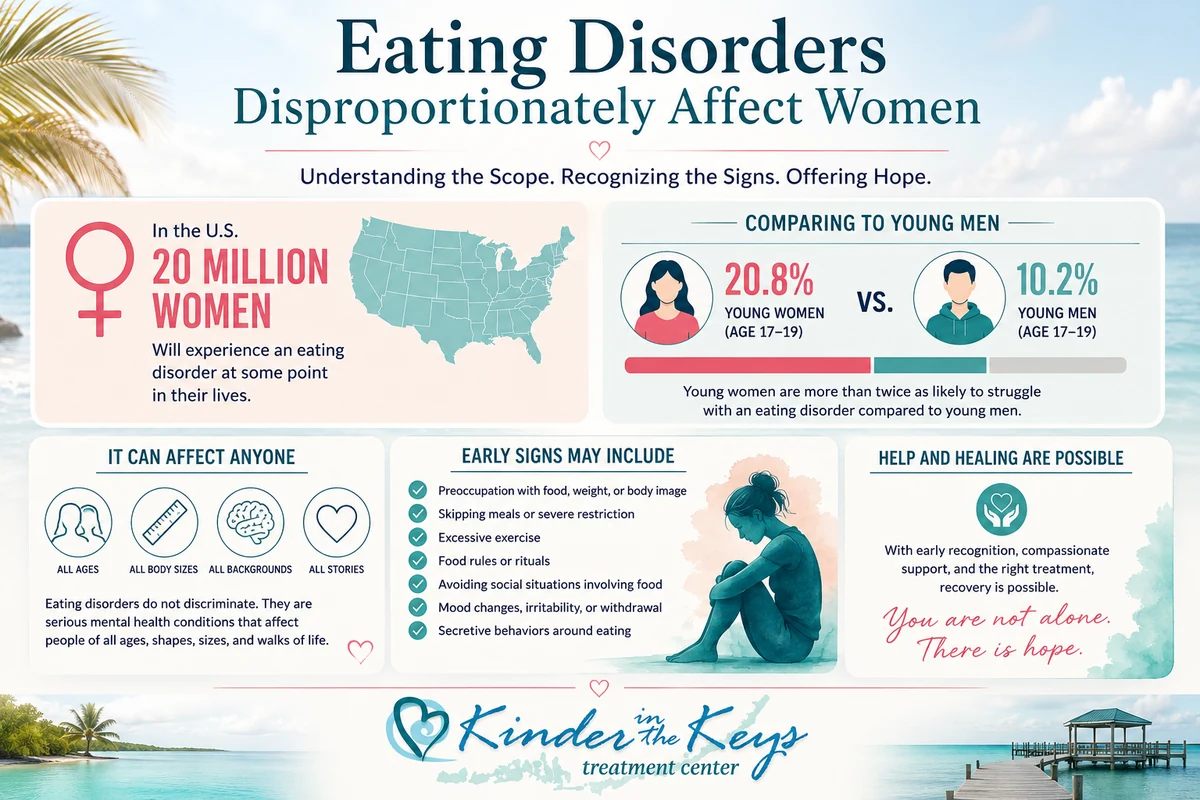
What Are the Early Signs of an Eating Disorder in Women?
There is no single behavior that proves someone has an eating disorder.
Instead, look for patterns and changes.
One skipped meal is not necessarily concerning. Neither is deciding to exercise more, changing dietary preferences, or wanting to improve nutrition.
The concern increases when behaviors become rigid, compulsive, secretive, emotionally charged, or progressively restrictive.
Early warning signs may include:
- Increasing preoccupation with food, calories, weight, body shape, or dieting
- Eliminating more and more foods or entire food groups
- Frequently skipping meals
- Eating very small portions
- Creating elaborate food rules or rituals
- Anxiety when preferred foods are unavailable
- Avoiding restaurants or social events involving food
- Exercising despite exhaustion, illness, pain, or injury
- Feeling guilty or distressed after eating
- Frequent weighing or body checking
- Comparing her body repeatedly with other women’s bodies
- Going to the bathroom immediately after meals
- Eating large quantities of food secretly
- Hiding food, wrappers, or evidence of eating
- Increasing isolation from friends or family
- Significant mood changes
- Becoming unusually defensive when someone expresses concern about eating
- Increasingly dividing foods into rigid categories such as “good,” “bad,” “clean,” or “forbidden”
These behaviors do not all occur in every eating disorder. Different eating disorders can present very differently.
The Woman May Not “Look Like” She Has an Eating Disorder
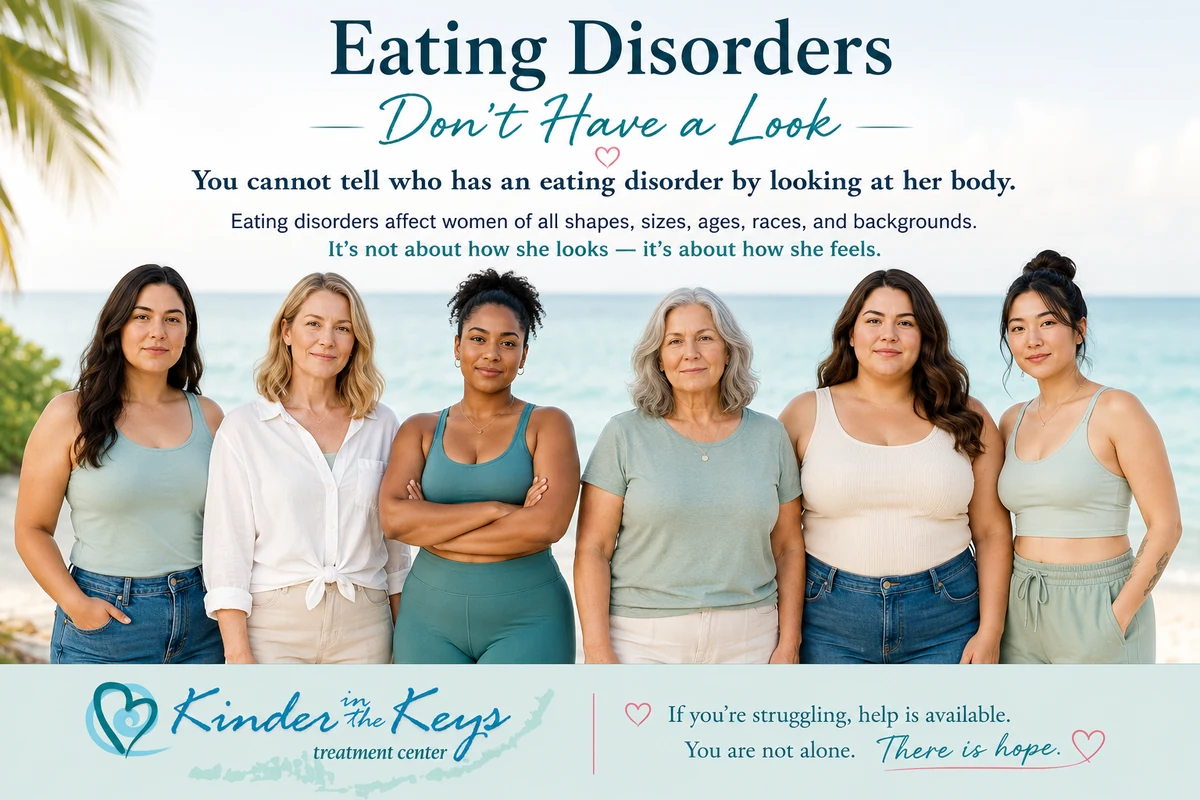
This is one of the most important misconceptions families need to understand.
You cannot reliably determine whether someone has an eating disorder by looking at her body.
A woman does not have to appear extremely thin.
She may have what others consider an “average” body weight. She may live in a larger body. Her weight may not initially attract anyone’s attention at all.
Yet her eating disorder may still be psychologically and medically serious.
A particularly important example is atypical anorexia nervosa.
A person with atypical anorexia can experience significant restriction, substantial weight loss, fear of weight gain, and body-image disturbance associated with anorexia without meeting the low-weight criterion associated with anorexia nervosa.
The absence of visible thinness should never be used to dismiss concerning eating-disorder behaviors.
Look for Change, Not Just Size
Ask:
How has her relationship with food changed?
How quickly has her weight changed, if at all?
How much of her day is being consumed by thoughts about food, weight, exercise, or her body?
Is she becoming less flexible?
Is the behavior interfering with relationships, work, health, or ordinary life?
Those questions may reveal much more than appearance alone.
When “Healthy Eating” Becomes Increasingly Rigid
Sometimes an eating disorder begins behind behaviors that initially appear healthy.
A woman may say:
“I just want to eat cleaner.”
“I don’t eat sugar anymore.”
“Carbs make you gain weight.”
“I already ate.”
“I’m not hungry.”
“I need to work off what I ate.”
None of those statements alone establishes an eating disorder.
What matters is what happens next.
Does one eliminated food become five?
Does avoiding dessert eventually become avoiding carbohydrates, fats, restaurant meals, family dinners, vacations, or anything she did not personally prepare?
Does missing a workout produce significant anxiety?
Does eating something outside the plan lead to guilt, compensatory exercise, restriction, or purging?
Healthy nutrition generally allows flexibility.
Increasing rigidity around food and exercise can be among the early signs of an eating disorder in women, particularly when these behaviors begin interfering with everyday life.
When food rules become increasingly rigid and begin controlling someone’s life, it deserves attention.
Food Begins Taking Up Too Much Mental Space
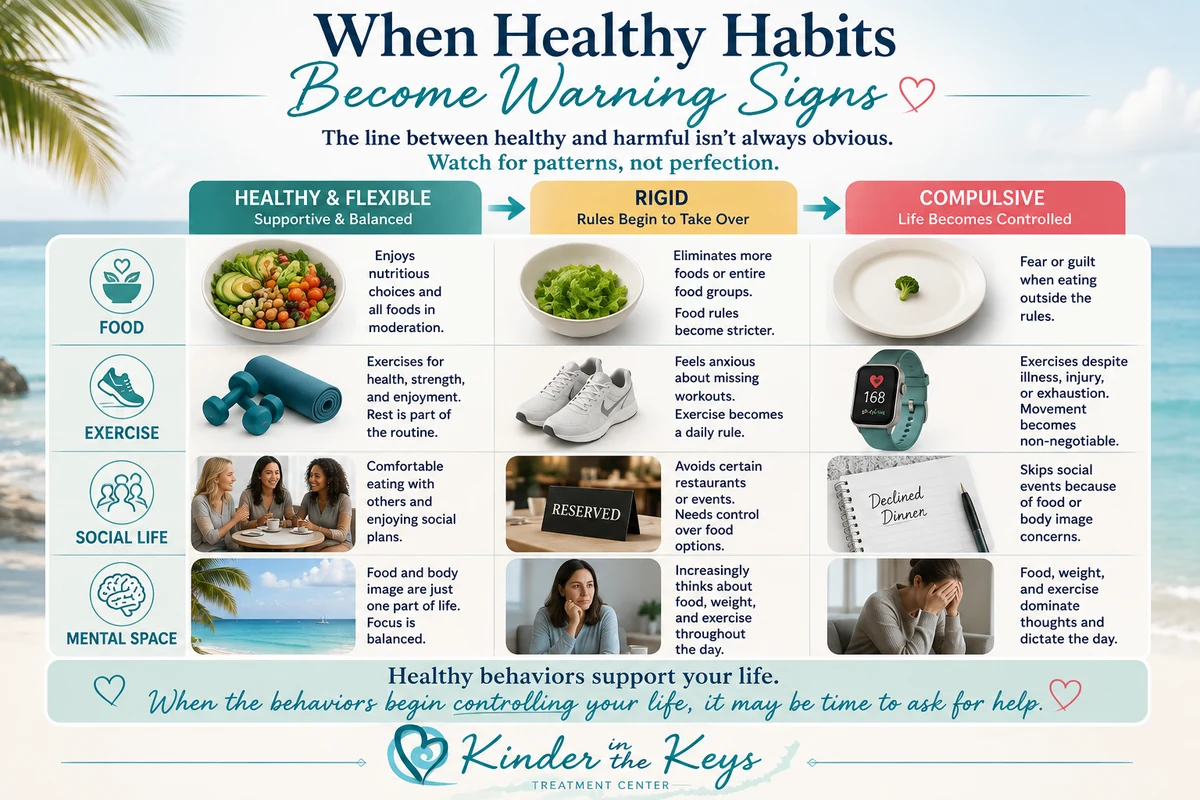
One of the subtler early signs is the amount of mental energy devoted to food.
A woman may spend substantial portions of her day:
- Planning meals
- Reading labels
- Calculating calories
- Researching ingredients
- Planning exercise
- Thinking about her next meal
- Thinking about her previous meal
- Feeling guilty about what she ate
- Trying to compensate for what she ate
- Checking her body
- Comparing herself with other women
- Thinking about losing weight
- Trying not to think about food
The issue is no longer simply what she eats.
Her relationship with food and her body is beginning to consume her attention.
Restriction and Skipping Meals
Restriction can be obvious, but it can also be disguised.
Someone may stop eating breakfast.
Then lunch becomes smaller.
She may claim she ate earlier.
She may begin preparing food for everyone else without eating herself.
She may insist she simply isn’t hungry.
She may eat normally in front of other people and restrict when alone.
Some women become increasingly skilled at making their eating appear normal.
That is why families should pay attention to patterns over time, rather than trying to determine what happened at one particular meal.
Food Rituals Can Be an Early Warning Sign
Eating may become increasingly ritualized.
Examples can include:
- Cutting food into extremely small pieces
- Eating foods in a particular order
- Taking an unusually long time to finish meals
- Requiring precise portions
- Repeatedly measuring or weighing food
- Refusing foods that touch one another
- Needing to know exactly how food was prepared
- Becoming distressed when expected food is unavailable
Again, an isolated preference is not an eating disorder.
The concern is increasing rigidity and distress.
Excessive or Compulsive Exercise
Exercise can be healthy.
Compulsive exercise is different.
The question is not simply:
How much does she exercise?
The more revealing question may be:
What Happens Emotionally If She Cannot Exercise?
Warning signs include exercising despite:
- Injury
- Illness
- Significant fatigue
- Medical advice to rest
- Dangerous weather
- Important family or social obligations
Exercise may also become a way of compensating for food.
“I ate too much, so I have to run.”
“I can’t miss today because of what I ate last night.”
“I need to burn this off.”
At that point, movement may no longer be primarily about health or enjoyment.
It has become connected to fear, guilt, control, or compensation.
Body Checking and Body Avoidance
Some women repeatedly check their bodies.
This may include:
- Frequently weighing themselves
- Looking at particular body parts in mirrors
- Pinching skin or measuring parts of the body
- Trying on the same clothing repeatedly to evaluate fit
- Taking frequent body-comparison photographs
- Seeking reassurance about appearance
- Comparing themselves with women online
Others do almost the opposite.
They may avoid mirrors, photographs, fitted clothing, intimacy, swimming, or situations in which they believe their bodies will be noticed.
Both patterns can reflect significant body-image distress.
Social Withdrawal Around Food
Changes in social behavior can therefore be among the early signs of an eating disorder in women that families notice before they recognize a problem with food itself.
Food is woven into social life.
Birthdays.
Restaurants.
Holidays.
Vacations.
Dates.
Work lunches.
Family dinners.
Celebrations.
When eating becomes frightening or highly controlled, a woman’s social world may begin shrinking.
She may decline invitations because she cannot control the menu.
She may eat before arriving.
She may say she is not hungry.
She may become anxious when someone changes restaurant plans.
Eventually, what initially looked like a food problem may become an isolation problem.
Secretive Behaviors Around Food
Secrecy is another important change.
Family members may notice:
- Food disappearing unexpectedly
- Food wrappers hidden in bedrooms, cars, bags, or trash
- Large quantities of food purchased privately
- Frequent trips to the bathroom after meals
- Eating alone when others are asleep
- Avoiding eating in front of others
- Unexplained use of laxatives, diuretics, or other methods intended to influence weight
Secretive binge eating may be accompanied by intense shame or distress afterward.
Bulimia nervosa can involve binge eating followed by behaviors intended to compensate for the binge, including vomiting, fasting, excessive exercise, or misuse of laxatives.
Binge-eating disorder involves recurrent episodes of eating unusually large amounts with a sense of lost control and distress, without the regular compensatory behaviors characteristic of bulimia.
Mood and Personality Changes Can Appear Before Families Recognize the Eating Disorder
These emotional and behavioral changes may also be early signs of an eating disorder in women, especially when they appear alongside increasing food rules, body concerns, or compulsive exercise. Families sometimes describe a woman as seeming like a different person.
She may become:
- More irritable
- More anxious
- More withdrawn
- More perfectionistic
- More emotionally reactive
- Less spontaneous
- Increasingly rigid
- Unable to concentrate
- Preoccupied
- Ashamed
- Depressed
The family may focus on the mood change without realizing that nutrition, eating-disorder thoughts, anxiety, and emotional distress are interacting.
Eating disorders also frequently occur alongside other mental health conditions, including depression and anxiety.
That means effective assessment should look at the whole woman, not simply her eating behavior.
Physical Signs Families Should Not Ignore
Physical symptoms can vary considerably.
Possible warning signs include:
- Dizziness or fainting
- Persistent fatigue
- Feeling unusually cold
- Weakness
- Difficulty concentrating
- Gastrointestinal complaints
- Constipation
- Changes in sleep
- Hair thinning or changes
- Dental problems
- Swelling around the jaw or salivary glands
- Menstrual changes in people who menstruate
- Noticeable or rapid changes in weight
Some eating disorders can cause serious cardiovascular, electrolyte, gastrointestinal, endocrine, dental, bone, and other medical complications.
Importantly, menstrual changes are not required for an anorexia diagnosis, and their absence should not be interpreted as evidence that someone is medically well.
Early Signs of Anorexia Nervosa
Anorexia nervosa involves significant restriction of food intake, intense fear of weight gain or persistent behaviors that interfere with weight gain, and disturbance in how body weight or shape is experienced.
Possible signs include:
- Increasing food restriction
- Fear of gaining weight
- Persistent drive for weight loss
- Disturbance in how body weight or shape is experienced
- Excessive exercise
- Food rituals
- Avoidance of meals
- Significant distress surrounding eating
Anorexia can have severe medical consequences and can be life-threatening.
Remember: a woman who is not at a low body weight may still have a serious restrictive eating disorder, including atypical anorexia.
Early Signs of Bulimia Nervosa
Bulimia may be particularly difficult for families to recognize because many behaviors occur privately.
Possible warning signs include:
- Recurrent binge eating
- Feeling unable to control eating during binges
- Going to the bathroom shortly after meals
- Self-induced vomiting
- Misuse of laxatives or other compensatory methods
- Fasting after eating
- Excessive exercise intended to compensate for food
- Shame or secrecy surrounding eating
- Dental changes
- Swelling around the jaw or salivary glands
- Gastrointestinal complaints
A woman with bulimia may not appear underweight.
Early Signs of Binge-Eating Disorder
Binge-eating disorder is not simply “overeating.”
Possible signs include recurrent episodes involving unusually large amounts of food accompanied by a sense of loss of control.
A woman may:
- Eat very rapidly
- Eat when she is not physically hungry
- Continue until she feels uncomfortably full
- Eat alone because of embarrassment
- Feel significant guilt, shame, or distress afterward
Unlike bulimia, binge-eating disorder does not involve regular compensatory behaviors such as purging after binge episodes.
What About ARFID?
Not every eating disorder is driven by weight or body-image concerns.
Avoidant/restrictive food intake disorder (ARFID) involves restriction in the amount or variety of food consumed for reasons that may include sensory sensitivity, lack of interest in food, or fear of consequences such as choking or vomiting.
The restriction can lead to nutritional deficiency, weight loss, dependence on supplements, or significant interference with daily functioning.
That distinction matters because someone can have a serious restrictive eating disorder without wanting to lose weight.
Why Eating Disorders Can Be Missed in Adult Women
Recognizing the early signs of an eating disorder in women requires looking beyond body size and paying attention to changes in behavior, flexibility, emotional wellbeing, and daily functioning.
Eating disorders are often culturally associated with adolescents and young women.
But eating disorders are not confined to one age group.
Adult women may have established careers, marriages, children, caregiving responsibilities, and years of experience concealing distress.
A behavior can also become normalized over time.
A woman may have dieted for decades.
She may have spent years criticizing her body.
She may have repeatedly lost and regained weight.
She may have learned to describe restrictive behaviors as “discipline.”
And because dieting and dissatisfaction with women’s bodies are so normalized culturally, significant pathology can hide in plain sight.
The question is not whether a woman has ever wanted to lose weight.
The question is whether thoughts and behaviors involving food, weight, exercise, or body image have become rigid, distressing, compulsive, medically concerning, or disruptive to her life.
Eating Disorders Are About More Than Food
Food may be where the disorder becomes visible.
But treatment often requires understanding what lies beneath the behavior.
For some women, eating-disorder symptoms become intertwined with:
- Trauma
- Anxiety
- Depression
- Perfectionism
- Shame
- Control
- Relationship difficulties
- Low self-worth
- Emotional avoidance
- Chronic stress
This does not mean every woman with an eating disorder has trauma or that one psychological issue causes all eating disorders.
Eating disorders are complex conditions influenced by biological, psychological, behavioral, and social factors.
It does mean that treatment should assess more than food intake alone.
Trauma and Eating Disorders
For some women, trauma is an important part of the clinical picture.
Food restriction, bingeing, purging, compulsive exercise, or attempts to control the body can become connected with emotional regulation, shame, safety, dissociation, or attempts to regain a sense of control.
When trauma and an eating disorder occur together, treating only the visible food behavior may leave important drivers of distress unaddressed.
At the same time, trauma treatment must be appropriately timed and coordinated with nutritional and medical stabilization.
The Link Between Trauma and Eating Disorders
When Should a Family Become Concerned?
Do not wait until you can prove that someone has an eating disorder.
You do not need to diagnose her.
You need to notice that something has changed.
Concern is reasonable when:
- Eating behaviors are becoming increasingly restrictive
- Food or exercise causes significant anxiety
- She is withdrawing from people or activities
- She is repeatedly bingeing or purging
- Her health appears to be changing
- Her thoughts about food or her body dominate her day
- She is unable to reduce behaviors despite wanting to
- The behavior is interfering with relationships, work, physical health, or emotional functioning
A professional assessment can help determine what is happening.
How to Talk to a Woman You Are Concerned About
Approach the conversation with concern rather than accusation.
Instead of:
“You barely eat anymore.”
“You’re getting too thin.”
“You look fine. Why are you worried about your weight?”
“Just eat.”
Try:
“I’ve noticed that eating seems to be causing you a lot of anxiety lately, and I’m concerned about you.”
Or:
“I’ve noticed you’ve stopped coming to dinner with us and you’re exercising even when you’re exhausted. I wanted to ask how you’re doing.”
Focus on observable changes and wellbeing, rather than debating whether her body looks healthy.
You may not receive an immediate admission that something is wrong.
That does not mean the conversation was pointless.
When Eating-Disorder Symptoms Require Urgent Medical Attention
Eating disorders can cause serious medical complications.
Symptoms such as fainting, significant weakness, severe dehydration, confusion, chest symptoms, or other signs of acute medical instability warrant prompt medical assessment.
Purging behaviors can also cause dangerous electrolyte disturbances.
When there is concern about medical stability, the appropriate first step may be an emergency department, hospital, or other medical setting rather than a behavioral-health residential program.
The correct level of care depends on the woman’s medical and psychiatric condition.
What Does Effective Eating-Disorder Treatment Involve?
Treatment should be individualized.
Depending on diagnosis and severity, care may include:
- Medical evaluation and monitoring
- Nutritional rehabilitation and counseling
- Psychotherapy
- Psychiatric care when indicated
- Treatment of co-occurring depression, anxiety, trauma, or other conditions
- Family involvement when appropriate
Different levels of care may be needed at different stages, ranging from outpatient treatment to more intensive programs or hospitalization.
When Residential Treatment May Be Appropriate
Residential treatment may be considered when a woman needs more structure and support than outpatient care can provide but does not require acute medical hospitalization.
The decision should be based on a comprehensive assessment.
At Kinder in the Keys, treatment for women with eating-disorder symptoms is approached within the broader context of mental health. When appropriate for our level of care, this means looking at the relationship between eating behaviors and concerns such as trauma, anxiety, depression, emotional regulation, self-worth, relationships, and patterns of coping—not reducing a woman’s experience to food or weight alone.
Eating Disorder Treatment at Kinder in the Keys
Women’s Trauma Treatment Center
Early Recognition Creates an Opportunity to Intervene
Families sometimes hesitate because they are afraid of overreacting.
But noticing a concerning pattern does not require labeling someone.
It simply means paying attention.
The early signs of an eating disorder in women may appear long before an illness becomes obvious to everyone around her.
A shrinking list of acceptable foods.
A workout she cannot miss.
A family dinner she suddenly avoids.
A body she checks repeatedly.
A meal followed immediately by a trip to the bathroom.
A life that is gradually becoming organized around food, weight, exercise, or fear.
Those changes deserve attention.
Because the goal is not to wait until a woman looks sick enough to receive help.
The goal is to recognize when her relationship with food, her body, or exercise is beginning to take control of her life—and intervene before the disorder takes more from her.
Medically Reviewed By
Dr. Laura Tanzini, DrPH, LMFT
Doctor of Public Health | Specialty in Lifestyle Medicine
Licensed Marriage and Family Therapist (Florida & California)
Founder & CEO, Kinder in the Keys
This article has been clinically reviewed for accuracy and consistency with current behavioral health and trauma-informed treatment principles. It is intended to provide educational information and help women and families recognize when professional assessment may be appropriate.
Medical Disclaimer
This article is for educational and informational purposes only and is not intended to diagnose, treat, cure, or prevent any medical or mental health condition.
Eating disorders can cause serious and potentially life-threatening medical complications. Anyone experiencing concerning symptoms should seek evaluation from an appropriately qualified healthcare professional. Emergency or medically unstable symptoms require immediate medical evaluation.