
Getting Help When Health Anxiety Is Controlling Your Life
Occasional concern about your health is normal. Health anxiety becomes more concerning when fear about illness begins controlling how you spend your time, make decisions, use healthcare, or participate in everyday life. Some of the most important signs of hypochondriasis are not the individual health fears themselves, but how much time, attention, and behavior those fears begin to control.
You may need professional support when health worries:
-
Consume a significant amount of your day
-
Interfere with work, school, relationships, or sleep
-
Lead to repeated body checking
-
Cause you to repeatedly search symptoms or diseases online
-
Lead to frequent requests for reassurance from family, friends, or healthcare providers
-
Continue despite appropriate medical evaluation and reassuring findings
-
Cause you to repeatedly seek medical testing or appointments
-
Cause you to avoid healthcare because you are afraid of what might be discovered
-
Lead you to avoid activities because you fear they could harm your health
-
Occur alongside panic attacks, depression, obsessive thoughts, or other significant mental health symptoms
Recognizing the signs of hypochondriasis does not mean deciding that your physical symptoms are imaginary.
The goal is to recognize when fear about illness has itself become a source of significant distress and impairment.
How Is Illness Anxiety Disorder Treated?
Illness anxiety disorder is treatable.
Treatment should begin with an individualized evaluation because health anxiety can overlap with other conditions, and people can experience legitimate medical problems at the same time they experience excessive health-related anxiety.
Cognitive Behavioral Therapy
Cognitive behavioral therapy, or CBT, is one of the psychological treatments commonly used for illness anxiety disorder.
CBT can help identify the connection between:
Physical sensation → interpretation → anxiety → behavior → temporary relief → renewed anxiety
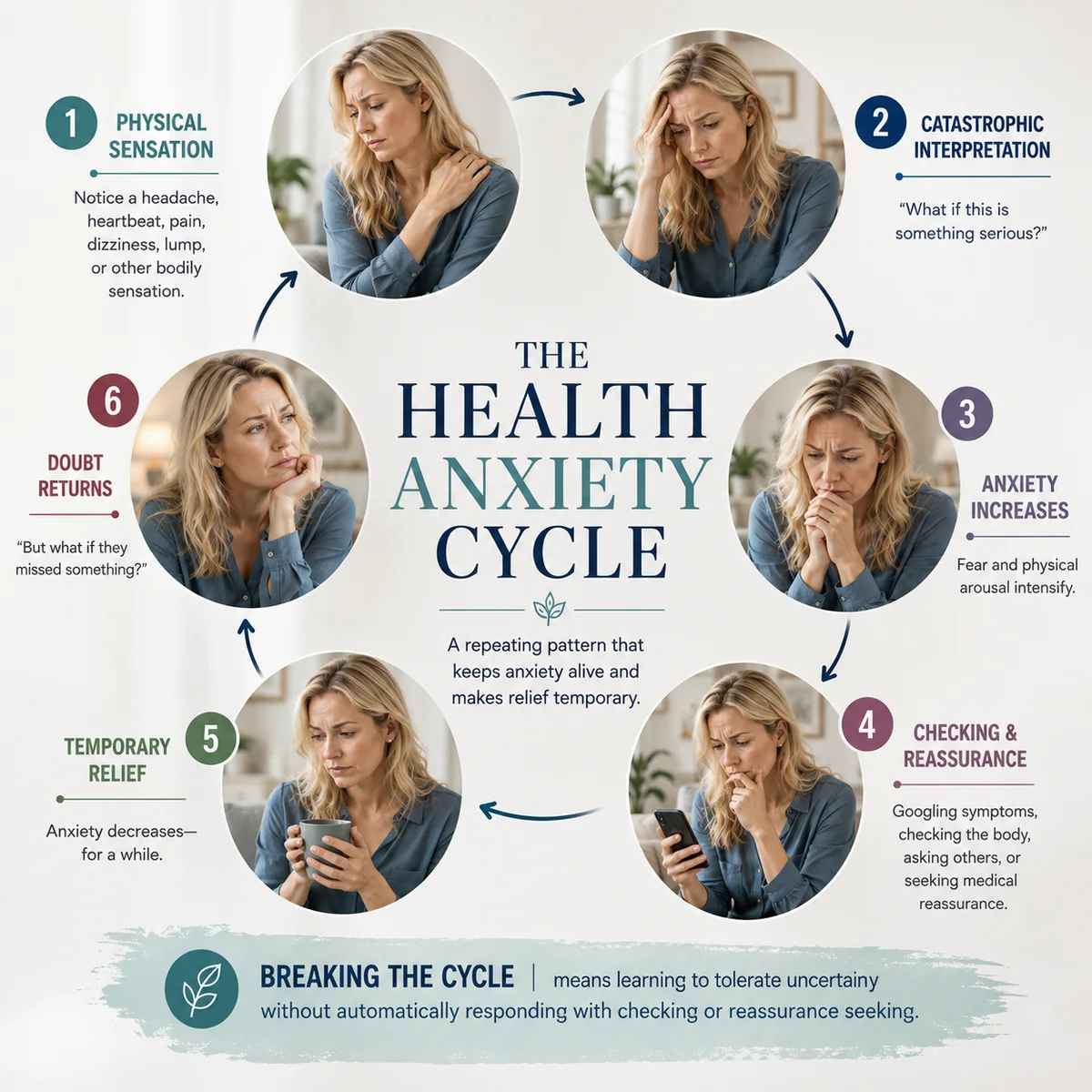
For example, someone notices a headache.
The automatic thought may be:
“What if I have a brain tumor?”
Anxiety increases.
She searches brain-tumor symptoms online, repeatedly checks how her pupils look, asks her partner whether she seems different, and schedules another medical appointment.
For a short period, reassurance may reduce the fear.
Then another sensation appears—or she begins doubting the reassurance—and the cycle starts again.
Treatment is not about convincing someone that nothing bad can ever happen to her.
It is about helping her respond differently to uncertainty, physical sensations, catastrophic interpretations, checking behaviors, and reassurance seeking.
Reducing Reassurance-Seeking and Checking Behaviors

This part of treatment can initially feel uncomfortable. Repeated reassurance seeking and body checking can therefore become important signs of hypochondriasis when they are driven by persistent fear of serious illness.
If checking your body or asking for reassurance temporarily lowers anxiety, stopping those behaviors may make anxiety increase at first.
Researchers have experimentally studied this pattern. In one study, people with hypochondriasis were exposed to personally relevant health concerns and then either performed safety behaviors such as checking or refrained from doing them. Checking produced more immediate relief, while people who refrained from the safety behaviors experienced a more gradual natural reduction in anxiety and the urge to check.
That helps explain why reassurance can become so difficult to stop.
The relief is real.
But it may be temporary.
A larger study of treatment-seeking patients with anxiety disorders and OCD also found that reassurance seeking was associated with anxiety symptoms and that reductions in reassurance seeking during cognitive behavioral therapy were associated with clinical improvement.
Repeatedly responding to fear with checking can teach the brain:
“I was only safe because I checked.”
The next physical sensation then produces another urge to check.
Treatment can help a woman gradually tolerate uncertainty without automatically responding with another search, another body check, or another request for reassurance.
Coordinated Medical Care
Appropriate medical care remains important.
One useful strategy for some people with significant health anxiety is having consistent care with a healthcare professional who understands both the medical history and the anxiety pattern.
That can help reduce fragmented care in which someone repeatedly visits different providers seeking certainty that no illness has been missed.
The purpose is not to deny medical evaluation.
It is to create a thoughtful approach in which new or changing symptoms receive appropriate attention without every ordinary physical sensation automatically triggering another cycle of emergency investigation.
Medication
Medication may be appropriate for some people, particularly when illness anxiety occurs alongside another anxiety disorder, depression, panic symptoms, or other mental health concerns.
Medication decisions should be individualized and made with an appropriately qualified prescribing professional.
Medication is not automatically necessary for everyone with illness anxiety disorder.
How Family Members Can Help With Health Anxiety

Health anxiety can affect an entire family. Family members are often among the first people to recognize the signs of hypochondriasis because they see the repeated questions, symptom checking, online research, and requests for reassurance.
Someone may repeatedly ask:
“Do you think this looks swollen?”
“Does my breathing sound strange?”
“Are you sure this headache isn’t serious?”
“Can you look at this spot again?”
A family member naturally wants to provide reassurance.
The problem is that reassurance may provide only temporary relief and unintentionally become part of the health-anxiety cycle.
That does not mean family members should become cold or dismissive.
Instead of repeatedly saying:
“I promise you don’t have anything wrong with you,”
a family member might say:
“I can see that you’re really frightened right now. What have you and your therapist discussed about responding when this fear comes up?”
That validates the distress without pretending the family member can provide medical certainty.
Family members can also encourage appropriate professional treatment, maintain reasonable boundaries, and avoid spending hours participating in repeated symptom searches or body checks.
Can Illness Anxiety Disorder Occur With Other Mental Health Conditions?
Yes.
Illness anxiety disorder can occur alongside other mental health conditions, including anxiety disorders and depression.
But similar behaviors can also appear in other diagnoses.
That is one reason self-diagnosis based on an online symptom list can be misleading.
Illness Anxiety Disorder and OCD
Illness anxiety and obsessive-compulsive disorder can sometimes look similar because both may involve intrusive fears and repetitive behaviors intended to reduce distress.
A person with OCD may have health-related obsessions and compulsions, but OCD can involve many other themes as well.
The diagnosis depends on the broader pattern of symptoms rather than the presence of one particular fear.
Illness Anxiety Disorder and Panic Disorder
Panic disorder can also produce intense concern about physical sensations.
A racing heart, dizziness, shortness of breath, trembling, or chest sensations during a panic attack may be interpreted as evidence of a serious medical emergency.
The clinical pattern, however, differs from persistent preoccupation with having or developing a serious disease.
Illness Anxiety Disorder and Depression
Depression can also affect how someone interprets physical symptoms and health concerns.
When significant health anxiety and depression occur together, treatment should address the entire clinical picture rather than assuming one diagnosis explains everything.
When Is Residential Treatment Appropriate for Severe Health Anxiety?
Most people who recognize signs of hypochondriasis or meet criteria for illness anxiety disorder do not require residential mental health treatment.
Many people can be treated successfully through outpatient psychotherapy and appropriate medical care.
A higher level of care may become appropriate when anxiety is severe enough to substantially impair daily functioning, outpatient treatment has not provided sufficient support, significant co-occurring mental health conditions complicate treatment, or anxiety and avoidance have made ordinary life increasingly difficult to manage.
For example, a woman may reach a point where she:
-
Can no longer work because she is constantly monitoring symptoms
-
Repeatedly visits healthcare facilities despite appropriate evaluations
-
Avoids leaving home because she fears becoming ill
-
Experiences severe panic alongside health fears
-
Has significant depression or another co-occurring condition
-
Cannot disengage from checking, researching, or reassurance-seeking behaviors
-
Has not been able to make progress with a less intensive level of treatment
At that point, treatment needs may extend beyond reassurance about one feared illness.
At Kinder in the Keys, our women’s anxiety treatment center provides residential mental health treatment for adult women whose anxiety and related symptoms require greater structure and support than traditional outpatient treatment can provide.
Frequently Asked Questions About Hypochondriasis and Illness Anxiety Disorder
These frequently asked questions address common signs of hypochondriasis and explain how those symptoms are understood within the modern diagnosis of illness anxiety disorder.
Is hypochondriasis still a diagnosis?
Hypochondriasis is an older diagnostic term.
The DSM-5 replaced the previous diagnosis of hypochondriasis with illness anxiety disorder and somatic symptom disorder, depending on the individual’s symptoms and clinical presentation.
People still commonly search for terms such as hypochondria and signs of hypochondriasis, so those terms remain useful when explaining the modern diagnoses.
What are common signs of hypochondriasis?
Common signs of hypochondriasis may include persistent fear of having or developing a serious illness, repeatedly checking the body, frequently researching symptoms, repeatedly seeking reassurance, difficulty accepting appropriate medical reassurance, excessive healthcare use, or avoiding medical care because of fear.
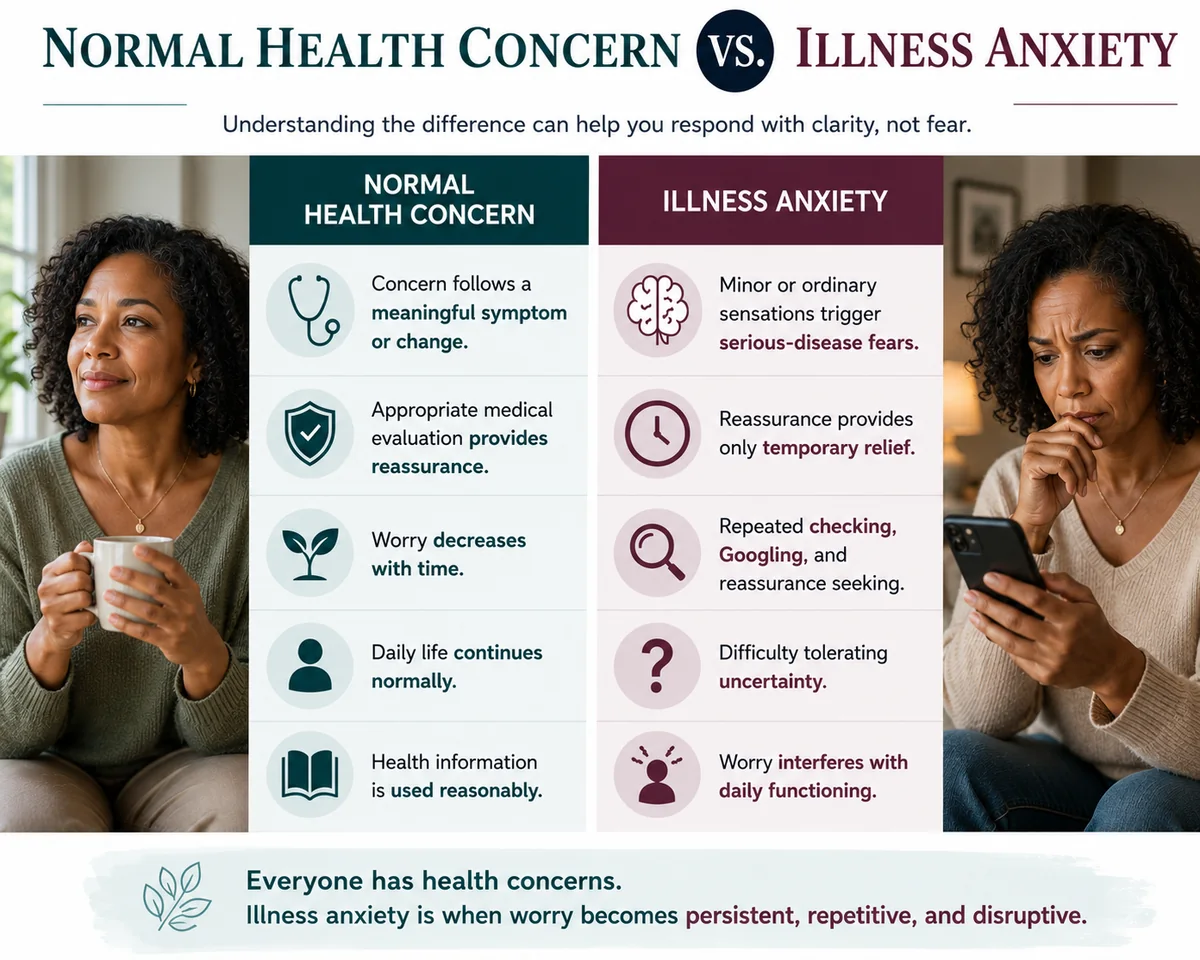
The important issue is not simply worrying about health. It is the persistence, intensity, and impact of the anxiety.
Is illness anxiety disorder the same as faking an illness?
No.
A person with illness anxiety disorder is not simply pretending to be afraid.
The anxiety and distress are real.
The problem involves how physical sensations and health information are interpreted and how the person responds to uncertainty about health.
Can someone have illness anxiety disorder and a real medical condition?
Yes.
Having health anxiety does not make someone immune to physical illness.
A person can have both a legitimate medical condition and excessive anxiety about health.
Healthcare professionals should evaluate physical symptoms appropriately rather than automatically attributing them to anxiety simply because someone has a mental health diagnosis.
Why doesn’t reassurance make health anxiety go away?
Reassurance often provides temporary relief.
The problem is that the relief may reinforce the habit of seeking reassurance whenever anxiety rises.
Eventually another sensation or doubt appears, and reassurance is needed again.
Treatment can help a person develop different ways of responding to uncertainty and fear.
Can constantly Googling symptoms make health anxiety worse?
It can.
Searching for health information is not inherently unhealthy, but repeatedly researching symptoms in an attempt to eliminate uncertainty can become part of the health-anxiety cycle.
Online searches can also expose someone to rare or frightening diagnoses that may increase catastrophic thinking.
Is illness anxiety disorder treatable?
Yes.
Psychotherapy—particularly cognitive behavioral approaches—can help people change patterns of catastrophic interpretation, checking, reassurance seeking, avoidance, and other behaviors that maintain health anxiety.
Treatment should be individualized based on the person’s symptoms, medical history, co-occurring conditions, and level of impairment.
Moving Beyond the Fear of Being Sick
Living with health anxiety can be exhausting. For someone experiencing persistent signs of hypochondriasis, ordinary physical sensations can begin to feel like evidence that something serious has been overlooked.
A headache becomes a possible tumor.
A racing heart becomes a cardiac emergency.
A swollen lymph node becomes cancer.
A normal laboratory result brings relief—but perhaps only until the next physical sensation appears.
The problem is not that the person is foolish or intentionally dramatic.
The fear feels real.
But a life organized around repeatedly proving that you are not sick can gradually become a life dominated by illness—even when the feared disease is not present.
Understanding the signs of hypochondriasis can help distinguish persistent health anxiety from ordinary concern about physical health.
Recognizing the signs of hypochondriasis can therefore be the beginning of understanding a much more useful question:
Has fear about my health begun controlling my life?
If the answer is yes, treatment does not require ignoring your body or pretending illness is impossible.
It involves learning how to take reasonable care of your physical health without allowing uncertainty about health to control your thoughts, behaviors, relationships, and daily life.
For women whose anxiety has become severe enough to interfere substantially with functioning, professional mental health treatment can help address the anxiety itself rather than continuing an endless search for absolute medical certainty.
Medically Reviewed By
Dr. Laura Tanzini, DrPH, LMFT
Doctor of Public Health | Specialty in Lifestyle Medicine
Licensed Marriage and Family Therapist (Florida & California)
Founder & CEO, Kinder in the Keys
Doctoral Research: Dr. Tanzini’s doctoral research at Loma Linda University examined childhood and adult traumatic events, cumulative trauma exposure, gender, forgiveness, life satisfaction, and long-term well-being.
This article has been clinically reviewed for accuracy and consistency with current behavioral health and trauma-informed care principles. Content is intended to provide general educational information and should not replace individualized evaluation, diagnosis, or treatment by a qualified healthcare professional.
Medical Disclaimer: The information provided in this article is for educational and informational purposes only and is not intended as medical advice, diagnosis, or treatment. Physical symptoms should be evaluated appropriately by a qualified healthcare professional. If health-related anxiety, checking, reassurance seeking, avoidance, or other mental health symptoms are significantly interfering with daily life, seek evaluation from a qualified mental health professional.