
How to Help a Family Member with Depression or Anxiety: 7 Practical Tips
Knowing how to help a family member with depression or anxiety can be difficult. You may see someone you love withdrawing, struggling to function, worrying constantly, avoiding situations, or simply seeming unlike herself.
You want to help.
But you may also be afraid of saying the wrong thing, pushing too hard, enabling avoidance, or making the situation worse.
Family support cannot replace professional mental health treatment, but it can matter enormously. A supportive family member can listen without judgment, help reduce practical barriers to treatment, encourage appropriate professional care, recognize when symptoms are becoming more serious, and remain connected without trying to become the person’s therapist.
Depression and anxiety are different conditions, and they do not always require the same response. Understanding those differences is an important part of learning how to support someone effectively.
Quick Takeaways
Depression and anxiety are mental health conditions, not character flaws or choices.
Listening is often more useful than immediately offering advice.
Depression may cause withdrawal, low motivation, hopelessness, fatigue, and loss of interest.
Anxiety may cause excessive worry, avoidance, reassurance seeking, panic, irritability, or physical symptoms.
Practical assistance can reduce barriers when ordinary tasks have become overwhelming.
Support should not turn into taking over someone’s life or becoming her therapist.
Encourage professional treatment without trying to control the treatment plan.
Any concerning signs of suicide risk should be taken seriously.
Family members need boundaries and support too.
Depression and Anxiety Can Look Very Different at Home
Before deciding how to help a family member with depression, it helps to understand what you may actually be seeing.
Depression does not always look like visible sadness.
A person with depression may become quiet, irritable, exhausted, emotionally flat, indecisive, or increasingly disconnected from activities and relationships she previously enjoyed.
Common symptoms can include:
Persistent sadness, emptiness, or low mood
Loss of interest or pleasure
Fatigue or reduced energy
Difficulty concentrating or making decisions
Changes in sleep
Changes in appetite or weight
Irritability
Feelings of worthlessness or excessive guilt
Withdrawal from other people
Hopelessness
Thoughts about death or suicide
Anxiety can look quite different.
Someone with an anxiety disorder may appear constantly worried, restless, tense, irritable, fearful, or unable to relax. She may repeatedly seek reassurance, avoid places or situations that frighten her, have difficulty sleeping, or experience physical symptoms such as muscle tension, stomach discomfort, sweating, trembling, dizziness, or a racing heart.
Women’s Anxiety Treatment Center
Anxiety can also lead to avoidance.
A woman may stop driving because she fears a panic attack.
She may avoid social situations because she fears being judged.
She may repeatedly ask family members for reassurance because uncertainty feels intolerable.
These behaviors can be confusing to family members who do not understand what is driving them.
Depression and anxiety can also occur together, which may make the clinical picture more complicated.
Tip 1: Learn What You’re Actually Dealing With
Learning how to help a family member with depression begins with recognizing that symptoms may look different from what family members expect.
One of the first steps in learning how to help a family member with depression or anxiety is understanding that these conditions involve much more than simply being sad or worried.
Depression can affect motivation, cognition, sleep, appetite, energy, relationships, physical functioning, and a person’s ability to experience pleasure.
Anxiety disorders involve more than ordinary worry. Anxiety can become persistent, excessive, difficult to control, and disruptive enough to interfere with work, relationships, social activities, sleep, or everyday responsibilities.
Reliable mental health information can help family members distinguish clinical symptoms from behaviors they may otherwise interpret as laziness, weakness, selfishness, stubbornness, or attention seeking.
Good sources include:
National Alliance on Mental Illness (NAMI)
Substance Abuse and Mental Health Services Administration (SAMHSA)
What Not to Say to Someone With Depression or Anxiety
Good intentions do not guarantee that words will be helpful.
Try to avoid statements such as:
“You have so much to be grateful for.”
“Other people have it worse.”
“Just stop worrying.”
“You need to think positively.”
“You just need to push through it.”
“There’s nothing to be afraid of.”
“Why can’t you just do it?”
“You need to get over this.”
These statements may unintentionally communicate that the person’s symptoms should be easy to control.
A better approach is curiosity.
Instead of:
“Why are you doing this?”
try:
“Can you help me understand what this feels like for you?”
That change may seem small, but it shifts the conversation from judgment to understanding.
Tip 2: Listen More Than You Speak
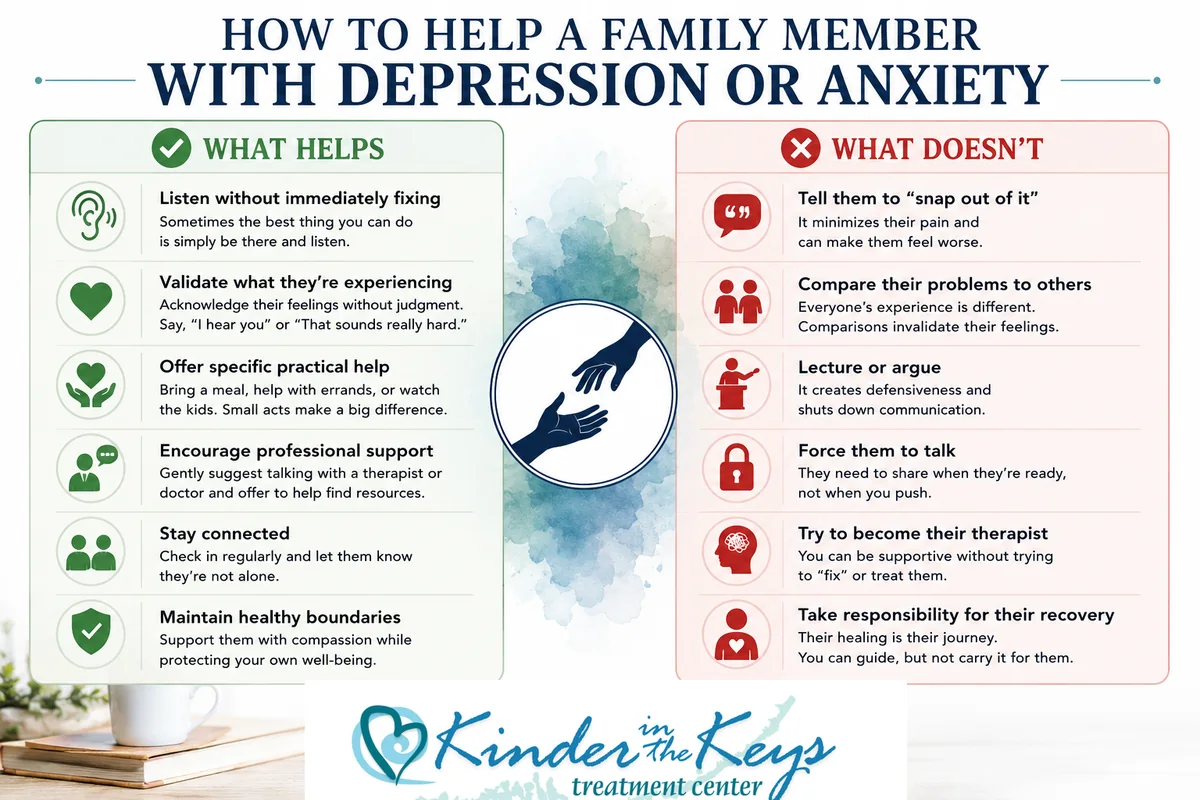
When someone is struggling emotionally, family members often feel pressure to fix the problem.
That instinct makes sense.
You love the person. You see her suffering. You want the suffering to stop.
But listening is not the same as doing nothing.
Giving someone your full attention without immediately correcting, lecturing, diagnosing, comparing, or solving can provide something important: a place where she does not have to defend what she is experiencing.
You might say:
“I’m here. You don’t have to figure everything out right now.”
Or:
“I may not completely understand what this feels like, but I want to understand.”
Or simply:
“Do you want me to listen, or do you want help thinking through what to do next?”
That last question can be particularly useful because it distinguishes emotional support from problem solving.
Validation Does Not Mean Agreeing With Everything
There is an important distinction between validating an emotion and agreeing with every conclusion someone draws from that emotion.
Someone with anxiety might say:
“If I go to that meeting, everyone will think I’m incompetent.”
You do not have to respond:
“Yes, they probably will.”
But:
“I can see how anxious you are about being judged”
acknowledges the emotional experience without reinforcing the feared conclusion.
Similarly, someone with depression might say:
“I’m completely useless.”
You can acknowledge the pain without agreeing with the belief:
“It sounds like you’re feeling incredibly defeated right now.”
Support does not require reinforcing distorted or hopeless thinking. When learning how to help a family member with depression, listening without immediately trying to solve the problem can be one of the most meaningful forms of support.
Tip 3: Offer Specific, Practical Support

When depression or anxiety becomes severe, ordinary tasks can require an extraordinary amount of effort.
Depression may reduce energy and motivation.
Anxiety may make decisions feel overwhelming.
Instead of saying:
“Let me know if you need anything,”
offer something concrete.
For example:
“I’m going to the grocery store. Can I pick something up for you?”
“Would it help if I drove you to your appointment?”
“I can sit with you while you make the phone call.”
“Would you like me to help you make a list of therapists?”
“I’m making dinner. I’ll bring you some if you’d like.”
“Would it help if I came over while you tackle some laundry?”
Specific offers remove the additional burden of figuring out what to request.
Help Without Taking Over
There is also a boundary here.
Helping someone accomplish something is different from assuming responsibility for everything in her life.
If family members begin handling every task, making every decision, calling every provider, managing every appointment, and preventing the person from experiencing any discomfort, support can gradually turn into overfunctioning.
This can become particularly complicated with anxiety.
Avoidance often provides immediate relief from anxiety, which makes avoidance very tempting.
A family member may therefore want to protect the person from anything uncomfortable.
But if a clinician is helping someone gradually confront anxiety-provoking situations as part of treatment, family members repeatedly helping her escape those situations may unintentionally work against that treatment.
The goal is support without replacing the person’s own agency.
Understanding how to help a family member with depression often means offering concrete assistance rather than waiting for someone who is already overwhelmed to ask for help.
Tip 4: Gently Encourage Professional Help
Family members can provide love, stability, practical help, and encouragement.
They cannot provide professional mental health treatment simply because they care deeply.
If symptoms are persistent, worsening, or interfering with daily functioning, encourage an evaluation by a qualified mental health professional.
You might say:
“I’ve noticed you’ve been having a really hard time lately. Would you be willing to talk with someone who understands this?”
Or:
“If finding someone feels overwhelming, I can help you look.”
Kinder also has an original depression self-assessment that can help someone reflect on symptoms and decide whether a professional evaluation may be appropriate.
A self-assessment is educational. It does not diagnose depression.
If Your Family Member Is Already in Treatment
Support the treatment process without trying to become the treatment provider.
That may mean:
Providing transportation if requested
Participating in family sessions when invited
Helping with practical barriers to attending appointments
Respecting privacy around therapy
Encouraging the person to discuss concerns about medication or side effects with her prescriber
Supporting treatment recommendations without attempting to manage them yourself
Medication decisions belong between the patient and the qualified prescribing professional.
Family members can be supportive without monitoring, policing, or changing medications themselves.
Treatment for depression or anxiety may involve psychotherapy, medication, lifestyle interventions, or a combination of approaches depending on the individual.
Part of learning how to help a family member with depression is recognizing when loving support is no longer enough and professional evaluation or treatment may be needed.
Knowing how to help a family member with depression also means understanding that family support and professional treatment serve different roles.
Tip 5: Know When Symptoms May Signal a Crisis
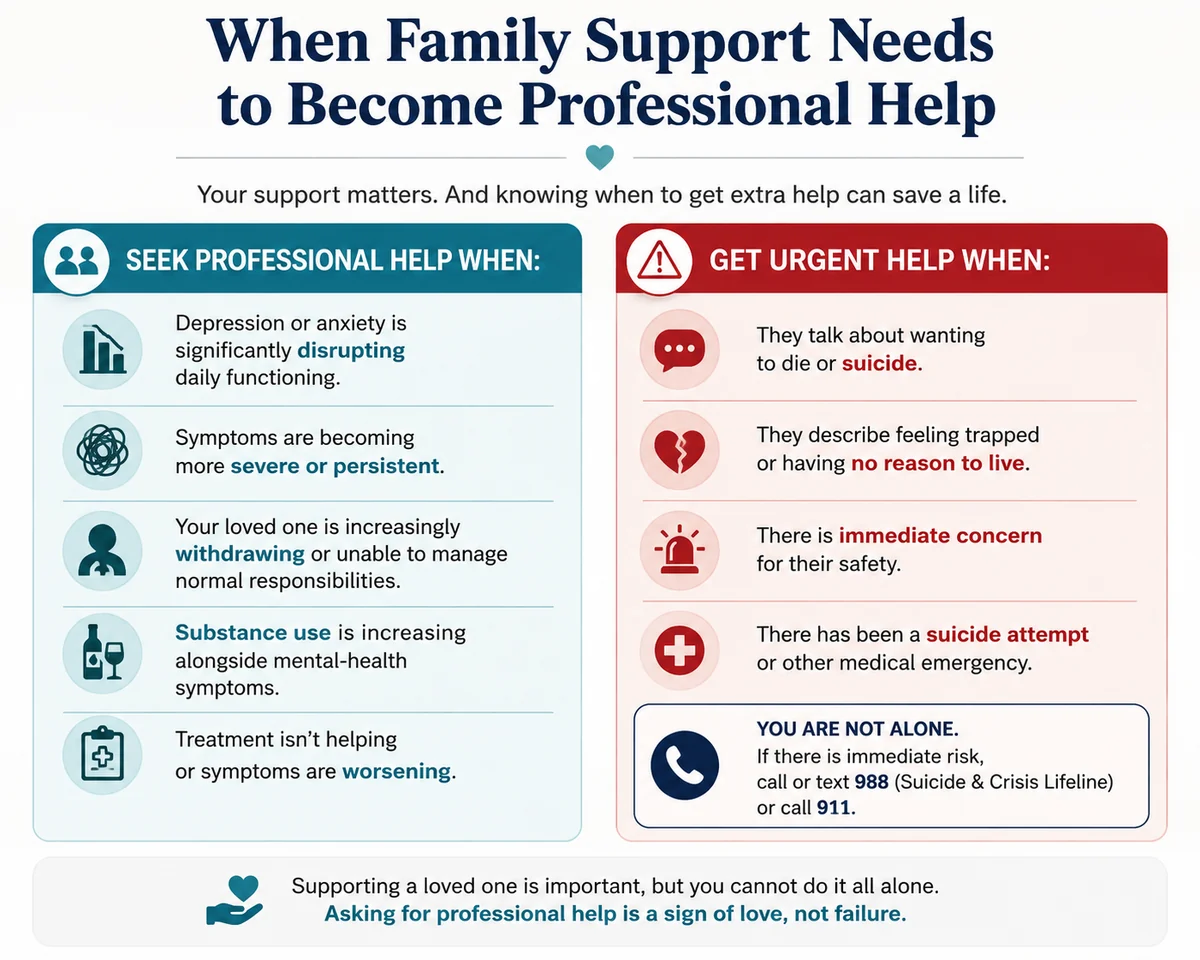
Most people with depression or anxiety are not in immediate danger.
But family members should know how to recognize warning signs that require urgent attention.
The National Institute of Mental Health identifies suicide warning signs that can include:
Talking about wanting to die
Expressing hopelessness or feeling there is no reason to live
Talking about being a burden to others
Feeling trapped or in unbearable emotional or physical pain
Making a plan or researching ways to die
Giving away important possessions
Saying goodbye unexpectedly
Withdrawing significantly from others
Taking dangerous risks
Showing extreme mood swings
Increasing alcohol or drug use
Warning signs deserve particular attention when they are new, increasing, or occurring after a painful event, loss, or major change.
Ask Directly About Suicide
If you are concerned, it is appropriate to ask directly.
You can say:
“Are you thinking about suicide?”
or:
“Are you thinking about killing yourself?”
Asking directly does not put the idea of suicide into someone’s head. Research reviewed by NIMH indicates that asking about suicidal thoughts does not cause or increase them.
If someone appears to be in immediate danger, has attempted suicide, or has a specific plan and access to lethal means, seek emergency assistance rather than attempting to manage the situation alone.
Knowing how to help a family member with depression also means taking changes in suicide risk seriously and knowing when ordinary family support needs to become immediate professional intervention.
Tip 6: Protect Your Own Well-Being and Maintain Boundaries
Learning how to help a family member with depression also means understanding what you cannot control.
You cannot recover for another person.
You cannot guarantee that she follows every treatment recommendation.
You cannot prevent every difficult emotion.
And you cannot sustainably provide support if your own physical and emotional health is deteriorating.
Healthy boundaries might include:
Being realistic about how much practical help you can provide
Maintaining your own relationships and activities
Continuing to work, sleep, exercise, and care for your health
Declining abusive or destructive behavior even when someone is struggling
Seeking your own therapy when needed
Participating in family support programs
Refusing to keep dangerous secrets involving suicide or serious safety concerns
Boundaries are not abandonment.
They define what you can offer while recognizing that another adult remains responsible for participating in her own treatment and recovery.
Learning how to help a family member with depression also includes understanding your own limits, maintaining healthy boundaries, and recognizing that you cannot take responsibility for another person’s recovery.
Tip 7: Stay Connected Without Making Recovery Your Responsibility
Mental health recovery is not always a straight line.
Someone may improve significantly and later experience a difficult period.
Symptoms can fluctuate.
Treatment may need adjustment.
A setback does not necessarily mean treatment has failed, but meaningful worsening of symptoms should be discussed with the person’s treatment provider.
Your role is not to guarantee a particular outcome.
Your role may simply be to remain a steady, appropriate presence.
Keep inviting.
Keep checking in.
Notice progress without demanding it.
Allow ordinary conversations that have nothing to do with mental illness.
Your family member is still a whole person.
She may have depression.
She may have anxiety.
But she is not only her diagnosis.
Understanding how to help a family member with depression is not about finding one perfect conversation or solution. Consistent support, appropriate boundaries, and encouragement toward treatment can matter over time.
Depression and Anxiety May Require Different Types of Support
Although many principles of family support apply to both conditions, some differences matter.
| What You May Notice | Depression | Anxiety | Helpful Family Response |
|---|---|---|---|
| Withdrawal | Low energy, loss of interest, hopelessness | Avoidance of feared situations | Check in without shaming or forcing |
| Reassurance seeking | May seek confirmation of worth or hopeless beliefs | May repeatedly seek certainty about feared outcomes | Be supportive without endlessly feeding reassurance cycles |
| Daily tasks | May feel physically or mentally exhausting | May feel overwhelming because of fear or uncertainty | Offer specific, limited practical help |
| Social activity | May lack interest or energy | May fear judgment, panic, embarrassment, or loss of control | Encourage connection while respecting the treatment plan |
| Treatment resistance | Hopelessness may make treatment seem pointless | Fear or avoidance may make treatment itself intimidating | Reduce practical barriers and encourage professional evaluation |
| Physical symptoms | Fatigue, sleep/appetite changes, aches | Muscle tension, racing heart, sweating, trembling, GI symptoms | Take symptoms seriously without trying to diagnose them yourself |
Understanding the reason behind a behavior often changes how family members respond to it.
How Your Role May Change During Treatment
Your family member’s needs may change over time.
| Stage | What She May Need | How Family Can Help | What to Avoid |
|---|---|---|---|
| Not yet in treatment | Information, encouragement, reduced barriers | Help identify qualified providers or make initial contact if requested | Lecturing, diagnosing, threats |
| Beginning treatment | Patience and logistical support | Transportation, scheduling help, participation in family sessions when invited | Expecting immediate improvement |
| Active treatment | Stability and appropriate encouragement | Respect treatment boundaries and reinforce healthy routines | Becoming the therapist or controlling treatment |
| Improvement/maintenance | Normalcy, autonomy, continued connection | Stay engaged while allowing independence | Assuming treatment is no longer necessary |
| Symptoms worsening | Reassessment and additional professional support | Encourage contact with the treatment team | Assuming the person simply isn’t trying hard enough |
Frequently Asked Questions About How to Help a Family Member With Depression or Anxiety
How do I talk to a family member about depression without making things worse?
Choose a private, relatively calm moment.
Lead with what you have observed rather than announcing a diagnosis.
For example:
“I’ve noticed you haven’t seemed like yourself lately, and I’ve been concerned about you. How are you doing?”
Then listen.
You do not need to have the perfect response.
How do I help a family member with anxiety?
Listen without dismissing the fear, but avoid automatically reorganizing the entire family’s life around preventing anxiety.
Encourage appropriate professional treatment when anxiety is persistent or interfering with daily functioning.
For someone already receiving treatment, ask what kind of support is actually helpful rather than assuming.
What if my family member refuses treatment?
Unless there is a situation involving immediate safety or another circumstance where intervention is legally warranted, adults generally make their own healthcare decisions.
You can express concern, provide information, offer practical help, and maintain boundaries.
You can also seek professional guidance for yourself about how to respond.
Should I keep reassuring someone with anxiety?
Occasional reassurance is part of normal relationships.
But repeated reassurance can sometimes become part of an anxiety cycle in which the person temporarily feels better and then needs reassurance again when uncertainty returns.
If this is happening frequently, ask the person’s therapist how family members can support treatment without reinforcing the cycle.
How do I know whether depression is becoming dangerous?
Pay attention to statements about wanting to die, hopelessness, being a burden, feeling trapped, planning suicide, giving away possessions, saying goodbye, major behavioral changes, increasing substance use, or other significant changes.
When you are concerned, ask directly about suicide and seek professional or emergency assistance when appropriate.
When Outpatient Support Is No Longer Enough
Many people with depression and anxiety receive effective treatment in outpatient settings.
Residential treatment is not necessary for everyone.
A higher level of care may be considered when symptoms have become severe enough to substantially impair daily functioning, outpatient treatment has not provided enough support, multiple conditions are complicating recovery, or a woman needs greater structure and clinical support than can reasonably be provided at home.
At Kinder in the Keys, we provide residential mental health treatment for adult women in Key Largo, Florida.
Our programs address depression, anxiety, trauma-related conditions, and other mental health concerns through individualized treatment within a structured environment.
Family support remains important, but family members should not be expected to substitute for a treatment team.
You Don’t Have to Have All the Answers
Ultimately, how to help a family member with depression is less about having perfect answers and more about offering informed, consistent support while respecting the limits of your role.
Learning how to help a family member with depression or anxiety does not mean learning how to become a psychologist, psychiatrist, nurse, or crisis professional.
You do not need all the answers.
You can listen.
You can learn.
You can offer specific practical help.
You can encourage appropriate treatment.
You can recognize when something exceeds what family support can safely provide.
And you can maintain boundaries while still loving someone who is struggling.
Sometimes the most meaningful message a family member can communicate is simply:
“I care about you. I’m here. And we can find the right help for this.
Medically Reviewed By
Dr. Laura Tanzini, DrPH, LMFT
Doctor of Public Health | Specialty in Lifestyle Medicine
Licensed Marriage and Family Therapist (Florida & California)
Founder & CEO, Kinder in the Keys
Doctoral Research: Dr. Tanzini’s doctoral research at Loma Linda University examined childhood and adult traumatic events, cumulative trauma exposure, gender, forgiveness, life satisfaction, and long-term well-being.
This article has been clinically reviewed for accuracy and consistency with current behavioral health and trauma-informed care principles. Content is intended to provide general educational information and should not replace individualized evaluation, diagnosis, or treatment by a qualified healthcare professional.
Medical Disclaimer: The information provided in this article is for educational and informational purposes only and is not intended as medical advice, diagnosis, or treatment. Mental health needs vary by individual. If you are concerned about depression, anxiety, suicidal thoughts, or another mental health condition in yourself or a loved one, seek evaluation from a qualified healthcare professional.