
Common eating disorders in women can look very different from one another. Some involve severe restriction of food, others involve binge eating or compensatory behaviors, and others involve avoidance that has little or nothing to do with weight or body image.
Eating disorders are mental health conditions that can also have significant physical consequences. They are not simply diets that have gone too far, problems with willpower, or choices someone can stop making once she understands the health risks.
For women, the psychological picture can include anxiety, perfectionism, trauma, shame, difficulty with emotional regulation, body-image concerns, rigid thinking, relationship patterns, and issues involving autonomy or control. But there is no single personality type or psychological explanation shared by every woman with an eating disorder.
Understanding the differences among eating disorders matters because appropriate treatment depends on the diagnosis, severity, medical status, nutritional needs, psychological factors, and individual woman.
At Kinder in the Keys, women with eating-disorder symptoms must be medically stable and clinically appropriate for our program. Women who require medical stabilization or a specialized higher level of eating-disorder care should receive treatment in a program equipped to provide that level of care.
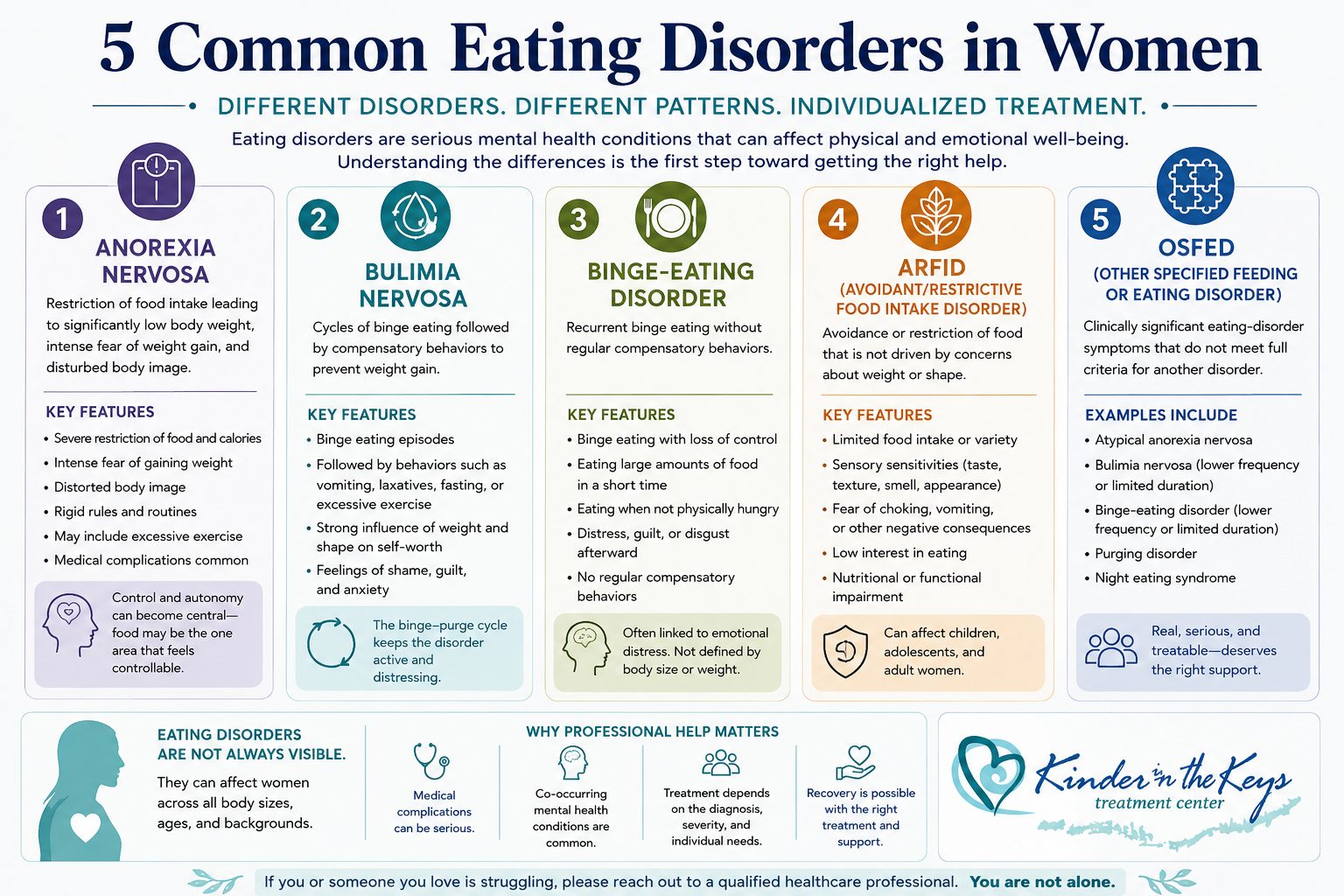
1. Anorexia Nervosa
Anorexia nervosa is an eating disorder characterized by restriction of energy intake resulting in significantly low body weight, along with an intense fear of gaining weight or persistent behavior that interferes with weight gain and disturbances in how body weight or shape is experienced or evaluated.
A woman with anorexia may severely restrict food, eliminate entire categories of food, develop increasingly rigid rules around eating, exercise excessively, or become intensely preoccupied with weight, shape, calories, or food.
Importantly, amenorrhea is not required for a diagnosis of anorexia nervosa.
Signs of Anorexia Nervosa
Signs can include:
Significant restriction of food intake
Significantly low body weight
Intense fear of weight gain
Persistent behaviors that interfere with weight gain
Preoccupation with food, calories, weight, or body shape
Rigid food rules or rituals
Excessive or compulsive exercise
Difficulty recognizing the seriousness of low body weight
Social withdrawal around meals or food
Fatigue or weakness
Feeling cold frequently
Dizziness or fainting
Gastrointestinal complaints
Changes in hair, skin, or nails
Anorexia can become medically dangerous.
A woman with significant restriction, rapid or substantial weight loss, fainting, cardiovascular symptoms, electrolyte abnormalities, severe dehydration, or other evidence of medical instability may require specialized eating-disorder treatment or medical stabilization before psychological treatment can safely proceed at another level of care.
Control, Autonomy, and Anorexia
From a psychological perspective, control can become an important part of anorexia for some women.
Food may begin as one area of life that feels controllable.
Restricting intake, controlling weight, maintaining rigid routines, exercising according to strict rules, or deciding exactly what can and cannot be eaten can create a temporary sense of predictability or mastery.
For some women, the eating disorder eventually becomes one of the few areas in which she feels:
“This belongs to me.”
“Nobody else gets to control this.”
“This is the one thing I can control.”
That does not mean a woman consciously chooses anorexia because she wants control.
Eating disorders are far more complicated than that.
But understanding what the behaviors have come to represent psychologically can be important in treatment.
Family Dynamics May Be Relevant
Family relationships can also be clinically relevant for some women with anorexia.
Some women describe growing up within highly controlling, perfectionistic, critical, emotionally restrictive, or achievement-focused family environments.
In some cases, a parent—including sometimes the mother—may have exercised substantial control over decisions, appearance, achievement, food, relationships, or independence.
For a woman who has struggled to develop autonomy, controlling food or her body may become intertwined with independence, self-definition, perfectionism, or resistance to external control.
But this distinction is important:
A controlling mother does not cause anorexia.
Families should not be blamed for the development of an eating disorder.
Anorexia develops through a complex interaction of biological vulnerability, psychological characteristics, environmental influences, relationships, experiences, and other factors.
Family dynamics should be explored when they are relevant to the individual woman, not assumed to exist simply because she has anorexia.
2. Bulimia Nervosa
Bulimia nervosa involves recurrent episodes of binge eating followed by recurrent behaviors intended to prevent weight gain.
A binge-eating episode involves consuming an unusually large amount of food within a particular period while experiencing a sense of loss of control over eating.
Compensatory behaviors may include:
Self-induced vomiting
Misuse of laxatives or diuretics
Fasting
Excessive exercise
Other inappropriate attempts to compensate for eating
Self-evaluation is also disproportionately influenced by body shape and weight.
Unlike anorexia nervosa, women with bulimia may be at a wide range of body weights, which can make the disorder less visible to other people.
The Binge-Purge Cycle
Bulimia can develop into a powerful behavioral and emotional cycle.
A woman may restrict food or attempt to control eating rigidly.
A binge occurs.
She experiences fear, guilt, shame, or distress.
She then attempts to compensate for what she ate.
That compensation may temporarily reduce anxiety about weight gain but reinforces the cycle.
The process begins again.
This is one reason simply telling someone to “stop purging” or “eat normally” does not adequately address bulimia.
Treatment needs to address the behaviors, nutritional patterns, thoughts, emotions, and psychological processes maintaining the disorder.
Medical Risks of Bulimia
Purging behaviors can cause serious medical complications.
Depending on the behaviors involved, complications can include electrolyte abnormalities, dehydration, gastrointestinal problems, dental damage, esophageal irritation, and cardiovascular complications.
A woman’s outward appearance cannot tell us whether bulimia is medically serious.
Medical assessment is important when purging is frequent, physical symptoms are present, or medical stability is uncertain.
3. Binge-Eating Disorder
Binge-eating disorder involves recurrent binge-eating episodes accompanied by a sense of loss of control.
Unlike bulimia nervosa, binge-eating disorder does not involve regular compensatory behaviors such as self-induced vomiting or fasting intended to prevent weight gain.
During binge episodes, a woman may:
Eat much more rapidly than usual
Eat until feeling uncomfortably full
Eat large amounts when not physically hungry
Eat alone because of embarrassment
Experience disgust, depression, or guilt afterward
The emotional experience is important.
Binge-eating disorder is not simply “overeating.” The National Institute of Diabetes and Digestive and Kidney Diseases distinguishes occasional overeating from binge-eating disorder by the recurrent loss of control and pattern of binge episodes associated with the disorder.
People occasionally eat more than they intended. That alone does not constitute an eating disorder.
With BED, binge episodes are recurrent and associated with significant distress.
Restriction Can Be Part of the Picture
Some women with binge-eating disorder have histories of repeated dieting or significant food restriction.
Rigid attempts to control food can sometimes contribute to patterns in which hunger, deprivation, emotional distress, or restrictive thinking become part of a binge cycle.
But not every woman with BED has the same history or the same triggers.
Treatment therefore should not assume that all binge eating has one psychological cause.
BED Is Not Defined by Body Size
Binge-eating disorder can occur across body sizes.
Body weight alone does not diagnose BED, nor does a higher body weight mean someone has an eating disorder.
Treatment should focus on the eating-disorder symptoms and the woman’s physical and psychological health rather than reducing the problem to weight.
4. Avoidant/Restrictive Food Intake Disorder (ARFID)
Avoidant/Restrictive Food Intake Disorder, or ARFID, involves persistent restriction or avoidance of food that results in significant nutritional or functional consequences.
Unlike anorexia nervosa, ARFID is not driven by concerns about gaining weight or by disturbance in body shape or weight perception.
A woman with ARFID may restrict food because of:
Very low interest in eating
Sensitivity to texture, taste, smell, temperature, or appearance
Fear of choking
Fear of vomiting
Previous frightening experiences involving food
Other concerns about negative consequences of eating
ARFID is frequently discussed in children, but adults can have ARFID as well.
Some adult women have struggled with restrictive food patterns for many years before realizing that their difficulties have a recognized clinical framework.
ARFID Can Become Medically Significant
Depending on severity, ARFID can result in nutritional deficiency, significant weight loss, reliance on nutritional supplementation, or substantial interference with social and everyday functioning.
A woman who cannot meet her nutritional needs safely may require specialized eating-disorder or medical care.
The absence of body-image concerns does not make ARFID less serious.
5. Other Specified Feeding or Eating Disorder (OSFED)
Not every clinically significant eating disorder fits neatly into the full diagnostic criteria for anorexia nervosa, bulimia nervosa, binge-eating disorder, or ARFID.
Other Specified Feeding or Eating Disorder (OSFED) is a diagnostic category used when significant eating-disorder symptoms cause distress or impairment but the presentation does not meet all criteria for another specified eating disorder.
Examples can include presentations involving:
Atypical anorexia nervosa
Bulimia nervosa of lower frequency or limited duration
Binge-eating disorder of lower frequency or limited duration
Purging disorder
Night eating syndrome
Atypical Anorexia Nervosa
Atypical anorexia deserves particular attention because the word “atypical” can be misleading.
A woman may meet the psychological and behavioral features of anorexia nervosa and experience significant weight loss without having a body weight classified as significantly low.
That does not mean the disorder is mild.
Women with atypical anorexia can experience serious psychological distress and medical complications.
This is one reason eating disorders should never be assessed solely by looking at someone’s body.
Because eating disorders are not always obvious from appearance or body size, recognizing the early signs of an eating disorder in women can help identify concerning changes before symptoms become more severe.
The National Institute of Mental Health describes eating disorders as serious illnesses that can affect physical and mental health and recognizes anorexia nervosa, bulimia nervosa, binge-eating disorder, and ARFID among the common types.
What About Orthorexia?
The term orthorexia is commonly used to describe an increasingly rigid or obsessive preoccupation with eating foods perceived as healthy, pure, clean, or correct.
A woman may gradually eliminate more foods, experience significant anxiety when preferred foods are unavailable, avoid social situations involving food, or attach increasing moral value to what she eats.
The behavior may begin under the appearance of health.
The problem emerges when the pursuit of healthy eating becomes so rigid that it harms nutritional adequacy, psychological well-being, relationships, or everyday functioning.
However:
Orthorexia is not currently a standalone diagnosis in the DSM-5-TR.
That does not mean clinically concerning behaviors should be ignored.
It means a qualified professional should assess the woman’s symptoms and determine whether they are better understood within another eating-disorder diagnosis or another clinical condition.
Eating Disorders Are Not Always Visible
One of the most harmful misconceptions about eating disorders is that someone must look sick to have one.
She does not.
Women with eating disorders can exist across the full range of body sizes.
A woman may have severe bulimia without anyone around her knowing.
Another may have binge-eating disorder while appearing outwardly functional.
A woman with atypical anorexia may have experienced substantial restriction and dangerous weight loss without ever reaching a stereotypically low body weight.
Appearance is not a reliable measure of psychological severity or medical stability.
Eating Disorders Often Occur With Other Mental Health Conditions
Eating disorders can occur alongside:
Anxiety disorders
Depression
PTSD
Trauma-related symptoms
Obsessive-compulsive symptoms
Substance-use problems
Other psychiatric conditions
Co-occurring conditions can complicate assessment and treatment.
For example, a woman may use restriction to manage anxiety or experience binge eating during periods of intense emotional distress.
Another woman may have trauma-related symptoms that interact with body image, control, trust, or emotional regulation.
For women whose trauma history is clinically relevant, understanding the connection between trauma and eating disorders can help explain how control, avoidance, emotional regulation, body image, or other patterns may interact without assuming trauma caused the eating disorder.
But the presence of trauma does not mean trauma caused the eating disorder.
Treatment should determine which conditions are actually present and how they interact for the individual woman.
Eating Disorders Require Medical as Well as Psychological Attention
Eating disorders are mental health conditions, but they can have serious physical consequences.
Depending on the diagnosis and severity, assessment may need to consider:
Weight and weight trajectory
Vital signs
Hydration
Electrolytes
Cardiovascular functioning
Gastrointestinal symptoms
Nutritional deficiencies
Menstrual or reproductive changes
Medication use
Purging behaviors
Exercise patterns
Other medical complications
Psychotherapy alone is not sufficient when a woman is medically unstable.
That is why determining the appropriate level of care is essential.
The American Psychiatric Association’s eating-disorder treatment guideline recommends comprehensive assessment of eating behaviors, weight history, compensatory behaviors, medical status, co-occurring psychiatric conditions, vital signs, laboratory findings when indicated, and the individual’s overall treatment needs.
Treatment Depends on the Eating Disorder
There is no single therapy that is the universal “gold standard” for every eating disorder and every woman.
Treatment depends on the diagnosis, age, medical status, severity, behaviors, co-occurring conditions, previous treatment, and individual needs.
Depending on the clinical presentation, treatment may involve:
Psychotherapy
Nutritional intervention
Medical monitoring
Psychiatric care
Family involvement when appropriate
Behavioral interventions
Treatment of co-occurring mental health conditions
A specialized eating-disorder level of care when necessary
Different psychotherapies have evidence for different eating disorders and populations.
For example, CBT-based approaches have substantial evidence for several eating-disorder presentations, while family-based treatment has an important evidence base particularly for adolescents with certain eating disorders.
The treatment plan should follow the diagnosis and the patient—not a generic list of eating-disorder therapies.
When a Higher Level of Eating-Disorder Care Is Needed
Some women need care beyond what a general residential mental health program can safely provide.
A specialized eating-disorder program or medical setting may be necessary when there is:
Medical instability
Significant malnutrition
Serious electrolyte abnormalities
Concerning cardiovascular findings
Severe or frequent purging
Inability to maintain adequate nutrition
Need for intensive meal supervision or nutritional rehabilitation
Other significant medical complications
A clinical presentation requiring specialized eating-disorder treatment
Choosing a higher level of care is not a failure.
It means matching treatment intensity and medical resources to the woman’s needs.
Eating-Disorder Treatment at Kinder in the Keys
Kinder in the Keys is a residential mental health treatment center for adult women in Key Largo, Florida.
We can work with eating-disorder symptoms when a woman is medically stable and her clinical needs are appropriate for our program.
Kinder is not an acute medical stabilization unit or a specialized hospital-level eating-disorder program.
When a woman’s eating disorder requires intensive medical management, significant nutritional rehabilitation, or another specialized level of eating-disorder care, we believe she should receive treatment in a setting designed to provide it.
For appropriate women, treatment can address the psychological and behavioral factors associated with eating-disorder symptoms while also considering co-occurring concerns such as depression, anxiety, trauma, relationships, control, self-worth, and emotional regulation.
The goal is not simply to tell a woman what she should or should not eat.
It is to understand what function the eating-disorder behaviors have taken on in her life and what needs to change for recovery to become possible.
5 Common Eating Disorders in Women: Frequently Asked Questions
What are the most common eating disorders in women?
Common eating-disorder diagnoses include anorexia nervosa, bulimia nervosa, binge-eating disorder, ARFID, and presentations diagnosed within OSFED. The prevalence of individual disorders varies, and eating disorders can affect women of different ages and body sizes.
Is anorexia always about wanting to be thin?
No. Weight and shape concerns are central to many presentations of anorexia nervosa, but the psychological picture can also involve rigidity, perfectionism, anxiety, autonomy, and control. Each woman’s experience needs individual assessment.
Is anorexia caused by controlling parents?
No. A controlling parent does not cause anorexia. Family dynamics can be clinically relevant for some women, including experiences involving control, criticism, perfectionism, or difficulty developing autonomy, but anorexia is a complex disorder with multiple interacting influences.
Can adults have ARFID?
Yes. Although ARFID is frequently discussed in children and adolescents, adults can also meet criteria for the disorder.
Is orthorexia an eating disorder?
Orthorexia is a commonly used term describing an unhealthy or obsessive preoccupation with eating foods perceived as healthy or pure. It is not currently a standalone DSM-5-TR diagnosis, although the behaviors can become clinically significant and warrant professional assessment.
Can you have anorexia without being underweight?
A person whose presentation resembles anorexia but whose weight is not significantly low may meet criteria for atypical anorexia nervosa, which falls under OSFED. Atypical anorexia can still be medically and psychologically serious.
Does everyone with an eating disorder need residential treatment?
No. The appropriate level of care depends on diagnosis, severity, medical stability, behaviors, functioning, and treatment needs. Some women can receive outpatient treatment, while others require specialized residential, inpatient, or medical care.
Does Kinder treat severe eating disorders?
Kinder can work with eating-disorder symptoms when an adult woman is medically stable and clinically appropriate for the program. Women requiring medical stabilization, intensive nutritional rehabilitation, or another specialized eating-disorder level of care should receive treatment in an appropriately equipped program.
Understanding the Disorder Before Choosing Treatment
Eating disorders share certain features, but they are not interchangeable.
Anorexia is not bulimia.
Bulimia is not binge-eating disorder.
ARFID is not simply picky eating.
OSFED is not an insignificant or “less serious” eating disorder.
And orthorexic behaviors should not be transformed into a formal diagnosis that does not currently exist.
Understanding which eating disorder is present, what behaviors are occurring, whether the woman is medically stable, and what psychological factors are maintaining the disorder is essential before deciding what treatment is appropriate.
The diagnosis matters.
The medical picture matters.
And most importantly, the individual woman matters.
Medically Reviewed By
Dr. Laura Tanzini, DrPH, LMFT
Doctor of Public Health | Specialty in Lifestyle Medicine
Licensed Marriage and Family Therapist (Florida & California)
Founder & CEO, Kinder in the Keys
This article has been clinically reviewed for accuracy and consistency with evidence-based behavioral health and eating-disorder principles. It is intended to provide educational information about eating disorders in adult women and does not replace individualized assessment, diagnosis, medical evaluation, or treatment by qualified healthcare professionals.
Medical Disclaimer
This article is for educational and informational purposes only and is not intended to diagnose, treat, cure, or prevent an eating disorder or any other medical or mental health condition.
Eating disorders can cause serious medical complications. Women experiencing significant restriction, purging, rapid or substantial weight changes, fainting, cardiovascular symptoms, severe dehydration, or other concerning symptoms should seek appropriate medical evaluation.