
Work can be stressful, exhausting, frustrating, and sometimes overwhelming. But work-related PTSD is different from ordinary job stress or burnout.
Post-traumatic stress disorder (PTSD) can develop when a person is exposed to actual or threatened death, serious injury, sexual violence, or certain forms of repeated or extreme exposure to traumatic events. In some professions, that exposure occurs as part of the job.
First responders may repeatedly arrive at scenes involving serious injuries or death. Healthcare professionals may witness traumatic medical events. Military personnel may experience combat or other life-threatening situations. Law enforcement officers, firefighters, emergency personnel, crisis workers, and others may encounter trauma repeatedly over the course of a career.
For some people, those experiences do not simply disappear when the workday ends.
Work-related PTSD can affect sleep, relationships, concentration, emotional regulation, physical health, and the ability to continue functioning at work.
Understanding the difference between occupational stress and occupational trauma is the first step toward getting the right kind of help
What Is Work-Related PTSD?
Work-related PTSD, sometimes described as occupational PTSD, refers to PTSD that develops following qualifying traumatic exposure connected to a person’s work.
PTSD is not simply the result of having a demanding career.
The National Center for PTSD explains that qualifying trauma exposure can include directly experiencing or witnessing traumatic events as well as repeated or extreme exposure to aversive details of traumatic events during professional duties, such as the exposure experienced by some first responders and medics.
That distinction matters.
A toxic supervisor, excessive workload, difficult coworkers, long hours, job insecurity, or chronic workplace pressure can seriously affect mental health. Those experiences may contribute to anxiety, depression, burnout, insomnia, or other psychological problems.
But they do not automatically mean someone has PTSD.
PTSD requires trauma exposure and a specific pattern of symptoms that persists and causes significant distress or impairment.
Who May Be at Risk for Occupational PTSD?
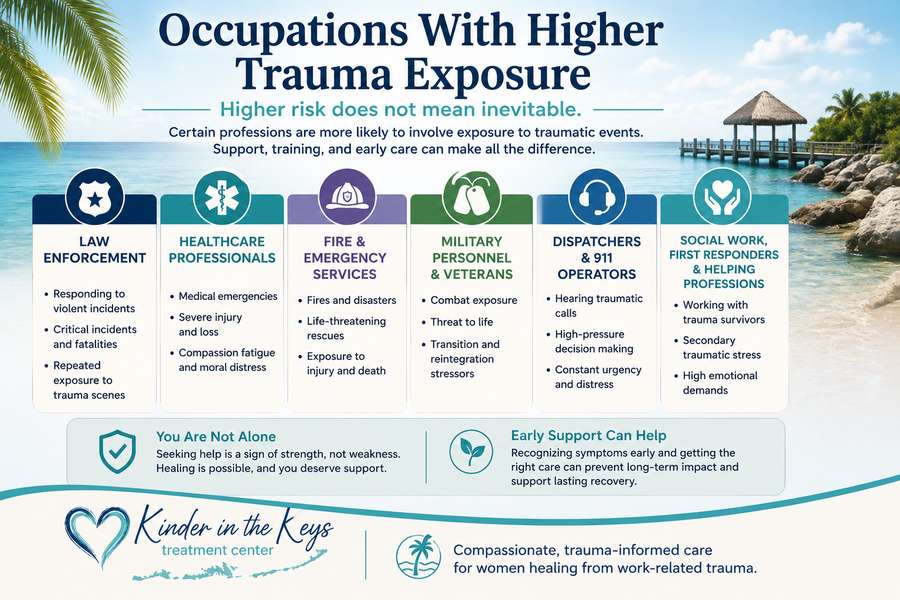
Any occupation involving exposure to qualifying traumatic events can potentially contribute to PTSD.
Some professions, however, create more frequent opportunities for traumatic exposure.
These can include:
- Firefighters
- Police officers
- Paramedics and EMTs
- Emergency department professionals
- Nurses and physicians working in high-acuity settings
- Military personnel
- Disaster-response professionals
- Crisis-response workers
- Corrections professionals
- Medical examiners and death-investigation personnel
- Professionals repeatedly exposed to traumatic material as part of their work
The important issue is not simply the person’s job title.
It is what she has actually experienced, witnessed, or repeatedly encountered through that work.
Two women can have the same occupation and respond very differently to similar events. Trauma exposure does not guarantee that PTSD will develop.
Work Stress, Burnout and PTSD Are Not the Same Thing
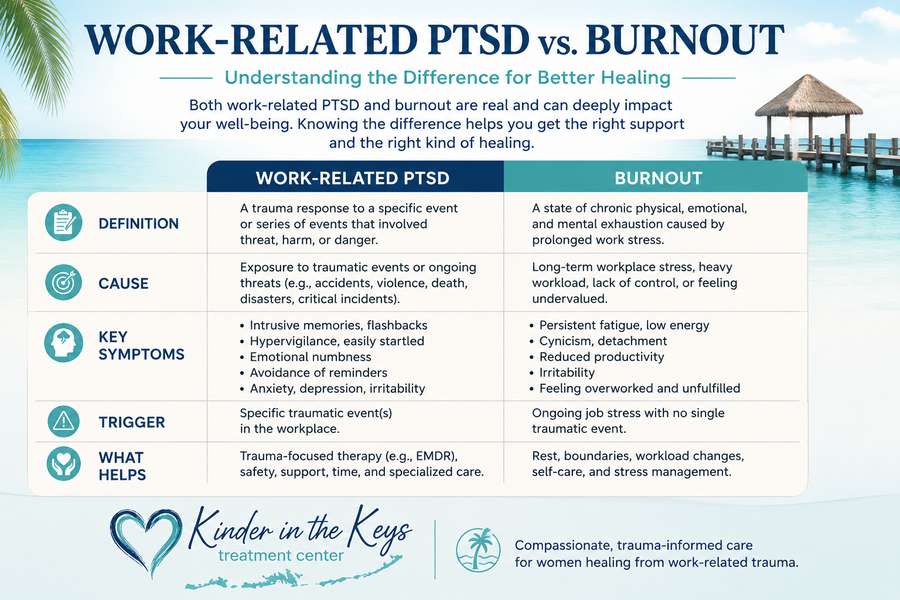
This is one of the most important distinctions in understanding PTSD from work.
Occupational Stress
Work stress can occur when job demands exceed a person’s perceived resources or ability to cope.
It may involve deadlines, staffing problems, workload, conflict, long hours, financial pressure, organizational instability, or lack of control.
Burnout
Burnout is generally associated with chronic workplace stress and may involve emotional exhaustion, detachment or cynicism, and a reduced sense of professional effectiveness.
Someone can be profoundly burned out without having PTSD.
Work-Related PTSD
PTSD involves qualifying trauma exposure followed by a particular constellation of trauma-related symptoms.
These may include intrusive memories, nightmares, flashbacks, avoidance, negative changes in mood or thinking, hypervigilance, exaggerated startle responses, sleep problems, irritability, or difficulty concentrating.
The National Institute of Mental Health notes that PTSD symptoms can interfere significantly with relationships, work, and everyday functioning.
A person may also experience more than one of these problems simultaneously.
Someone can have occupational burnout and PTSD. Another person may have depression and burnout. Someone else may experience severe anxiety after workplace stress without meeting criteria for PTSD.
Accurate assessment matters because treatment should address what is actually happening.
Why Repeated Occupational Trauma Can Be Different
Some occupational trauma occurs during one catastrophic event.
A healthcare professional may experience a particularly traumatic patient death. A police officer may be involved in a shooting. A first responder may arrive at a devastating accident.
But occupational trauma can also accumulate.
A paramedic may respond to hundreds of serious emergencies over a career. A healthcare professional may repeatedly witness suffering and death. A military service member may experience multiple traumatic events rather than one isolated incident.
Over time, the nervous system may have fewer opportunities to fully recover before the next exposure occurs.
This does not mean repeated exposure inevitably causes PTSD.
Many trauma-exposed professionals remain psychologically healthy and resilient. NIMH notes that most people exposed to traumatic events do not ultimately develop PTSD.
But repeated exposure can create a clinical picture that deserves careful assessment rather than dismissal as simply “part of the job.”
Signs and Symptoms of Work-Related PTSD
Occupational PTSD can follow the same major symptom patterns as PTSD arising from trauma outside the workplace.
Intrusive Memories
A woman may repeatedly remember traumatic events from work even when she does not want to think about them.
She may replay a scene, hear a sound in her mind, remember a patient’s face, or suddenly feel as though she is back in the traumatic situation.
Nightmares
Trauma-related dreams can disrupt sleep and make someone dread going to bed.
Chronic sleep disruption can then make emotional regulation, concentration, and coping even more difficult.
Avoidance
Someone may avoid conversations, locations, people, tasks, or situations that remind her of what happened.
In occupational PTSD, avoidance can become especially complicated when the reminders are part of the person’s actual job.
Hypervigilance
A nervous system trained to detect danger may have difficulty turning that vigilance off.
Someone may constantly scan rooms, monitor exits, react strongly to sounds, or remain physically tense even when she is home.
Increased Startle Response
Sudden noises, unexpected touch, alarms, sirens, or other reminders may cause an exaggerated reaction.
Changes in Mood and Thinking
PTSD can affect how someone thinks about herself, other people, safety, responsibility, guilt, and the world.
A professional may begin thinking:
“I should have prevented it.”
“I should have done more.”
“Nobody understands what I’ve seen.”
“I can’t trust anyone to keep me safe.
Emotional Numbing
Some people do not appear outwardly distressed.
Instead, they feel emotionally disconnected.
They may stop enjoying activities, withdraw from relationships, or describe feeling as though they are simply going through the motions.
Irritability and Anger
A nervous system that remains prepared for danger may respond strongly to relatively minor stressors.
This does not mean anger defines PTSD. It means increased arousal and reactivity can be part of the disorder.
Difficulty Concentrating
Trauma symptoms and poor sleep can interfere with attention, memory, decision-making, and executive functioning.
For professionals responsible for other people’s safety, this can become particularly concerning.
For a more complete discussion of how PTSD can present in women, see PTSD Symptoms in Women.
Why Someone May Not Recognize PTSD From Work
Professionals in high-trauma occupations may normalize what they experience.
They may tell themselves:
“Everyone in my field sees this.”
“This is what I signed up for.”
“Other people have handled worse.”
“I should be able to deal with it.”
That mindset can make it difficult to recognize when a normal response to trauma has developed into a persistent mental health problem.
There can also be professional concerns.
Someone may worry that admitting she is struggling will affect how coworkers see her, jeopardize her career, suggest weakness, or mean she is no longer capable of doing work she once loved.
As a result, some people become very good at functioning professionally while deteriorating personally.
They go to work.
They complete their responsibilities.
They take care of everyone else.
And then they go home and cannot sleep, cannot relax, withdraw from people they love, or remain psychologically stuck in the events they witnessed.
Functioning is not the same thing as being well
Women and Occupational PTSD
Women working in trauma-exposed professions may experience many of the same occupational risks as men, but their overall trauma history also matters.
A traumatic event at work does not erase everything that happened before it.
Previous trauma, including childhood trauma or interpersonal violence, may influence how later traumatic experiences are processed. NIMH identifies previous traumatic exposure, particularly during childhood, as one factor associated with greater risk for developing PTSD following later trauma.
For some women, occupational trauma becomes one part of a much larger trauma history.
This is why treatment should not assume:
“The work incident is the entire problem.”
A comprehensive assessment asks what happened at work and what the woman’s nervous system was carrying before it happened.
First Responders and PTSD
First responders are repeatedly placed in situations most people encounter rarely, if ever.
They may witness severe injuries, violent deaths, suicide, abuse, catastrophic accidents, disasters, or threats to their own safety.
Repeated exposure does not mean every first responder will develop PTSD.
But when symptoms do develop, occupational culture can sometimes make seeking help more difficult.
A first responder may have spent years being the person other people depend on during emergencies. Suddenly becoming the person who needs help can challenge her identity.
Treatment should respect that.
The goal is not to portray someone as fragile.
The goal is to help a highly capable person understand what repeated trauma has done to her nervous system and give her effective ways to recover.
Healthcare Professionals and Occupational Trauma
Healthcare workers may also encounter significant traumatic exposure.
Emergency medicine, critical care, trauma medicine, oncology, intensive care, obstetrics, pathology, and other specialties can expose professionals to suffering, serious injury, death, medical emergencies, or devastating outcomes.
But again, terminology matters.
Not every difficult patient encounter is traumatic exposure, and not every distressed healthcare professional has PTSD.
Healthcare professionals may experience burnout, grief, moral distress, anxiety, depression, secondary traumatic stress, PTSD, or combinations of these concerns.
The appropriate response begins with identifying the actual problem rather than applying the same label to every form of occupational distress.
Military and Service-Related Trauma
Military trauma can involve combat, threats to life, witnessing death or serious injury, military sexual trauma, accidents, or other traumatic experiences.
For some service members, symptoms appear relatively soon after the traumatic event.
For others, difficulties become more noticeable after leaving the environment that required them to remain constantly alert.
The transition from a high-threat environment to ordinary civilian life can reveal just how difficult it has become for the nervous system to stop anticipating danger.
Military experience can also intersect with occupational identity.
The skills that helped someone function effectively in dangerous environments may not translate easily into relationships, sleep, family life, or ordinary daily routines.
Can You Develop PTSD Years After a Work Trauma?
PTSD symptoms do not always follow a simple timeline.
Some people recognize difficulties soon after trauma. Others may initially function relatively well and notice significant symptoms later.
A change in circumstances can sometimes make previously managed symptoms harder to ignore.
Retirement, leaving a profession, another traumatic event, relationship stress, illness, or simply having more time away from a high-intensity environment can bring trauma-related difficulties into clearer focus.
This is one reason clinicians should evaluate the entire history rather than asking only:
“What happened recently?”
When Work-Related PTSD Begins Affecting Life Outside Work
One of the clearest signs that occupational trauma needs attention is when the effects no longer remain at work.
A woman may notice:
- She cannot relax at home.
- She has recurring nightmares.
- She avoids people or places associated with work.
- She feels detached from her partner or family.
- She becomes increasingly isolated.
- She is constantly watching for danger.
- She cannot tolerate ordinary noise or crowds.
- She uses work to avoid being alone with her thoughts.
- She dreads returning to work.
- She has difficulty concentrating.
- She feels guilty about events she could not control.
- She no longer feels like herself.
At that point, telling herself to “leave work at work” is unlikely to solve the problem.
The trauma response has already followed her home.
How Work-Related PTSD Is Treated
PTSD is treatable.
NIMH identifies psychotherapy, medication, or a combination of approaches as treatment options for PTSD, depending on the person’s symptoms and individual needs.
Trauma-focused psychotherapy may include approaches such as Cognitive Processing Therapy, Prolonged Exposure, or other evidence-based trauma treatments.
Treatment is not simply about repeatedly talking about terrible events.
It can involve understanding trauma responses, identifying avoidance, examining trauma-related beliefs, processing traumatic memories in a structured clinical environment, improving emotional regulation, restoring sleep, rebuilding relationships, and helping the nervous system distinguish past danger from present safety.
For some women, EMDR may also be clinically appropriate as part of an individualized treatment plan.
When Residential Treatment May Be Appropriate
Many people with work-related PTSD can be treated successfully in outpatient care.
Residential treatment is not necessary simply because someone has a PTSD diagnosis.
However, a higher level of care may become appropriate when symptoms are significantly interfering with daily functioning, outpatient treatment has not provided enough stabilization, the woman is struggling with multiple mental health concerns, or her ordinary environment makes it difficult to step away from the patterns maintaining her symptoms.
For some professionals, physically leaving the environment in which they have spent years functioning in crisis mode creates an opportunity to focus fully on treatment.
At Kinder in the Keys, residential mental health treatment for adult women is individualized around the person’s clinical needs rather than around a diagnosis alone.
Learn more about Residential PTSD Treatment for Women.
PTSD treatment at Kinder in the Keys
Clinical Perspective on Occupational Trauma
One of the mistakes people make with occupational PTSD is assuming that professional competence protects someone from trauma.
It does not.
A person can be exceptionally skilled, highly trained, psychologically strong, and deeply committed to her profession—and still develop PTSD.
In clinical work involving trauma and PTSD, including work with military populations and suicide-risk assessment, I have seen how easily highly capable people can minimize their own symptoms because they are accustomed to being responsible for everyone else.
They often know how to function in a crisis.
What they may not know is how to stop functioning as though every moment is still a crisis.
That distinction matters in treatment.
The goal is not to take away someone’s strength.
It is to help her stop needing survival responses when she is no longer in danger.
Can Someone Continue Working After Developing Occupational PTSD?
Sometimes, yes.
A PTSD diagnosis does not automatically mean someone must abandon her career.
The answer depends on the individual, the severity of symptoms, the nature of the work, safety considerations, treatment response, and whether returning to the same environment is clinically appropriate.
For some people, successful treatment allows them to continue meaningful careers.
Others decide that returning to the same work is no longer healthy.
And some need time away before making that decision.
Treatment should help a woman make thoughtful choices rather than forcing an immediate decision based on fear, shame, or pressure from other people.
Frequently Asked Questions About Work-Related PTSD
Can a job actually cause PTSD?
A job itself does not automatically cause PTSD. However, qualifying traumatic events experienced, witnessed, or repeatedly encountered through professional duties can lead to PTSD in some people. The National Center for PTSD specifically recognizes repeated or extreme professional exposure to aversive details of traumatic events as a possible form of qualifying trauma exposure.
Is workplace stress the same as PTSD?
No. Workplace stress can seriously affect mental health, but PTSD requires qualifying trauma exposure and a specific pattern of persistent trauma-related symptoms.
Is burnout the same as occupational PTSD?
No. Burnout and PTSD can share symptoms such as sleep problems, emotional exhaustion, or difficulty concentrating, but they are not the same condition. A person can also experience both simultaneously.
Can first responders develop PTSD from repeated exposure?
Yes. Repeated or extreme professional exposure to traumatic events or their aversive details can qualify as trauma exposure associated with PTSD. However, trauma exposure does not mean a person will inevitably develop PTSD.
Can healthcare workers develop work-related PTSD?
Yes, when their professional experiences involve qualifying traumatic exposure. Healthcare workers can also experience burnout, grief, anxiety, depression, moral distress, and other occupational mental health concerns, so accurate assessment is important.
Can work-related PTSD affect relationships?
Yes. PTSD symptoms such as avoidance, emotional numbing, irritability, hypervigilance, sleep disruption, and isolation can affect intimate relationships and family life.
Does having PTSD mean I have to quit my job?
Not necessarily. Career decisions should be individualized and consider symptoms, safety, treatment response, the work environment, and the person’s goals.
Work-Related PTSD Treatment for Women at Kinder in the Keys
When occupational trauma begins affecting a woman’s sleep, relationships, emotional well-being, ability to function, or sense of safety, professional treatment may help.
Kinder in the Keys provides residential mental health treatment for adult women in the Florida Keys, including treatment for PTSD when clinically appropriate.
Our small treatment environment allows clinicians to understand the woman behind the diagnosis—including occupational trauma, previous trauma, relationships, mental health history, physical well-being, and the circumstances she will return to after treatment.
Learn more about Residential PTSD Treatment for Women at Kinder in the Keys.
Medically Reviewed By
Dr. Laura Tanzini, DrPH, LMFT
Doctor of Public Health | Specialty in Lifestyle Medicine
Licensed Marriage and Family Therapist (Florida & California)
Founder & CEO, Kinder in the Keys
This article has been clinically reviewed for accuracy and consistency with current behavioral health and trauma-informed treatment principles. Dr. Tanzini has extensive clinical experience in trauma, PTSD, anxiety, depression, and women’s mental health, including professional experience assessing PTSD and suicide risk in military populations.
Doctoral Research: Dr. Tanzini’s doctoral research at Loma Linda University examined childhood and adult traumatic events, cumulative trauma exposure, gender, forgiveness, life satisfaction, and long-term well-being.
Medical Disclaimer
This article is provided for educational and informational purposes only and is not a substitute for individualized evaluation, diagnosis, or treatment by a qualified healthcare professional.